
theory

Sociology Twitter lit up after the US Women’s National Team’s World Cup win with the revelation that many of their players were sociology majors in college. It is an inspiration to see the team succeed at the highest levels and call for social change while doing so.

https://twitter.com/nedasoc/status/1148237568481398784

This news also raised an interesting question: do student athletes major in sociology because it is a compelling field (yay, us!) or because they are tracked into the major by academic advisors who see it as an “easy” choice to balance with sports?

According to data from the NCAA, the most common majors for both student athletes and the wider student body at Division 1 schools are business, STEM, and social sciences. Trend data show the biggest difference is in the choice between business and STEM; both groups seem to pick up social science majors at similar rates.
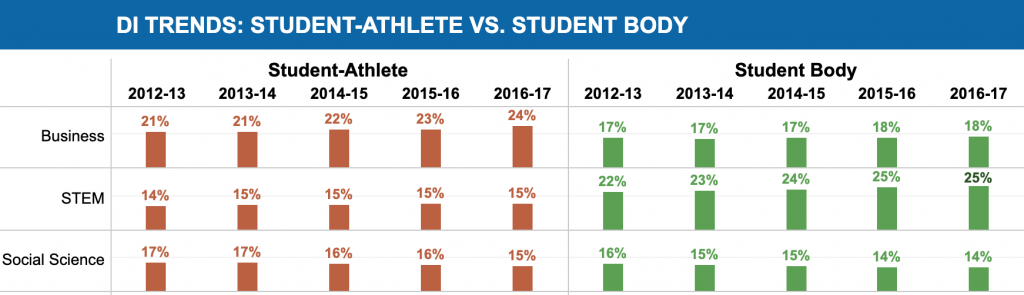
Source: NCAA D1 Diploma Dashboard

While the rate of majors is not that different, there is something special that sociology can do for these students. Student athlete lives are heavily administered. Between practice, conditioning, scheduled events, meals, and classes, many barely have a few hours to complete a full load of course work. In grad school, I tutored many student athletes who were sociology majors, and I watched them juggle their work with the demands of heavy travel schedules and intense workouts, all under the watchful eye of an army of advisors, coaches, mentors, and doctors. The experience is very close to what Erving Goffman called a “total institution” in Asylums:

“A total institution may be defined as a place of residence and work where a large number of like-situated individuals, cut off from the wider society for an appreciable period of time, together lead an enclosed, formally administered round of life. (1961, p. xiii)”

We usually associate total institutions with prisons and punishment, but this definition highlights the intense management that defines the college experience for many student athletes. When I tutored athletes in sociology, we spent a lot of time comparing their readings to the world around them. Sociological thinking about institutions, bureaucracy, and work gave them a language to think about and talk about their experiences in context.

Athletic programs can be complicated for colleges and universities, and there is ongoing debate about how the “student” status in student athlete shapes their obligation to pay for all this work. As debates about college athletics continue, it is important for players, fans, and administrators to think sociologically about their industry to see how it can better serve players as both students and athletes.

Evan Stewart is an assistant professor of sociology at University of Massachusetts Boston. You can follow his work at his website, or on BlueSky.


I love this episode on Supreme and streetwear from Patriot Act with Hasan Minhaj, especially for the explainer on conspicuous consumption with a nod to “O.G. Hypebeast” Thorstein Veblen.

Veblen’s The Theory of the Leisure Class is a classic on how people use wealth and taste to make status, and conspicuous consumption is a good way to explain how hype happens. It got me thinking about other classic sociological explanations for how luxury brands blow up.

Marx’s idea of commodity fetishism is also important for understanding luxury brands and other Veblen goods. While conspicuous consumption focuses on why people buy, this idea gets to the core of how these goods get associated with status. We often venerate all the labor that supposedly goes into a luxury product, like a fancy watch, or we venerate the creative processes in branding or appropriating ideas. For Marx, the important part is that we transfer the value of that labor into the product and treat the product like it just has that value on its own.

This is the reason why the products of labour become commodities, social things whose qualities are at the same time perceptible and imperceptible by the senses. In the same way the light from an object is perceived by us not as the subjective excitation of our optic nerve, but as the objective form of something outside the eye itself…There it is a definite social relation between men, that assumes, in their eyes, the fantastic form of a relation between things.

Karl Marx. 1887. Capital: A Critique of Political Economy. Volume 1

Marx goes on to compare this process to the development of religious beliefs, and here we could also look at Émile Durkheim and collective effervescence. Part of the reason these products get hype is that they create big social events around shopping. The long lines and limited edition “drops” force people to get together in large crowds at special times to get the product. This makes shopping less of an individual experience and more of a collective one, where just being in the crowd contributes to the excitement.

All these theories make an important point about the social dynamics of popular products. As Matt Powell says in an interview earlier in the episode, you can’t take hype to the bank. But maybe you can; the generation of hype isn’t just an ephemeral, “fake” thing, but an example of a core truth in sociology—if people define hype as real it is real in its consequences.

Evan Stewart is an assistant professor of sociology at University of Massachusetts Boston. You can follow his work at his website, or on BlueSky.

In March, in an Instagram interview with Jameela Jamil, British pop star Sam Smith announced being non-binary in both gender and sexuality, stating “I’m not male or female. I think I float somewhere in between – it’s all on a spectrum” (timestamp 21:50 to 22.10). Smith had made a similar declaration to the Sunday Times in October, 2017, but did not suggest that the media use non-binary gender pronouns at the time. During the interview, Smith also revealed that “the basis of all my sadness” has been body shaming.

This instance of “biography and history” producing a non-binary person haunted by fat-shaming is important to the sociological understanding of gender. It reminds us that gender is lived in the body, not just as an idea but as a “looking-glass self” in which multiple kinds of stigma can simultaneously reduce a person to a “tainted, discounted one”. As culture shapes the way we see ourselves, it can produce an overpowering feeling of what Cooley called “mortification,” because “we always imagine, and in imagining share, the judgments of the other mind.” In Mead’s terms, culture produces this in the “generalized other”; how we imagine ourselves as an object in the eyes of the whole society. 

The intersection of body-shaming and transphobia shows us how bullying turns the body into an object. Jamil recounted in the interview that a photographer had called her a “fat c-word.” This can be compared with C.J. Pascoe’s famous study of how the word “fag” is used in bullying to police the gender of boys. Smith concludes the interview with a vow to promote self-forgiveness and the love of the body. This struggle against the gender binary fits within the mission of Jamil’s “I Weigh” instagram series seeking to resist all forms of cultural bullying and policing of bodies, gender expression and sexuality.

Jonathan Harrison, PhD, is an adjunct Professor in Sociology at Florida Gulf Coast University, Florida SouthWestern State College and Hodges University whose PhD was in the field of racism and antisemitism.

At the start of a new year, our thoughts often turn to self-improvement. People make all kinds of resolutions to live healthier, happier, more engaged lives…at least until the middle of February.

Sociological thinking often gets skeptical of this work. Sure, it is great to set personal goals, but fixating on personal problems can also make us blame ourselves for larger social and cultural factors that make it hard to meet those goals. You can buy a new trendy Bullet Journal and fill it with to-do lists, but that alone probably won’t beat a whole culture of burnout.

I get a kick out of imagining a new wave of snarky sociological self-help. The headlines would be fantastic.

  • I lost 20 pounds on this new hot diet: not having to live in a food desert!
  • Trouble in the bedroom? Your problems may be political!
  • And, of course, the classic:

This year I found a book that gets as close the dream genre as ever. After multiple nods from the Ezra Klein Show and buzz from Silicon Valley, I picked up James P. Carse’s Finite and Infinite Games (1986) for a holiday read. The first sentence of the second section sums it up:

No one can play a game alone. One cannot be human by oneself. There is no selfhood where there is no community. We do not relate to others as the persons we are; we are who we are in relating to others. Pp. 37

That line didn’t sound like the typical self-focused pop philosophy, and it kicked off a lot more sociology than I was expecting. Carse’s book focuses on “finite games” as social interactions that are meant to come to a clearly defined end and “infinite games” where the aim is simply to keep playing with other people. Along the way, he riffs on some major sociological themes like role theory, and there’s even an appearance from Veblen. Much of the argument boils down to the classic structure and agency debate in sociology—new situations often give us both strict social rules to follow in finite games and resources that invite creative improvisation in infinite games. Recognizing both kinds of games in life draws our attention to social structures and opens up the possibility to turn off autopilot once in a while.

It isn’t a perfect read, but I appreciated seeing a book with a popular following putting these kinds of ideas in the spotlight, especially because economists and psychologists often get more of the credit in popular nonfiction. Maybe we can replace the resolutions with a few more good reads. Can you think of other examples of self-help sociology?Evan Stewart is an assistant professor of sociology at University of Massachusetts Boston. You can follow his work at his website, or on BlueSky.

People talk. Their interactions become habits, habits become routines, and routines become rules. Sociologists call this emergent behavior, and sometimes it happens so slowly we don’t even notice it until we look back and think “where did that come from?”  Emergent behavior can be quirky and fun (think of Taco Friday at the office or “on Wednesdays we wear pink“), but sometimes it can also be far more serious or more troubling.

The challenge is that new technology makes these interactions happen much faster, on a much larger scale, and with less editing—often with odd results. Check out this TED talk—The Nightmare Videos of Children’s YouTube— for a good illustration of the dark side of emergent behavior when algorithms accelerate and exploit social interactions online.

 Evan Stewart is an assistant professor of sociology at University of Massachusetts Boston. You can follow his work at his website, or on BlueSky.

One major part of introducing students to sociology is getting to the “this is water” lesson: the idea that our default experiences of social life are often strange and worthy of examining. This can be challenging, because the default is often boring or difficult to grasp, but asking the right questions is a good start (with some potentially hilarious results).

Take this one: what does English sound like to a non-native speaker? For students who grew up speaking it, this is almost like one of those Zen koans that you can’t quite wrap your head around. If you intuitively know what the language means, it is difficult to separate that meaning from the raw sounds.

That’s why I love this video from Italian pop singer Adriano Celentano. The whole thing is gibberish written to imitate how English slang sounds to people who don’t speak it.


Another example to get class going with a laugh is the 1990s video game Fighting Baseball for the SNES. Released in Japan, the game didn’t have the licensing to use real players’ names, so they used names that sounded close enough. A list of some of the names still bounces around the internet:

The popular idea of the Uncanny Valley in horror and science fiction works really well for languages, too. The funny (and sometimes unsettling) feelings we get when we watch imitations of our default assumptions fall short is a great way to get students thinking about how much work goes into our social world in the first place.Evan Stewart is an assistant professor of sociology at University of Massachusetts Boston. You can follow his work at his website, or on BlueSky.
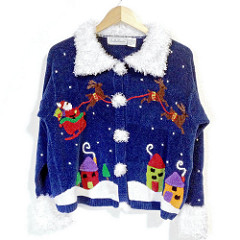
National Ugly Christmas Sweater Day is this Friday, December 15th. Perhaps you’ve noticed the recent ascent of the Ugly Christmas Sweater or even been invited to an Ugly Christmas Sweater Party. How do we account for this trend and its call to “don we now our tacky apparel”?

Total search of term “ugly Christmas sweater” relative to other searches over time (c/o Google Trends):

Ugly Christmas Sweater parties purportedly originated in Vancouver, Canada, in 2001. Their appeal might seem to stem from their role as a vehicle for ironic nostalgia, an opportunity to revel in all that is festively cheesy. It also might provide an opportunity to express the collective effervescence of the well-intentioned (but hopelessly tacky) holiday apparel from moms and grandmas.

However, The Atlantic points to a more complex reason why we might enjoy the cheesy simplicity offered by Ugly Christmas Sweaters: “If there is a war on Christmas, then the Ugly Christmas Sweater, awesome in its terribleness, is a blissfully demilitarized zone.” This observation pokes fun at the Fox News-style hysterics regarding the “War on Christmas”; despite being commonly called Ugly Christmas Sweaters, the notion seems to persist that their celebration is an inclusive and “safe” one.

Photo Credit: TheUglySweaterShop, Flickr CC

We might also consider the generally fraught nature of the holidays (which are financially and emotionally taxing for many), suggesting that the Ugly Sweater could offer an escape from individual holiday stress. There is no shortage of sociologists who can speak to the strain of family, consumerism, and mental health issues that plague the holidays, to say nothing of the particular gendered burdens they produce. Perhaps these parties represent an opportunity to shelve those tensions.

But how do we explain the fervent communal desire for simultaneous festive celebration and escape? Fred Davis notes that nostalgia is invoked during periods of discontinuity. This can occur at the individual level when we use nostalgia to “reassure ourselves of past happiness.” It may also function as a collective response – a “nostalgia orgy”- whereby we collaboratively reassure ourselves of shared past happiness through cultural symbols. The Ugly Christmas Sweater becomes a freighted symbol of past misguided, but genuine, familial affection and unselfconscious enthusiasm for the holidays – it doesn’t matter that we have not all really had the actual experience of receiving such a garment.

Jean Baudrillard might call the process of mythologizing the Ugly Christmas Sweater a simulation, a collapsing between reality and representation. And, as George Ritzer points out, simulation can become a ripe target for corporatization as it can be made more spectacular than its authentic counterparts. We need only look at the shift from the “authentic” prerogative to root through one’s closet for an ugly sweater bestowed by grandma (or even to retrieve from the thrift store a sweater imparted by someone else’s grandma) to the cottage-industry that has sprung up to provide ugly sweaters to the masses. There appears to be a need for collective nostalgia that is outstripped by the supply of “actual” Ugly Christmas Sweaters that we have at our disposal.

Colin Campbell states that consumption involves not just purchasing or using a good or service, but also selecting and enhancing it. Accordingly, our consumptive obligation to the Ugly Christmas Sweater becomes more demanding, individualized and, as Ritzer predicts, spectacular. For examples, we can view this intensive guide for DIY ugly sweaters. If DIY isn’t your style, you can indulge your individual (but mass-produced) tastes in NBA-inspired or cultural mash-up Ugly Christmas Sweaters, or these Ugly Christmas Sweaters that aren’t even sweaters at all.

The ironic appeal of the Ugly Christmas Sweater Party is that one can be deemed festive for partaking, while simultaneously ensuring that one is participating in a “safe” celebration – or even a gentle mockery – of holiday saturation and demands. The ascent of the Ugly Christmas Sweater has involved a transition from ironic nostalgia vehicle to a corporatized form of escapism, one that we are induced to participate in as a “safe” form of  festive simulation that becomes increasingly individualized and demanding in expression.

Re-posted at Pacific Standard.

Kerri Scheer is a PhD Student working in law and regulation in the Department of Sociology at the University of Toronto. She thanks her colleague Allison Meads for insights and edits on this post. You can follow Kerri on Twitter.