bodies: hygiene

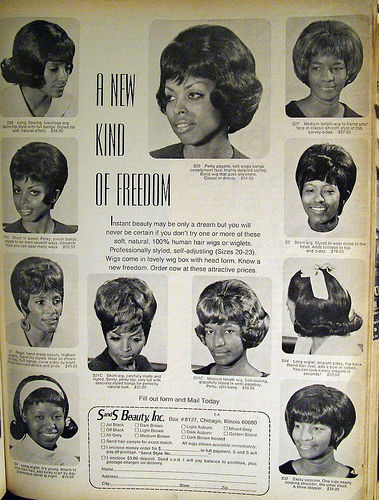
Taylor D. sent in a link to a set of vintage ads featuring African Americans. This one is for wigs. Notice the commodification of liberation and freedom: you buy it in the form of a wig, which gives you a whole new look in seconds!
This one is for a hair straightener:
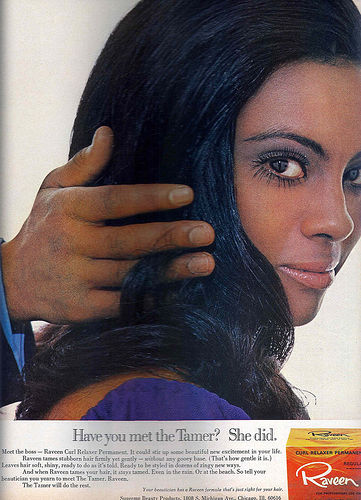
Of course, the “tamer” and “the boss” that can “stir up some beautiful new excitement in your life” can also refer to the man who is stroking her hair, playing into the idea of the man who tames a wild woman–and that all women, deep down, want a strong man to tame them.

This next one uses women’s fear that men won’t find them attractive to sell deoderant:
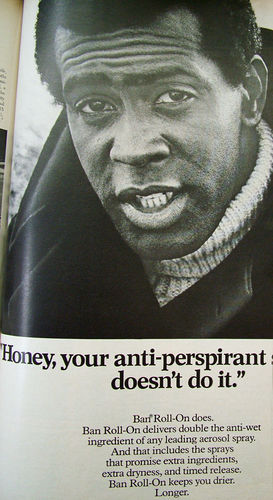
Thanks, Taylor!
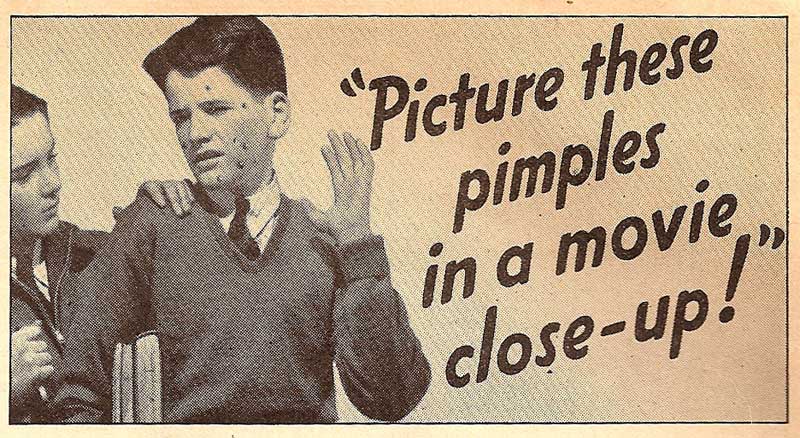
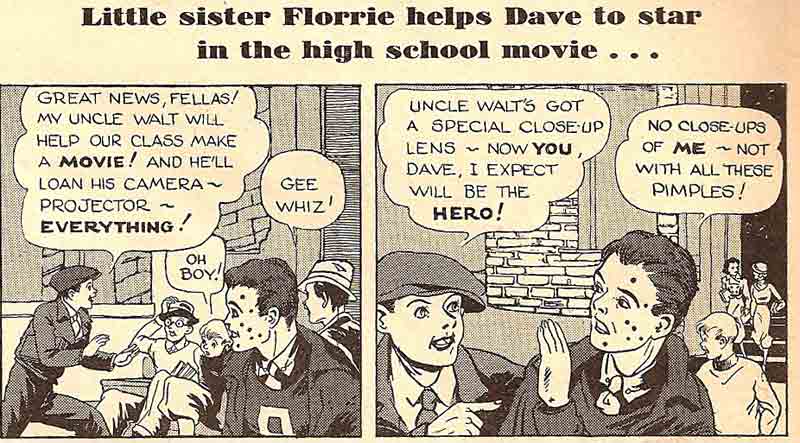
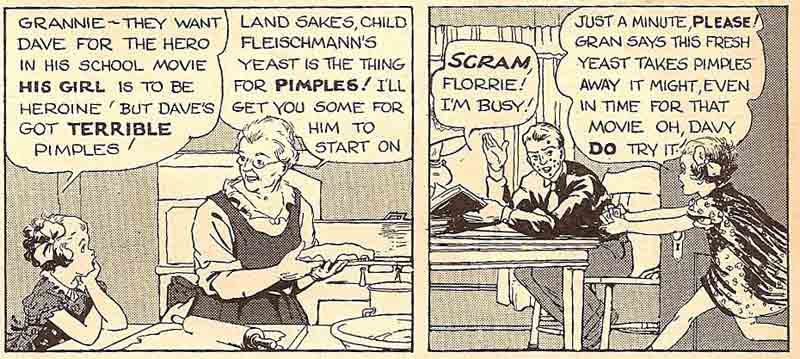
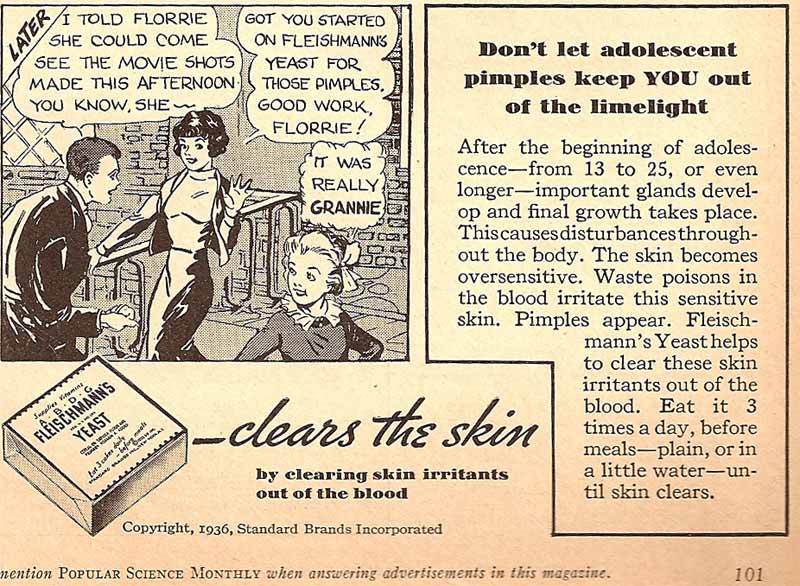
Here’s a vintage Fleishmann’s Yeast ad (found here), which presents yeast as the answer to the horrors of pimples–awful, hideous pimples!

I don’t know in what world high schools have movies, but whatever. Clearly, the message is “pimples = social death and eternal loneliness.” It’s not just that Davy can’t be in the movie due to his horrible affliction; if he can’t play the lead along with his girlfriend, he faces the possibility of losing her to a leading man with a clear complexion.

Given such messages about the importance of clear skin, it’s no wonder teens and their families were willing to shell out enormous sums of money on skin-care products. Apparently yeast didn’t catch on as a treatment, though.

For other examples of vintage ads playing on teens’ fear of facial blemishes, see here and here.

Text:  “These guys these street gangs, settle their scores by singing and dancing together?  Doesn’t sound like anybody on the Westside I know.”

Text: “You want nice.  Go pick your mommy a flower.”

Text:  “Gentlemen, Check your skirts at the door.”

Text: “Today you’re using your girlfriend’s hair gel.  Tomorrow, your wife’s hairspray.  Where does it end my friend?  Where does it end?”

NEW (Mar. ’10)! Emma H. sent in this commercial, which ran during the 2010 Olympics, in which a man — shock and horror! — likes ice dancing:

More ads policing men’s behavior: sissies suck, how to do masculinity (hugging and sitting), “woman” as an insult, and boys can’t wear make-up at school.

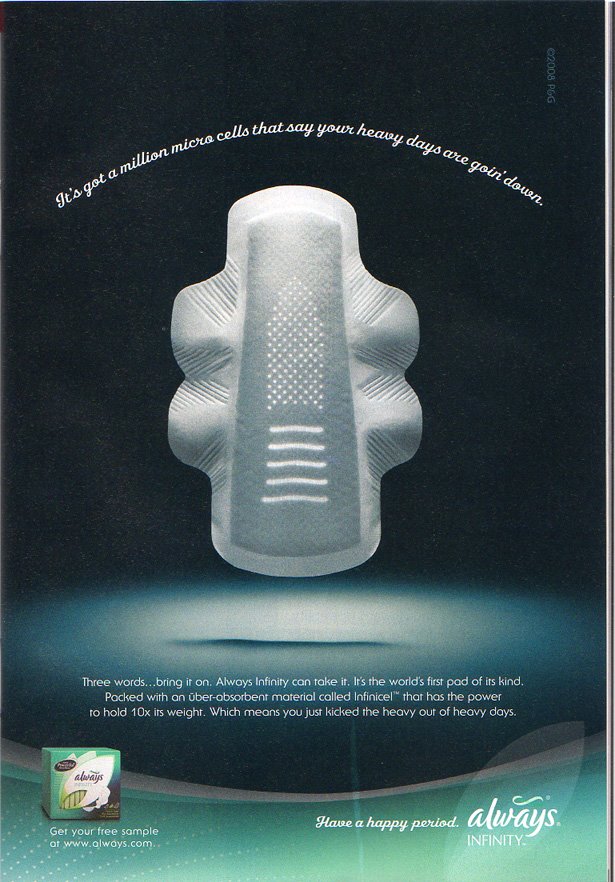
Ii think this ad for Kotex is using the X-TREME meme to sell pads (found here):

The copy reads:

It’s got a million micro cells that say your heavy days are goin’ down.

Three words… bring it on.  Always Infinity can take it.  It’s the world’s first pad of its kind.  Packed with an uber-absorbent material called Infinicel that has the power to hold 10x its weight.  Which means you just kicked the heavy out of heavy days.

Um, “goin’ down,” “bring it on,” “uber-absorbent,” “kicked the heavy”?  They even have an “x” in there.  Not to mention the whole floating in a circle of light thing.

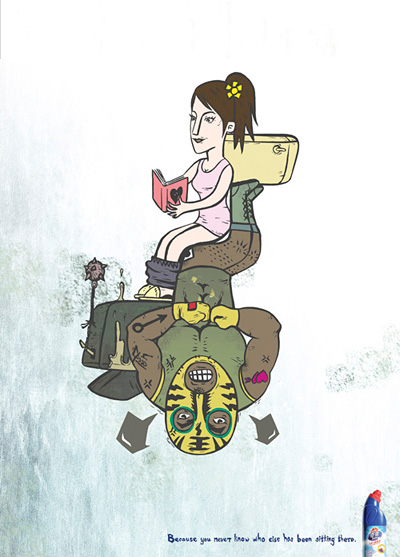
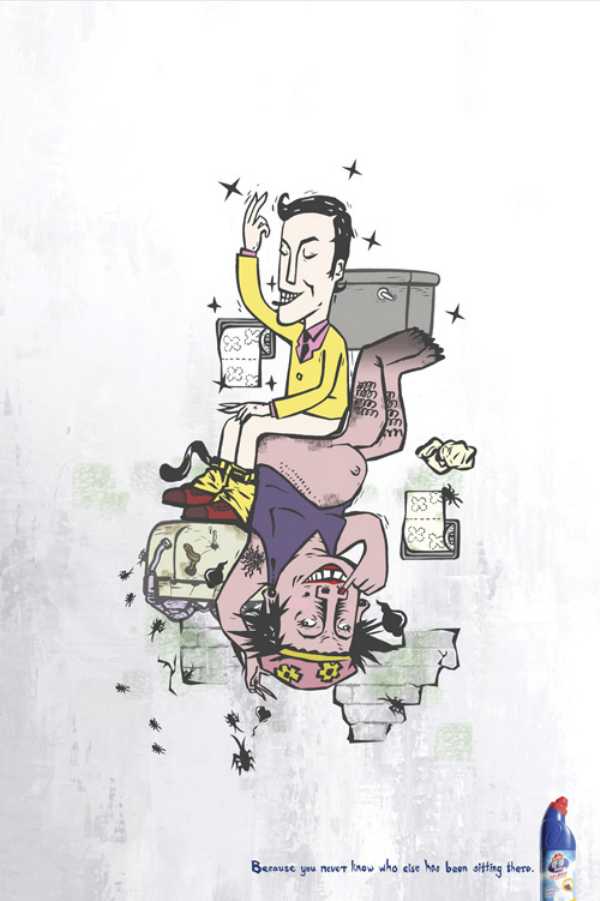
Nadya at Coilhouse sent in this ad campaign for Kiwi Kleen Toilet Cleaner.  In order to disgust you, the ads suggest that sharing a toilet seat is like sitting directly on someone else’s ass and, to disgust you further, they suggest that that someone else could be a Mexican wrestler, a fat pig, and a transsexual.  Keep it classy, Kiwi Kleen.  (Images found at Coilhouse and Coloribus.)


A recent installment in the Sexist Body Wash Ad category [see any Axe ad for others], Old Spice’s Double Impact body wash uses a centaur [man/horse hybrid] to suggest that the hybrid product will boost users’ sexual potency. The centaur calls himself “two things at once.” The first time, he says he’s “a man AND a smart shopper.” The second time, he says that he’s “a man AND a provider.” The viewer thus easily links the “man” with the human part of the centaur and the “smart shopper,” along with the “provider,” with the equine part by process of elimination. Drawing in the idea of a particularly potent man being “hung like a horse,” the ad implies that users of Old Spice body wash are not only “smart shoppers” and good “providers,” but also that they are heterosexual [notice the woman as prop, signifying the centaur’s heteronormative orientation] dynamos in the sack [stall?] with really big penises! The message, however, is complicated by the fact that the centaur is apparently composited from a male model and a female horse, who is obviously not hung. Hooray for polysemy!

[youtube]http://www.youtube.com/watch?v=YtN9CW01QDM[/youtube]

For further interesting hybrids, you can see video at the product’s Web site shows the same male model combined with different animals, including a slug, an octopus and a snake, as well as non-animal things, such as a tree, a cannon and a fish stick [?]. I’m not sure what to think about them….

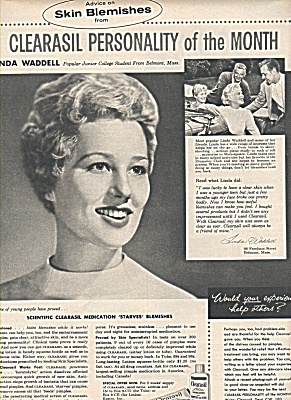
In the 1950s, Clearasil started a new marketing campaign called Clearasil Personality of the Month. These were ads disguised as advice columns that ran in magazines. They featured the stories of real girls who wrote in to Clearasil to talk about their own struggles with acne and, of course, how they finally overcame this horrible affliction with the help of Clearasil. Here is an example (found here), a piece on a college student named Linda Waddell:

Sorry, the resolution isn’t good enough for me to be able to read all the text, so I don’t know what it says. The general layout was that teens and young women wrote in with little bios about themselves and descriptions of the problems they’ve experienced with pimples.

Notice the connection between clear skin and popularity–we see a picture of Linda surrounded by friends in the upper right corner (and, most importantly, a guy is clearly paying attention to her).

I originally read about this feature in Joan Jacobs Brumberg’s book The Body Project: An Intimate History of American Girls. She discussed it in the context of talking about increasing concern about acne and the rise of a whole host of products to combat it. However, I think it would be great for a discussion about advertising, particular about efforts to disguise advertising as simple information or entertainment (it’s still often difficult to distinguish these categories in women’s magazines). It’s also a good example of a marketing campaign that attempts to appeal to consumers by getting them to think of a product almost as a friend–here, the product is personified by nice, wholesome-looking girls who were just providing friendly advice to other girls just like them.

You still see the strategy of portraying products as friends that help women–for instance, ads for food products or cleaners that depict them as friends that help women get everything done, since apparently no one in their families will. See this post for a humorous take on some of these ads.

In her book The Body Project: An Intimate History of American Girls, Joan Jacobs Brumberg has a chaptered titled “Perfect Skin” in which she looks at the rise of acne as a significant concern among adolescent girls. Because pimples and blackheads were believed by some people to be a sign of immorality–masturbation, lascivious thoughts, or promiscuity–both teenagers and their parents were quite distressed at the appearance of teen acne. Though teens had long been concerned about their appearances, the widespread use of mirrors in bathrooms starting in the Victorian Era gave them many more opportunities to examine their faces and find themselves lacking. And girls tended to be more concerned about their faces than boys, perhaps because girls were judged more harshly for any perceived sexual immorality. A whole industry arose to sell generally useless products to teens, particularly girls, to cure their acne.

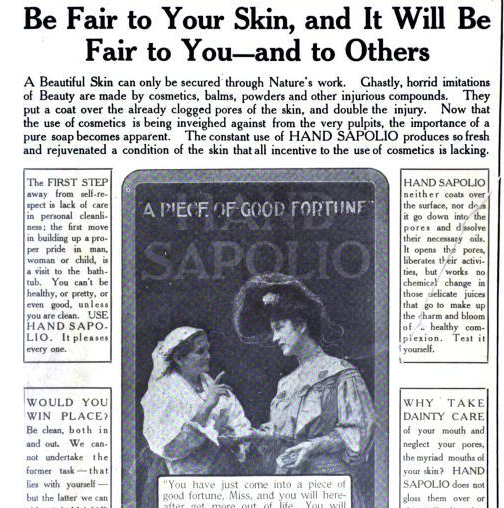
Marketers for soap and other products used concerns about morality in their ads. Here is an ad for Hand Sapolio, a popular soap in the early 1900s (found in a 1906 issue of McClure’s Magazine):

Notice how the text in the top box mentions that cosmetics, which might be used to cover pimples, were being “inveighed against from the very pulpits,” meaning good moral girls couldn’t use cosmetics to hide their acne. Also I like how the title (“Be Fair to Your Skin, and It Will Be Fair to You–and to Others”) implies that if you aren’t fair to your skin, it is going to do something dreadful to the people around you…presumably busting out into a hideous display of pimples that will pain people to look upon.

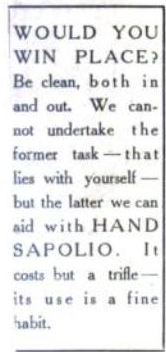
I zoomed in and did a couple of smaller screen captures of some sections of the text that also stress morality or “goodness”:

Be clean, both in and out. We cannot undertake the former task–that lies with yourself–but the latter we can aid with HAND SAPOLIO.

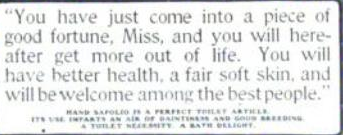
This section of text makes it clear that good skin is essential for popularity, at least among the “best” people:

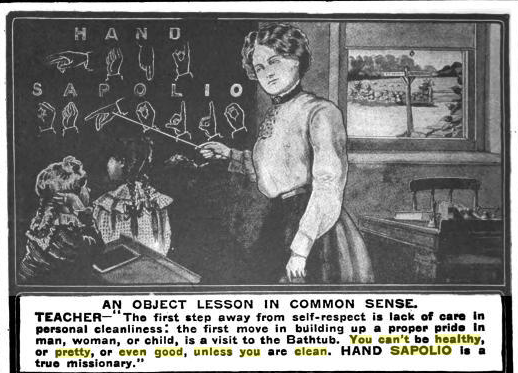
This Hand Sapolio ad (from a 1903 issue of New England Magazine), sums it up:

The first step away from self-respect is lack of care in personal cleanliness: the first move in building up a proper pride in man, woman, or child, is a visit to the Bathtub. You can’t be healthy, or pretty, or even good, unless you are clean. HAND SAPOLIO is a true missionary.

So there we see a connection being made between having good skin and being “good,” which means that, like missionaries who help save heathens, Hand Sapolio is a “missionary” spreading moral goodness and self-respect. Because what could build up self-respect more than being told that if you have less than perfectly clean skin, you can’t be pretty or good?

These could be useful for discussions of how physical appearances were steadily connected to ideas of morality and how biological processes, like getting pimples in adolescence, were turned into diseases that required (often expensive) intervention to “cure.” They could also be good for a discussion of marketing, particularly how ideas of morality were tied to particular products, such that goodness was commodified–by buying the item, you were buying goodness.