Search results for embed

Our reader, Elizabeth A., drew our attention to this ad and she does a great job of describing what, exactly, is so disturbing about it:

The sexism at work here is nothing new. It’s just your tired, old, run-of-the-mill objectification of women as inanimate objects [robots] whose sole purpose is to sacrifice their own desires so that they may cater to the tastes [for draught keg contents] of the implied male viewer. In fact, the image in the commercial of a woman emptying herself for a man while keeping a constant smile is actually a disturbing reification of many women’s experience. Socialized to abnegate themselves, women may try and try to please other people, draining themselves of energy, until they are as empty as used beer cans. While the images used here are distractingly sexy, the underlying message is a terrifying turn-off, yet another example of how Heineken’s execs underestimate their target audience [hey, hetero men, you don’t want female companionship, just a fembot-like servitor!], insult women and leave everyone feeling demoralized and worse for wear.

More from Elizabeth at her blog: Blog of Stench.

Lisa Wade, PhD is an Associate Professor at Tulane University. She is the author of American Hookup, a book about college sexual culture; a textbook about gender; and a forthcoming introductory text: Terrible Magnificent Sociology. You can follow her on Twitter and Instagram.
In this nine and a half minute clip, Tim Wise describes the way in which race was invented by elites in early America in order to divide and conquer the working class… and is still used to do so.

Found here via Alas A Blog.

Lisa Wade, PhD is an Associate Professor at Tulane University. She is the author of American Hookup, a book about college sexual culture; a textbook about gender; and a forthcoming introductory text: Terrible Magnificent Sociology. You can follow her on Twitter and Instagram.
Here’s a strange Australian ad for U, a feminine hygiene product. It shows women hanging out with beavers…the animal type, of course. Men look on approvingly, so I guess the message is if you take appropriate care of your girly bits, men will like you.

Here’s the website.

Might be good for a discussion of hygiene and women’s bodies or the history of feminine hygiene products and the way we think about menstruation.

Thanks, Patrick C.!

This commentary by Dan Charnas on Obama’s speech and the public reaction (found here) might inspire an interesting class discussion on race, politics, and getting along:

[vimeo]http://www.vimeo.com/808451[/vimeo]

White People, Get Over Yourselves from Dantrification on Vimeo.

Thanks to Lawgeek for sending this our way!

.

NEW (Dec. ’09)! Ted K. sent in this contemporaneous commercial for Rice Krinkles:

[youtube]https://www.youtube.com/watch?v=Zs-P_u7taMI[/youtube]

Lisa Wade, PhD is an Associate Professor at Tulane University. She is the author of American Hookup, a book about college sexual culture; a textbook about gender; and a forthcoming introductory text: Terrible Magnificent Sociology. You can follow her on Twitter and Instagram.

If you don’t eat this Snickers bar I’m going to smash your bleeping face in.

Get some nuts, fool!

Lisa Wade, PhD is an Associate Professor at Tulane University. She is the author of American Hookup, a book about college sexual culture; a textbook about gender; and a forthcoming introductory text: Terrible Magnificent Sociology. You can follow her on Twitter and Instagram.

This quick video presents an American and a Swedish military recruitment commercial back-to-back.

Our member blogger, Wendy, who is writing her dissertation on the military, had this to say:

The most striking difference between these ads to me is what these commercials choose to show and what they don’t show to recruit new members.

The Marines’ commercial focuses on the duty, bravery, glory, honor aspects of service. And this is entirely focused inward– toward the Marines and the country’s goals (and in that order– Marines’ loyalties are to “unit, Corps, God and country” in that order). Where is the “other” in this commercial (that is such a part of the Sweden commercial)? Who is the “for honor” for? Who is the “for courage” for? It seems implicitly to be to the corps.

This is right in line with most Marine discourse. All of their recruitment info is the same– the focus is on the corps, and on the highly specialized ways Marines serve. As a popular Marine slogan says “The USMC: When it absolutely, positively must be destroyed overnight.”

And the Swedish commercial is even more fascinating. There is no focus on the actual members of the Nordic Battlegroup. Instead it is all about everyday people– both in Sweden and in countries experiencing conflict. The focus is on the privilege of living in a country not at war (”everybody’s everyday is not like ours”).

The images of war in this commercial are disturbing– hectic, scary and out of control. This is the exact opposite of the Marine commercial where everything is ordered and organized and machines (helicopters, guns) are shown as extension of this order and control– instead of in a context of chaos. There’s a HUGE disconnect between the weapons shown and what they actually DO during war.

War in all its chaos is present in the Swedish commercial, and absent from the Marines commercial. That in and of itself is interesting.

Via Spiked Humor

Thanks to Julie C. for this tip!

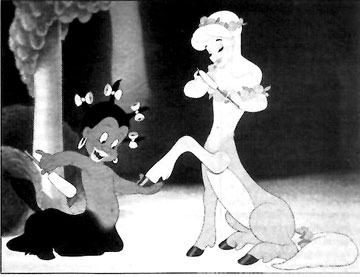
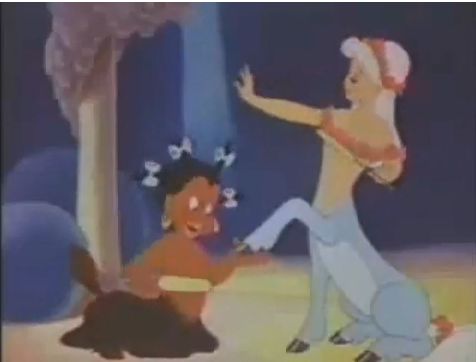
The centaur scene in Disney’s highly acclaimed cartoon Fantasia (1940) clearly communicates gendered expectations for men and women, but there are also racial politics. First, note that, in the film as released, all of the centaurs end up in color-matched heterosexual pairs.  Second, most people do not know that the original centaur scene included a pickaninny slave to the centaur females and exotic, brown-skinned zebra-girl servants.

Here’s a link to the whole thing (embedding disabled, but it works as of Feb. ’11).

A clear still in black and white:

Fuzzy color stills from the youtube clip:


Don’t miss our post showing bugs bunny in blackface, too.