Search results for economicsociology

Flashback Friday.

Adam Smith observed in his Lectures on Jurisprudence (1762) — a series of talks that he gave at the University of Glasgow — that national character plays a significant role in economic transactions: the Dutch, he said, are “more faithful to their word” and better at “performing agreements” than the English, and the English more faithful than the Scots.

In the past few months, I’ve observed a similar kind of cultural variation in a much more prosaic setting: the panhandling interaction.

If you’re from North America, as I am, you’ve probably seen people on the street requesting money from strangers using appeals such as “Homeless—Please Help” or “Homeless Veteran.”  There are a number of variations, but homelessness is the common theme in many cases.
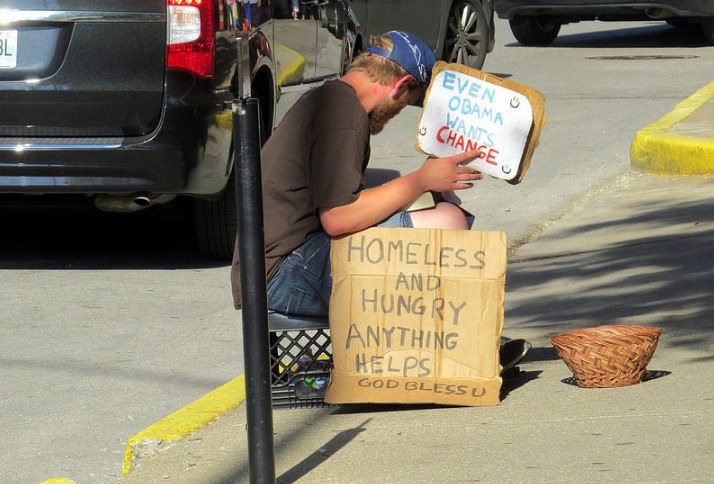
Photo by Steve Baker.

Elsewhere in the world, panhandlers use quite different rationales—or what the great mid-century sociologist C. Wright Mills would call “vocabularies of motive.” Mills wasn’t interested in what actually motivated people—such as what psychologists would term “needs” or “drives”—but rather in the ideologically-charged terms they used to justify their actions to themselves and others. As he observed, some motives are more acceptable than others, and we can learn something about local cultures based on what passes for a “good reason.”

So it’s sociologically interesting that within the North American context, the concept of “home” has such resonance that the claim of “homelessness” is considered a compelling and sufficient motive for giving money to strangers. But while the need for shelter would seem universal, it’s rare to see a panhandler outside North America requesting a donation on the basis of homelessness.

In Germany, for example, one often finds people begging for trinkgeld—”drinking money.” And they’re not playing for laughs, as one sometimes finds in the US, when panhandlers give a wink and a nod to the stereotype that money given to beggars is only ever used to buy alcohol (or drugs). When a panhandler asks for “drinking money” in the US, it’s sort of an in-joke, or an attempt to appear disarmingly honest; based on the limited examples I’ve seen, this seems to jolly people up and get good results (i.e., quantities of cash).

But in Germany, drinking money is serious business. In the four years I lived in the Rhine Valley, I saw dozens of men (always men) on public transport and on the street, asking for “trinkgeld, bitte” in monotonous, dirge-like tones that seemed to express just how grim a fate it was to lack beer money. Equally surprising to me was the willingness of Germans to open their purses for this reason, as if it was a truth universally acknowledged that a man with empty pockets must be in want of a beer. In the interactions I witnessed, no one on either end of the transaction ever smiled.

Yet another vocabulary of motive can be found on the streets of Istanbul, where panhandlers often approach passers-by with a request for ekmek parası—Turkish for “bread money.” In perhaps 10 visits to Turkey in the last 3 years, I’ve never seen anyone on the street claiming to be homeless. Nor have I seen a cardboard sign of the kind so common in North America.

In all three settings, the vocabularies of motive among panhandlers have a common theme of need: for shelter, drink or food. What’s interesting is how each cultural setting changes the calculus about what kind of motive is most likely to bring in the cash. Perhaps it comes down to what each society views as among the basic human rights: in the US, shelter has a plausible claim to that status, but beer does not; whereas in Germany, it an appeal for trinkgeld succeeds as an appeal to common humanity and decency; in Turkey, hunger seems to trump all other claims.

Originally posted in 2010.

Brooke Harrington is Associate Professor of Economic Sociology at the Copenhagen Business School. She is the author of two books: Pop Finance: Investment Clubs and the New Investor Populism and Deception: From Ancient Empires to Internet Dating.  She is currently doing research on offshore banking and blogs at our fellow Society Pages blog, Economic Sociology.

Last month the cast of Jersey Shore rang the opening bell at the New York Stock Exchange (NYSE). The public responded negatively.  Says one snarky observer on the NYSE’s Facebook page:

The kids of the Jersey Shore rang the opening bell at the New York Stock Exchange this week.  In a related story, civilization is down 500 points.

The trouble, it seems, comes from the weirdness of bringing together trivial-and-fake-“reality”-stars with the very-important-and-really-real-U.S.-financial-market.

Economic sociologist Brooke Harrington, however, thinks the two are less incongruent than they seem.  She writes:

I’d like to suggest that what seems so wrong with that picture of Snooki and company ringing the opening bell actually makes a lot of sense sociologically. If this meeting of worlds—entertainment and the stock market—seems strange, it may be because we’re so used to regarding the markets as “real,” rather than as a performance (or even as entertainment in their own right).

Markets, she explains, aren’t “more ‘real’ than ‘reality TV.'”  Instead, both the characters on Jersey Shore and markets are playing themselves.   The reality show stars respond to expectations of “Guido” and “Guidette” personalities.  Likewise, the market responds to  economists whose predictions often create the very reality that they anticipate.

Harrington brings in a fancy concept:

Both are engaged in producing what French sociologist and cultural theorist Jean Baudrillard calls “the simulacrum:” a copy without an original, a pretense that replaces and ultimately negates “reality” so successfully that we no longer care about what is real.

She finishes:

Theorized through this lens, the image of the Jersey Shore cast ringing the opening bell at the NYSE persists in memory not because it is represents a collision of worlds, but because it brings together two genres of performance whose entertainment value depends on their purported “reality.”

Lisa Wade, PhD is an Associate Professor at Tulane University. She is the author of American Hookup, a book about college sexual culture; a textbook about gender; and a forthcoming introductory text: Terrible Magnificent Sociology. You can follow her on Twitter and Instagram.


With tax season upon us, it is almost obligatory for Americans to complain about what they’re shelling out to Uncle Sam. According to Gallup polls, 46 percent of Americans think their taxes are too high.

The good news is that figure is near rock-bottom for the past 50 years; the bad news is that tax-related violence has been on the rise for the same period. The most recent example of this trend occurred last month, when software engineer Joe Stack, enraged by disputes with the Internal Revenue Service going back to the 1980s, flew a small plane into an IRS building in Texas.

In a lengthy essay/suicide note posted on his website, Stack styled himself after the early American patriots of “no taxation without representation” fame, reminding us all of the unique prestige of tax revolt in American history. As Stack points out, some of the first lessons American children receive about their nation’s history equates taxes to oppression, and revolt against those taxes to the struggle for liberty and justice for all. This probably contributes to Americans’ widespread distrust of taxation, and the acceptance of that distrust as normal and natural.

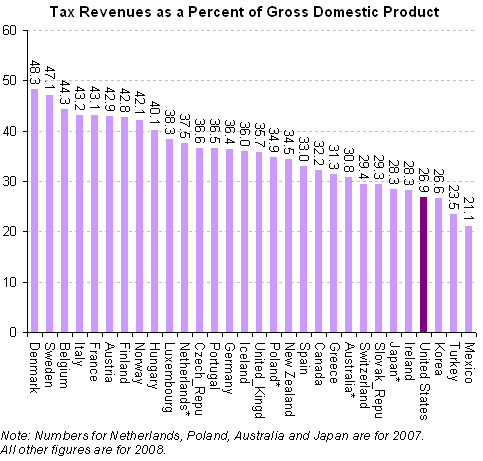
But that view of taxation is not shared worldwide. In fact, citizens of some countries are actually happy about paying taxes. If you’re an American reading these words, that statement probably sounds pretty far-fetched. But consider this: the citizens of Denmark pay the highest income taxes in the world (an average of 48.3 percent), and are also the happiest people in the world.

It’s not just that Danes pay those high income taxes: they also pay a Value Added Tax of 25 percent on every cup of coffee or pair of sneakers they buy, making the outcry in my hometown of Chicago over having the highest sales tax of any major city in the US (a whopping 10.25 percent) look picayune by comparison. And then there’s Denmark’s tax on new cars: a heart-stopping 180 percent. So if you buy a car with an MSRP of € 20,000 , you’ll pay an additional € 36,000 to get the car registered and licensed.

The Danish car tax, in and of itself, would probably be enough to provoke armed rebellion in the United States. So why do the citizens of Denmark not only tolerate the array of taxes they pay, but appear downright happy about them?

And just to be clear, Danes aren’t just generally happy, or happy despite the taxes they pay. Rather, they are specifically happy about paying taxes! Take this exchange, for example, from a recent series of “person in the street” interviews from Copenhagen by United States National Public Radio:

KESTENBAUM [Ed—NPR reporter]: You think paying taxes is terrific?

Ms. BAUOLASON [Ed—resident of Copenhagen]: I do actually think it is terrific.

From an American perspective, Denmark “seems to violate the laws of the economic universe.”

The key to this attitude seems to lie in Danes’ trust in government and each other—something I noted in an earlier post. As this video interview with a pair of Danish sociologists suggests, this trust stems from several factors. Among the most important is the widely-shared belief that their society is just, and that socio-economic goods are equitably distributed. As a result, many Danes seem satisfied that they are getting their money’s worth–that is, they enjoy tangible benefits of the taxes they pay in terms of universal health care, tuition-free education through the university level, and employment benefits and security far beyond anything available in the United States.

Meanwhile, things could not be more different in the United States, which ranks 23rd in the world happiness rankings, and where distrust of government has been virtually axiomatic since the Reagan era—if not before. This helps account for a paradox: while the United States has among the lowest income tax rates in the world, and we have nothing like the VAT and auto registration taxes that Danes pay, Americans rarely challenge each others’ complaints about “high taxes.”

In fact, one of the remarkable things about Joe Stack’s anti-tax rant/suicide note is how much it resembles what now constitutes “mainstream” rhetoric on taxation in America—particularly in the aftermath of the government bailout of financial firms following the 2008 economic crisis.

Stack wrote:

Why is it that a handful of thugs and plunderers can commit unthinkable atrocities (and in the case of the GM executives, for scores of years) and when it’s time for their gravy train to crash under the weight of their gluttony and overwhelming stupidity, the force of the full federal government has no difficulty coming to their aid within days if not hours?

Compare this to CNBC newsman Rick Santelli’s now legendary on-air rant of February 2009, in which he sounds many of the same notes as Stack, using virtually identical arguments and references to American history:

So while Stack’s violent actions took this rhetoric to the extreme, the evidence suggests that he was no outlier in his  perspective on taxation in America: his basic views are apparently shared by a wide swath of his fellow citizens, from television news reporters to the Tea Party movement to think tanks like the conservative Cato Institute.

What accounts for this extreme disparity between American and Danish attitudes toward taxes? And what does this have to do with the differences between the two countries in terms of happiness?

The evidence suggests that both phenomena stem from perceptions of fairness. While—as the two video interviews from Denmark suggest—many Danes believe that they benefit personally from their tax contributions, the rhetoric of people like Stack, Santelli and others suggest that many Americans believe they get little to nothing in return for their tax contributions. Instead, they believe their taxes benefit the “free riders” in US society—whether conceived as “welfare queens” at the bottom of the socio-economic ladder, or as corporations and executives at the top.

Thus, Stack signed off with this bitter epigram: “The capitalist creed: From each according to his gullibility, to each according to his greed.” For him, it was a bitterness unto death; for like-minded Americans, these beliefs contribute to a sense of pervasive injustice that frustrates their “pursuit of happiness” and makes April 15 a day of national resentment rather than a simple administrative deadline.

——————————

Brooke Harrington is Associate Professor of Economic Sociology at the Copenhagen Business School. She is the author of two books: “Pop Finance: Investment Clubs and the New Investor Populism” (Princeton University Press, 2008) and “Deception: From Ancient Empires to Internet Dating” (Stanford University Press, 2009). She is currently doing research on offshore banking.  Harrington blogs at our fellow Contexts blog, Economic Sociology.

If you would like to write a post for Sociological Images, please see our Guidelines for Guest Bloggers.

Triathlon is the new Golf: As a young lawyer making a name for himself in the mid-seventies, my father’s superiors told him to “pick up golf” as a way to rise quickly within the firm, and to land lucrative clients. It’s still all about who you know, but if you want to get ahead in business today, don’t hit the putting green, sign up for an Ironman. Why?

Like Golf, Triathlon is cost prohibitive: The average annual income of an Ironman participant is nearly $160,000, while the average golfer makes a measly $100,980 a year, according to Golf.com’s 2009 Survey.

With Ironman entry fees upwards of $500 each (plus the flight and lodging expenses associated with destination racing), a decent bike starting around $3,000 (plus $400 for the shoes, helmet, peddles and accessories), $200 for swim, bike and run gear, and $300/month in coaching and facilities fees; you start to understand the need for that extra $60,000/year.

Triathletes make better business connections: Like Golf, Triathlon entrances “Type A” personalities, obsessed with winning, even if victory requires continuous practice and focus. Unlike golf, Triathlon also demands incredible pain tolerance and phenomenal endurance. Consequently, “the sport attracts high-income, driven, focused individuals who are able and willing to pay the price in time and money,” says David Samson, Florida Marlins president, and Hawaii Ironman 2006 finisher.

Not only are triathletes more driven, they’re also younger. On average, Ironman triathletes are 35-44, while avid golfers are generally in their early 50’s. Consequently, triathletes are at the peak of their professional careers, while many golfers are contemplating retirement, and thereby less effective in helping you infiltrate the network or company of your choosing.

Triathlon is a better way to schmooze (on a Micro Level): Now that you’ve drawn all of the rich, hard working, high powered individuals into one sport, it is time to make connections. Typically, only four players participate in a round of golf, which takes around 4.5 hours. You likely know at least one or two of the other competitors if you’ve been invited to play in the first place, so you’re left with at best two networking opportunities, which isn’t an efficient way to find the right contact for you.

Most of the Multi-Sport fitness groups in my home town (Marin County, CA), host weekly group rides, averaging thirty to fifty participants. The group usually covers seventy miles in a given ride, thereby providing five hours (plus a group brunch) to make friends, and connections. The group usually breaks into smaller packs of evenly matched athletes after a ten mile warm-up. As competitive, Type A folks, multiple members in a given group will eventually ask you how old you are, what team you belong to, and what you do (probably to ascertain how much time you have to train, how long you’ve been serious about the sport, who coaches you, and what if any advantage your bike may provide you).

It is during this hierarchical ranking process that you establish dominance over the somewhat older, not-as-fast man on the really expensive bike. He may be the CEO of a major tech company in Silicon Valley, but that is the professional “Pond” (Frank, 1987) or “Sphere” (Putnam, 1995). Right now, you’re both in the triathlon sphere, where you’re fitter, faster and had a better time at Ironman Canada last year. As Frank noted, it is relative status that creates happiness and satisfaction, and in this pond, your status is higher than his.

So, for the remainder of the ride (and during brunch afterward), he picks your brain about triathlon, and you arrange to have lunch with him at his office next week, a networking win you’d never enjoy if you’d attempted to engage said CEO in the professional Sphere.

Triathlon as a character reference: Not only have you now procured a meeting, you’ve already passed the first round of the interview process. The ability to withstand (and even enjoy) suffering is a form of ‘bonding social capital’ (Putnam, 2001) that forges a strong sense of collective identity. It implies a preference for achieving work-like goals in the leisure sphere, which translates seamlessly into a strong, professional recommendation from your new friend, the high powered CEO.

Triathlon is a better way to schmooze (on a Macro Level): There is no other sport in which every race includes Professional, Amateur and “Age Group” triathletes from under ten to over eighty, separated only by “wave” times, which are determined by age and gender. As Bob Babbitt, publisher of Competitor Magazine put it: “I can’t pitch to Barry Bonds or tee off with Tiger Woods, but I can be on the starting line with the top people in triathlon.” Consequently, you can train, compete and network with individuals of all ages and abilities, from around the world.

While the world of triathlon is growing rapidly (223,594 US adults participated in a triathlon in 2007, up from just 83,612 just ten years ago), Triathlon is still a small community, even at the Macro level. With a limited number of Ironman (2.4mi Swim, 112mi Bike, 26.2mi Run), Half Ironman (1.2mi Swim, 56mi Bike, 13.1mi Run), Olympic (.9mi Swim, 26mi Bike, 6.1mi Run) and Sprint (.5mi Swim, 16mi Bike, 2mi Run) distance races, you are assured to become familiar (and even friendly) with similarly matched athletes from across the country, and the world.

Triathlon is a reciprocal Panopticon: Your athletic club affiliations are declared on your uniform, and your age is written on your calf prior to each race (so you can check the legs of everyone you pass and everyone who passes you, to estimate ranking in on your age group during the actual race).

Your relative time and ranking is posted within minutes of completing the race, so all can see where you fall amongst the 2,000 or so athletes who participated that day. Award ceremonies are performed immediately, and results are posted online within 24 hours. You can even look up their participant’s photos!

Basically, Triathlon is a Panopticon (Bentham 1995 [1785]; Foucault 1995 [1977]), in which everyone is given the role of prison guard and prisoner. You can’t hide anything about yourself, but in turn, you know everything about everyone else.

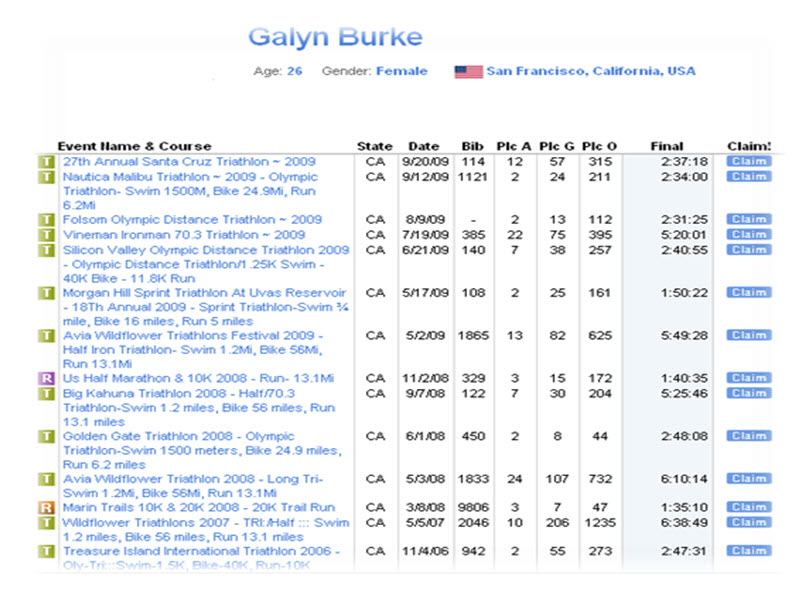
Athlink.com results display an athlete’s age, gender, city, and results for every event completed:

Athlink_Results_Image_4

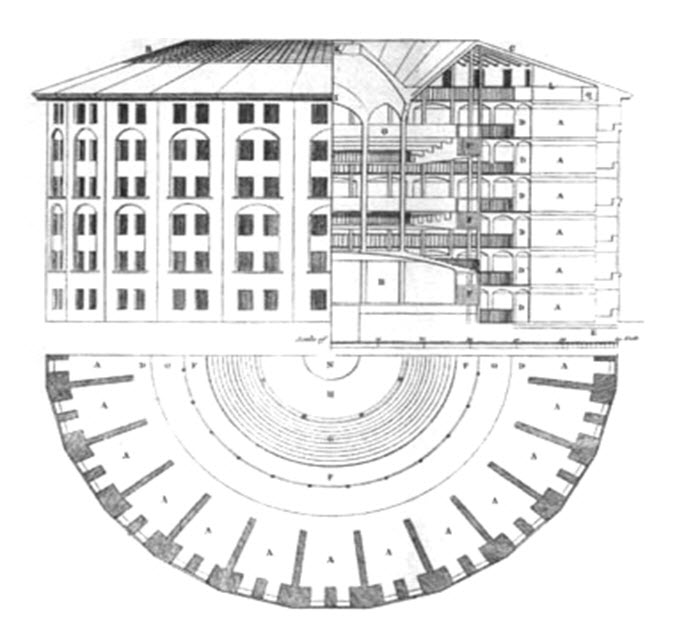
Bentham’s Panopticon: A theoretical prison that allows guards to observe (-opticon) all (pan-) prisoners, who can’t reciprocally tell whether they are being watched:

Panopticon_Image_5

Conclusion: Triathletes are a self selecting group of affluent, highly motivated individuals, who spend countless hours forging bonds through the competitive, grueling, and socially cohesive ritual of endurance athletics. The greater community convenes several times a year to establish relative rank by sex, age, casual, amateur and pro standards. With access to the region, age, gender and past performances of every athlete in this group, Triathletes are “tee’d up” to make local, national and international connections that turn into husbands, wives (38% of Triathletes are now women), employees, employers and friends. In a world where it’s all about whom you know, it doesn’t hurt to know the rich, successful, driven group that is Triathlon.

References:

Bentham, Jeremy. 1995 [1785]. Panopticon Letters. Miran Bozovic (Ed.). London: Verso.

Foucault, Michel. 1995 [1977]. Discipline and Punish: The Birth of the Prison. New York: Vintage.

Frank, Robert. 1987. Choosing the Right Pond: Human Behavior and the Quest for Status. New York: Oxford University Press.

Putnam, Robert. 2001. Bowling Alone: The Collapse and Revival of American Community. New York: Simon and Schuster.

Galyn Burke–Brown, formerly a competitive equestrienne, is now an enthusiastic triathlete.   She blogs at Economic Sociology.