Search results for The

Miguel in Barcelona sent us this government-sponsored poster aimed at promoting egalitarian relationships. He translates the text as:

The love has to be free
Free of machismo
Free of fights
Free of jealousy

This image, as a representation of idealized egalitarian love, is a nice contrast to the representations of love common in the U.S. (and in Spain?) that make power asymmetry sexy, desirable, and constitutive of love. Consider the love affair between this apple and pear and these two images (which look more like the fruit than Miguel’s image above):


Thanks to Miguel for sending us our first image from Spain!>
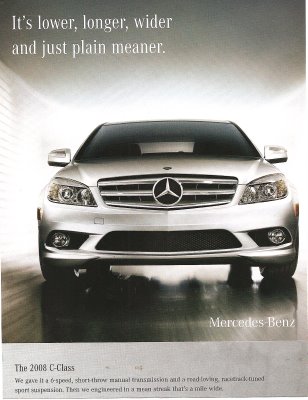
The last line says, “Then we engineered in a mean streak a mile wide.” Can you imagine such a marketing campaign for a Honda Civic or a VW Passat? This is a man’s car–it takes up more space, and it’s mean–characteristics we allow (some) men, but not women, to have.

Note: I like the commenters’ points that this intersects with class more (as well?)–see the comments. They did a better job with the analysis on this one than me.

NEW:

This ad (found here) plays up the fact that some cars are designed to look “mean,” so the Jaguar is actually afraid of the BMW:

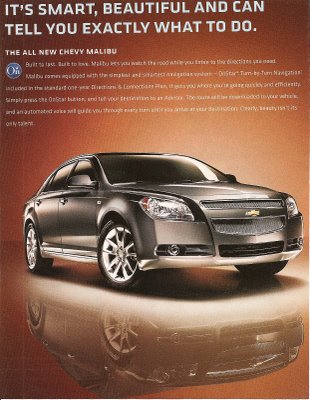
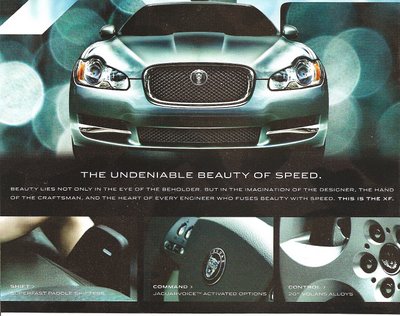
Compare the ads above to these two that link a car and beauty. The first one seems to be portraying the car as a beautiful but bossy woman (“…can tell you exactly what to do”):

It’s an interesting contrast–these three cars all look very similar, and yet one is mean/masculine and the other two are beautiful/feminine. I like to show comparisons like these in class to make it clear to students that advertisers have many different motifs and meanings to draw from when creating marketing strategies, and that the ones they pick are just that–CHOICES among many, many different ways you could advertise a product, none of which are necessarily more “obvious” or “natural” than others.

The Home Made Simple Squad is a new ad campaign for Proctor & Gamble cleaning products. Five women make up the Squad. From Lori’s bio:

‘I love to entertain in my home, and when people come over, I want them to walk in and immediately feel welcome and comfortable. So I make sure my house is always looking good and smelling fresh.’ Lori, 37, prides herself on her clean and well-organized home that’s always ‘company-ready’. Lori is disciplined about more than just caring for her home – she’s also recently lost 95 lbs, and keeps fit with a regimen of healthy eating, power walking and yoga.

So not only is she a good housekeeper, she keeps herself fit and trim, too!

Although all of the bios mention that the women have children and are busy, not a single one mentions a husband, partner, or other adult who might have some role in keeping a house clean. Or, for that matter, making the kids clean up after themselves.

Thanks to an anonymous commenter on another post for bringing my attention to this one!

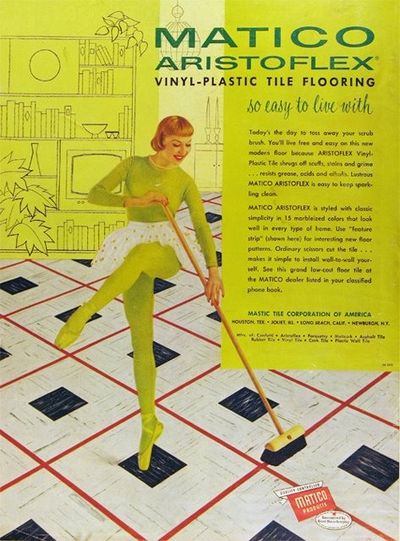
NEW! This vintage ad relates sweeping the floor to dancing… because cleaning vinyl-plastic tile flooring, unlike cleaning other kinds of floors, is a kick!

6a00d83451ccbc69e2011570fdce1f970c-400wi

An Anonymous Reader sent another example of the message that women absolutely love cleaning!  The bucket reads, “What could be better than this?”  I suppose it could be tongue-in-cheek, but I’m not getting that vibe.

Gwen Sharp is an associate professor of sociology at Nevada State College. You can follow her on Twitter at @gwensharpnv.

Here is an image for the website from Just for Men’s Touch of Gray line:


This product covers most, but not all, of a man’s gray hair. From the website:

Why use Touch of Gray? A little gray to show your experience, but not so much
that it hides your vitality.

There are a range of shades available and you can control how much gray is hidden.

The website has a total of four images of men with women. As Vanessa V., who sent this one in, pointed out, none of the women have a “touch of gray.” Nor could she imagine a product like this marketed to women.

Here is another example of an ad that gives men permission to age in a way women never are.

Other men’s hair dye posts: here, here, and here.

Thanks, Vanessa!

NEW: Corey O. found a Just for Men commercial that references Woodstock (sadly, I can’t find a video of it). Corey says,

It has everything you could want in an advertisement: classic rock soundtrack, co-opted counterculture, mixed messages about aging, demonstrations of male virility, minorities on the margins, gender disparity, and attempts to sell a “natural” look. The total package. What really got to me, though, was the gender aspect. Can you imagine a line of hair dye marketed toward women which is meant to leave some grey intact? I don’t think that Just for Men can either — in contrast to the silver-streaked men, none of the women in the ad are sporting a natural look and some look like they’ve had rather recent visits from the botox fairy. This ad is a nice way of illustrating the double-standard that women face in regards to aging: while men can benefit from grey hair as an illustration of their maturity without sacrificing their virility, women must always strive to look as young as possible. Because this is an ad for men’s hair dye, however, it also illustrates that while men may benefit from less scrutiny of their appearance than women, their appearance is also satisfactory only with the use of beauty aids.

I also like the appropriation of Woodstock and the counter-culture movement of the ’60s.

Thanks, Corey!

Gwen Sharp is an associate professor of sociology at Nevada State College. You can follow her on Twitter at @gwensharpnv.

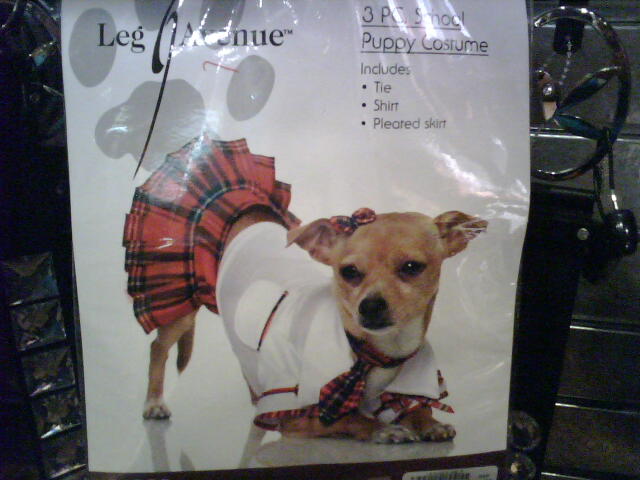
One of my students took a picture of this outfit at the mall–I believe she said it’s for sale at Spencer’s. For the sexy Catholic (?) school-dog of your dreams!

Thanks, Blanca M.!

About the Site

Sociological Images is designed to encourage all kinds of people to exercise and develop their sociological imagination by presenting brief sociological discussions of compelling and timely imagery that spans the breadth of sociological inquiry. Please friend us on Facebook or follow us on Mastodon, TwitterTumblr, or Pinterest.

Sociological Images is used as a source by a wide range of news organizations and are routinely cross-posted at high profile news and opinion sites.

Accolades

We have been reviewed favorably in Teaching Sociology and Visual Studies, featured in an academic article at Teaching in Higher Education. The blog received the 2015 Distinguished Contributions to Teaching Award from the American Sociological Association. We have also been granted awards from The American Sociological Association section on Communication and Information Technologies, The Pacific Sociological Association, the University of Minnesota Department of Sociology, and the Multimedia Educational Resource for Learning and Online Teaching.

People

Editor and Principal Author

Evan Stewart is an assistant professor of sociology at University of Massachusetts Boston. He earned his MA and PhD in sociology from the University of Minnesota and holds a BA in political theory and social policy from Michigan State University. His research on political culture, public opinion, and religion and secularism has appeared in journals such as Social Forces, Social Currents, and The Sociological Quarterly. You can follow Evan on Twitter, or visit his website for a curriculum vitae, teaching information, and more.  

Founding Editor and Contributor

With Gwen Sharp, Lisa Wade founded Sociological Images in the summer of 2007. She remained the principal writer and editor of the site until the September 2017.  She earned a BA in philosophy from UC Santa Barbara, an MA in human sexuality from NYU, and a PhD in sociology from the University of Wisconsin, Madison. Today she is an Associate Professor at Tulane University in New Orleans, with appointments in sociology, gender and sexuality studies, and the Newcomb Institute. Her most recent book, American Hookup, is described as an open-minded, compassionate, and unflinching account of the new culture of sex on campus. She is also the author of a forthcoming introduction to sociology textbook titled Terrible Magnificent Sociology, the bestselling textbook Gender: Ideas, Interactions, Institutions (with Myra Marx Ferree), and the co-editor of Assigned, a book about life with gender. You can join Lisa on Twitter and Instagram. Or, you can visit her website for her curriculum vitae, syllabi, information on public speaking, and more.

Founding editor

Gwen Sharp co-founded Sociological Images with Lisa Wade in 2007 and was a principal writer and editor for the site until 2012. She earned a PhD from the University of Wisconsin-Madison and is currently an Associate Dean at Nevada State College. She developed the sociology minor at NSC and taught Principles of Sociology, Gender and Society, Racial and Ethnic Conflict, Social Stratification, Sex and Social Relations, and Popular Culture. Dr. Sharp won the 2012 campus award for Teaching Excellence at NSC, and in 2014 received the state-wide Nevada Board of Regents Teaching Excellence Award. You can visit her website for more.

Other Associates

Tristan Bridges served as the Sociological Images Guest Editor from January 2017 to March 2017. He is an assistant professor in the sociology department at the University of California, Santa Barbara.  His research is primarily concerned with shifts in the gender identities and practices of young men and how those transformations relate to contemporary gender and sexual inequality. You can visit his website, his blog, or follow him on Twitter.

Our regular contributors have included Philip Cohen of Family Inequality, Martin Hart-Landsberg of Reports from the Economic Front, and Jay Livingston of Montclair SocioBlog.

Our student interns have included Javier Quiroz (2013/2014), Laura Bertocci (2012/2013), Norma Morella (2011/2012), and Lauren McGuire (2010/2011).

ABOUT THE WEBSITE

WHY: In an era where people face fake news and post-truth politics, the sociological imagination is more necessary than ever. It is also easier than ever for us to share what we learn about the social systems that shape our world. Researchers are flocking to social media, people are making their data beautiful, and, as always, a good image is often more effective for getting a point across than all the citations, repetition, or jumping up and down and saying “really I swear” will be.

We hope this blog encourages all kinds of people to exercise and develop their sociological imagination and that, between all of us, public discourse will increasingly include a sociological lens with which we can all learn about social processes, critique social inadequacies, and design functional and equitable alternatives.

Also, if you are an instructor, we hope that the material will be useful for your classes.  Check out our collection of Sociological Images assignments.

OUR AUDIENCE: We assume that you, our audience, are sociologically-inclined folks. So we do not typically include a lengthy beginner-level sociological interpretation of the images.

DIALOGUE: Images are polysemic and people will view and use them in many different ways, so our commentary, when offered, is never meant to control how people use the images (as if we could anyway).  We welcome comments that offer additional or alternative interpretations of images.

TRIGGER WARNINGS: We do our best to place potentially upsetting images and text after a jump.  If we’ve failed to notice that something needs a trigger warning, or have forgotten to do this, please feel free to send us a note letting us know.  We’ll fix it ASAP.

COMMENTS MODERATION: Comments that are hateful or threatening toward other commenters, mean-spirited toward particular social groups, or otherwise useless, will be deleted.

STANDARDS OF EVIDENCE: The point of this blog is not to prove that sociological insights actually describe the social world (i.e., “prove” that they are “true”), but to illustrate those sociological insights that are shown or posited to be true elsewhere in academia.  This is by design.

LEGALITY: While all law is a matter of interpretation, we believe Sociological Images to be legal under the Fair Use doctrine. That is, we use the images for a non-commercial educational purpose and that makes it all good.


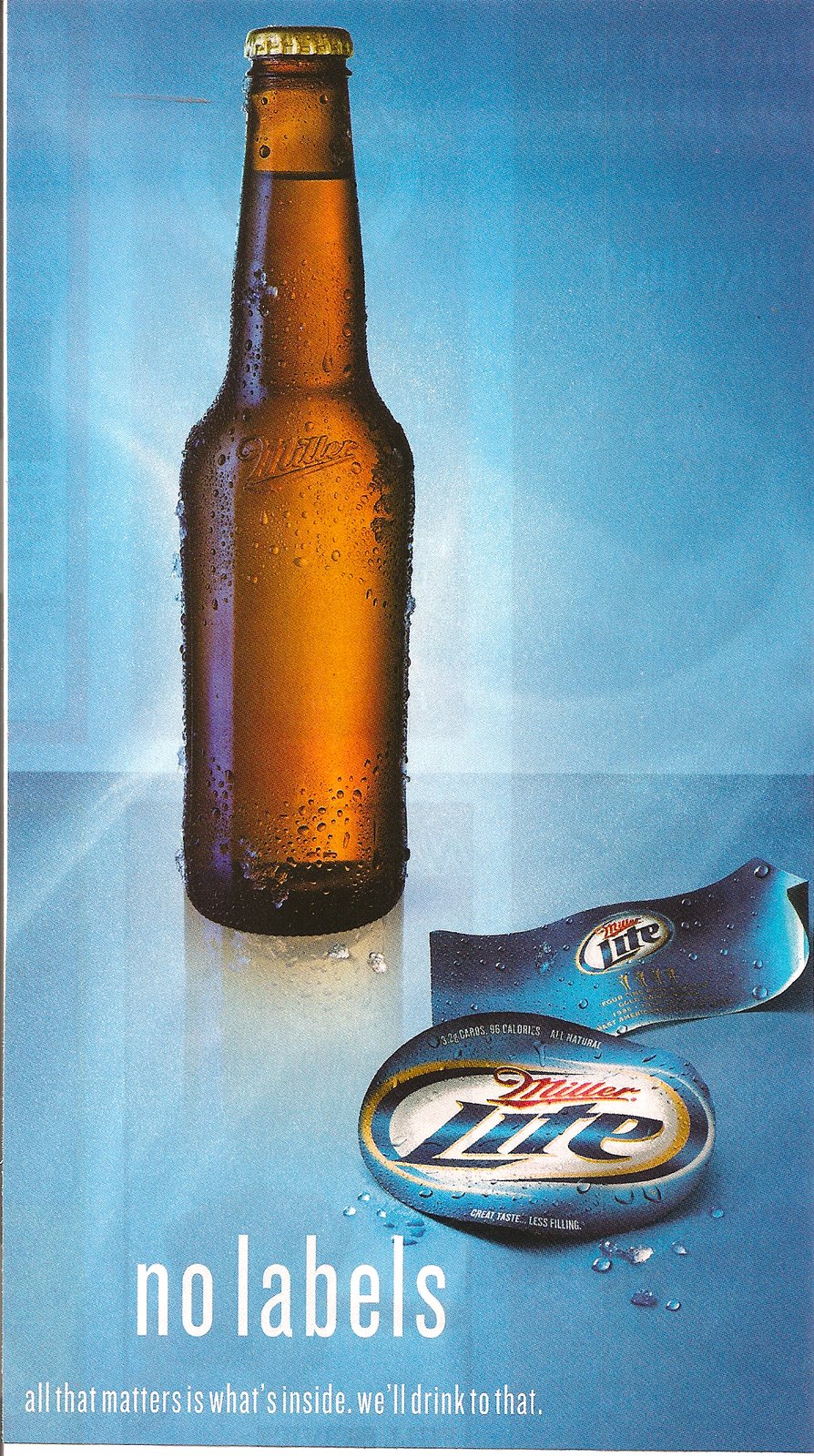
I found these two Miller Lite ads in QVegas, a magazine aimed at the GLBT community.

It would be interesting to pair with these ads for Skyy vodka to illustrate how companies make different ads to target different audiences. If you find an ad offensive or dumb, it’s not necessarily an ineffective ad, it’s that you probably aren’t the target consumer and it’s not supposed to appeal to you.

NEW! Philip D. sent in a link to a post by Sister Toldja at Me, Myself An Eye about slightly different versions of ads for Crown Royal. This one is presumably aimed at a general audience:

cr

Text: “Have you ever seen a grown man cry?”

Sister Toldja suspects that this one is targeted more specifically at African Americans:

crb

Text: “Oh, hell no.”

Now, just to be clear, I’m not arguing these are racist ads. I just think they would provide a good example to start students thinking about the fact that a) advertisers actively market to various groups by trying to appeal to them in specific ways that may differ from an ad made for a “mainstream” or “general” audience (i.e., one that would presumably appeal to just about everybody) and b) they do this by playing on stereotypes or cultural assumptions about what different groups like (or are like). What separates these two ads into “mainstream” and “Black” ones? Simply the presence of a phrase that many people associate with African Americans (although I have to admit I mostly associate it with one of my male cousins more than anyone else). You might start with this example, which is fairly innocuous, I think, and then start asking students to think about other ways advertisers might indicate who an ad is supposed to appeal to (men or women, gay or straight, or more broadly to “everyone”). When do these efforts become problematic?

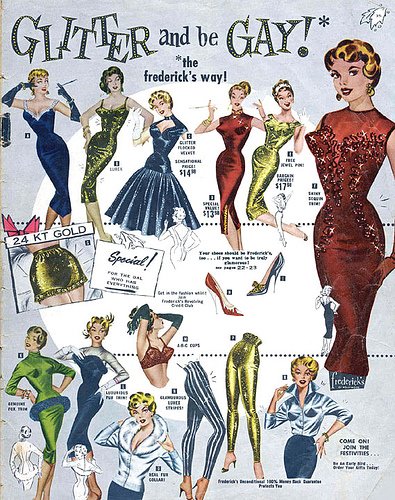
Then:

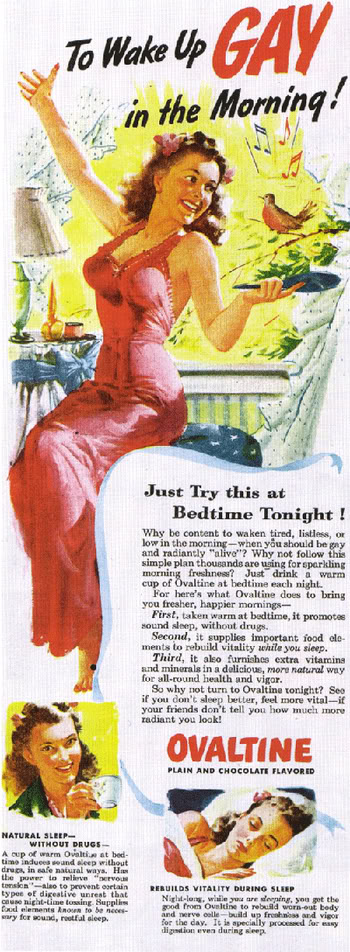
Then:

ovaltine_old_ad

Now:

Thanks to Jason for sending along the first “then”!