I’m going to start this post even though I don’t have an ending.

About a year ago I was asked to start writing for Playboy. The editor said that he was helping to transform the magazine’s website into one that “was a destination for smart writing on sex.” I said that I’d keep the offer in mind but, between you and me, the answer was no.

Around the same time, I heard of some other high-profile feminist writers being invited as well. “Huh,” I thought, “they may actually be serious about this.”

Since then, I’ve ended up on the Playboy website a couple of times, following links by like-minded people who found material they thought was valuable. I’ve been surprised and tentatively impressed. Then, this week there was a flurry of links to a piece by Noah Berlatsky, deftly and smartly analyzing feminist responses to trans woman Laverne Cox’s decision to pose nude for Allure.

The article began with a cropped screenshot of Cox’s photograph featuring her face and de-emphasizing her body and a quote from Cox about the widespread belief that black women and trans women, and especially black trans women, can’t be beautiful.

Berlatsky then goes on to discuss the challenges intersectionality poses to feminism, conflicts within feminism about whether trans women count as women, debates over cosmetic surgery and the problem with trying to live up to patriarchal standards of beauty, and whether Cox’s decision to pose naked is degrading. You don’t have to agree with all Berlatsky says to notice that he is no stranger to feminist theory.

Moreover, he seems to look upon Cox’s photograph with a delicate and sensitive gaze, describing what he sees like this:

Cox is not fashion-model-thin. She’s not fashion-model-petite or willowy, either. She has very large hands, which are not hidden, boldly displayed. In the photo, Cox lies on a blanket; her body taut rather than relaxed, her head in one big, strong hand, eyes closed, a slight smile on her face — like she’s a little embarrassed and amused at being embarrassed. She’s voluptuous and awkward and sweet all at once. In her simultaneous enjoyment of and discomfort before the camera, she seems, in the frankly staged pose, startlingly natural — and beautiful.

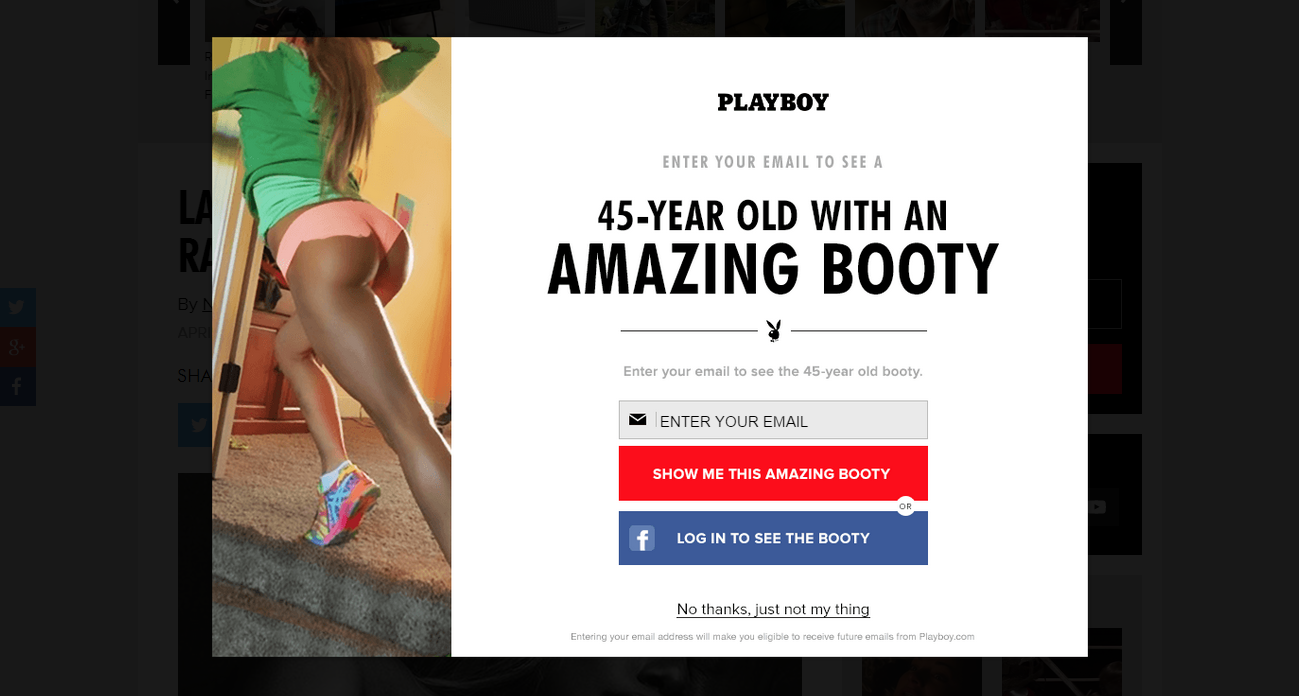
As I reached the end of the article, I was considering sharing a post from Playboy for the very first time. Then, this happened:
11

That’s a screenshot of a pop-up that arrived on my screen when I reached the end of Berlatsky’s thoughtful, feminist essay. It says: “Enter your email to see a 45-year-old with an amazing booty.” In other words, “Click right now to see a woman still fuckable after 40!” (And here I’m going to just go with the idea that this is sexist, but not engage with the extensive feminist theorizing about pornography.)

This is where I’m at a loss.

Is this what change looks like? Is this what change looks like, specifically, when it comes from inside of an organization? A slow, stuttering shift from misogyny to feminism, replete with missteps and contradictions?

Who’s in charge over there? What is their strategic plan? Are they trying to appropriate feminism? It’s not like they haven’t done it before. What role do they see this feminist discourse playing in a space that’s still so misogynist?

Or is the right hand just not paying attention to what the left hand is doing? Maybe Berlatsky was as surprised by the pop-up as I was, thinking “Come on, guys!” Or do they not think that their pop-up was sexist at all?

And, from a feminist perspective, does this do anyone any good? I don’t mean this rhetorically. I honestly don’t know how to answer that question. And, on the flipside, could this hurt feminist activism?

What say you?

Lisa Wade, PhD is an Associate Professor at Tulane University. She is the author of American Hookup, a book about college sexual culture; a textbook about gender; and a forthcoming introductory text: Terrible Magnificent Sociology. You can follow her on Twitter and Instagram.
Thanks to Stuff Mom Never Told You for this fantastic satire!

Thanks to Meredith E. for the tip!

Lisa Wade, PhD is an Associate Professor at Tulane University. She is the author of American Hookup, a book about college sexual culture; a textbook about gender; and a forthcoming introductory text: Terrible Magnificent Sociology. You can follow her on Twitter and Instagram.

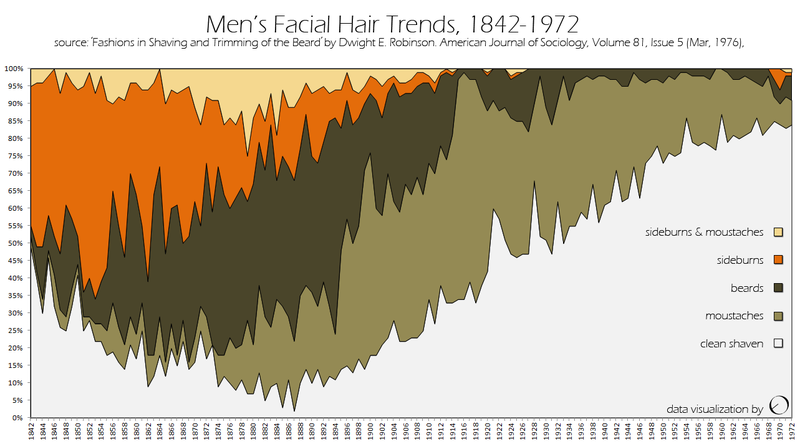
At Vox, Phil Edwards dug up and revived an article from the American Journal of Sociology published in 1976. It tracks facial hair trends — or what the author whimsically calls “frequencies in whisker forms” — from 1842 to 1972. He notes, in particular, the overwhelming dominance of the clean face at the time of publication.

This is your image of the week:

8

The original author uses the data to make an argument about the existence of fashion trends. He’s interested, too, in why fashions change and, in like any good sociologist, recommends further research. He does speculate, though, about one possible driver of change: old people. He writes:

…as long as any considerable number of people who have stuck to a superseded form of personal appearance are still living, the young may tend to avoid such a mode as old hat. These distasteful associations seem to be safely overcome only after the passage of a century or more.

His theory holds. If his data is correct, beards disappeared right around 1915. It’s been a hundred years and beards are back!

Lisa Wade, PhD is an Associate Professor at Tulane University. She is the author of American Hookup, a book about college sexual culture; a textbook about gender; and a forthcoming introductory text: Terrible Magnificent Sociology. You can follow her on Twitter and Instagram.

Flashback Friday.

Beautiful:

Flickr Creative Commons, Rowena Waack

Disgusting:

Flickr Creative Commons, Brendan Wood

Dirt:

Flickr Creative Commons, Mark O’Rourke

Soil:

Flickr Creative Commons, JaulaDeArdillo

In the classic book, Purity and Danger (1966), Mary Douglas points to the social construction of dirt. She writes:

There is no such thing as absolute dirt: it exists in the eye of the beholder.

If dirt and dirtiness is socially constructed, what do things we identify as dirt, filth, rubbish, and refuse have in common?

Douglas suggests that dirt is really a matter of disorganization. Literally, that a thing becomes dirt or garbage when it is out-of-place. “Dirt,” she writes, “offends against order.”

Eliminating it is not a negative movement, but a positive effort to organise the environment.

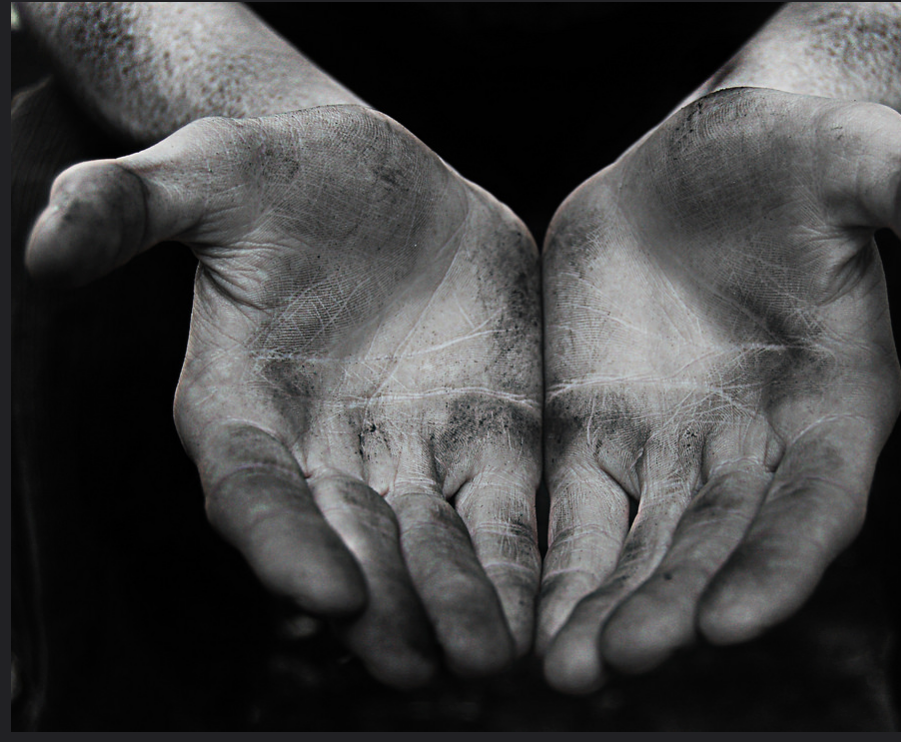
I chose the images above to try and illustrate this idea. Hair in the drain, like dirt on our hands, is out-of-place. It doesn’t belong there. In both cases, our reaction is disgust. Hair on the head, in contrast, is beautiful and becoming, while dirt outside is life-giving soil and part of the beauty of nature.

Images royalty free from Getty. Originally posted in 2009.

Lisa Wade, PhD is an Associate Professor at Tulane University. She is the author of American Hookup, a book about college sexual culture; a textbook about gender; and a forthcoming introductory text: Terrible Magnificent Sociology. You can follow her on Twitter and Instagram.
In the U.S., we recognize two main party platforms: Republican and Democrat. Each party packages together specific positions on economic and social issues together into ideologies we call conservative and liberal. The desire for a small government, for example, is lumped with opposition to same sex marriage, while believing in a larger role for government is lumped together with support for abortion rights.

Do all people neatly fit into these two packages? And, if not, what are the consequences for electoral outcomes?

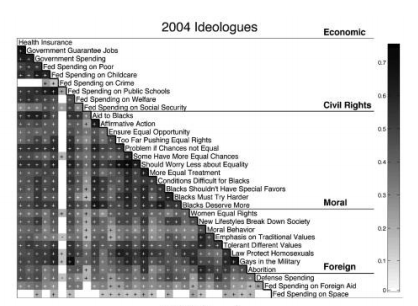
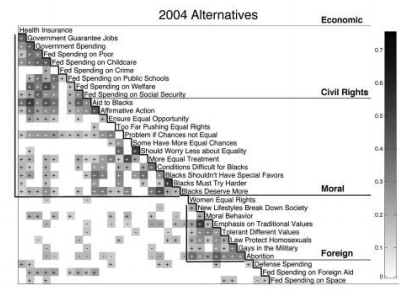
In the American Journal of Sociology, Delia Baldassarri and Amir Goldberg use 20 years of data (1984–2004) from the National Election Studies to show that many Americans have consistent and logical political ideas that don’t align with either major party’s ideological package. These voters, whom the authors call alternatives, are socially liberal and economically conservative (or vice versa).

The images below show correlations between social and economic liberalism or social and economic conservativism. Strong correlations are dark and weak are light. The top image is of the opinions of ideologues — those who adhere pretty closely to the existing liberal and conservative packages — and the bottom images shows the opinions of alternatives.

111 222

In this data, being an alternatives is not just about being unfocused or uncommitted. Baldassarri and Goldberg show that their positions are logical, reasoned, consistent, and remain steady over time.  The study makes it clear that the ties between economic and social issues made by the left and the right, which many people see as normal or natural, represent just two among the many belief systems that Americans actually hold.

When it comes to the ballot box, though, alternatives usually vote Republican. The authors write that the most conservative among the alternatives’ views tend to hold sway when it comes to picking a party. It appears that the salience of moral issues is not the primary reason for Republicans’ electoral success. Instead, for as-yet unknown reasons, alternative voters follow their more conservative leanings at the ballot, whether economic or social.

Cross-posted at The Reading List.

Jack Delehanty is a graduate student in sociology at the University of Minnesota. His work is about how social movement organizations can reframe dominant social narratives about inequality. In his dissertation, he explores how white Protestant-influenced discourses of poverty, family, and individual choice are being critically reshaped in the public sphere today.

Chris Christie’s net worth (at least $4 million) is 50 times that of the average American. His household income of $700,000 (his wife works in the financial sector) is 13 times the national median.  But he doesn’t think he’s rich.

I don’t consider myself a wealthy man. . . . and I don’t think most people think of me that way.

That’s what he told the Manchester Union-Leader on Monday when he was in New Hampshire running for president.

Of course, being out of touch with reality doesn’t automatically disqualify a politician from the Republican nomination, even at the presidential level, though misreading the perceptions of “most people” may be a liability.

But I think I know what Christie meant. He uses the term “wealth,” but what he probably has in mind is class.  He says, “Listen, wealth is defined in a whole bunch of different ways . . . ”  No, Chris. Wealth is measured one way – dollars. It’s social class that is defined in a whole bunch of different ways.

One of those ways, is self-perception.

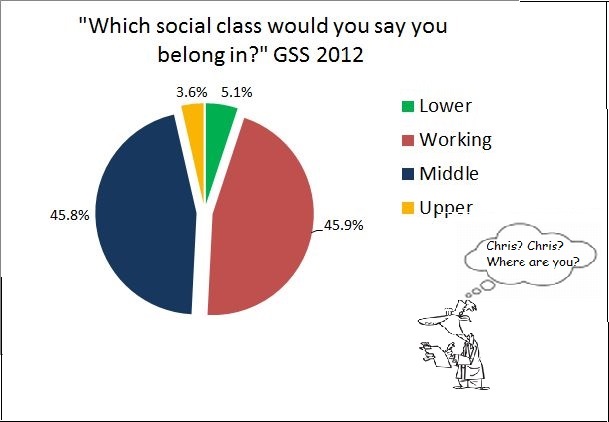
“If you were asked to use one of four names for your social class, which would you say you belong in: the lower class, the working class, the middle class, or the upper class?”

That question has been part of the General Social Survey since the start in 1972. It’s called “subjective social class.” It stands apart from any objective measures like income or education. If an impoverished person who never got beyond fifth grade says that he’s upper class, that’s what he is, at least on this variable. But he probably wouldn’t say that he’s upper class.

Neither would Chris Christie. But why not?

My guess is that he thinks of himself as “upper middle class,” and since that’s not one of the GSS choices, Christie would say “middle class.”  (Or he’d tell the GSS interviewer where he could stick his lousy survey. The governor prides himself on his blunt and insulting responses to ordinary people who disagree with him.)

1c

This  self-perception as middle class rather than upper can result from “relative deprivation,” a term suggesting that how you think about yourself depends on who are comparing yourself with.* So while most people would not see the governor as “deprived,” Christie himself travels in grander circles. As he says, “My wife and I . . . are not wealthy by current standards.” The questions is “Which standards?”  If the standards are those of the people whose private jets he flies on, the people he talks with in his pursuit of big campaign donations – the Koch brothers, Ken Langone (founder of Home Depot), Sheldon Adelson, Jerry Jones, hedge fund billionaires, et al. – if those are the people he had in mind when he said, “We don’t have nearly that much money,” he’s right. He’s closer in wealth to you and me and middle America than he is to them.

I also suspect that Christie is thinking of social class not so much as a matter of money as of values and lifestyle – one of  that bunch of ways to define class. To be middle class is to be one of those solid Americans – the people who, in Bill Clinton’s phrase, go to work and pay the bills and raise the kids. Christie can see himself as one of those people. Here’s a fuller version of the quote I excerpted above.

Listen, wealth is defined in a whole bunch of different ways and in the end Mary Pat and I have worked really hard, we have done well over the course of our lives, but, you know, we have four children to raise and a lot of things to do.

He and his wife go to work; if they didn’t, their income would drop considerably. They raise the kids, probably in conventional ways rather than sloughing that job off on nannies and boarding schools as upper-class parents might do. And they pay the bills. Maybe they even feel a slight pinch from those bills. The $100,000 they’re shelling out for two kids in private universities may be a quarter of their disposable income, maybe more. They are living their lives by the standards of “middle-class morality.” Their tastes too are probably in line with those of mainstream America. As with income, the difference between the Christies and the average American is one of degree rather than kind. They prefer the same things; they just have a pricier version. Seats at a football game, albiet in the skyboxes, but still drinking a Coors Light. It’s hard to picture the governor demanding a glass of Haut Brion after a day of skiing on the slopes at Gstaad, chatting with (God forbid) Euorpeans.

Most sociological definitions of social class do not include values and lifestyle, relying on more easily measured variables like income, education, and occupation. But for many people, including the governor, morality and consumer preference may weigh heavily in perceptions and self-perceptions of social class.

Jay Livingston is the chair of the Sociology Department at Montclair State University. You can follow him at Montclair SocioBlog or on Twitter.

Sociologists are quite familiar with the combination of marginalized identities that can lead to oppression, inequalities, and “double disadvantages.” But can negative stereotypes actually have positive consequences?

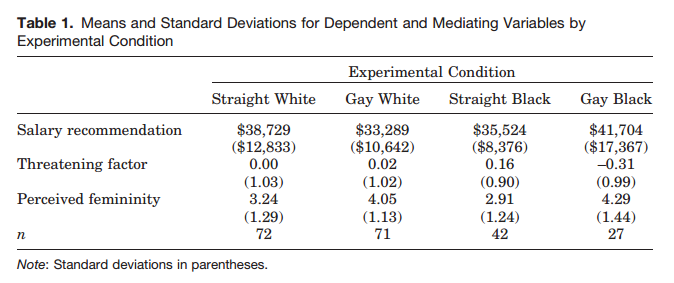
Financial Juneteenth recently highlighted a study showing that gay black men may have better odds of landing a job and higher salaries than their straight, black, male colleagues. Led by sociologist David Pedulla, the data comes from resumes and a job description evaluated by 231 white individuals selected in a national probability sample. The experiment asked them to suggest starting salaries for the position and answer questions about the fictional prospective employee. To suggest race and sexual orientation, resumes included typically raced names (either “Brad Miller” and “Darnell Jackson”) and listed participation in “Gay Student Advisory Council” half the time.

Pedulla found that straight Black men were more likely to be perceived as threatening, measured with answers as to whether the respondent thought the applicant was likely to “break workplace rules,” make “female co-workers feel uncomfortable,’’ or “steal from the workplace.” In contrast, gay Black men were considered by far the least threatening. Gay black men were also judged to be the most feminine, followed by gay white men.

Perhaps most surprisingly, the combination of being gay, Black, and male attracted the highest salaries. Gay Black men were considered the most valuable employee overall. Straight white men were offered slightly lower salaries and gay white men and straight black men were offered lowered salaries still.

333

Pedulla’s findings have sparked a conversation among scholars and journalists about the complexity of stereotypes surrounding black masculinities and sexualities. Organizational behavior researcher and Huffington Post contributor Jon Fitzgerald Gates also weighed in on the findings, arguing that the effeminate stereotypes of homosexuality may be counteracting the traditional stereotypes of a dangerous and threatening black heterosexual masculinity.

Cross-posted at Citings and Sightings.

Caty Taborda is a graduate student in sociology at the University of Minnesota, where she’s on the Grad Editorial Board for The Society Pages. Her research concerns the intersection of gender, race, health, and the body. You can follow her on twitter.

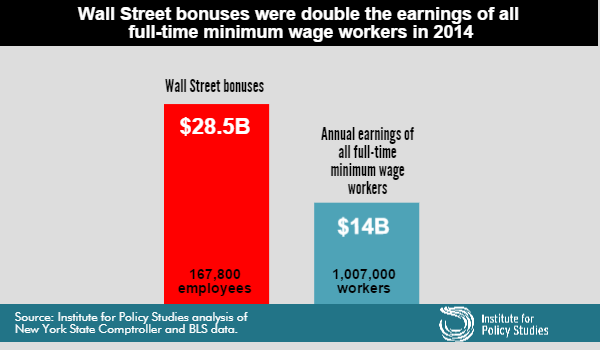
1,007,000 Americans working full-time earn the federal minimum wage of $7.25 per hour. All of that pay, to all of those people, for all of 2014 adds up to $14 billion dollars. And that is less than half of what employees on Wall Street earned in bonuses alone.

This is your image of the week:

4

Source: Institute for Policy Studies.

Lisa Wade, PhD is an Associate Professor at Tulane University. She is the author of American Hookup, a book about college sexual culture; a textbook about gender; and a forthcoming introductory text: Terrible Magnificent Sociology. You can follow her on Twitter and Instagram.