Fabian D. S. sent us this screenshot from a men’s health email he gets:
Along the bottom it reads: “Get the sex you deserve.”
The phrase could be read: “Get the SEX you deserve.” That is, get sex. Or it could be read: “Get THE SEX you deserve.” That is, get awesome mindblowing sex. The context reveals that it’s the latter meaning and I’ve seen this sentiment (but not the former) in material aimed at women, too. I wonder when, in American history, we decided we were entitled to awesome sex. I can’t imagine that pioneer husbands and wives, after spending all day trying to not to die (whether it be that day or that winter), and laying lying on a straw mattress next to their six children in their freezing/sweaty one-room home, felt pouty if their sex wasn’t mindblowing. The entitlement to great sex, then, must have come later (at least to the regular folk). I would bet it had something to do with capitalism and the commodification of pleasure, generally, and sex, specifically. After all, how do you get the sex you deserve? Well, you buy the right products: whether that be, for example, diet- and exercise-related products, cosmetic surgery, or sex toys. Ariel Levy said it very well (watch the 2nd video down here especially starting at 1:22… but all the clips are great).
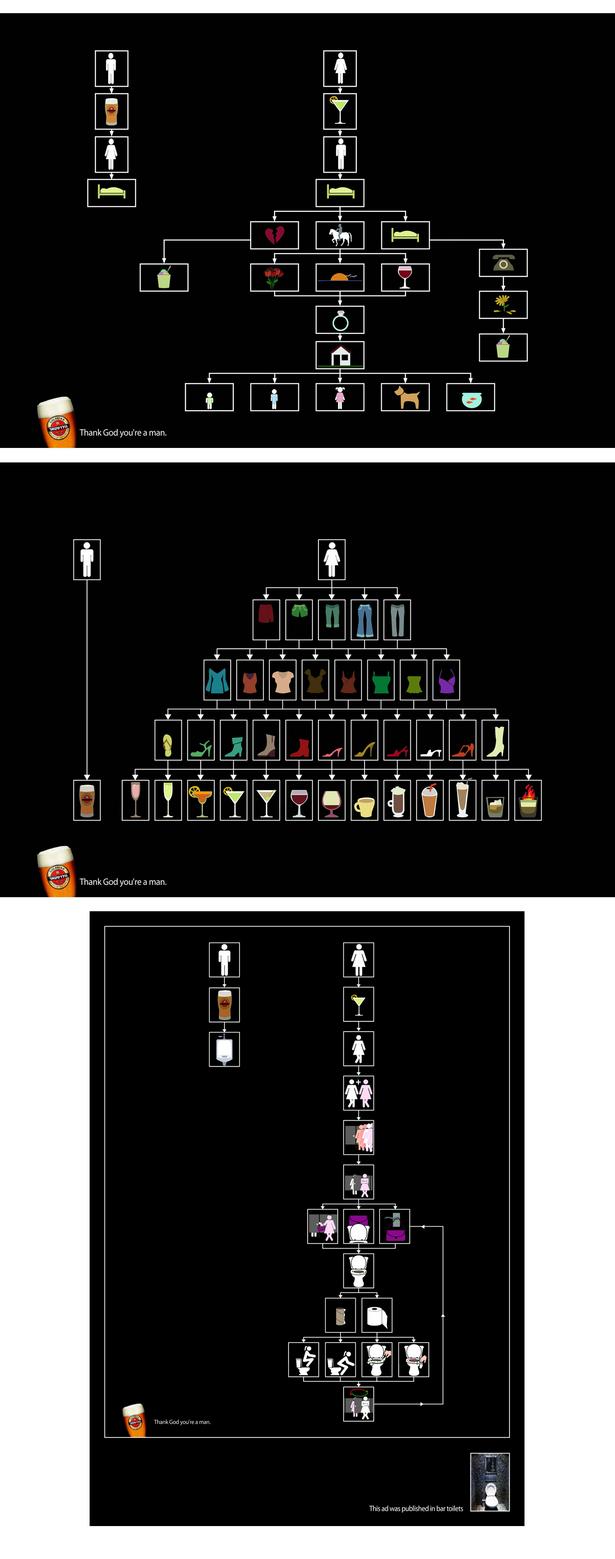
Christoph B. sent in these Goldstar Beer ads, found at BuzzFeed, that show the differences between men and women:
I know that I, for one, immediately start thinking about marriage every time I meet a guy. My new male neighbor waved at me the other day, and I ran out and bought a wedding dress, just in case.
The other thing here is the assumption that a) the viewer is definitely a man and b) of the two options, the “man’s” life is always preferable. I suppose in the second two ads that might be reasonable–although I never experience all that many problems using public restrooms, but whatever–but why is it automatically better to have sex with no emotional attachments or expectations of ever interacting again? I doubt that all men enjoy such encounters, any more than all women are thinking of marriage every time they have sex with someone.
Gwen Sharp is an associate professor of sociology at Nevada State College. You can follow her on Twitter at @gwensharpnv.
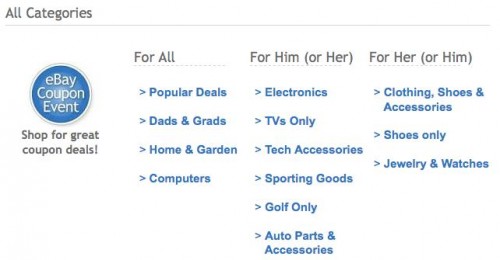
Erin S. sent in this screencapture of a set of ebay gift suggestions:
Erin says,
For her? A Roomba automatic vacuum! For him? A new sports car, of course!
Apparently Zunes are an androgynous gift, which is good to know.
Random, non-sociological story: My ex-stepdad once got my mom a mop for their anniversary. For her birthday he got her a live mouse trap–the type that doesn’t kill them but just keeps them contained so you can take them outside. She actually liked these gifts better than the time he got them “both” a rifle for their anniversary, as a “shared” gift. Ah, romance.
Thanks for the image, Erin!
NEW! (July ’10): Carissa sent in an image of an advertisement for an eBay Coupon Event that provides suggestions for different groups. There’s a clear assumption of who would be most interested in the different categories, with the other gender thrown in as an afterthought. But it’s also an example of how we insist on dividing things by gender, even when there’s absolutely no reason to do so. If you’re acknowledging that both men and women might like everything listed, why bother to categorize them by gender at all? Why not just have a list under “All Categories” and leave it at that?
Edward L. sent in a link to Ultra Culture’s post about trailers for the new Will Smith movie “Seven Pounds” market the movie differently depending on whether the target audience is men or women. Ultra Culture’s analysis is funnier than anything I’d say, so I’m just going to quote it.
WOMEN!
This is the film for you! Its got that sexy Will Smith in it (from Hitch!) and just look at all the emotional turmoil he’s going through with Rosario Dawson. And did you see that? It’s directed by the guy who did Pursuit of Happyness! What a lovely, life-affirming film that was.
Another trailer:
Again from Ultra Culture:
MEN!
This is the film for you! Its got that cool Will Smith in it (from Hancock!) and just look at all that fast paced action he’s going through with that gruff-voiced man. And those fast cuts, whooshing noises and gradually fading words remind me of Enemy of the State! What a heart-pounding thrill-ride that was.
You might pair this with a discussion of how other products are marketed differently to men and women, such as cars or food.
Thanks, Edward!
Gwen Sharp is an associate professor of sociology at Nevada State College. You can follow her on Twitter at @gwensharpnv.
Why do Native Americans ask you “how?” According to the song, it’s because the Native American always thirsts for knowledge. OK, that’s not so bad, we guess. What gives the Native Americans their distinctive coloring? The song says a long time ago, a Native American blushed red when he kissed a girl, and, as science dictates, it’s been part of their race’s genetic make up since. You see, there had to be some kind of event to change their skin from the normal, human color of “white.”
“Where they cut off your ear if they don’t like your face” is the offending line, which was changed on the DVD to the much less provocative “Where it’s flat and immense and the heat is intense.”
In a city full of Arabic men and women, where the hell does a midwestern-accented, white piece of cornbread like Aladdin come from? Here he is next to the more, um, ethnic looking villain, Jafar.
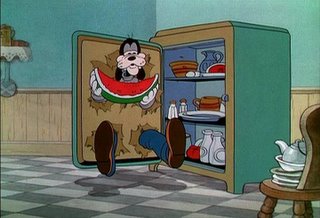
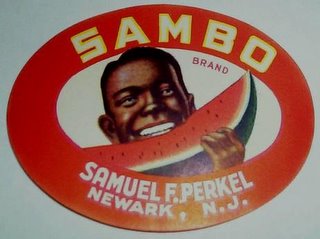
NEW: Miguel (of El Forastero) sent in a post from El Blog Ausente that compares an image of Goofy, a character generally portrayed as sort of dumb and lazy, to a traditional Sambo-type image:
The post suggests that Goofy is a racial archetype, built on stereotypical African American caricatures. I can’t remember ever seeing anything that suggested this, but that doesn’t mean much, and I certainly don’t put it past Disney to do so. Does anyone know of any other examples of Goofy supposedly being based on African American stereotypes? On the other hand, is it possible to depict a character eating watermelon in an exuberant manner without drawing on those racist images? When I look at the image of Goofy above, I have to say…that’s pretty much what it looks like when my (mostly White) family cuts a watermelon open out on the picnic table in the summer and everybody gets a piece and they all have ridiculous looks on their faces as they dribble juice all down themselves eating big chunks (I say “they” because I’m a weirdo who doesn’t really care for watermelon, so I rarely eat any, and even then only if I can put salt on it). I’m fairly certain that I couldn’t put up a photo of my family eating watermelon like that without it seeming, to many people, to draw on the Sambo-type imagery. It brings up some interesting thoughts about cultural and historical contexts, and how and in what circumstances you can (or can’t) escape them, regardless of your intent.
Freud distinguished between a “mature” (vaginal) and “immature” (clitoral) orgasm, telling women that to require clitoral stimulation for orgasm was a psychological problem. Contesting this, in 1970 Anne Koedt wrote The Myth of the Vaginal Orgasm. She explains:
Frigidity has generally been defined by men as the failure of women to have vaginal orgasms. Actually the vagina is not a highly sensitive area and is not constructed to achieve orgasm. It is the clitoris which is the center of sexual sensitivity and which is the female equivalent of the penis… Rather than tracing female frigidity to the false assumptions about female anatomy, our “experts” have declared frigidity a psychological problem of women.
Indeed, studies show that about 1/3rd of women regularly reach orgasm during penile-vaginal sex. The rest (that is, the majority) require more direct clitoral stimulation. Koedt goes on (my emphasis):
All this leads to some interesting questions about conventional sex and our role in it. Men have orgasms essentially by friction with the vagina, not the clitoral area, which is external and not able to cause friction the way penetration does. Women have thus been defined sexually in terms of what pleases men; our own biology has not been properly analyzed. Instead, we are fed the myth of the liberated woman and her vaginal orgasm – an orgasm which in fact does not exist.
Koedt’s article was highly influential and rejecting the notion of the “vaginal orgasm” (both anatomically and functionally) was part of second wave feminism.
Still, the vaginal orgasm keeps coming back. During the ’90s, it came back in the form of the G-spot. You, too, can have a vaginal orgasm if you can just find that totally-orgasmic-pleasure-spot-rich-in-blood-vessels-and-nerve-endings-that-makes-for-wildly-amazing-orgasms-with-ejaculation that you, strangely, never knew was there! (See what Betty Dodson has to say about the g-spot here.)
Most recently, the vaginal orgasm has come back in the form of orgasmic birth. The idea is that women can, if they really want to, have an orgasm (or orgasms) during childbirth.
Now, I don’t want to argue that women never have orgasms from penile-vaginal intercourse. They do. I also don’t care to debate whether a g-spot exists. And I am certainly not going to look a mother in the face and tell her she did not have an orgasm during childbirth. I am sure some women do. (And, anyway, I get a kick out of thinking about such a mother telling her teenager the story of his birth, so I’m going to keep believing it is true).
Anyway, what I do want to do is discuss how the video below uses the idea of orgasmic birth to reinscribe the myth of the vaginal orgasm. The reporter says that orgasmic birth is just “basic science” and then turns to interview an M.D. The M.D. uses the vaginal orgasm as scientific evidence for the possibility of orgasmic birth. She says: obviously a baby would cause an orgasm when it comes out the vagina, since a penis causes an orgasm when it goes into the vagina. But, of course, it usually doesn’t. That last part isn’t “basic science,” it’s ideology (as Koedt so nicely points out).
I wonder how many women now feel doubly bad. Not only can they not have orgasms from penile-vaginal intercourse, they also experienced pain during childbirth! Bad ladies! Watch the whole 8-minute clip or start at 3:28 to see the interview with the M.D.:
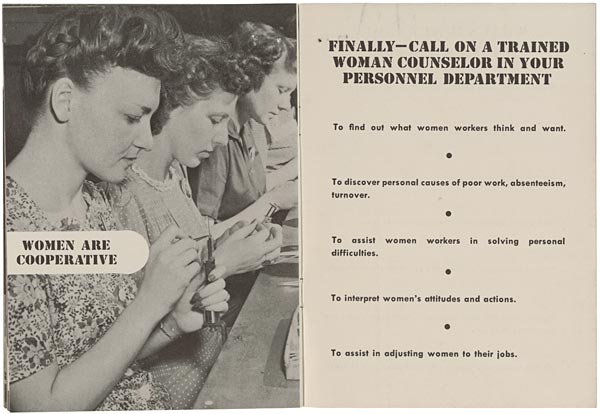
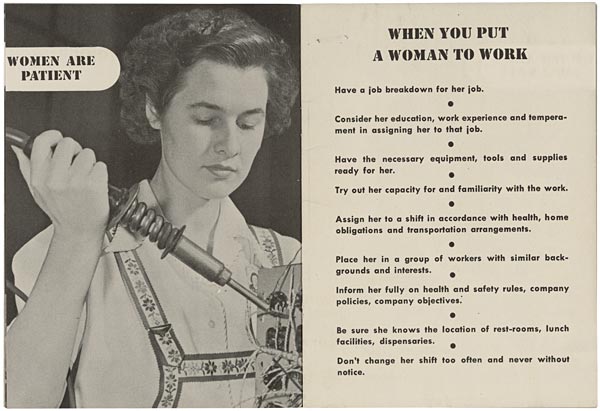
Naama Nagar sent in these images from a “booklet that was intended to assist male bosses in supervising their new female employees at RCA plants,” according to the National Archives, Southeast Region (found via Michael Zilberman’s history blog; sorry it’s in Hebrew):
Text:
When you supervise a woman…Make clear her part in the process or product on which she works. * Allow for her lack of familiarity with machine processes. * See that her working set-up is comfortable, safe and convenient. * Start her right by kindly and careful supervision. * Avoid horseplay or “kidding”; she may resent it. * Suggest rather than reprimand. * When she does a good job, tell her so. * Listen to and aid her in her work problems.
Text:
Finally–call on a trained woman counselor in your personnel department…to find out what women workers think and want. * To discover personal causes of poor work, absenteeism, turnover. * To assist women workers in solving personal difficulties. * To interpret women’s attitudes and actions. * To assist in adjusting women to their jobs.
Text:
When you put a woman to work…Have a job breakdown for her job. * Consider her education, work experience and temperament in assigning her to that job. * Have the necessary equipment, tools and supplies ready for her. * Try out her capacity for and familiarity with the work. * Assign her to a shift in accordance with health, home obligations and transportation arrangements. * Place her in a group of workers with similar backgrounds and interests. * Inform her fully on health and safety rules, company policies, company objectives. * Be sure she knows the location of rest-rooms, lunch facilities, dispensaries. * Don’t change her shift too often and never without notice.
These are interesting from a gender perspective, of course, but they’re also sort of fascinating for what they tell us about changing assumptions about what the workplace is (or should be) like. While there were many problems with the World War II (and post-war) workplace, there was also a certain assumption that companies would take care of their employees to some degree in return for employees’ loyalty and hard work. This comes through in instructions such as “Assign her to a shift in accordance with health, home obligations and transportation work” and “Don’t change her shift too often and never without notice.” The idea is that workplaces, including factories, should think about their employees’ lives and how their work schedules fit in with their other obligations, as well as provide things like dispensaries. Now, I’m sure many companies didn’t actually meet these ideals, but this booklet sent out to managers at least acknowledges that they exist. Today, most workplaces don’t even pretend to aspire to such ideals. While some privileged white-collar workers may have options like flexible hours or working from home, many workers find that their hours and schedules change from week to week, making it difficult to arrange child care or work around other obligations. McDonald’s is well known for making workers sign out during slow periods during their shift to keep payroll down (workers are expected to be available, however, should business pick back up) and Wal-Mart has been sued for failing to pay overtime or for asking workers to work off the clock, again to reduce payroll costs.
So these might be useful for a discussion of work and what we expect from the worker-employer relationship. Is it simply a contractual financial exchange? Do workers and employers owe each other anything besides an hour of work and an hour of pay at the agreed-upon price? How have employers pushed concerns about schedule disruptions and payroll reductions off on workers, forcing them to accommodate the company’s needs?
Thanks, Naama!
About Sociological Images
Sociological Images encourages people to exercise and develop their sociological imaginations with discussions of compelling visuals that span the breadth of sociological inquiry. Read more…