
Click to embiggen.
Found here.
Mercedes DeM. sent in this Vanity Fair cover (for April 2009)…
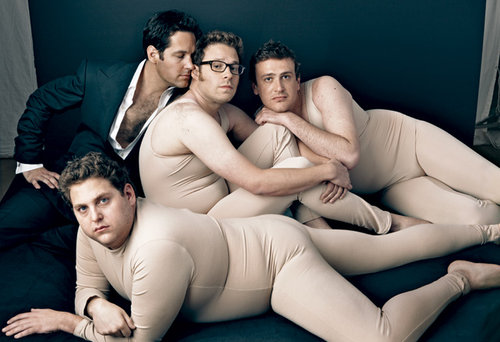
…spoofing this previous cover:
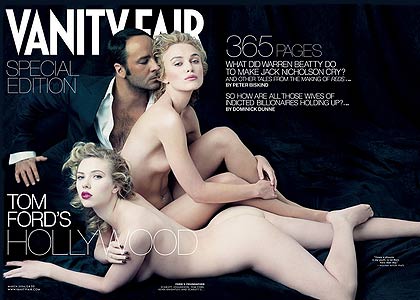
The women on the original cover are sex symbols. We should expect gratuitous nudity. The men in the spoof, in contrast, are comedians and so a direct comparison, arguing that men’s bodies are more off-limits, would be misguided. (Not that I think an argument couldn’t be made, but I don’t think this set of images supports it.)
Nor do I think that these images support the idea that we’re more accepting of variation in men’s bodies than women’s. If that were so, I think the men would actually be nude. Instead they’re covered up. My sense is that they’re covered up because their bodies are, according to rigid cultural standards, gross.
The relevant comparison, I think, would be between the spoof cover and a similar spoof cover featuring non-skinny women in nude body suits. The fact that the former is funny points to how men are allowed to be many things. They can be good-looking and fit, OR they can be not-so-good-looking, but rich, nice, or funny. And we still like them. There is no disdain for these men. We may even like them MORE because they’re willing to pose in ways that reveal how imperfect their bodies are.
I think we would be unlikely to see a similar cover featuring women, even women comedians, because women are allowed to be rich, nice, or funny but they must ALSO be good-looking and fit. A cover featuring chubby women would JUST be gross. It wouldn’t be gross and funny.
Being good-looking and fit is ONE way for men to be admire in our society. Being good-looking and fit is a REQUIREMENT for women to be admired, no matter what else she brings to the table.
I asked myself: in the entire history of Vanity Fair, would we be able to find three women with a similar body type to those men on the cover?
I found two, both featuring Roseanne Barr (images here and here):
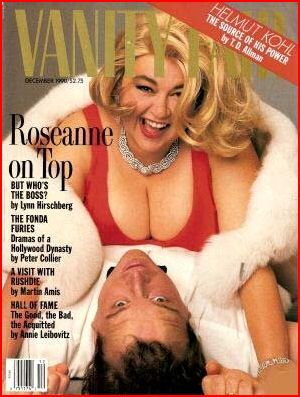
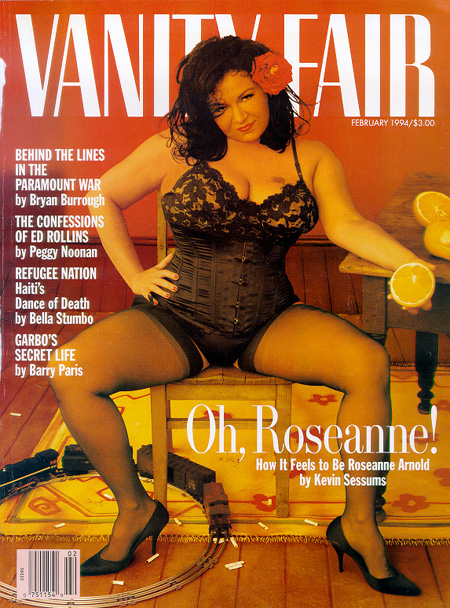
The covers feature a comedian who is well-known for being successful while bucking social expectations for women. She’s the exception to the rule that proves the rule. Or is she? I certainly think so. That “Oh, Roseanne!” is about how crazy she is.
In any case, notice that she’s still a sex symbol, while the men in the spoof are decidedly not. They’re spoofing such symbolism. Roseanne, despite her wacky resistance, still has to abide by it.
The Scion is an interesting study in marketing. Scion (noun: descendant) is a subsidiary of Toyota. Why Scion? Well, Toyota wanted to sell cars to young, hip, urban guys but (as we all know) Toyotas are for fuddy duddies (yeah I’m talkin’ to you). So Toyota started Scion. Scions are really just Toyotas, less the fuddy duddy baggage. Toyota has marketed Scions accordingly. Here are some commercials:
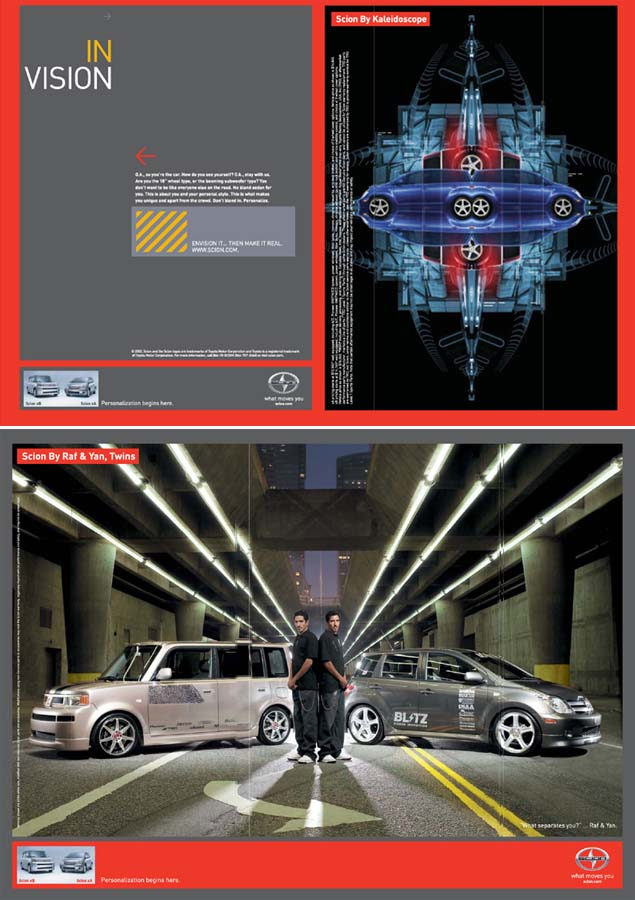
Scion advertising features young people of color, usually men, in urban spaces (found here):
I have a Scion. This one:
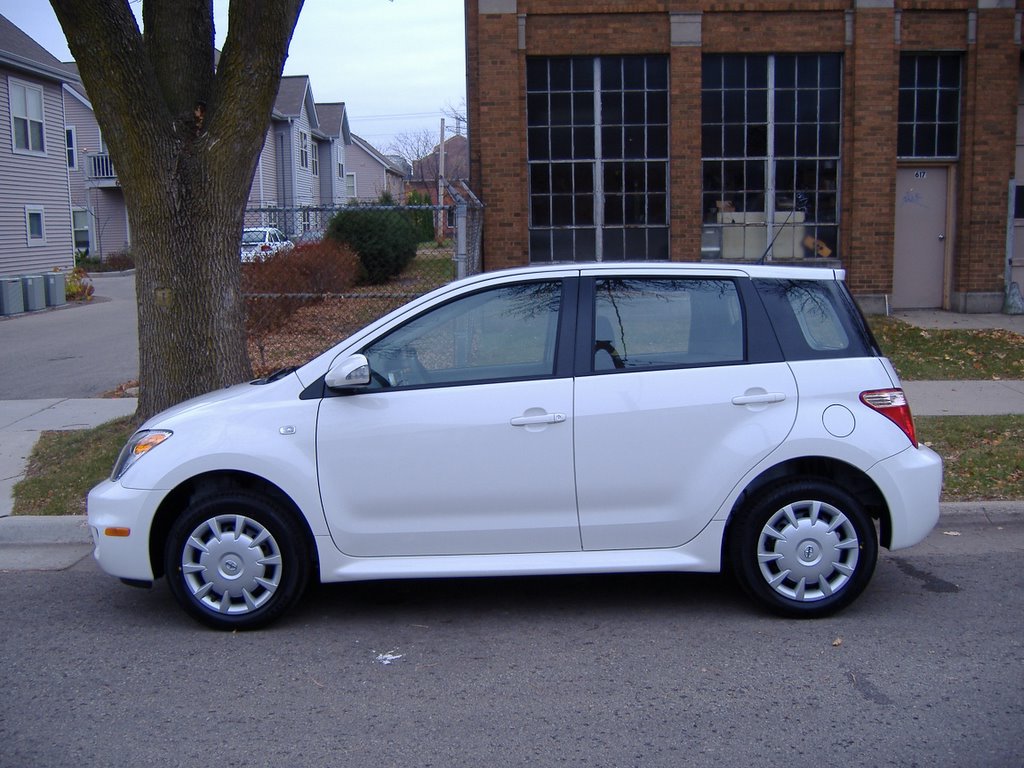
When I walked into the Madison, Wisconsin Toyota dealer to purchase it, there were a dozen middle-aged white men with pot-bellies, and a Latina that looked about 16 years old. She was the Scion salesperson. (Hi Celia!)
Also appealing to its intended customers, Toyota encourages you to customize your Scion. When I purchased the car, I had the option of adding neon trim around the bottom of the car, glowing cup holders, and giant speakers that took up the entire back seat. Factory installed. (I opted for all three, of course.)
Scion encourages these additions. As the commercials show, Scion emphasizes customization and the individualization of your car. “United by Individuality” is one of their advertising themes (found here):
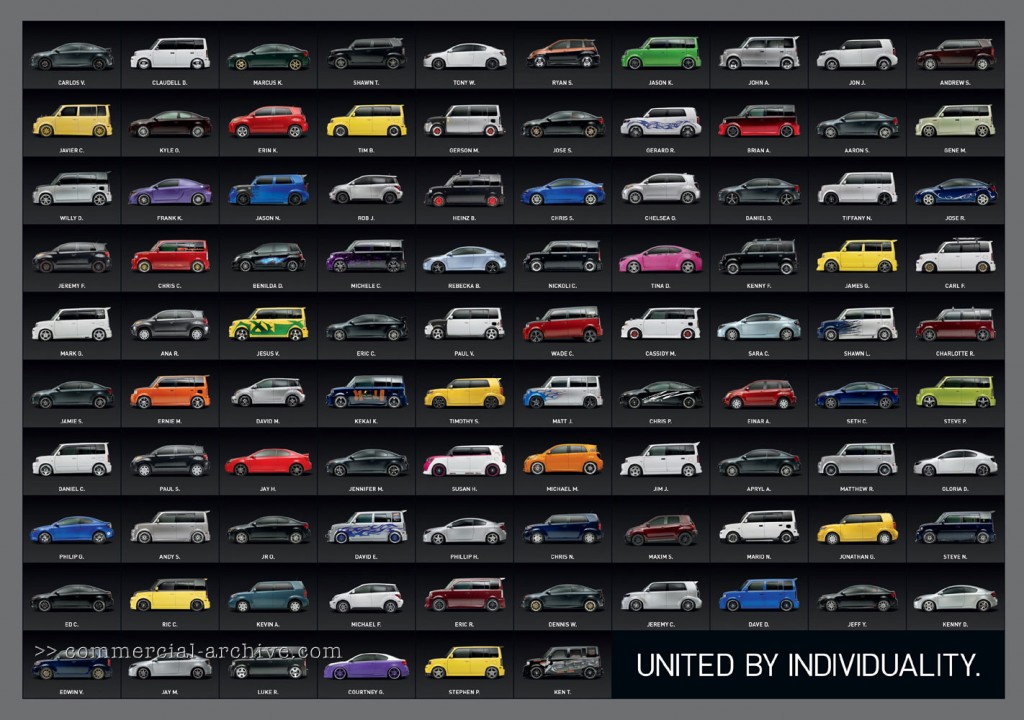
Underneath each of these unique Scions is the name of its owner. These names include Carlos V., Claudell D., Javier C., Benilda D., Jesus V., Kekai K., Nickoli C., Mario N., Einar A., Jose S., and Jose R. They’re definitely not marketing to the stereotypical Toyota crowd.
The marketing of the Scion points to how we separate old from young and then layer the binary with further binaries: boring/exciting, suburban/urban, conformity/individuality, and even white/non-white. Toyota doesn’t sell Scions by constantly reminding us that Scions are Toyotas (with all the dependability and efficiency that Toyotas are known for), just the opposite. And youth, Toyota appears to believe, want to differentiate themselves from dull, grown-up, suburban, whitebread conformity as much as possible.
But here’s the twist:
Celia (who I bought my Scion from in Madison, Wisconsin) told me that, despite all of their efforts, the “boxy” Scion (the one on the left in the first print ad) is bought disproportionately by elderly people. Why? Because the spacious interior holds a wheelchair just as easily as a mountain bike or a drum kit and the height of the car makes it easy to get in and out of without having to pull yourself up or lower yourself down.
Marketing, thanks to human creativity and free will, has its limits and marketers can’t always predict how their strategies will play.
Andrew over at FiveThirtyEight posted three maps that show which candidate would have carried each state if only members of one social class voted (in case it’s not obvious, blue = Obama and red = McCain):
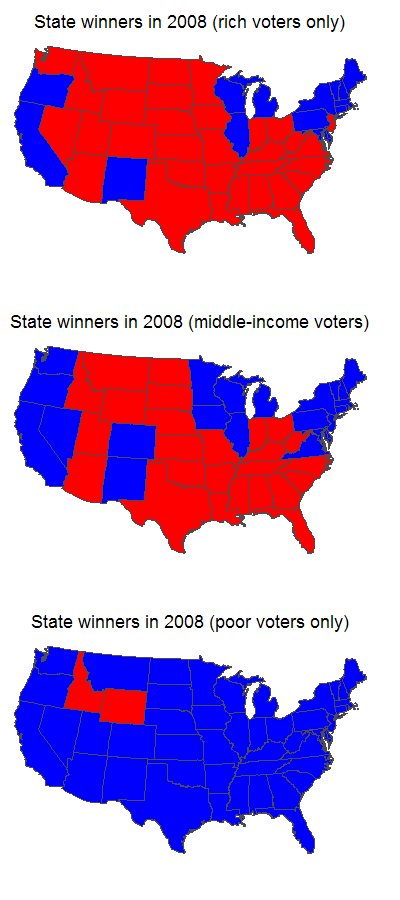
For the purposes of the estimate, “rich” was defined as a household income of $150,000+, “middle-income” was $40,000-75,000, and “poor” was $0-20,000. [Note: for the point of illustration, he just made maps showing the lowest, middle, and upper 20% of households by income, which is why the groups between $20,000-39,000 and $76,000-150,000 don’t show up here–he just made the 3 maps to illustrate the point.]
So what we seem to see here is that poor voters were more consistently partisan than rich voters, at least in the 2008 election. Whether this is a general pattern or something unique to 2008 I don’t know.
Hyperion submitted a great illustration of cultural change. Today, cigarette smoking is illegal in most public places, but there was a time in which cigarette smoking was normative instead of deviant. This radar analysis instrument, in use through the 1950s through 1980s, includes a built-in cigarette lighter and ashtray:

More on this and like instruments here.
Thanks Hyperion!
Laura W. sent us a link to a review of sex education in the U.K. that featured a three minute video. The video is a clip from a 1917 film, called “Whatsoever a Man Soweth,” encouraging Canadian soldiers to refrain from having sex with prostitutes. It was important for states to keep their soldiers from hiring prostitutes because soldiers filled up the sick bay with sexually transmitted infections that, during World War I, were not easily cured with antibiotics. Watch it here.
Also in soldiers and STIs: “Bad” women as disease vectors.
Britt Karp, Occidental College student and all-around great person, saw this public service notice on a subway in Manhattan:
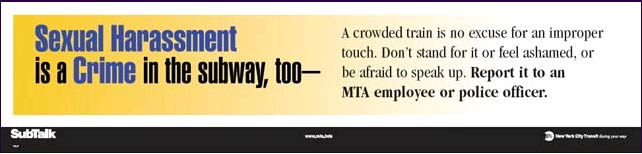
Britt remarks:
Why is the message not – don’t sexually assault people?! Instead of reprimanding perpetrators of sexual assault (most frequently men), this poster places the responsibility on the person who is being assaulted (usually a woman). By doing this, it completely normalizes sexual harassment. The poster alludes to the argument touted by evolutionary psychologists – that it is in men’s nature to sexually assault women and so trying to control this behavior is futile. In this way, they make it seem that the only way to deal with this issue is for women to be braver. It’s no wonder women so frequently blame themselves when they are sexually assaulted.
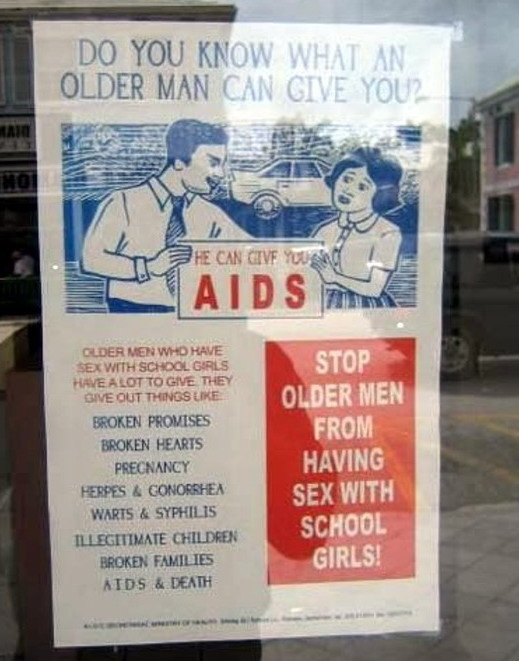
NEW! Rachel McC. J., from Deeply Problematic, sent us another example of a poster asking women to stop men from behaving badly. This one targets young girls, telling them to turn away older men:
Brady sent me a link to a story in the Times Online about a poster put out by the British National Party, a right-wing anti-immigrant political party. Here’s the poster (found at the BNP website):

They’re clearly trying to connect efforts to defend Britain during World War II to the idea of a modern “battle for Britain,” which this time is against immigrants. However, they missed a detail when the chose the image for their poster, according to the Times story:
[The plane] could be clearly identified by its RF marking as belonging to 303 Squadron, an expatriate Polish unit, even though the BNP campaigns against immigration from Eastern Europe.
The BNP claims they knew it all along and did it on purpose; others believe they’re just trying to cover an incident that they find embarrassing.
Regardless, it brings up interesting questions about nationhood and definitions of who can be included in a country’s idea of its history. In the imagining of the BNP, would immigrants’ contributions be erased? Would they be acknowledged, but only as something that was appropriate and welcome in the past? After all, one of the very groups they’re vilifying played a role in defending Britain during the exact era that the BNP is trying to symbolically connect itself to. I suspect they might try to make an argument that the ex-pat Polish fighters were involuntary and temporary refugees that were being protected by Britain during a time of warfare and were in fact fighting to retake their own country, which is different than permanent immigrants who take British jobs and mess up the culture and whatnot, but that’s just a guess.
Of course, this isn’t something unique to the BNP; nativist groups everywhere face the problem of having to erase or explain away the contributions of groups they’re trying to exclude from citizenship.
Thanks for the tip, Brady!