The figure below contrasts the average U.S. response to various questions measuring perceptions of mobility and inequality with the average response of 27 comparison countries (from the International Social Survey Programme).  In other words, how far from the mean are U.S. citizens’ beliefs about life chances and the value of social inequality?  The pink triangle is the U.S. and the orange line is everyone else.  It’s a bit difficult to read (click to enlarge), so I’ll describe the data below.
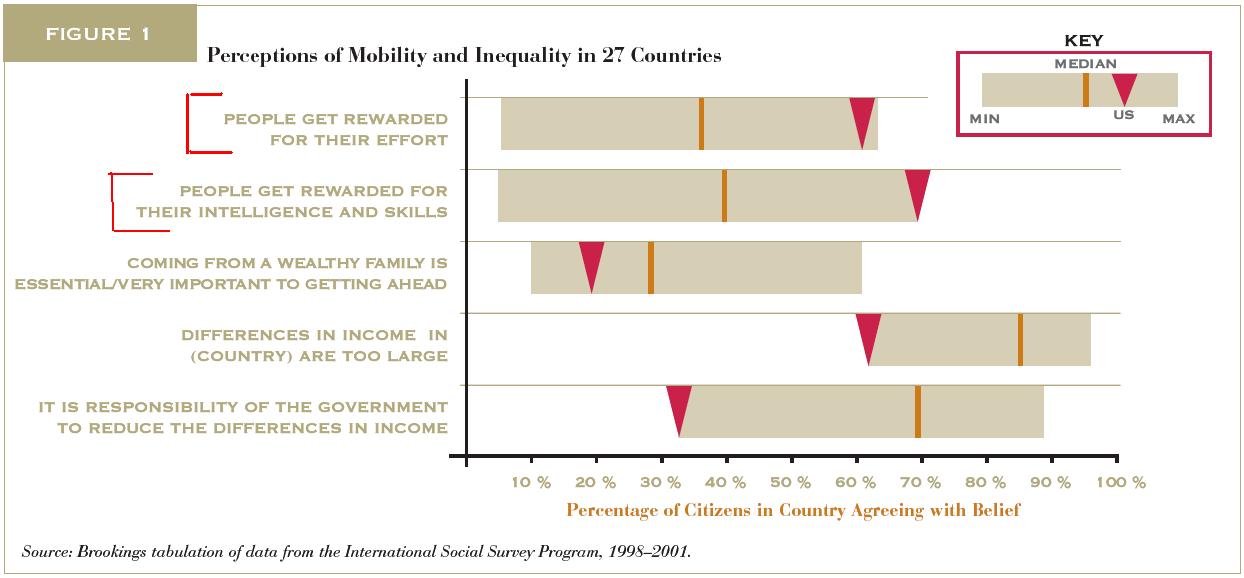
  • About 62% of Americans think that “people get rewarded for their effort,” compared to about 35% of citizens in our national comparison group.
  • About 70% of Americans think that “people get rewarded for their intelligence and skills,” compared to about 40% of citizens in our national comparison group.
  • About 19% of Americans think that “coming from a wealthy family is essential/very important to getting ahead,” compared to about 29% of citizens in our national comparison group.
  • About 62% of Americans think that “differences in income in their country are too large,” compared to about 87% of citizens in our national comparison group.
  • And about 33% of Americans think that “it is the responsibility of the government to reduce the differences in income,” compared to about 69% of citizens in our national comparison group.

Americans, then, are much more likely than the average citizen in our comparison countries to believe that individual characteristics determine success, wide gaps in income are acceptable, and the government should let them be.   No wonder Americans tend to vote to cut taxes and services, tolerate unequal educational opportunity, and resist top-down solutions to inequality.  They think inequality is good and that individuals will always get what they deserve.

Like I said, “stunning,” given the depth of our income inequality and the data on class mobility.  Though it makes perfect sense in light of our deep and abiding patriotism.

Via the MontClair SocioBlog.

Lisa Wade, PhD is an Associate Professor at Tulane University. She is the author of American Hookup, a book about college sexual culture; a textbook about gender; and a forthcoming introductory text: Terrible Magnificent Sociology. You can follow her on Twitter and Instagram.


…asks Bryant Gumbel as he, Katie Couric, and an unnamed co-host try to decipher the @ symbol and figure out what “email” is in the aftermath of an earthquake in 1994.  It’s a precious and hilarious peek into a moment that changed the world forever.

Found at Buzzfeed.

Lisa Wade, PhD is an Associate Professor at Tulane University. She is the author of American Hookup, a book about college sexual culture; a textbook about gender; and a forthcoming introductory text: Terrible Magnificent Sociology. You can follow her on Twitter and Instagram.
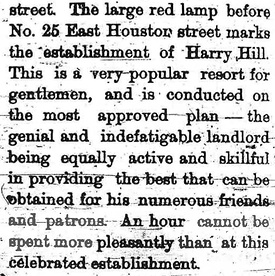
The New York Times has made available a digital copy of The Gentleman’s Directory, a guide to New York City published in 1870. The guidebook informs travelers of a particular type of local attraction: brothels. Of course, the information was for curiosity’s sake only:

Not that we imagine the reader will ever desire to visit these houses. Certainly not; he is, we do not doubt, a member of the Bible Society, a bright and shining light…But we point out the location of these places in order that the reader may know how to avoid them… (p. 6-7)

Certainly passages like this, from p. 13, make it clear that such establishments are to be avoided:

It also included pages that were simply ads for particular brothels:

Interestingly, the NYT checked the 1870 Census for the houses listed in the guide. In general, the women living there were described by Census workers as domestic servants or women who “kept house.” However, they found a few cases where the Census openly listed them as working at a “house of prostitution” or “house of assignation.”

A doctor advertised “imported male safes,” i.e., condoms:

His ad also describes an unspecified cure for women that may very well refer to abortions (at the time, products that caused abortion were often advertised as helping with menstrual regulation or any type of “menstrual stoppage”):

In addition to an article about the directory, the NYT put together a map showing the locations of the establishments it mentions (which were a small proportion of all brothels in NYC, where prostitution was illegal but widely available at the time):


Benedict Anderson coined the phrase “imagined communities” to point to the way that humans believe they are meaningfully connected, by virtue of some commonality, to people they will never know, and may have very little in common with.  He applied the idea to the nation.  Why do all of the citizens of China, for example, have in common with other citizens of China?  In some cases little, other than their citizenship.  Yet, the fact that “we are all Chinese” can motivate many people to do and feel things.

In an RSA video featuring Jeremy Rifkin, sent in by Dmitriy T.M., it is argued that the human ability to imagine a community is a neurological capacity for empathy that has evolved, both neurologically and socially, throughout human existence.  First, he argues, we identified with close relatives, then with our religious community, and later with our nation-state.  Our future, then, he argues, is dependent on our ability to imagine the whole world as a community.  New technologies may very well enable this and Rifkin has his fingers crossed.

Lisa Wade, PhD is an Associate Professor at Tulane University. She is the author of American Hookup, a book about college sexual culture; a textbook about gender; and a forthcoming introductory text: Terrible Magnificent Sociology. You can follow her on Twitter and Instagram.


In the first five minutes of the clip below, economist Jeffrey Sachs explains to Dalton Conley that ending poverty in Africa requires a demographic transition, one where we move from high fertility and high mortality to low fertility and low mortality.

How to encourage such a transition?

1. Bring down mortality with advanced medicine. Declines in childhood mortality lead families to choose to have fewer children (’cause they don’t have to).

2. Make sure girls go and stay in school; they’ll get married later, and have less babies.

3. Provide free contraceptive services and family planning education.

Also see Dr. Sachs explain why Africa ended up so poor in the first place.

Lisa Wade, PhD is an Associate Professor at Tulane University. She is the author of American Hookup, a book about college sexual culture; a textbook about gender; and a forthcoming introductory text: Terrible Magnificent Sociology. You can follow her on Twitter and Instagram.

Cross-posted at Jezebel.

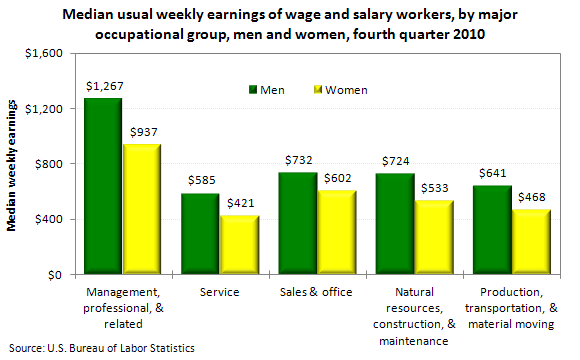
Kelsey C. sent in a graph from the Bureau of Labor Statistics that highlights the gender wage gap. Among full-time workers during the last three months of 2010, men made more per week than women in each of these occupational categories:

In terms of dollars, the gap is largest for the highest-paid workers — $330 — and smallest for those in sales/office, at $130. By percent, it’s worst for service (women make 72% as much as men in that sector) and again smallest for sales/office (women make 82% as much as men in that area).

And if we extrapolate this out, it adds up to a significant difference in annual earnings. If these income levels persisted for, say, 50 weeks, men in management would make $16,500 more than women; in sales, they’d make $6,500 more.

This is the only image the BLS provides, but if you’re interested in the topic, the full report has wages broken down by age and race/ethnicity (and sex within those categories) as well.

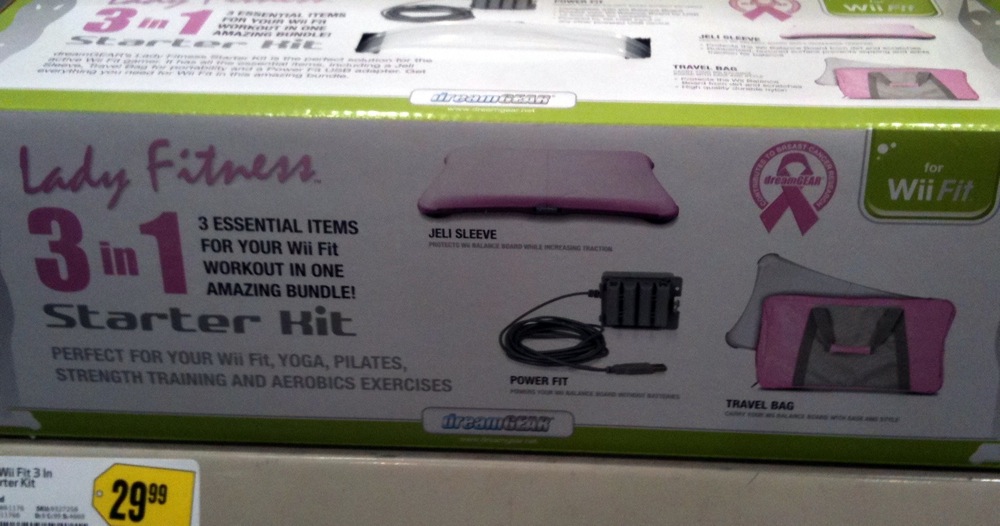
Harmony sent along a set of photographs of a fitness starter kit, a pink one for “ladies” and a green one for, um, “people.”  In any case, putting aside the women-are-women and men-are-people thing for a minute, she also noted that the pink one was breast cancer-themed.  So here is, explicitly, what so many breast cancer awareness-themed items imply: pink = women = breast cancer awareness = boobies = women = pink = pink = pink.  The items, by cultural definition, exclude men from caring about breast cancer.

Lisa Wade, PhD is an Associate Professor at Tulane University. She is the author of American Hookup, a book about college sexual culture; a textbook about gender; and a forthcoming introductory text: Terrible Magnificent Sociology. You can follow her on Twitter and Instagram.

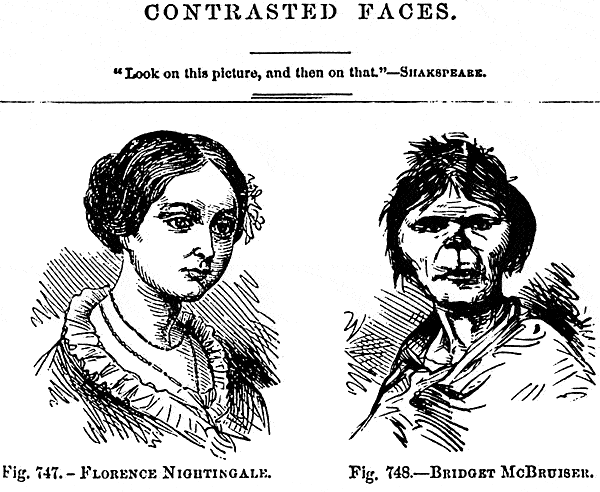
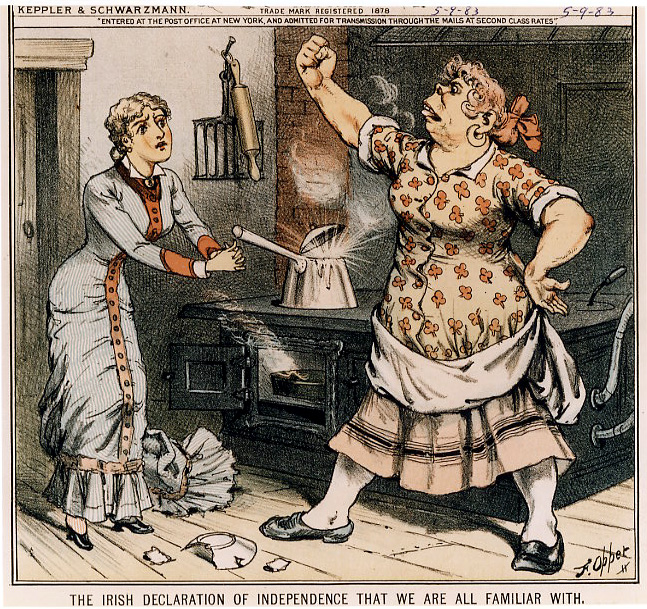
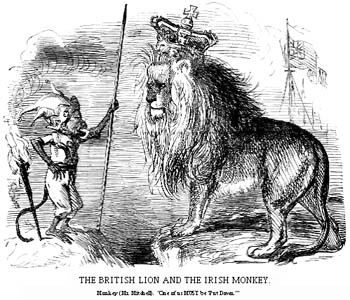
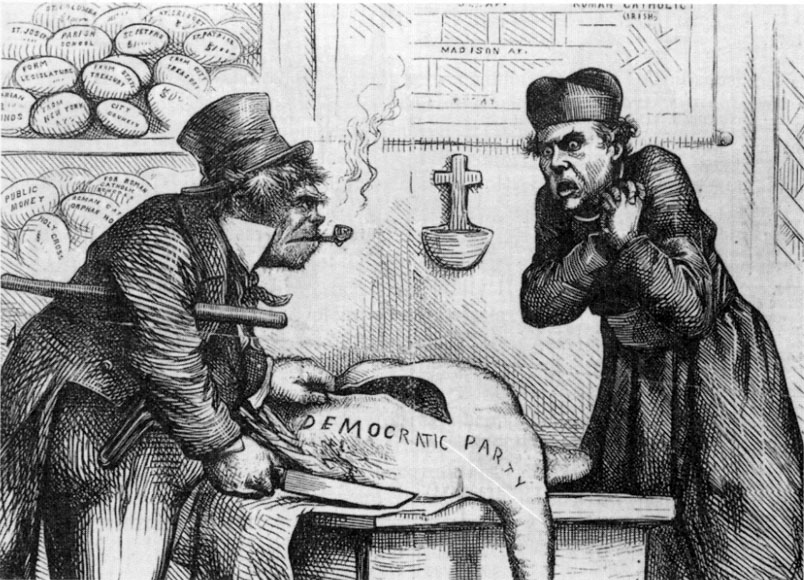
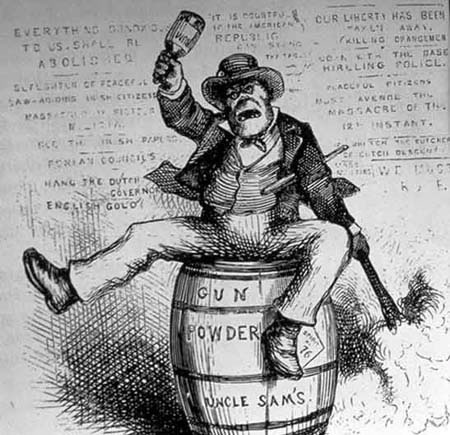
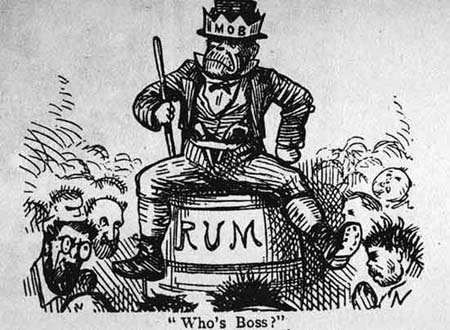
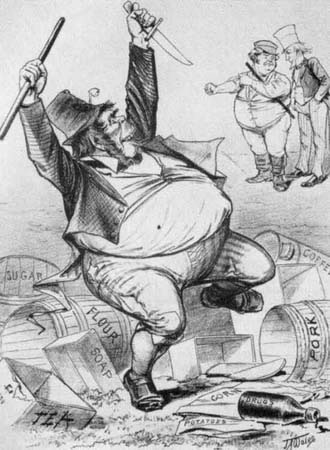
In the last few hundred years, dark-skinned peoples have been likened to apes in an effort to dehumanize them and justify their oppression and exploitation.  This is familiar to most Americans as something that is done peculiarly to Black people (as examples, see  here, here, and here).  The history of U.S. discrimination against the Irish, however, offers an interesting comparative data point.  The Irish, too, have been compared to apes, suggesting that this comparison is a generalizable tactic of oppression, not one inspired by the color of the skin of Africans.

Irish woman, “Bridget McBruiser,” contrasted with Florence Nightengale:

(source)

A similar contrasting of the English woman (left) and the Irish woman (right):

(source)

Cartoon facing off “the British Lion” and “the Irish monkey”:

(source)

An Irishman, looking decidedly simian, in the left of this cartoon:

(source)

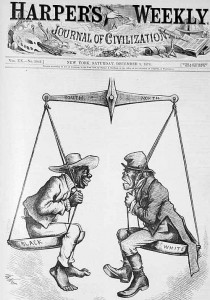
The Irish and the Black are compared as equally problematic to the North and the South respectively.  Notice how both are drawn to look less human:

(source)

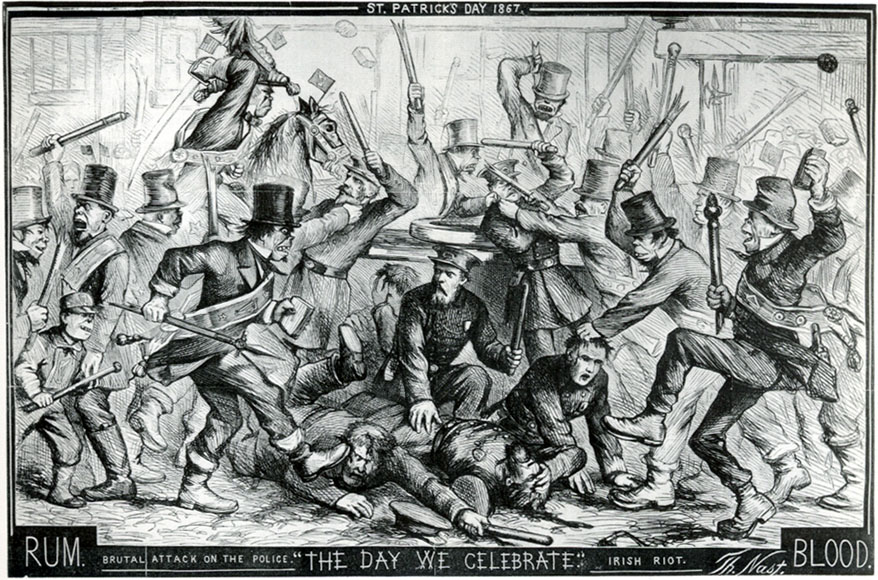
A depiction of an Irish riot (1867):

(source)

An Irishman, depicted as drunk, sits atop a powderkeg threatening to destroy the U.S.:

(source)

Two similar cartoons from the same source:

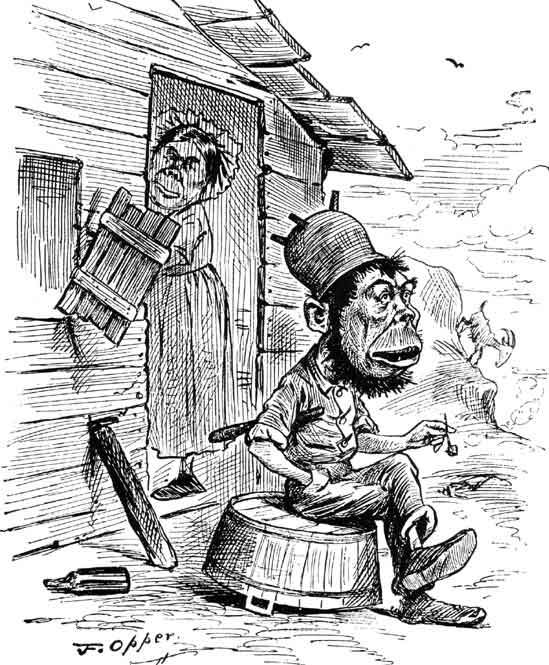
About this cartoon, Michael O’Malley at George Mason University writes:

In this cartoon, captioned “A King of -Shanty,” the comparison becomes explicit. The “Ashantee” were a well known African tribe; “shanty” was the Irish word for a shack or poor man’s house. The cartoon mocks Irish poverty, caricatures irish people as ape like and primitive, and suggests they are little different from Africans, who the cartoonists seems to see the same way. This cartroon irishman has, again, the outhrust mouth, sloping forehead, and flat wide nose of the standard Irish caricature.

(source)

So, there you have it.  Being compared to apes is tactic of oppression totally unrelated to skin color — that is, it has nothing to do with Black people and everything to do with the effort to exert control and power.

For more on anti-Irish discrimination, see our post on Gingerism.  And see our earlier post on anti-Irish caricaturein which we touched on this before.

Lisa Wade, PhD is an Associate Professor at Tulane University. She is the author of American Hookup, a book about college sexual culture; a textbook about gender; and a forthcoming introductory text: Terrible Magnificent Sociology. You can follow her on Twitter and Instagram.