In this four-minute video, Dwayne McDuffie describes what it’s like being a Black comic book writer:

Related, see Hennessey Youngman on being a black artist.

Via Racialicious.

Lisa Wade, PhD is an Associate Professor at Tulane University. She is the author of American Hookup, a book about college sexual culture; a textbook about gender; and a forthcoming introductory text: Terrible Magnificent Sociology. You can follow her on Twitter and Instagram.

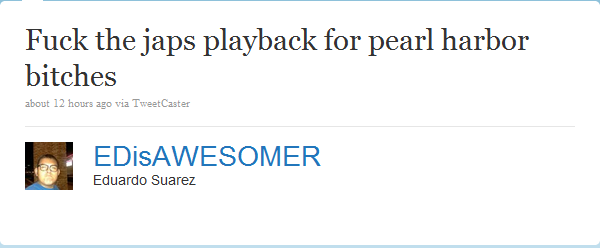
Karma Japan and Ignorant and Online are new sites, featured at BoingBoing, dedicated to collecting tweets and Facebook status updates that suggest that the tsunami in Japan is karmic: pay-off for supposed Japanese sins.  The guilt ascribed to Japan ranges from their hunting and eating dolphins and whales and their bombing of Pearl Harbor especially, but also things like their rate of atheism and their politics.  But all have in common the notion that the Japanese deserve what has happened and that mother nature/God herself is against Japan and ensuring that the society is punished.  A fascinating peek into the minds of these Americans.


Trigger Warning: These comments are hateful and vulgar (and in pretty large font if you’re at work).


From Karma Japan:

The rest after the jump:

more...

Today, most Americans grow up in racially (and economically) segregated communities. When these same students come to college, however, many will live, work, and take courses with individuals who do not share their ethnic and class background. For many of these students, it will be the first time in their life to have any meaningful contact across difference.

Unfortunately, the racial harmony presented in recruitment materials is usually greatly exaggerated. Students of color experience daily racial microaggressions. Campus Safety officers often mistake them for non-students (at best) and trespassing criminals (at worst). Professors butcher their names and ignore them during most of the term (excluding the few days when the discussion shifts to hip-hop or colonization). White students dress up as People of Color for Halloween and numerous “themed” social gatherings (e.g., “Conquistabros and Navajos,” “Compton Cookouts,” and other race-mocking parties). Residence halls and bathroom stalls are consistently vandalized with racial epithets.

Unlike their homogeneous neighborhoods, then, college students are confronted with the reality of race every day.  Suddenly the myths of racial harmony and colorblindness are whisked away by institutional inequity, intergroup conflict, and hostile campus climates.

And on those campuses in which university leaders fail to think proactively about race, the inevitable dynamics of racism are left to be tackled by 18-24 year olds; the same 18-24 year olds who are encountering racial difference for the first time in their lives.  As the great drama of race plays out in campus newspapers, dorm rooms, classrooms, and off-campus parties. Racial identity, values, and beliefs take center stage in the minds of most students, often for the first time.

(confession borrowed from PostSecret)

Kenjus Watson is the Assistant Director of the Intergroup Dialogue Program and teaches courses in the Psychology Department at Occidental College.  He received a Masters of Education from Penn State University with an emphasis in diversity and social justice-oriented Student Affairs.  He writes about issues of race, gender, and sexuality in higher education.

We’ve posted before about the use of women’s bodies to sell real estate. But this Australian commercial for luxury housing, sent in by Nigel M., takes it to a whole new level. As Nigel said, “Even if I told you, you still wouldn’t believe me.” Let’s just say it includes a “lingerie model tied to a chair,” hot lesbians making out for male pleasure, and the phrase “speaking of broads.”

It’s a real gem:

The blog-o-sphere is abuzz with praise for Vivian Maier’s mid-century photographs of public New York and Chicago life.   The photos were taken by a live-in nanny working for wealthy families in Chicago’s north shore.  Her photos, over 100,000 of them, were discovered after her death two years ago.  To my untrained eye, they are gorgeous, interesting, and well-composed.  A fascinating look at another time.  More sociologically, they gracefully depict differences in socioeconomic class. I wonder if Maier, working-class herself, had a special sensitivity to these divides. In any case, I appreciate the texture that the photographs add to an understanding of how people of different classes lived.

Visit the website devoted to Maier here.  Photos borrowed from there and Chicago Magazine.  Via Crooked Timber.

Lisa Wade, PhD is an Associate Professor at Tulane University. She is the author of American Hookup, a book about college sexual culture; a textbook about gender; and a forthcoming introductory text: Terrible Magnificent Sociology. You can follow her on Twitter and Instagram.

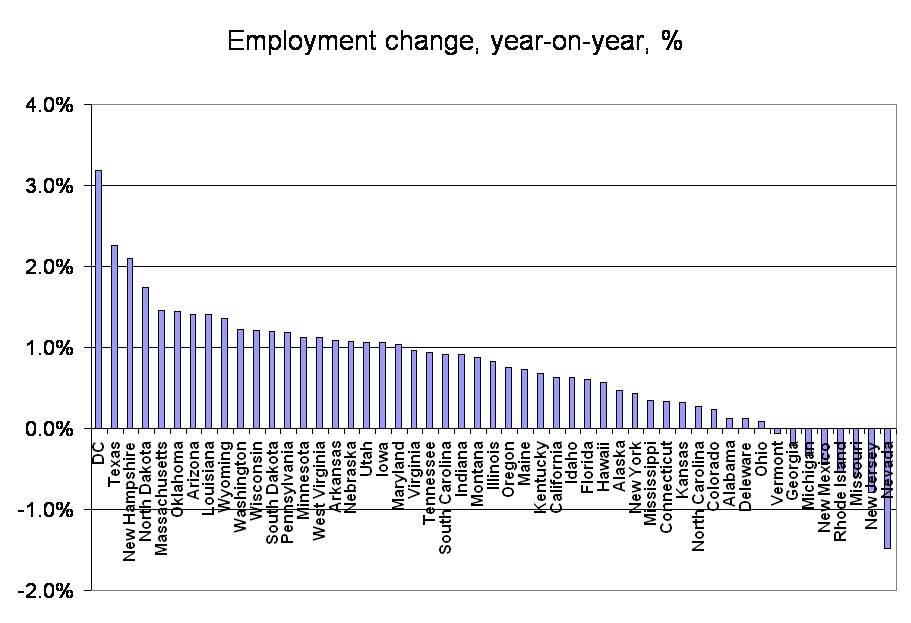
For those keeping track of unemployment in the U.S., The Economist posted this graph showing job gains and losses by state, based on Bureau of Labor Statistics data:

According to the BLS, as of January 2011, the U.S. unemployment rate had dropped to 9.0%. The lowest unemployment rate is in North Dakota, at 3.8%, while the highest is still in Nevada, at 14.2%.

The BLS has detailed state-level employment data here.

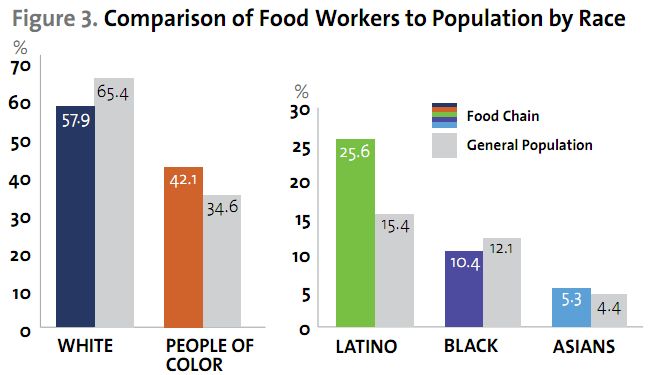
Via Colorlines I discovered an Applied Research Center report titled The Color of Food.  The report found that Blacks, Latinos, and Asians were overrepresented in food service work:

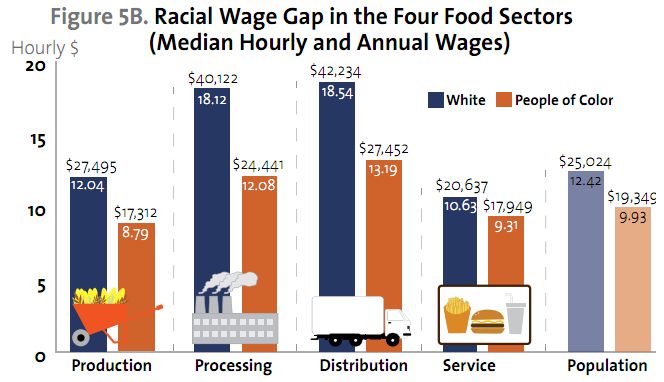
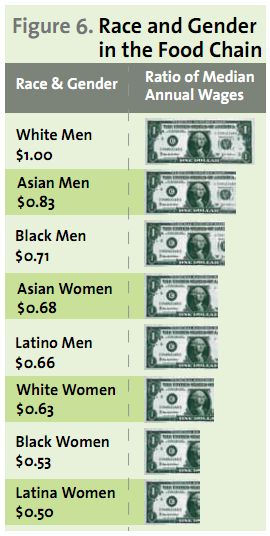
The report also discovered a wage gap between White workers and non-White workers at every level of food production:

Race intersected with gender, such that women earned less than men of their same race for each group studied:

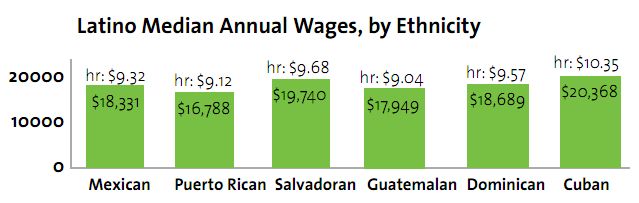
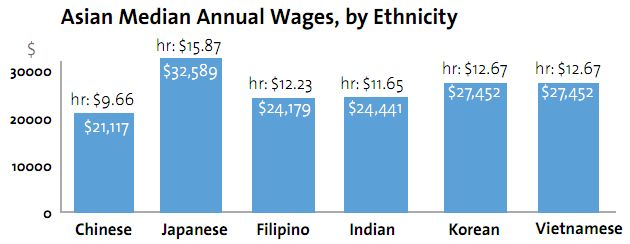
The authors go on to break down the data further by each part of the commodity food chain — production, processing, distribution and service — and by racial group.  For example, they show that the average wage of Latinos and Asians differs by ethnic background (always a good reminder that racial categories obscure variability):

Lots more at The Color of Food.

Lisa Wade, PhD is an Associate Professor at Tulane University. She is the author of American Hookup, a book about college sexual culture; a textbook about gender; and a forthcoming introductory text: Terrible Magnificent Sociology. You can follow her on Twitter and Instagram.


In the six-and-a-half minute video below, Feminist Frequency‘s Anita Sarkeesian makes the controversial argument that True Grit‘s Mattie Ross is not a feminist character.  Her argument revolves around an important distinction: the difference between admiring women for doing masculinity and admiring them.

Our instinct to see Ross as a feminist character comes from her performance of masculinity: she is aggressive, tough, and vengeful.  But is the valuing of masculinity feminist?  Some say no.  Instead, such detractors might argue, a true feminist perspective involves not just valorizing women who do masculinity, but coming to value femininity.  In fact, valuing masculinity over femininity might be part of the problem.  On this blog, we call this “androcentrism.”

Here’s how Sarkeesian makes the argument:

Lisa Wade, PhD is an Associate Professor at Tulane University. She is the author of American Hookup, a book about college sexual culture; a textbook about gender; and a forthcoming introductory text: Terrible Magnificent Sociology. You can follow her on Twitter and Instagram.