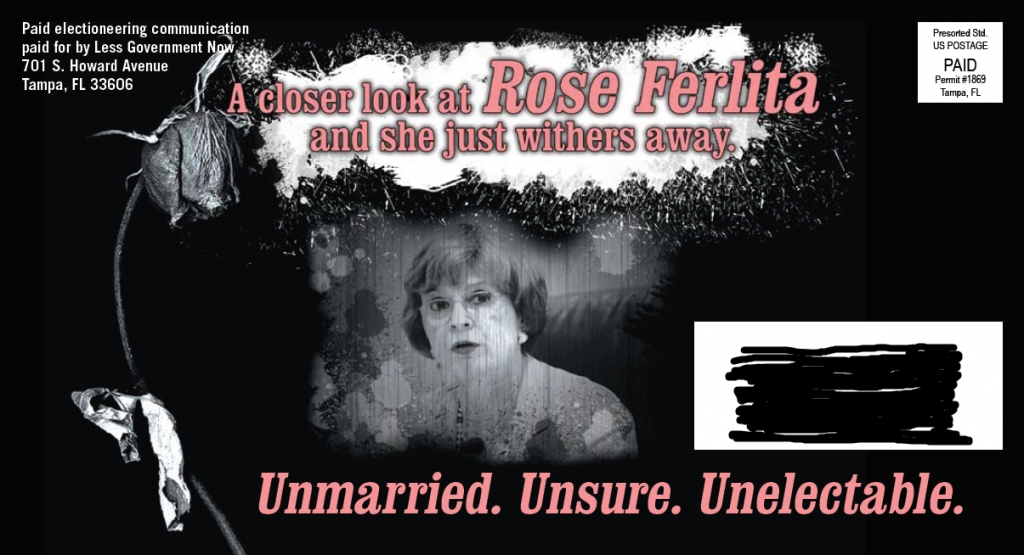
Clayton W. sent us a political mailer that recently went out against Rose Ferlita, a candidate for mayor of Tampa, Florida. What makes her unfit for office? Among other things, she’s single:
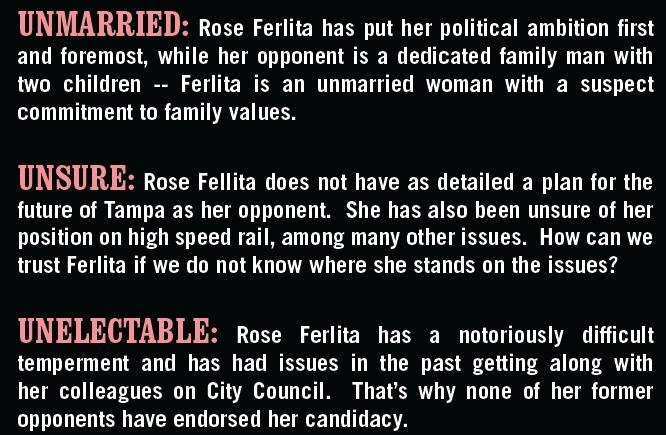
Text from the other side:
(Via Think Progress.)

So, awful, right? She’s single, she has a “suspect commitment to family values,” which I think it isn’t a stretch to say means “she might be a lesbian,” she’s a bitch. Given our current political alignments, we might legitimately assume this mailer was created by a very far right, possibly religious-based group, presumably on the conservative side of the spectrum.

But the story turns out to be weirder than that. Ferlita is a Republican, though Tampa’s mayoral races are non-partisan. The mailer, as you can see in the return address, is from Less Government Now, a 527 political action group (that is, one that can take unlimited donations as long as they do not directly advocate voting for a specific candidate). And it’s tied to a man named Scott Maddox, a Democrat who ran (unsuccessfully) for office last year. In that race, he had a friend enter the campaign as a fake Tea Party candidate in hopes of splitting the Republican vote.

It appears that Less Government Now is pursuing a similar strategy here, sending out materials that attack candidates from the right by coming up with the types of arguments they imagine will resonate with very conservative voters and thus split their vote. It doesn’t seem clear whether the other candidate for mayor of Tampa, Bob Buckhorn, had any knowledge of the mailer, or if Less Government Now acted on its own (Buckhorn has denounced the mailer).

I gotta say, I thought this was repugnant when I first saw it and assumed the group who put it out might actually believe this kind of crap. But to encourage people to vote based on sexist, homophobic values that you presumably don’t even agree with, simply as a political ploy? That is some nasty, nasty business.

UPDATE: Suzie emailed us about her post on March 20th at Echidne of the Snakes (there’s no way to link directly to the post, sorry) questioning the origin of the mailer. The St. Petersburg Times Tampa Bay site reports that according to the post office, the permit number listed on the mailer is fake, and there’s no evidence it was actually mailed. Less Government Now denies all knowledge of it. It’s possible that this is a fake mailer created to discredit the Democratic candidate by making it look a Democrat-affiliated group sent out something sexist. The person who first made it public, claiming to have received it anonymously, has been involved in political consulting and has a history of criminal charges. This is all making my head spin.
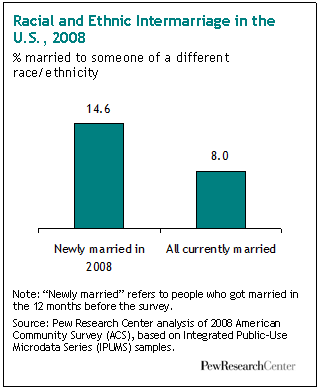
New-ish data from the Pew Research Center suggests that inter-racial and -ethnic marriages are on the rise due to cohort changes.  First, the report shows that people who were newly married in 2008 were more likely to be married to someone of a different racial or ethnic group:

This trend is likely facilitated by greater acceptance of intermarriage.  According to the report, in 1987 less than half of Americans said it was okay for White and Black people to date each other, by 2009 that number had risen to 83%.  Among 18- to 32-year-olds, 93% approve.

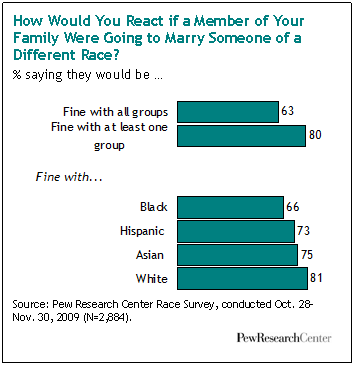
Among Pew’s respondents, 63% said that they approved of inter-racial and -ethnic marriages without reservation and another 17% said that they approved of at least one type of intermarriage, but not others.  Still, overall acceptance of intermarriage still aligns with the familiar racial hierarchy in that Americans are more comfortable with outmarriages to Whites, than to Asians, Hispanics, and especially Blacks.

Acceptance of inter-racial and -ethnic marriage is on the rise, then, in part because younger people are more accepting of it than older people.  Acceptance, however, still reflects a color-based racial hierarchy.

Lisa Wade, PhD is an Associate Professor at Tulane University. She is the author of American Hookup, a book about college sexual culture; a textbook about gender; and a forthcoming introductory text: Terrible Magnificent Sociology. You can follow her on Twitter and Instagram.

Authors are increasingly arguing that mainstream culture has been “pornified” (see, for example, the books Pornified and The Porning of America).  In other words, what used to be considered pornographic is now disseminated widely as simply advertising or entertainment and both verbal and visual references to pornography in popular culture are increasingly common.   In this vein, we have a collection of posts featuring ejaculation imagery (visual references to the “cum shot”), and I thought an ad recently submitted by one of my students, Breiana Caldwell, as well as readers Scatx and Xander, was a good opportunity to remind readers of this pervasive trope:

(source)

Lisa Wade, PhD is an Associate Professor at Tulane University. She is the author of American Hookup, a book about college sexual culture; a textbook about gender; and a forthcoming introductory text: Terrible Magnificent Sociology. You can follow her on Twitter and Instagram.

Leslee Beldotti sent in this 7-minute video from The Escapist that discusses female characters in video games and how game developers could incorporate women as complex characters rather than stereotypes. Leslee points out that the video somewhat conflates sex with gender in the discussion of biological vs. social behaviors, but it highlights the outcomes of making video games through a gendered lens (sorry about the 30-second intro ad):

On this topic, also see Lisa’s recent post on boob inflation in video games.


Dr. Bethany Pope, Pris S., and Christine each sent in the trailer for the Disney film, opening today, called Mars Needs Moms.  It is impossible not to be sarcastic about this trailer.

What can I say.  The premise of the film is that only women can parent (and by “parent,” I mean feed and vacuum).  I’m sure all of the human women out there with children really appreciate this sentiment.  Dads, HUH!  …what are they good for!  Absolutely nothing! Or, at least, that is what nearly every corner of Western society is trying to tell us.  How convenient, given that raising kids is rewarded with, basically, absolutely nothing concrete. Thanks, thanks for nothing Disney.

Also, as far as the trailer goes, it appears that this movie focuses almost entirely on boys and men. I wonder if it even passes the Bechdel test.  Twist the knife, why don’t you.

Lisa Wade, PhD is an Associate Professor at Tulane University. She is the author of American Hookup, a book about college sexual culture; a textbook about gender; and a forthcoming introductory text: Terrible Magnificent Sociology. You can follow her on Twitter and Instagram.

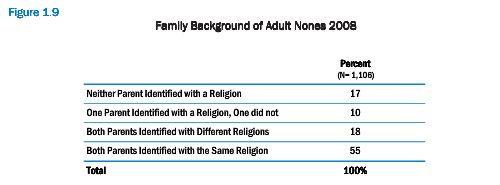
Data from the American Religious Identification Survey (collected in 2008) reveals some interesting things about the population of Americans that do not identify with organized religions: atheists, agnostics, and the “spiritual but not religious.”  Most of the non-religious grew up with religious parents.  Only 17% report that neither of their parents identified with a religion:

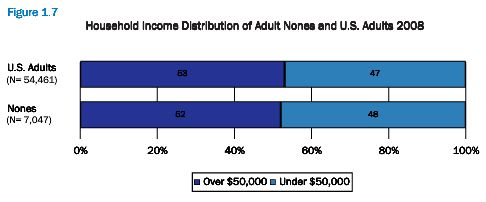
Being non-religious does not correlate with income or education:

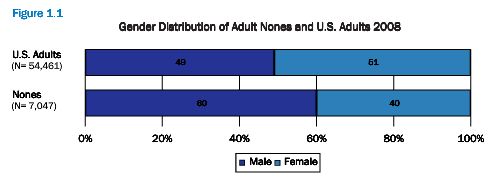
Instead, it’s strongest correlation is with gender.  Women are more likely than men to believe in God, more likely to convert to a faith if raised as a non-believer, and less likely to leave a faith they are raised in.

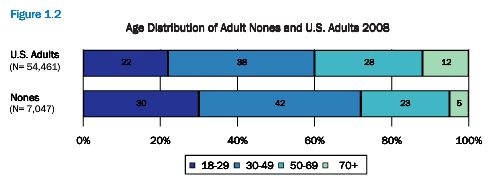
Younger people are also more likely to be non-religious:

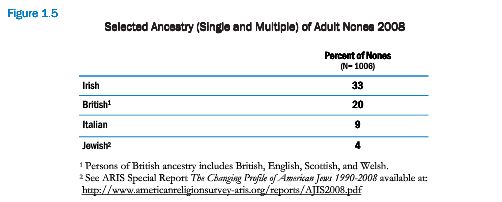
Americans with Irish ancestry make up a significant percentage of the non-religious. They account for about 12% of Americans, but about 1/3rd of all non-religious:

More details at American Nones.

Lisa Wade, PhD is an Associate Professor at Tulane University. She is the author of American Hookup, a book about college sexual culture; a textbook about gender; and a forthcoming introductory text: Terrible Magnificent Sociology. You can follow her on Twitter and Instagram.

Squee sent in this video on the complexities of the placebo effect. We most often hear about the placebo effect in terms of medicine (the famed “sugar pill” that makes people feel better despite having no known effect on a condition), but as the video points out, we use placebos in other aspects of social life as well, such as buttons at intersections that don’t affect the timing of the “walk” signal but make pedestrians feel better about their wait anyway. And since the placebo effect is based in part on cultural assumptions about what should make us feel better (i.e., an expensive drug must be better than a discounted one, right?), not surprisingly the effectiveness of specific placebos varies cross-culturally.

Fun!

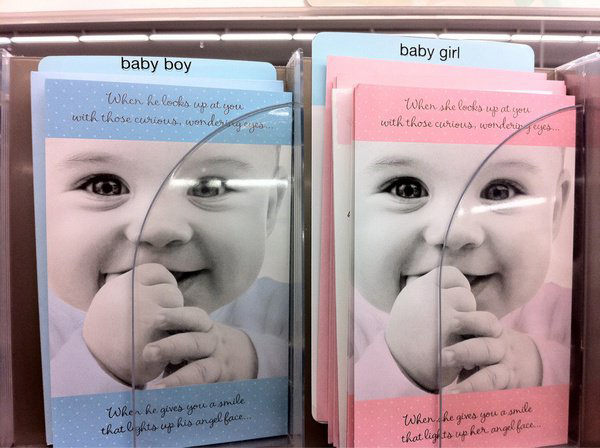
There is something so damn ironic about this pair of greeting cards photographed by Julie Becker from Lansing, Mich.   The cards, designed to congratulate new parents on the birth of their child, reveal a (perceived) desire to gender our infants from Day One. It is important to identify this child’s gender; it must be noted and color-coded that it is a “he” or a “she.” But the card company finds no irony in using exactly the same baby on each card:


In fact, gendering infants is a rather new phenomenon in Western history and not cross-culturally consistent. Some cultures, and in Western culture previously, the sex of children was considered rather irrelevant until puberty.

Lisa Wade, PhD is an Associate Professor at Tulane University. She is the author of American Hookup, a book about college sexual culture; a textbook about gender; and a forthcoming introductory text: Terrible Magnificent Sociology. You can follow her on Twitter and Instagram.