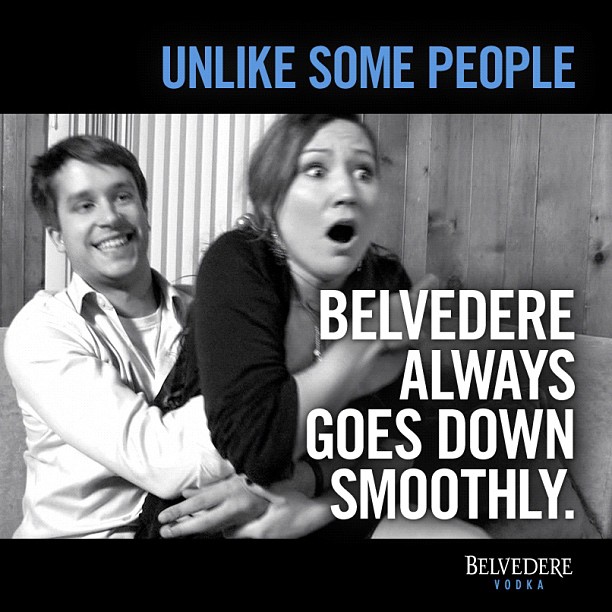
YetAnotherGirl, Andrew, Rosemary, Nathan Jurgens0n, Dolores, and Ann K. all sent in an ad for Belvedere Vodka that should be listed in the annals of bad ideas. The ad shows a gleeful man grabbing a distressed-looking woman who, we are to presume from the text, must not be going down smoothly (via Feministing):

Because how is it not funny to present your product in a context that says sexual assault is funny?

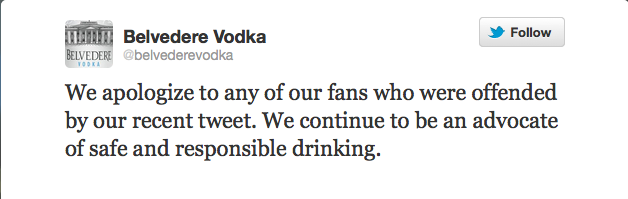
Online criticism of an ad that seems to be making a joke about forcing women to engage in sexual acts led to the company pulling the ad and issuing an apology of the passive “sorry if you were offended” type:

The company’s president also apologized when speaking to CNN about the controversy (via The Consumerist):

It should never have happened. I am currently investigating the matter to determine how this happened and to be sure it never does so again. The content is contrary to our values and we deeply regret this lapse.

The company also made a donation to the Rape, Abuse, and Incest National Network (RAINN).

Phil Villarreal, who posted about the ad and the apology at The Consumerist, suggests that the ad may be even more cynical than it at first appears:

The cynical might wonder whether or not the campaign and apology made up a coordinated effort to draw attention to the brand.

Intentionally invoking outrage, then making an apology and symbolic corporate donation as marketing strategy. Any readers with marketing expertise have any insight here? We often see cases of companies desperately trying to control the negative effects of controversies. When does a controversy hurt a brand and when does it serve as a marketing opportunity?

UPDATE: Reader Tom points out that it turns out to be a still from a parody video that someone at the company then reposted (via Adland):

Somebody on their social media team obviously created (or found) and posted it thinking it was an amusing parody. And that person has probably been found and fired.

But it is unlikely anyone officially *in charge* of the brand actually saw and approved this.

As Tom says, this brings up a separate issue: the challenges to companies of managing brand image in a world where one person in the organization can quickly disseminate something via the company’s social networking sites to thousands or even millions of people with much less oversight than a traditional ad campaign would get, especially when viewers make little distinction between images included in tweets or Facebook updates and those in billboards, print ads, etc.

Cross-posted at Global Policy TV.

Recent research has unearthed the interesting finding that most Americans dislike atheists.  In fact, they strongly dislike atheists. Surveys suggest that they’d rather share a beer with almost anyone, even members of historically-hated groups: homosexuals, African-Americans, or Muslims (yes, even after 9/11).  This phenomenon is new in American society, as I’ll discuss below, and reflects a significant change in our social alliances.

But first, consider this data published by Penny Edgell and her colleagues in the American Sociological Review (full text).  It reveals that Americans believe that atheists, more than many other groups, are not likely to agree with their “vision of American society.”  Atheists topped the list, beating out the second contender, Muslims, by 13 percentage points.  Likewise, among the types of people Americans would not want their children to marry, atheists come first, beating out Muslims (again) by 14 points and African Americans by a full 20.
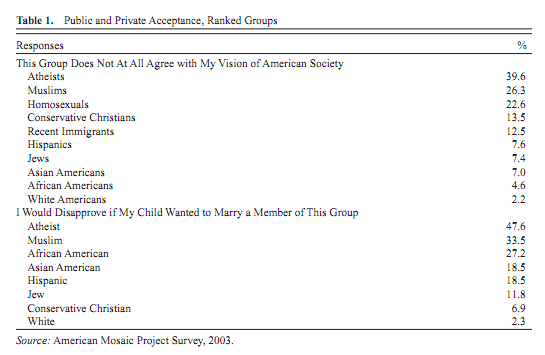
This dislike for atheists, by the way, isn’t on the wane.  While dislike of gays and lesbians has been easing, racism has become increasingly unacceptable, and religious diversity has become less contentious, intolerance for non-believers has held steady.

An even more recent article revealed that the reason people dislike atheists so much has to do with trust (cite).  Many people are skeptical that someone who doesn’t believe in God would do the right thing, given that they don’t imagine that a higher power is watching them and keeping score.  Atheists were more distrusted than Muslims, Jews, gay men, and feminists.  The only group that was as strongly suspected of bad behavior as atheists?  Rapists.

What is interesting in all this – above and beyond a clear prejudice against atheists – is the change in how Americans think about religion.  Until recently, members of different religious saw each other as enemies, not friends.  American history is characterized by “long-standing divisions among Protestants, Catholics, and Jews” (Edgell et al.). Many of us can remember how significant it was to elect the first Catholic president (something we take for granted as unremarkable now) and we are on the precipice of nominating a Mormon to run on the Republican ticket.

Indeed, historical data shows that Americans have been increasingly willing to vote for a Catholic or Jewish Presidential Candidate (as well as an African American and homosexual candidate), but their willingness to vote for an atheist is lagging behind:
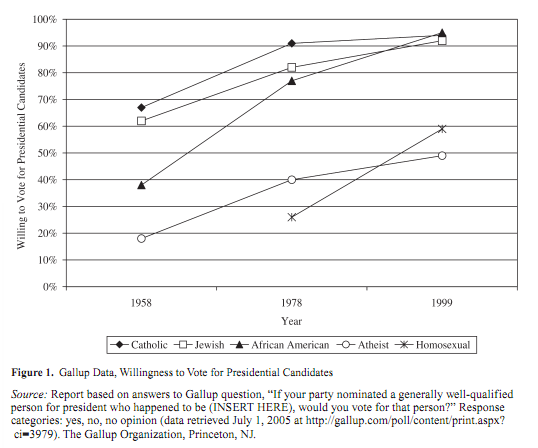
The take home point has to do with shifting social alliances.  Now that most Americans have abandoned a strong dislike for members of other religions, it’s possible for The Religious to emerge as a socially-meaningful identity group.  In other words, once members of different religions begin to see each other as the same instead of different, they can begin to align together.  Suddenly atheists become an obvious foe.  Instead of one of many types of people who had lost their way (along with people of different faiths), atheists could emerge as uniquely problematic.  It is the building of cross-religious alliances, then, that undergirds the strong dislike for atheists specifically.

Lisa Wade, PhD is an Associate Professor at Tulane University. She is the author of American Hookup, a book about college sexual culture; a textbook about gender; and a forthcoming introductory text: Terrible Magnificent Sociology. You can follow her on Twitter and Instagram.

Cross-posted at Ms.

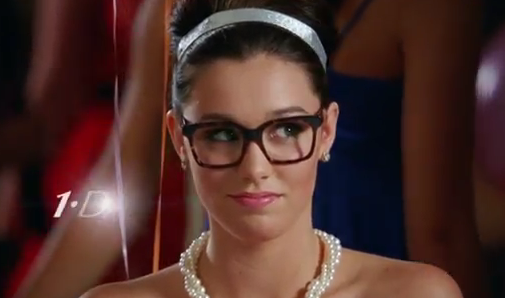
Abby F. and an anonymous reader let us know about an Acuvue contact lens commercial aimed at teens that reinforces both gender and racial stereotypes. The teens look forward to their futures. For the boys, these involve future career success — notice the African American teen dreams of being a famous athlete, while the White boy’s future involves moving up the corporate career ladder. And what does the girl’s life hold? A boy who currently ignores her will want to dance with her.

As the submitters said, the boys are future role models and leaders, while the height of the girl’s future is that she gets to be desired.

UPDATE: James McRitchie, who posts at Corporate Governance, linked to our post last week and has spoken to someone in the PR department at Johnson & Johnson, the makers of Acuvue. The company has since pulled this particular ad, and provided this explanation, which James posted:

The Acuvue Brand Contact Lenses 1-Day campaign was designed to portray defining moments in teens’ lives that often involve the desire to wear contact lenses rather than glasses, such as when playing sports, in social situations, and at life events (i.e., moving to a new school).  As the campaign evolved, we continued to ask teens and their parents to share their thoughts about how wearing contact lenses could play a role in helping teens achieve their dreams.  We received thousands of responses that helped us add new ideas to the campaign.

We recently received feedback about one ad in the campaign that regrettably appeared to reinforce stereotypes.  While this was clearly not our intent, we appreciate consumer feedback and have removed this ad.  We are currently reassessing elements of this campaign so that we can continue to share how contact lenses can play a role helping teens’ realize their hopes and aspirations.

I think James makes a very good point in his post as well:

I’m sure kids have all kinds of dreams that play into society’s stereotypes. Many little girls love Barbies and dream of being a princess. Many young black boys hope to be NBA stars. How does J&J reflect the dreams of its customers while ensuring they don’t reinforce stereotyping?

There’s nothing inherently wrong with these representations in and of themselves, if they existed among a diverse array images of other dreams boys and girls of all races should aspire to. Unfortunately, however, they don’t exist in a vacuum; they appeared in a cultural context in which young women are told, via a variety of messages that they encounter over and over again, that their primary concern should be their attractiveness to boys and where African American teens often find themselves valued for their athletic ability more than their academic successes. When you live in a society with gender and racial inequality, sometimes messages intersect with existing stereotypes in ways that reinforce negative messages just because of their pervasiveness; figuring out how to negotiate such potential problems is an ongoing challenge for all of us concerned about racial and gender representation.

Gwen Sharp is an associate professor of sociology at Nevada State College. You can follow her on Twitter at @gwensharpnv.

W.W. Norton released a couple two-minute interviews in which I talk about hook up culture, part of their collection of academics talking about their research.

In the first clip, I discuss the difference between hooking up and a hook up “culture.”  In the second, I respond to the concern that there is something “wrong” with casual sex on college campuses.  There is something wrong, I argue, but it’s not unique to casual sex. Instead, the problems students face on campus — heterosexism, gender inequality, and a relentless pressure to be “hot” — don’t go away with graduation.

In that sense, for better or worse, college is a “functional training ground” for the friendships, marriages, workplace interactions, and other types relationships that students will encounter after college; social inequalities threaten the health of all of these relationships.  Instead of shaking our fingers at college students, then, we should recognize that the acute problems we see on campuses are symptoms of the ills that characterize our wider sexual culture as well.

I’m speaking about hook up culture at Harvard and Dartmouth this week. If you’re in the area, please come by and say “hello!”

  • Monday, Mar. 26th at 8:00pm: “Sex Lives and Sex Lies: Hooking Up on Campus” (Harvard University, Science Center D)
  • Wednesday, Mar. 28th at 7:30pm: “Sex Machines vs. Sex Objects: How Stereotypes Subvert Sexual Pleasure” (Harvard University, Fong Auditorium)
  • Thursday, Mar. 29th at 4:30pm: “The Promise & Perils of the Hook-Up Culture”  (Dartmouth University, Rockefeller Center “Rocky” 2)

Lisa Wade, PhD is an Associate Professor at Tulane University. She is the author of American Hookup, a book about college sexual culture; a textbook about gender; and a forthcoming introductory text: Terrible Magnificent Sociology. You can follow her on Twitter and Instagram.
In “Just Walk on By: A Black Man Ponders His Ability to Alter Public Space,” author Brent Staples recounts his realization, in his early 20s, that his mere presence in public often made others uncomfortable or outright fearful, a fact they were not hesitant to make clear. Staples points out that while he poses no threat to  those around him, others’ fear of him — including an instance in which he was assumed to be a robber when visiting his editor’s office to drop of a story and was chased by security — puts him in potential danger:

…I soon gathered that being perceived as dangerous is a hazard in itself. I only needed to turn a corner into a dicey situation, or crowd some frightened, armed person in a foyer somewhere, or make an errant move after being pulled over by a policeman. Where fear and weapons meet—and they often do in urban America—there is always the possibility of death.

I thought of Staples’s essay as soon as I heard about the Trayvon Martin case, and particularly after Fox News ran a segment in which Geraldo Rivera basically blames Trayvon himself for wearing a hoodie:

Rivera removes the focus from the man who shot an unarmed teen and places it instead on what the teen should have done to not get shot. Yes, yes, people shouldn’t shoot unarmed minority teens, but Trayvon’s choice of clothing was, according to Rivera, equally responsible for the shooting. He normalizes prejudice and stereotypes — it’s just normal for people to cross the street when they see a Black or Latino youth in a hoodie on the street. Trayvon should not have “allowed” himself to be seen as a criminal — as though he could individually ensure racial stereotypes and prejudices were not applied to him.

Rivera argues that Trayvon Martin wouldn’t have been shot if he hadn’t been wearing a hoodie. But Staples’s experiences undermine this reasoning; he presumably wasn’t wearing a hoodie the many different times he was taken for a criminal or treated like a threat while trying to carry out his role as a professional reporter. Merely being African American was sufficient to make him scary, as it was enough to make Trayvon Martin “suspicious” to George Zimmerman, and it’s unlikely a cardigan instead of a hoodie would have changed the situation.

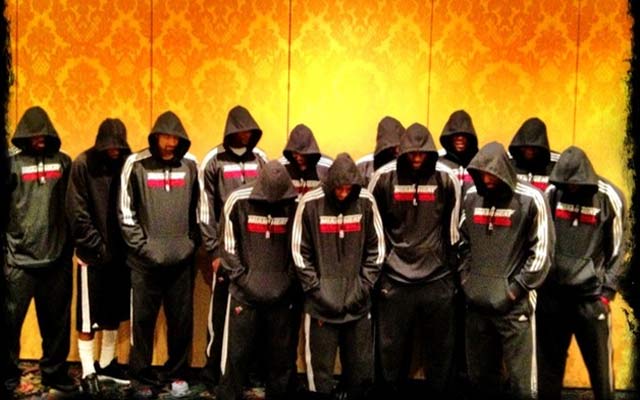
In support of Trayvon Martin, LeBron James tweeted a photo of Miami Heat players in hoodies:

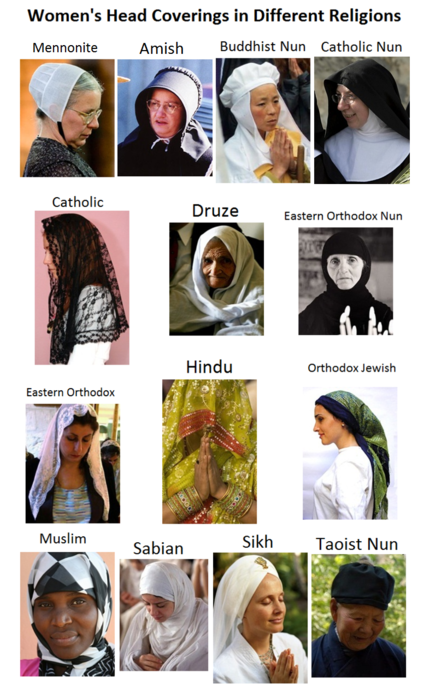
The burqa and headscarf are often identified as symbols of women’s oppression in Muslim countries.  In fact, head covering is a form of religious garb in many sub-cultures.  Some of these subcultures require head covering all of the time, and others only during religious rituals, but all involve this tradition.  Yet, when it comes to Muslims, the discussion often goes forward as if it is a uniquely oppressive, and uniquely Islamic, practice.  Food for thought.

Thanks to Dolores R. for the link.  Found at Socialist Texan.

UPDATE: In the comments, Alastair Roberts suggests that it’s important to consider whether head covering is required for just women, or both women and men.  I agree.

Lisa Wade, PhD is an Associate Professor at Tulane University. She is the author of American Hookup, a book about college sexual culture; a textbook about gender; and a forthcoming introductory text: Terrible Magnificent Sociology. You can follow her on Twitter and Instagram.
Here we have another great vintage ad (1962) that upsets the idea that today’s norms are trans-historical.  First, the idea of having a “pint about midday” would be considered inappropriate by many U.S. employers (though, as several commenters have pointed out, not necessarily elsewhere).  Second, the large print — “Beer, It’s Lovely!” — sounds unmasculine today, even though these grizzled sea-farers likely would have seemed perfectly masculine enough at the time.

From the RAF Flying Review, found at Retronaut.

Lisa Wade, PhD is an Associate Professor at Tulane University. She is the author of American Hookup, a book about college sexual culture; a textbook about gender; and a forthcoming introductory text: Terrible Magnificent Sociology. You can follow her on Twitter and Instagram.
In 2010 we wrote about how gender ideology inflects even the most “objective” of spheres.  In this case, we featured four examples of anatomical illustration, portrayals of human beings used to educate viewers about biology.  In each case, while the man faced forward with his weight evenly distributed on his two feet, the woman placed her hand on her hip, cocked a knee, or even turned slightly sideways.  In other words, he was posed in a masculine way and she in a feminine way.

When we see this kind of gendered posing in drawings that are ostensibly neutral, we are being told that our particular historically- and culturally-contingent version of masculinity and femininity is natural.

In this vein, Courtney S. sent in a Design by Hümans Size Chart.  The chart is supposed to help buyers decide what size to purchase, but the accompanying images do more than just illustrate how measurements are made; by torquing the female torso, they send a message about gender too:

Lisa Wade, PhD is an Associate Professor at Tulane University. She is the author of American Hookup, a book about college sexual culture; a textbook about gender; and a forthcoming introductory text: Terrible Magnificent Sociology. You can follow her on Twitter and Instagram.