The producers had teens vandalize a car in public to see what onlookers would do. To see if race played a role, they tried it with a group of White boys and then with a group of African American boys. Only one 911 call was made on the White boys, but 10 calls were made on the African American teens. Moreover, while the White teens were vandalizing the car, 911 received a call to report the African American boys simply for being asleep in a car, which the caller took as a possible sign they were planning to engage in criminal activity.
We see this same pattern in another “What Would You Do?” segment. This time, a young White man and a young African American man try to remove a lock from a bike as the cameras capture the reactions of onlookers.
The onlooker interviewed toward the end says race played no role in his reaction. But the extremely different reactions to the two teens indicate differences in who is perceived as likely to be engaged in criminal activity, and whose criminal activity we may think deserves being reported to the police, rather than given a disapproving tsk-tsk as we walk on by.
Gwen Sharp is an associate professor of sociology at Nevada State College. You can follow her on Twitter at @gwensharpnv.
UBC Sociology student Pat Louie tweeted us a touching set of photographs by artist Gabriele Galimberti. Each image is a child with his or her favorite toys. They are in Malawi, Italy, Ukraine, Thailand, Zanzibar, Albania, Botswana, and elsewhere and the diversity is stunning.
The photographs reveal a universality — pride in favorite toys and the love of play — but, writes Ben Machell at Galimberti’s website, “how they play can reveal a lot.” The children’s life experiences influenced their imaginative play:
…the girl from an affluent Mumbai family loves Monopoly, because she likes the idea of building houses and hotels, while the boy from rural Mexico loves trucks, because he sees them rumbling through his village to the nearby sugar plantation every day.
Galimberti, interviewed by Machell, also observed class differences in entitlement to ownership:
The richest children were more possessive. At the beginning, they wouldn’t want me to touch their toys, and I would need more time before they would let me play with them. In poor countries, it was much easier. Even if they only had two or three toys, they didn’t really care. In Africa, the kids would mostly play with their friends outside.
We all-too-often take for granted that photographs like this one, revealing the impact of an oil pipeline leak on Mayflower, Arkansas, will be able to inform us about the state of the world. In fact, such images are taken by actual human photojournalists whose rights of access are protected by the First Amendment establishing the freedom of the press.
This is a real thorn in the side of both corporations and governments that might prefer to control media’s access to embarrassing or illegal activities. So, often they try to strong arm journalists, co-opt local officials, or pass (likely illegal) legislation designed to protect them from the free press’ gaze. Here are two current examples.
First, Mother Jonesreports that Exxon officials are making efforts to limit reporter access to the oil pipeline leak in Mayflower, Arkansas. This is happening in at least two ways. First, Exxon representatives and local law enforcement are blocking journalists from accessing the spill site, threatening “arrest for criminal trespass.” Second, BoingBoing reports that the Federal Aviation Administration (FAA) has instituted a temporary “no-fly zone” in the area of the spill. Here’s a screenshot from the FAA’s website:
Second, in the last two years Americans have shuddered in response to the release of undercover video revealing the abuse of animals on industrialfarms and the torture of Tennessee Walking horses. These have resulted in convictions, but they’ve also raised the hackles of the agricultural industry. The New York Timesreports that, in an effort to limit their risk, they’ve sponsored bills (proposed or enacted in about a dozen state legislatures) making it illegal to videotape animals on their property without their permission and requiring all prospective employees to reveal associations with animal rights groups.
These examples remind us how important it is that journalists have the freedom to do their job. They also remind us that we must vigilantly protect that freedom. Corporations, and governments too, have an incentive to limit the freedom of the press. These are powerful entities, often in cahoots, that can and will ignore the First Amendment when they can get away with it.
“You just have to be cheerful about it and not get upset when you get insulted,” said rocket scientist Yvonne Brill.
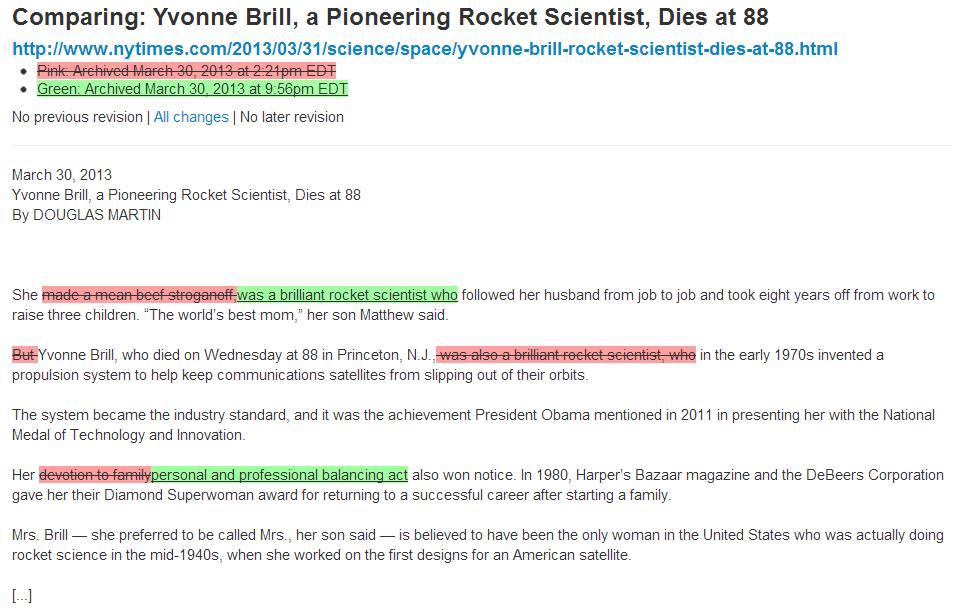
She must be chuckling in heaven, because her obituary at the New York Times made the common mistake of making her femaleness and femininity a central part of their retrospective. After objections, NYT corrected the obit. Here are the tracked changes, courtesy of NewsDiffs:
At Feministe, Caperton offers a nice discussion of this phenomenon and draws our attention to the Finkbeiner Test, named after journalist Ann Finkbeiner. Inspired by the Bechdel Test for movies, the Finkbeiner Test is used to judge whether stories about women focus excessively on the fact that they are women. To pass the test, the story cannot mention:
The fact that she’s a woman
Her husband’s job
Her child care arrangements
How she nurtures her underlings
How she was taken aback by the competitiveness in her field
How she’s such a role model for other women
How she’s the “first woman to…”
Awesome.
We’ve documented lots of instances of the men-are-people and women-are-women phenomenon. It’s no wonder it shows up in obituaries too. I’m glad that we’re becoming sensitive enough to the issue to notice it and that institutions like the NYT are responsive enough to change the most egregious examples of it. Next step: prevention.
We’ve been covering the saga of Russian protest punk group Pussy Riot for over a year now. The feminist collective performed guerrilla musical protests around Russia against Vladimir Putin. One in particular, in a church, ended with members Nadezhda Tolokonnikova and Maria Alyokhina sentenced to two years imprisonment for “hooliganism motivated by religious hatred”. The human rights implications of this sentence attracted much worldwide attention, with Amnesty International and celebrities like Sting, Yoko Ono and Madonna speaking out for the women.
Which is what makes this video by Blush lingerie an intriguing conundrum. While it legitimately promotes the freepussyriot.org fundraising site to help the women, it is also promoting a product using a woman’s sexuality as the bait:
On the first anniversary of the Pussy Riot concert in the Cathedral of Christ the Savior, the Berlin based Lingerie label blush supports the free pussy riot movement with a sexy protest march through icy Moscow (-15° C). Support Freepussyriot.org!
This is no Femen action, in which women’s bodies become weapons of protest. It is a commercial for sexy underwear that pays for its appropriation of a radical feminist cause by directing people to that cause.
Is this irony?
Tom Megginson is a Creative Director at Acart Communications, a Canadian Social Issues Marketing agency. He is a specialist in social marketing, cause marketing, and corporate social responsibility. You can follow Tom at workthatmatters.blogspot.com.
Re-posted in honor of Roger Ebert’s passing. Cross-posted at BlogHer.
University of Minnesota doctoral candidate Chris Miller sent in a fascinating episode of Siskel and Ebert, a long-lasting TV show devoted to reviewing movies. What is amazing about this episode is the frankness with which the movie critics — Gene Siskel and Roger Ebert — articulate a feminist analysis of a group of slasher movies.
The year? 1980.
First they describe the typical movie:
A woman or young girl is shown alone and isolated and defenseless… a crazy killer springs out of the shadows and attacks her and frequently the killer sadistically threatens the victims before he strikes.
They pull no punches in talking about the problem with the films:
These films hate women.
They go on to suggest that the films are a backlash against the women’s movement:
I’m convinced it has to do with the growth of the woman’s movement in America in the last decade. I think that these films are some sort of primordial response by some very sick people… of men saying “get back in your place, women.”
…
One thing that most of the victims have in common is that they do act independently… They are liberated women who act on their own. When a woman makes a decision for herself, you can almost bet she will pay with her life.
They note, too, that the violence is sexualized:
The nudity is always gratuitous. It is put in to titillate the audience and women who dress this way or merely uncover their bodies are somehow asking for trouble and somehow deserve the trouble they get. That’s a sick idea.
And they’re not just being anti-horror movie. They conclude:
[There are] good old fashioned horror films… [but] there is a difference between good and scary movies and movies that systematically demean half the human race.
It’s refreshing to hear a straightforward unapologetic feminist analysis outside of a feminist space. Their analysis, however, isn’t as sophisticated as it could be.
In doing research for a podcast about sex and violence against women in horror films (Sounds Familiar), I came across the keen analysis of Carol Clover, who wrote a book called Men, Women, and Chainsaws.
Clover admitted that most horror films of the time sexualized violence against women — meditating on the torture and terrorizing of beautiful female victims — but she also pointed out that the person who ultimately vanquished the murderer was almost always also female. She called this person the “final girl.”
The final girl was different than the rest of the women in the film: she was less sexually active, more androgynous, and smarter. You could pick her out, Clover argued, from the very beginning of the movie. She was always the first to notice that something frightening might be going on.
Boys and men watching horror films, then (and that is the main audience for this genre), were encouraged to “get off” on the murder of women, but they were also encouraged to identify with a female heroine in the end. How many other genres routinely ask men to identify with a female character? Almost none.
In this sense, Clover argues, horror films don’t “hate women.” Instead, they hate a particular kind of woman. They reproduce a Madonna/whore dichotomy in which the whores are dispatched with pleasure, but the Madonna rises to save us all in the end.
American companies that once looked to places like Mexico and China for cheap labor are bringing those jobs back to the U.S. Why? Because prison labor is much, much cheaper. Paid between 93¢ and $4.73 per day, and collecting no benefits, prisoners are a cheap labor source for about 100 companies (source).
What does this have to do with you?
If you have insurance, invest, use utilities, have a bank, drive a car, send a child to school, go to a dentist, call service centers, fly on planes, take prescription drugs, or use paper, you might be benefiting from prison labor.
If you’ve bought products by or from Starbucks, Nintendo, Victoria’s Secret, JC Penney, Sears, Wal-Mart, K-Mart, Eddie Bauer, Wendy’s, Proctor & Gamble, Johnson & Johnson, Fruit of the Loom, Motorola, Caterpiller, Sara Lee, Quaker Oats, Mary Kay, or Microsoft, you are part of this system.
When prisoners are in state and federal prisons, the U.S. taxpayer is subsidizing low wages and corporate profits, since they are paying for prisoners’ room, board, and health care. When prisoners are in private prisons, prison labor is a way to make more money off of the human beings caught in the corrections industry. In other words, prison labor is an efficient way for corporations to continue to increase their profits without sharing those gains with their employees.
For an extensive list of the companies contracting prison labor, click here. You might also find interesting the video clips, embedded in this news story, of promotional videos by prison corporations that attempt to sell the idea of prison labor to companies:
In an article titled “Egos Inflating Over Time,” psychologist Jean Twenge and her colleagues show that rate of narcissism among U.S. college students has risen significantly. Narcissism is a “positive and inflated view of the self.” Narcissists are attention-seeking extroverts who have a high opinion of their value, importance, and physical attractiveness. They feel entitled to admiration from others and may act aggressively if they don’t receive the attention they feel they deserve.
Twenge and her colleagues found a 30% increase in narcissism between 1979 and 2006; almost 2/3rds of college students in the mid-2000s were above the mean score reported in the early ’80s.
I can’t help but think of her research every time I see a current commercial for the iPhone 5. What strikes me is the message that every moment of our lives is so amazing that it would be a horrible shame to not share it with everyone:
We can share every second… a billion roaming photojournalists uploading the human experience, and it is spectacular…
And that we should feel entitled to the technological ability to share ourselves:
I need to upload all of me. I need — no, I have the right — to be unlimited.
Wow. I mean, that’s some pretty serious self-importance there.
Twenge and her colleagues argue that the increase in narcissism is related to the fact that American culture has increasingly celebrated individualism. This is exactly the kind of message that they might point to as reflecting the cultural dimension of this personality shift.
Sociological Images encourages people to exercise and develop their sociological imaginations with discussions of compelling visuals that span the breadth of sociological inquiry. Read more…