Please peruse the posts we’ve enriched this month:

The idea of interracial and cross-national sex as cultural tourism came up at PostSecret.  We added a postcard to an earlier post on the topic.

We added a video about the video game BoneTown to this post about Miss Bimbo and Sexy Beach 3. BoneTown, supposedly the “world’s first action adventure porno video game, is exactly what you’d think it is, except with Mormons, American Indians in business suits, and a mysterious thing called Jew Magic. It’s pretty fascinating.

In a comments thread, Mordicai alerted us to “Man Glaze,” i.e., finger polish for men.  We added it to our thread on make-up for guys here.  Scroll down.

We added an o.b. tampon ad sent in by Claire T. to this post about marketing products with eco-conscious messages as evidence that “being green” (at least in theory) is becoming increasingly mainstream.

We added a commercial, also sent in by Claire T., for the EU’s “Cool Capitals” tourism campaign, to this post about imagery of cheating (polygamy?) in AirFrance advertising. The EU commercial documents the case of Francine, a fictional polygamist with husbands in five European capital cities.

In the comments thread to our post about the NOT FOR GIRLS candy bar, Trevor pointed us to the girl version.  But it is a girl version?  I couldn’t figure out the message.  Can you? We also added an image of Men’s Pocky, pointed to by Lis Riba.

Pharmacopaeia alerted us to another ad campaign on the “Thank God You’re A Man” theme.

We found another instance of pre-nazi uses of the swastika, this time the symbol was used in a warm, cozy quilt.  Thanks to Felicity who pointed us to it in the comments!

Taylor D. sent us another add for Wate-On, a product that supposedly helped women gain weight, this one targeted to African American women. We added it to this post about weight-gain supplements.

We added two more ads, sent in by Taylor D., to this post about non-subtle uses of sex in advertising.

We added another Gillette ad to this post about how body wash is marketed to men.

Finally, we added the Obama Chia Pet to a post about advertising products with Obama.

I just discovered that PBS provides the entire documentary “A Class Divided” online. The video discusses the experiment a teacher conducted in her classroom, in which she divided her 3rd-grade class into groups with blue eyes and brown eyes and told them the blue-eyed groups were “the better people in this room,” later changing the rules and saying that brown-eyed kids are better (she started this experiment the day after Martin Luther King, Jr., was shot). It’s an interesting look at stereotyping and social psychology, particularly how quickly groups will change their behavior if they are told they have a superior or inferior characteristic.

The website also has clips from a class reunion 14 years later where the people who took part in the experiment talk about it, as well as when the teacher was hired to conduct the experiment on Corrections Department employees to teach them about discrimination and stereotyping.

You might also discuss this experiment when you’re looking at ethics of research–would we allow something like this now? How would parents likely react today if they found out their child was told they were in an “inferior” group? My guess is a teacher would face a lot of opposition trying to do this now.

The New York Times recently published an article on the evolving Diagnostic and Statistical Manual of Mental Disorders (DSM).  The DSM is the official source for psychologists who are diagnosing patients with mental disorders.  The article points out that the number of disorders in the manual has more than doubled since the 1950s:

1218-nat-subpsychweb

Hypothesis One:  The DSM reflects an increasingly sophisticated and exhuastive compendium of all possible mental disorders.

Hypothesis Two:  More psychological disorders = more people diagnosed with mental disorders = more money is siphoned off to hospitals, treatment centers, drug companies, mental health professionals, social workers, school counselors, etc.  (Scientists who are currently working on the next version of the DSM have agreed to restrict their income from drug makes to $10,000 a year or less.)

Hypothesis Three:  We are an increasingly rationalized society and all things are becoming increasingly listed, compiled, organized, and annotated.

Hypothesis Four:  What is considered a “problem” depends on the social context.  (“Homosexuality” used to be in the DSM, but it isn’t any longer.)  Perhaps a shift in the last 50 years has created a social context that is less tolerant of difference, more insistent upon happiness, or requires a more compliant citizen.

Hypothesis Five:  Grassroots activists get together and lobby scientists to include disorders in the DSM so that they can raise awareness and money for research.

What do you think?

Thanks to Francisco for pointing me to this article!

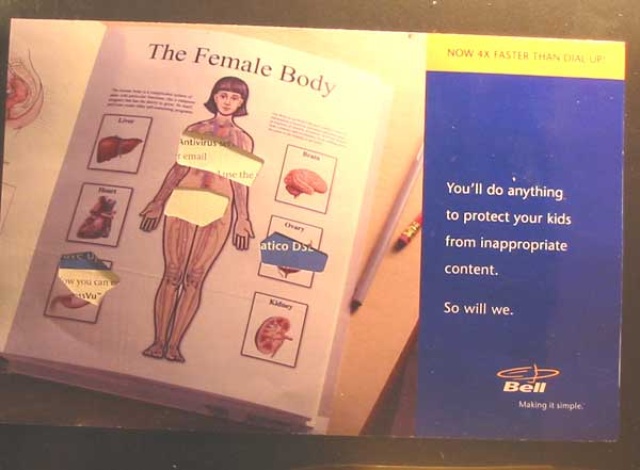
Julie C. drew our attention to this ad for an internet service that filters “inappropriate” content:

bell-ad-large

Lizvang nicely articulates an objection (my emphasis):

The breasts, the vagina, the uterus and the colon is cut out of an anatomical text book. When did biology and education about our bodies become shameful? Haven’t we as a society moved past the “a woman’s body is dirty” mindset?

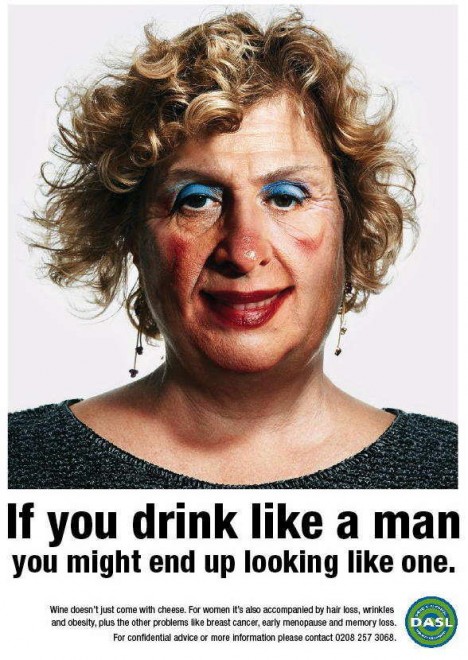
dasl-drunk-woman_thumb

Text:

Wine doesn’t just come with cheese.  For women it’s also accompanied by hair loss, wrinkles, and obesity, plus the other problems like breast cancer, early menopause and memory loss.

This ad rests on women’s fear of looking like men (whatever that means)

(1) Interestingly, none of the side-effects of alcoholism listed seem, to me, to be masculinizing.  I can only imagine that the creators of this ad thought that straying from the norms of youthful femininity makes a woman seem masculine, thereby conflating aging with masculinization in women.

(2)  Also, notice the excessive make-up.  The ad is relying on the viewer being disgusted at the idea of a masculine face covered in make-up.  That is part of what is supposed to create a negative reaction.  But make-up and masculinity are not intrinsically or naturally at odds.  We only believe this to be so.

(By the way, the fact that most men do not wear make-up, I think, is a beautiful example of the triumph of gender ideology over capitalism.  For example.  But see here.)

(3) Finally, what’s “drink like a man” all about?  I guess men can have all the wine and cheese that they want without getting wrinkles because, gosh darn it, it’s just how men drink!   Maybe they even get more masculine!  (Hmmmm… as someone who loves her liquor, suddenly I do have penis envy.)

Thanks to Julie C. for the link!

NEW! This vintage ad (found here) uses the same logic:

capture33

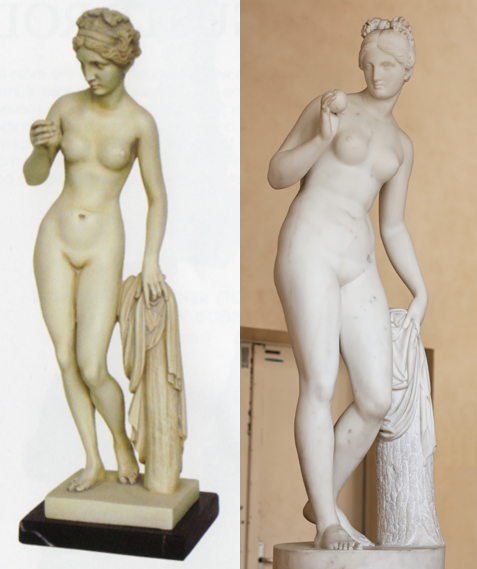
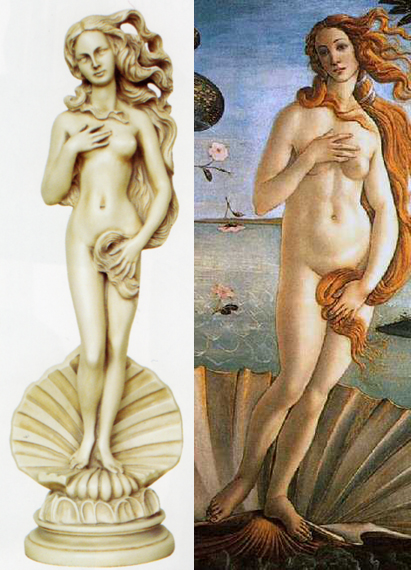
Ten Apples and a Flat Sponge reports that the Thorvaldsen Museum in Copenhagen is selling reproductions of Venus with Apple and the Birth of Venus, with some artistic interpretation:

001k60b2

001k852y

Hat tip to Shapely Prose.

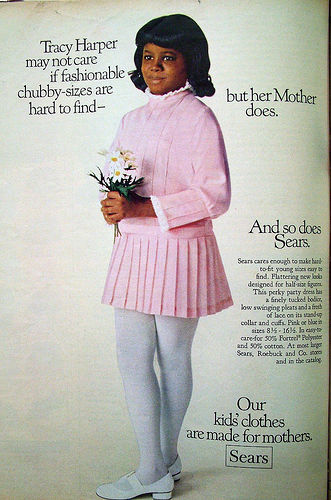
Taylor D. sent in a link to a collection of vintage ads that includes this one:

From Vintage Ads:

6a00d83451ccbc69e2011571f29c13970b

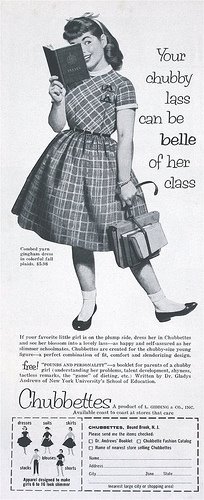
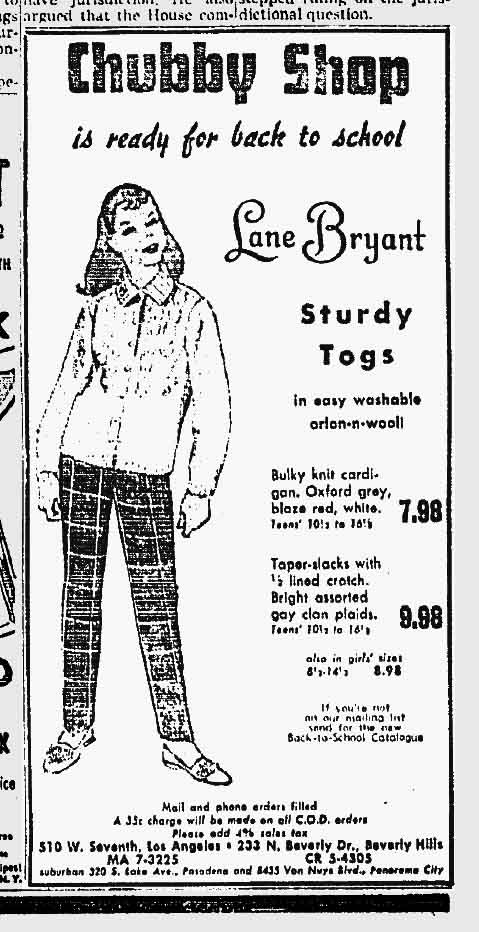
Holly M. sent us this one:

chubbiesad

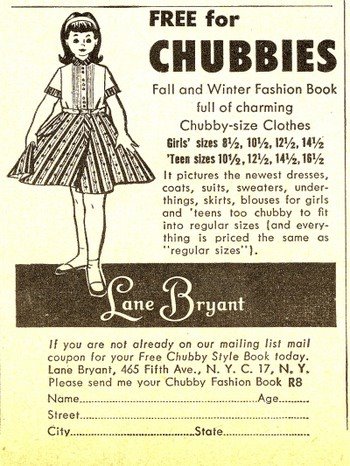
NEW! Larry Harnisch, of The Daily Mirror, sent us this one:

-1

The fact that these girls were considered “chubby” is only slightly more distressing than the fact that polyester blends were considered fashionable.

What do they call sizes for “larger” kids these days? I know they don’t say “chubby,” but I don’t think they use the “plus-size” term for kids–am I wrong? Is there a standard industry term?

The ownership of corporations under parent companies concentrates profits and profit motives, often in ways that undermine the progressive or conservative causes that the subsidiary companies purport to promote. Ben and Jerry’s Ice Cream is famous for its progressive and countercultural flavors and activities.

A tribute to the countercultural bands, Phish and The Grateful Dead:


A pacifist message:

The Barack Obama inspired flavor, Yes Pecan:

Alas, in 2000 Ben and Jerry’s was bought by Unilever, the company that brings us (pseudofeminist) Dove, (misogynistic) Axe, and (racist) Fair and Lovely products (examples herehere, here, here, here, here, here, and here).

Oh, to bring the irony full circle, Unilever owns Slimfast too.

Don’t shoot the messenger.

Hat tip to Jezebel.