As a fan of both sci fi and pre-WWII pop culture, I naturally have a lot of affection for Alex Raymond’s Flash Gordon. There’s much to be enjoyed about the original comic strip (which basically invented the style that led to the creation of super-hero comics), the 1936 serial starring Buster Crabbe, and even the 1980 movie, which I’ve mentioned before.  The 1970’s softcore porn version, Flesh Gordon, is also a lot of fun.  Although the various incarnations get pretty complicated, the basic story is of a regular guy from Earth who ends up on a bizarre alien planet, where he inadvertently becomes a hero in the struggle against Emperor Ming, the tyrant who has been keeping the whole planet under his thumb.  With the recent rebirth of big budget sci fi and comic book adaptations, the time almost seems perfect for a new Flash Gordon movie.  It’s never quite been done cinematic justice, and the basic story would hold up well to a modern interpretation.

Unfortunately, there’s one rather big problem: Emperor Ming.  As the name implies, Flash’s nemesis is an unreconstructed “yellow peril” Asian stereotype.  Despite being an alien, he’s undeniably portrayed as the worst sort of racist view of a Chinese ruler.  He’s a vindictive, inscrutable tyrant with an affection for ornate finery and a lecherous eye for (white) Earth women.  In the original comic he has bright yellow skin, long fingernails, a high-collared robe, and a Fu Manchu goatee.

Unsurprisingly, the serial was faithful to this version, casting a white actor named Charles Middleton and putting him in the same kind of “yellowface” make-up that was common in those days for portrayals of Asian characters.  Of course, the actual skin tone was irrelevant in a monochromatic film.

Concerns about racism never even entered anyone’s mind until the 1980 film.  By that time, it was necessary to be at least a little racially sensitive (but not too much).  The answer was to leave Ming basically unchanged, while pretending there was never anything Asian about him.  Swedish actor Max von Sydow was given a look that was immediately recognizable as the classic Ming, but with just enough of the Asian elements replaced with a more futuristic, “alien” look for plausible deniability.

The animated versions of Ming, in both the Filmation’s Flash Gordon series and the later Defenders of the Earth, took this idea a step further.  Ming was given green skin, as if to say, “See, this guy’s clearly an alien!  How could you accuse him of representing an Earthly race?”

Even with these attempts at a more extraterrestrial appearance, however, anyone who’s at all familiar with longstanding racist depictions of Asian men can recognize Ming as an embodiment of that unfortunate tradition.  Meanwhile, more sympathetic characters who are clearly of the same race as Ming, such as his traitorous daughter Aurra and her lover Prince Barin, were unambiguously white.  They did have yellow skin in the original comics, but even then they were less recognizable Asian than Ming.  Later portrayals, even the cartoons in which Ming is green, show them as totally caucasian.  The message seems to be that the more evil you are, the more alien you are, and alien in this case looks a lot like Chinese.

Naturally, when the Sci Fi Channel decided to adapt Flash Gordon for TV in 2007, they were eager to avoid anything that could be perceived as racism.  Their answer to the Ming problem was to completely remake the character, removing every bit of his previous look to create a very white sort of fascist dictator.

There was a lot wrong with this adaptation (it was unwatchably boring, for one), but one of the complaints against it was that Ming was lackluster and missing everything that had made him a memorable villain.  Regardless of his origins, we expect certain things from Ming: a bald head, facial hair, an ornate robe.  Exoticism.  So what is to be done?  There can be no Flash Gordon without Ming the Merciless, but it’s possible that Ming is a character too wrapped up in racism to ever escape.

In my idle moments I’ve given some thought to how Hollywood could pull off a successful Flash Gordon revamp, and the only idea I have for Ming is this: don’t run away from his faux-Chinese heritage; push it in the other direction.  Cast a Chinese actor as Ming, and make Aurra, Barin, and the rest of their people equally Chinese.  Eliminate Earth entirely, setting the story in the future and making Flash’s planet one that was colonized by the United States, while Ming’s planet was colonized by China.  You don’t need exposition for this- just imply it with production design.  For Ming’s costumes, create a futuristic variation on what Chinese emperors actually wore, rather than just an American’s simplistic idea of the look.  Do away with Ming’s predatory behavior toward Flash’s girlfriend.  It’s a creepy and dated element regardless of his race.  Finally, sweep away the blond=good/dark=bad undertone of the original by making Flash Gordon black.  After all, it would make a great role for Will Smith, a charismatic action hero who’s been hurting for a sci fi property that’s actually worth watching.

As for the role of Ming himself, there are plenty of aging action stars who could pull it off.  Given the inevitable campiness of the project, Jackie Chan might work.  I’d suggest Chow Yun Fat, except that it could be hard to distinguish his version of Ming from the character he played in the last Pirates of the Caribbean movie.

But would this be enough to redeem the character and the franchise?  Maybe privileged white fans like me need to accept that some characters and stories have too much bigotry in their history to ever be redeemed.  After all, nobody is trying to create an acceptable new version of Uncle Remus (although I say this with hesitation, because it seems possible that someone in a locked room at Disney might right now be doing that very thing).  If there is to be no more Flash Gordon, I’ll accept that, but I do wish someone could find a way to solve the problem of Emperor Ming.

———————————

Dustin Collins is pursuing an MA at the Ohio University School of Film.  When he has time between classes and screenings, he blogs about film, pop culture, and Betty Boop at okaywithme.

If you would like to write a post for Sociological Images, please see our Guidelines for Guest Bloggers.

Lisa Wade, PhD is an Associate Professor at Tulane University. She is the author of American Hookup, a book about college sexual culture; a textbook about gender; and a forthcoming introductory text: Terrible Magnificent Sociology. You can follow her on Twitter and Instagram.

Tom Schaller at FiveThirtyEight.com posted a summary of the book Authoritarianism & Polarization in American Politics:

…authoritarianism is really about order–achieving it, maintaining it, and affirming it–and especially when citizens are uncertain or fearful. This, they say, is why authoritarians seek out and elevate, well, authorities–because authorities impose order on an otherwise disordered world. They provide a useful review the existing literature on authoritarian traits, which have been connected to negative racist stereotyping, a belief in biblical inerrancy, a preference for simple rather than complex problem-solving, and low levels of political information.

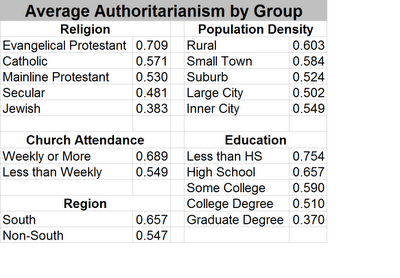
The authors, Marc Hetherinton and Jonathan Weiler, provide a breakdown of average levels of authoritarianism in the U.S. based on various characteristics:

authority

Over at the Huffington Post, Weiler discusses the connection between authoritarianism and racial attitudes:

Authoritarian-minded individuals are, after all, likely to judge more negatively minority groups and those negative judgments, in turn, inform a host of political positions…

We find that in a politics organized by authoritarianism, even non-racial issues are becoming a matter of race and, more broadly, are taking on more visceral symbolic significance…

In sum, there is reason to think that beneath the arguments about government intrusion into the health care market, death panels, and such, a much more visceral dynamic is at work. To be perfectly clear, it is far from the case that every opponent or skeptic of significant health-care reform is a racist or racially motivated in her or his thinking. But there is, at the least, very strong circumstantial evidence that views of race and beliefs about health care reform are linked significantly among many Americans, which probably explains why the debate on health care reform has caused a much stronger uproar in 2009 than it did in 1994.

For an example of this type of racial resentment, see our recent post on Rush Limbaugh’s description of “Obama’s America.”

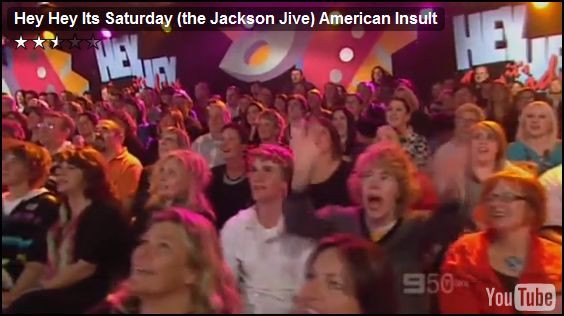
Our intern, Velanie, forwarded us a link to a clip from an Australian variety show called Hey Hey It’s Saturday.  In the clip a group called the Jackson Jive perform in blackface.  Steel yourself; maybe skip it if you’re not up to being reminded, again, of white racism against blacks.

Sometimes people wonder why black people are not more open or trusting of whites.  This is why.  Harry Connick Jr., bless his heart, did what he could to try to make it clear that the performance was not acceptable.   And, to be fair, the producers (?) gave him an opportunity to object more articulately.  Here is a part of what he said at the end of the clip:

I just wanted to say on behalf of my country, I know it was done humorously but we have spent so much time trying to not make Black people look like buffoons that when we see something like that we take it really to heart… if I knew it was gonna be a part of the show I definitely wouldn’t have done it. So I thank you for the opportunity. I give it up cause Daryl said on the break you need to speak as an American. Not as a Black American or a White American but as an American I need to say that, so thank you for the opportunity.

I’m sure that many people appreciated that Connick stood up against blackface.  But he is the exception.  The host of the show didn’t apologize, he just pleaded ignorance and felt bad that Connick was offended.  The rest of the people, including the unrepetant performers, the judges, and (it appears) the majority of the audience, had absolutely no problem with the performance.  Further, the majority of Australians are defending the minstrelsy.  Mary Elizabeth Williams, at Salon, summarizes:

In a poll on PerthNow.com.au, 81 percent of respondents said the sketch was not racist, with other newspapers clocking in with similar percentages. Punch deputy editor Tory Maguire glumly asserted that “The 2.5 million Australians who were watching were looking for nostalgia, so a returning act like the Jackson Jive was always going to appeal to them.” It’s a sentiment echoed by the show’s host, Daryl Somers, who told reporters that Australian audiences “see the lightness of it.”

Dr. Anand Deva, who appeared as Michael in the sketch, told an Australian radio station this week, “This was really not intended … [to be] anything to do with racism at all…

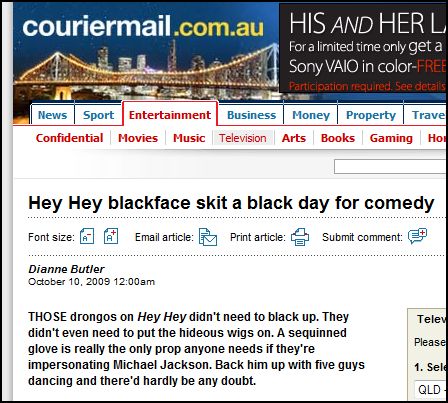
Couriermail decides it’s a great opportunity for a cheeky pun:

sss

Williams continues:

What should be obvious to anyone who isn’t a complete moron is that a little something called the entire history of Western civilization — what with the slavery and the colonization and the genocide — disqualifies us from mocking people for their color as grounds for entertainment. It’s just that simple.

It is just that simple.  But so many white people still defend it.

This is why black people don’t trust white people.  Because they never know what kind of white person they’re dealing with and it’s not worth the risk because, a good portion of the time, they’re dealing with the host who is “sorry that you were offended” (as if the offense is your own personal defect) or the lady in the audience who is just really excited to be on TV.

Capture11

Via Shakesville and Womanist Musings.

—————————

Lisa Wade is a professor of sociology at Occidental College. You can follow her on Twitter and Facebook.

Lisa Wade, PhD is an Associate Professor at Tulane University. She is the author of American Hookup, a book about college sexual culture; a textbook about gender; and a forthcoming introductory text: Terrible Magnificent Sociology. You can follow her on Twitter and Instagram.

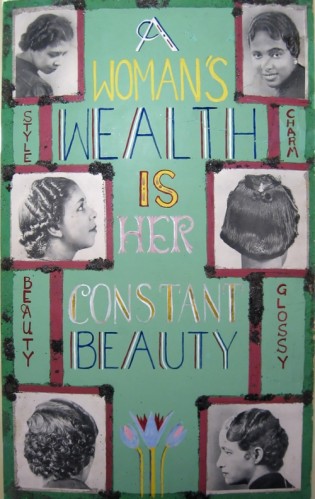
Mary M., of Cooking with the Junior League, took a moment out of her busy Dodgers-watching schedule to send me a link to some posters for products aimed at African American women. They were displayed at the Negro Industrial Fair in NYC in 1939 and contain some fascinating ideas about femininity, beauty, and attracting a man.

Given that a woman’s best chance at economic stability was often through marriage, this one probably wasn’t all that off-base:

jwj_mss_47_placard_05

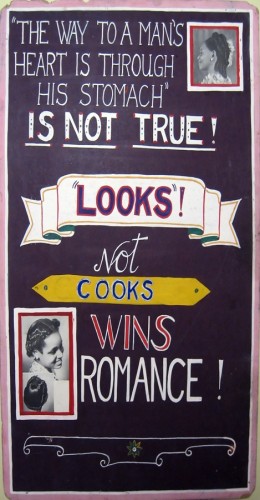
Of course, it takes an enormous amount of time, energy, and money to be sure your beauty is “constant.” But it’s necessary, because beauty is the true way to get a husband:

jwj_mss_47_placard_06

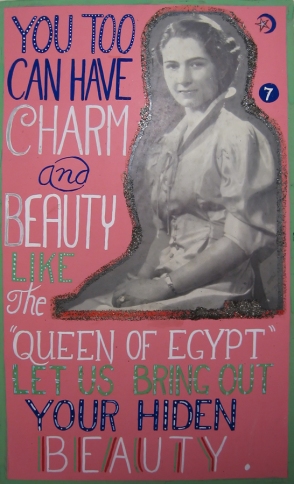
Notice the message in that one: you might be incredibly skilled in some areas of traditional femininity (say, cooking), but it’s not enough if you can’t combine it with beauty. And you can get charm and beauty through purchasing the right products:

jwj_mss_47_placard_011

See also our post on Chris Rock’s documentary “Good Hair“and a woman gets fired for having an Afro.

Though EVERYONE knows that models are very skinny and that this is bad for the self-esteem and health of women, I was just shocked at how deathly thin the models were at the most recent Paris Fashion Week.

Ashley Mears has a really excellent and sophisticated article in the journal Ethnography, based on her experiences as a model, called Discipline of the Catwalk.  She describes how models are subject to (from the abstract) “…a disciplining labor process in which female bodily capital is transformed into a cultural commodity.” More, because market demand is based on constantly changing fashions in women’s “looks,” women have little to no control over their own value in the market.  Mears writes:

This labor process typifies the politics of gender, in which women exercise power over themselves insofar as they internalize and pursue the glamour of their regime.

Given that some things about our bodies are simply not under our control (e.g., height, skin and eye color, etc), thinness may be appealing as it is one thing that models can control.  And, apparently, being very, very skinny is still very, very in.

These women are modeling Lindsey Lohan’s fashion line only incidentally.  It’s just the particular post I happened to see over at Jezebel.

See also a previous post on how celebrity superstar women have been getting skinnier over time.

—————————

Lisa Wade is a professor of sociology at Occidental College. You can follow her on Twitter and Facebook.

Lisa Wade, PhD is an Associate Professor at Tulane University. She is the author of American Hookup, a book about college sexual culture; a textbook about gender; and a forthcoming introductory text: Terrible Magnificent Sociology. You can follow her on Twitter and Instagram.

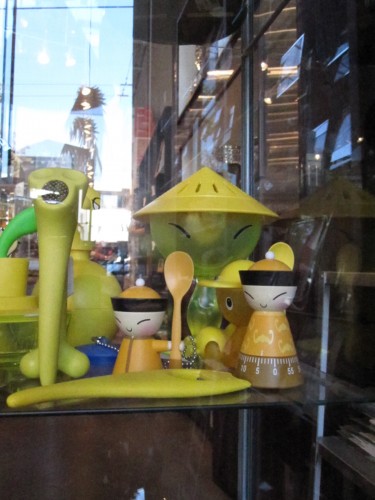
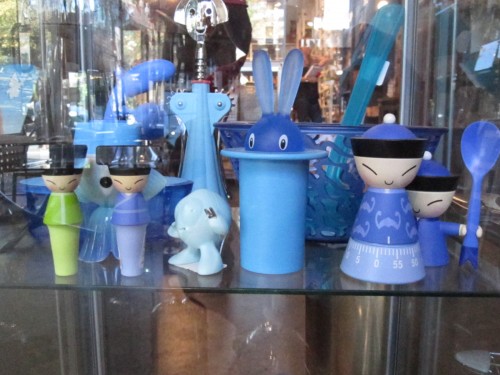
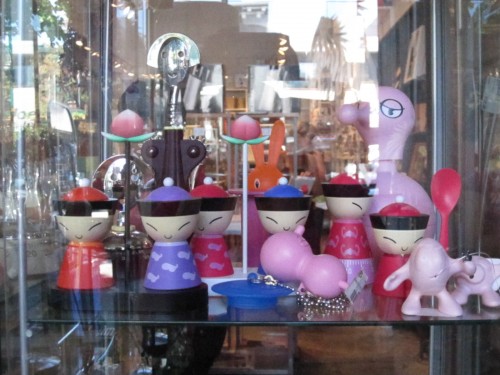
Tracy H. and a friend were shopping in some expensive kitchen/housewares stores in Kits, an upscale  neighborhood on the west side of Vancouver. In one store they came upon a display of kitchen utensils (salt and pepper shakers, timers, and so on) designed to look like Asians, complete with slanted eyes and what Tracy calls “rice-paddy hats”:

IMG_0724

IMG_0725

IMG_0726

Here’s another set in the display case:

IMG_0727

So we have a display case in an expensive store full of utensils meant to be cutesy and funny, and where items shaped like monkeys, rabbits, faceless blobs, and Asians are all presented as equivalent adorable, humorous, hip options.

UPDATE: Commenter London Mabel gave us a link to the National Palace Museum in Taiwan’s website; the Asian kitchen utensils are part of the “Chin Family Series’:

Drawing his inspiration from a picture of the young Chin seen on a visit to the NPM, one of ALESSI’s main designers Stefano Giovannoni created The Chin Family series– “Mr. Chin” and other items in the series including the salt & peppershaker set “Mr. and Mrs. Chin”, the eggcup and timer…Customers around the globe will have the opportunity to take home a piece of ancient Chinese history brought tastefully into fashion!

So what do you think? Cute? Neutral? Problematic? Does it make a difference that the majority of people who see them probably don’t know about the context and just seem them as Asian-themed utensils? Would people of Asian descent living in the U.S., Canada, and other countries possibly feel differently about seeing things like this on display or sale than the directors of the museum?

Other examples of modern racial caricatures on sale: golliwogs, mammie souvenirs in Georgia, and an Icelandic reproduction of 10 Little Negro Boys.

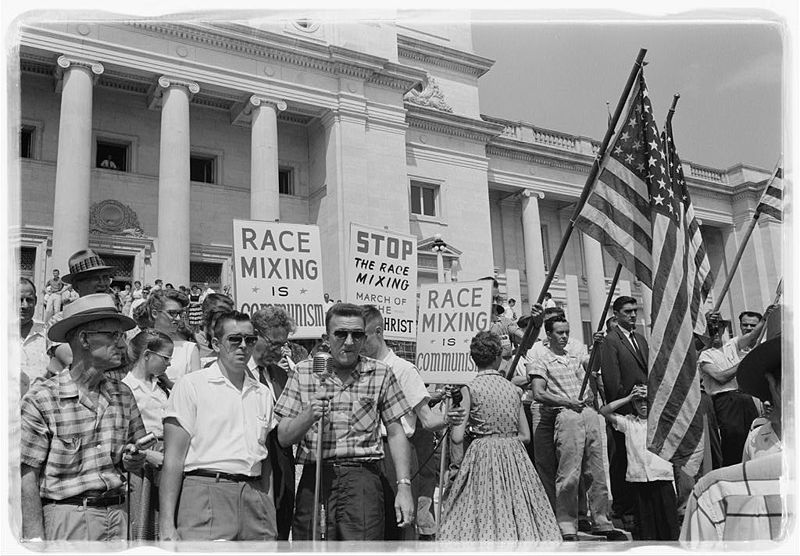
Protesters in Little Rock, Arkansas, (1959) declared that “race mixing” (or school integration) was “communism”:

800px-Little_Rock_integration_protest

A reader at Andrew Sullivan’s The Daily Dish argues that accusations of communism then, and socialism now, are not only about the redistribution of wealth.  They are about the redistribution of privilege of all kinds, including white privilege.

Read it here.

Thanks to Dmitriy T.M. for the link.

—————————

Lisa Wade is a professor of sociology at Occidental College. You can follow her on Twitter and Facebook.

Sometimes you see an image or video that is pretty subtle and complicated, and it takes some mental wrangling to figure out what it’s conveying and what cultural ideas it’s drawing on or contradicting.

And then there are things like this, sent in by Joshua B.:

1. Normalization of heterosexual male gaze (until the very end)

2. Girls getting naked

3. While washing a car ‘n stuff

4. And they come in various ethnic flavors

That’s pretty much it.

About the man at the end, reader Victoria says,

I think it’s still the male gaze – just adding gay men to the mix at the end. The “Or, if you prefer” (or whatever they say) seems to clearly speak to the men in the audience.

I agree.