Sonita M. sent in a report from the Movement Advancement Project about the state of lesbian, gay, bisexual, and transgender (LGBT) families.

LGBT families are more likely to be poor than non-LGBT families.  Nine percent of married cis-gender different-sex couples live in poverty, compared to 21% of gay male couples and 20% of lesbian couples:
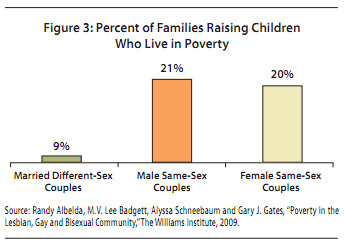
LGBT couples may be more likely to be in poverty in part because of wage differentials between gays, lesbians, and their heterosexual counterparts.  Research shows that gay and bisexual men earn significantly less money than heterosexual men, whereas lesbians make somewhat more money than straight women.  Gay men would be more likely than heterosexual men to be in poverty, then.  But what about women? Women in same-sex couples face the same wage disadvantage that all women face, but also are not married to the heterosexual men that are making so much money (making it so that heterosexual women can make less money than gay women, but still be less likely to live in poverty). Make sense?  I hope so.

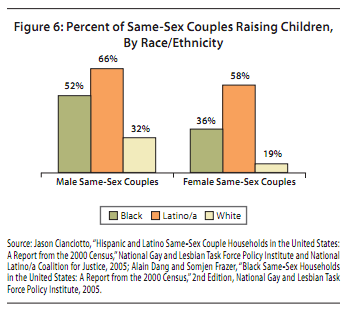
The second reason that LGBT couples with children are more likely than cis-gendered different-sex couples with children to live in poverty is that Black and Latino LGBT people are more likely than White LGBT people to be parents, and Blacks and Latinos are disproportionately poor to begin with:
Among same-sex couples, being a parent is also correlated with immigration status, which also correlates with class.  Non-citizens are more likely to be parents than citizens:
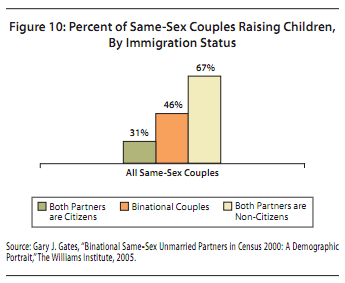

The two million children in America being raised by LGBT parents, then, are more likely to suffer from class disadvantage.  The authors of the report go on to discuss the ways in which formal policy and informal discrimination contribute to this state of affairs.

Via Andrew Sullivan.

Lisa Wade, PhD is an Associate Professor at Tulane University. She is the author of American Hookup, a book about college sexual culture; a textbook about gender; and a forthcoming introductory text: Terrible Magnificent Sociology. You can follow her on Twitter and Instagram.
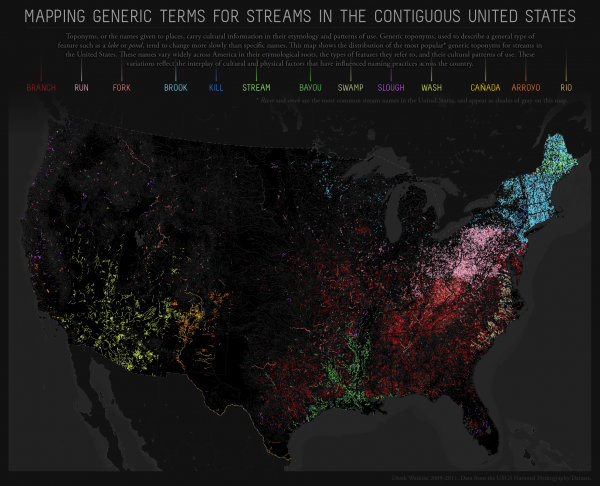
Dolores R. sent a link to a map created by Derek Watkins to show how the names given to geographic features reflect cultural patterns. Using a database of names officially accepted by the U.S. Board of Geographic Names, Watkins mapped generic terms used in the names of streams (excluding “creek” and “river,” which are commonly used throughout the U.S and were plotted in a gray that fades into the background):

The generic terms reflect historical immigration patterns. “Kill” appears in areas of New York originally settled by the Dutch; “cañada,” “arroyo,” and “río” indicate areas of Spanish exploration and settlement in the Southwest; of course, Louisiana and the surrounding area still reflects its French heritage through the term “bayou.”

The map reflects internal migration and cultural diffusion within the U.S., as well. For instance, Watkins suggests that the patch of red in southwest Wisconsin, indicating the use of “branch,” may be due to the lead mining boom in the early 1800s. Lead mining attracted Appalachian miners to the area, and they may have influenced local naming practices, bringing along terms common in Appalachia.

For more on the interconnections between geographic names or terms and larger cultural patterns, Watkins suggests reading Names on the Land: A Historical Account of Place-Naming in the United States, by George Stewart (2008). Another excellent source is Wisdom Sits in Places: Landscape and Language among the Western Apache, by Keith Basso (1996).

To be effective, every social movement has to ensure that the language used to describe it sends the message it wants to send and resonates with a large audience.  The Occupy Movement’s popularization of the phrase “We are the 99%” is an excellent example of this.  It is a simple, inclusive phrase that brings to mind the wealth gap.  It has certainly resonated and it has changed the overall discourse.

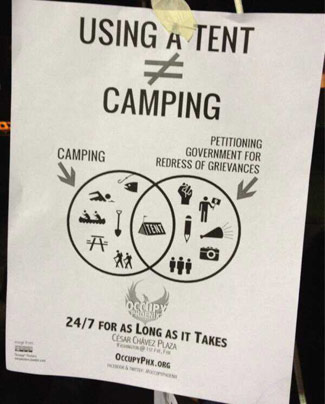
Keeping atop of the language, though, is always an ongoing battle.  This flyer, put up by members of Occupy Phoenix, is a great example of a conscious effort to get control of the discourse.  It targets the word “camping,” suggesting that what they are doing is not accurately described by the term:

“Using a tent,” they claim, is not the same as camping.  Camping is fun, filled with leisure activities.  They, in contrast, are doing hard work, “petitioning the government for redress of grievances.”  I hadn’t thought of it before I saw the flyer, but they are absolutely right that the word “camping” threatens their cause.  What a wonderful example of the power of language and the need to carefully control it.

Lisa Wade, PhD is an Associate Professor at Tulane University. She is the author of American Hookup, a book about college sexual culture; a textbook about gender; and a forthcoming introductory text: Terrible Magnificent Sociology. You can follow her on Twitter and Instagram.
Jake C. sent in a good example of the racialization and gendering of jobs within the service industry. This photo shows two notices for openings at a restaurant, one in English, one in (misspelled) Spanish:

The notice in Spanish isn’t a translation of the one about the hostess job; rather, it announces that two people are needed as dishwashers. It shows the way that particular positions within a workplace are often associated with certain groups, and how organizational policies may reinforce occupational segregation by sex or race/ethnicity. The role of greeting and seating customers is explicitly gendered as a hostess, while the language difference will channel applicants into different jobs. These types of practices are one part of the process that channels individuals into different positions in the workplace, both by restricting access to information about jobs and providing subtle messages to potential applicants about which positions are the best fit for them.

According to Federal Parliament member Charlie Angus, leaders of the Attawapiskat First Nation have declared a state of emergency. Living conditions are so terrible on the reserve that members of the community are at significant risk of illness and death.  Many residents have no electricity, heat, or running water.  They are living in uninsulated tents and shacks.  Many of these residences are filled with black mold and prone to quick-spreading fires.  Some use buckets as bathrooms; with no facilities, they dump their sewage into the streets.

Angus writes:

When it comes to the misery, suffering and even the death of First Nations people, the federal and provincial governments have developed a staggering capacity for indifference.

Try to imagine this situation happening in anywhere else in this country. We all remember how the army was sent into Toronto when the mayor felt that citizens were being discomforted by a snowstorm. Compare that massive mobilization of resources with the disregard being shown for the families in Attawapiskat.

The government waited a month to respond, but has now accepted some responsibility for the health and welfare of the residents.  Attawapiskat leaders are now trying to raise awareness of the other First Nation communities in Northern Canada with similar conditions.

Lisa Wade, PhD is an Associate Professor at Tulane University. She is the author of American Hookup, a book about college sexual culture; a textbook about gender; and a forthcoming introductory text: Terrible Magnificent Sociology. You can follow her on Twitter and Instagram.

Cross-posted at Ms.

I thought it would be fun to have a round-up of examples of masculinizing the feminine — that is, attempts to sell items to men through repackaging and renaming, drawing on ridiculous stereotypes of masculinity to assure men that they can use these products without becoming girly.

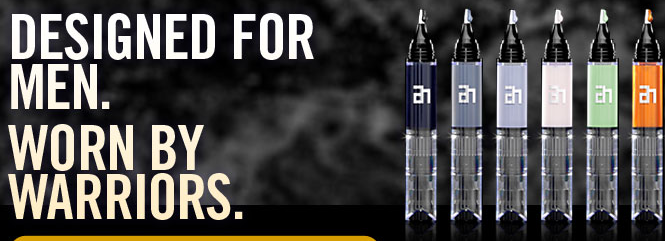
To start off, how might you sell nail polish to men? Call the brand Alphanail and associate the product with sex and warfare, of course, with, as submitter Gabriella says, “women as props and men as warriors”:

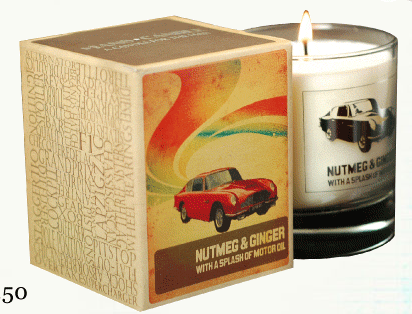
Clémentine C. noticed that Canova, a British company that sells candles, has a line of candles specifically for men, identifiable by the manly images and scents. While the other candles are given names like sweet pea or watermelon, the men’s versions have more detailed names, with allusions to “bringing out the dog in you,” “the sweet smell of success,” and “a splash of motor oil.” The Cassis & Fig with Added Danger candle  includes a silhouette of a woman behind a martini glass, reminiscent of a stripper pole:

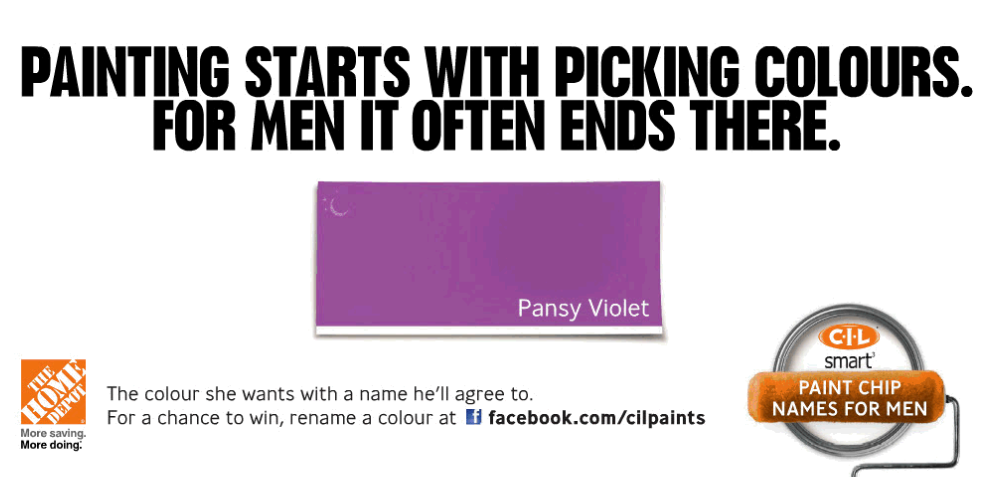
Jennifer W., Kirstie McC., Savannah G., Kristina K., Dmitriy T.M., and Scott C. informed us that CIL Paints, a Canadian company, is trying to masculinize paint colors. The website provides men with a range of colors for their “ultimate man caves.” Scott saw this ad for the line in Toronto’s Metro back in September:

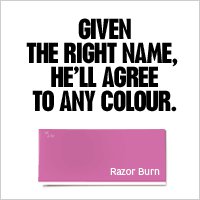
What makes these colors masculine? A simple name change. The website helpfully translates the “real” names of their paints into man-speak:

According to a video created as part of the ad campaign, a quick name change instantaneously changes men’s perceptions, making them compliant with women’s wishes (“The colour she wants with a name he’ll agree to”):

Indeed, the central message is that men are incredibly stupid and easily duped; women just have to manipulate them a bit:

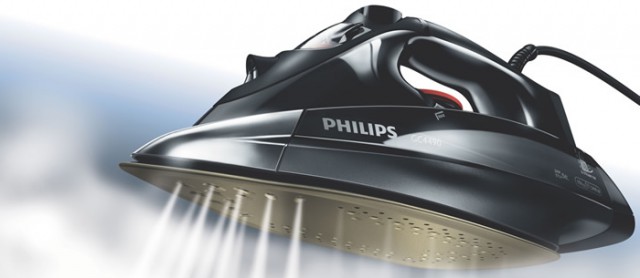
Now we’ve got the house painted; it’s time for some chores! Anjan G. let us know that appliance company Philips designed an iron just for men:

The man-friendly features on this “robust” iron “power tool for ironing,” described on the Philips website as the “Anodilium soleplate man iron,” include “more power, more steam, more performance” to give you “an endless excellent gliding experience.”

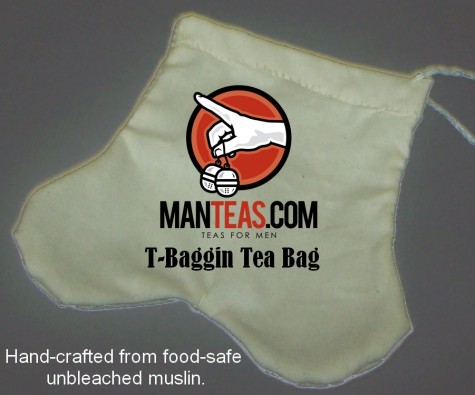
Now, let’s say that you’ve just ironed all your clothes with your ironing power tool, and now you want a little rest. Hmmm, you might think, I’d like a nice warm beverage, but I don’t want to appear girly. Thanks to Elisabeth M., we discovered that Man Teas has an answer for you, with their goal of making tea safe for men:

…most of the specialty teas out there have stuff like rosehips and lemon zest in them (what the hell is “zest” anyway?) and they are packaged and merchandised to appeal to women. What guy is going to pick up a box of Cozy Sleepytime Tea with a pajama’d teddy bear on it? Not this guy.

At least three different varieties of their teas are bacon-flavored. And to make sure every element of your tea-consuming experience is sufficiently manly, you can steep your tea is this manly T-Baggin Tea Bag:

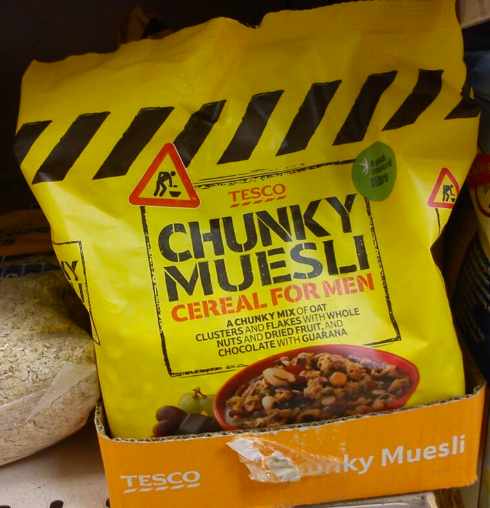
And finally, along with your tea, perhaps you’d like some healthy cereal, but you’re worried that health foods are associated with women. Well, don’t worry; Tesco sells Chunky Muesli, a “cereal for men.” It’s made safe for men with construction-zone packaging:

Thanks to Sophie K. for sending us the photo!

Gwen Sharp is an associate professor of sociology at Nevada State College. You can follow her on Twitter at @gwensharpnv.

In a link sent in by Anjan G., Victoria’s Secret model Adriana Lima explains what she does in the months prior to walking the catwalk (source).   Here’s a summary:

  • For months before the show, she works out every day with a personal trainer; for the three weeks before, she works out twice a day.
  • A nutritionist gives her protein shakes, vitamins and supplements to help her body cope with the work out schedule.
  • She drinks a gallon of water a day.
  • For the final nine days before the show, she consumes only protein shakes.
  • Two days before the show, she begins drinking water at a normal rate; for the final 12 hours, she drinks no water at all.  She loses up to eight pounds during this time.

The result.

Lima’s training and nutrition regimen reveal that the look that is believed by some to be the epitome of feminine accomplishment — the look required to be a Victoria’s Secret Angel — is accompanied by significant physical strain.  Lima looks as she is supposed to on the runway, but she is also dehydrated and hungry.

The story reminded me of this photograph, taken by Zed Nelson.  It shows Ronnie Coleman, immediately after walking off the stage at the Mr. Olympia competition, breathing through an oxygen mask.  He would take first place.  Explaining the photograph, Nelson writes:

Oxygen administered to exhausted contestants during final round of judging. The strain of intense dieting, dehydration and muscle-flexing, places high levels of strain on the heart and lungs, rendering many contestants dizzy, light-headed and weak.

Bodybuilders often have extreme and rigid exercise and diet plans in the months preceding a contest.  In those months, a male bodybuilder’s goal is to make himself appear as strong as possible. He must balance his body’s functional needs with his aesthetic goals, and sometimes the latter wins over the former.

Male bodybuilders and female models, then, represent aesthetic extremes of masculinity and femininity, but their bodies aren’t the natural extension of male and female physicalities. Instead, achieving the look require significant sacrifice of one’s body.  In other words, they look fit and strong, but looks can be deceiving.

See also:  criticism of female body builders and the right to consume women’s beauty.

Lisa Wade, PhD is an Associate Professor at Tulane University. She is the author of American Hookup, a book about college sexual culture; a textbook about gender; and a forthcoming introductory text: Terrible Magnificent Sociology. You can follow her on Twitter and Instagram.
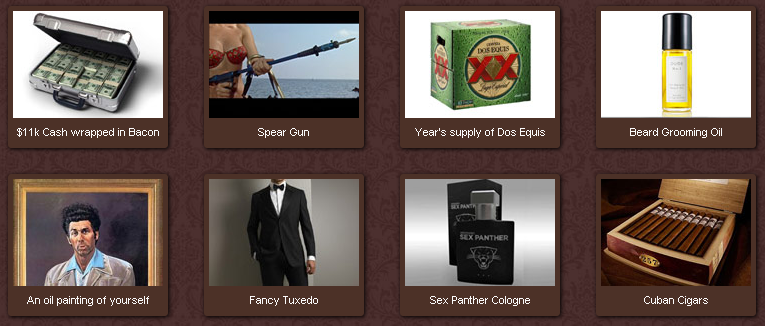
Kathy H. sent in a link to a story about a start-up in Los Angeles, Scopely, that’s trying to use humor to compete with the budgets of bigger companies.  Their aim is to hire engineers who are willing to trade a higher salary to get in on the ground floor of a promising, but nascent endeavor.  How are they doing it?  By promising silly signing-prizes, like $11,000 wrapped in bacon.  Cute, right?  But in their creative planning, they forgot that women exist. Here’s their list of bonuses:

Cigars and beer are masculinized items, but tuxedos, cologne, and beard grooming oil are actually for men.  Maybe the spear gun is for women?   They do, to be fair, show a pair of breasts operating it.

Maybe if Scopely recognized the other half of the population, they wouldn’t have to try so hard to find employees.

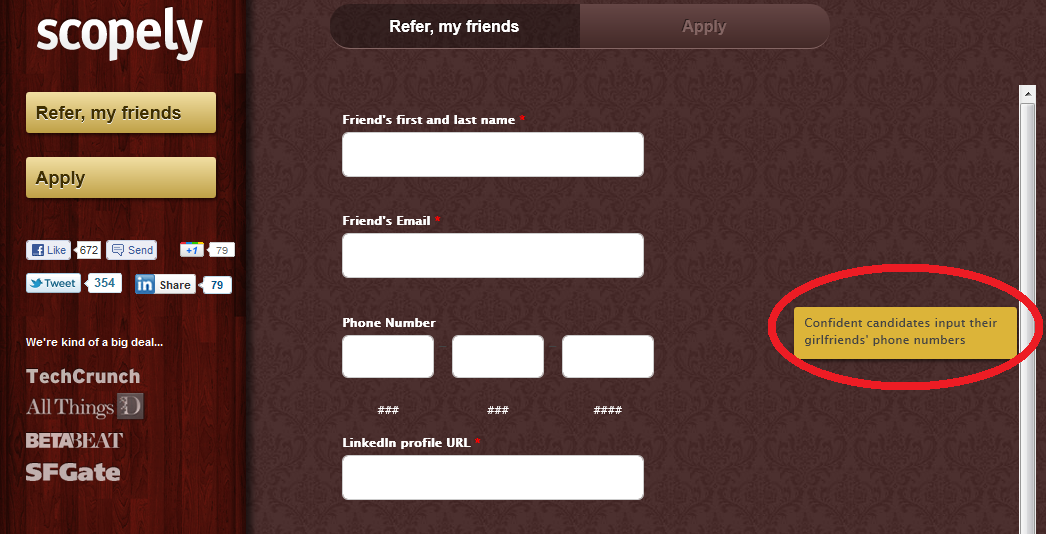
UPDATE: A reader, who also happens to be a female engineer, noticed that Scopely throws in another sexist (and this time heterocentrist) LOL on its job application form, where it prompts applicants to put in their girlfriend’s phone number if they’re confident (and, yes, this could include lesbians, but I don’t think that’s what they were going for):

Lisa Wade, PhD is an Associate Professor at Tulane University. She is the author of American Hookup, a book about college sexual culture; a textbook about gender; and a forthcoming introductory text: Terrible Magnificent Sociology. You can follow her on Twitter and Instagram.