
This is the first part in a series about how girls and women can navigate a culture that treats them like sex objects. Cross-posted at Ms., BroadBlogs, and Caroline Heldman’s Blog.
Around since the 1970s and associated with curmudgeonly second-wave feminists, the phrase “sexual objectification” can inspire eye-rolling. The phenomenon, however, is more rampant than ever in popular culture. Today women’s sexual objectification is celebrated as a form of female empowerment. This has enabled a new era of sexual objectification, characterized by greater exposure to advertising in general, and increased sexual explicitness in advertising, magazines, television shows, movies, video games, music videos, television news, and “reality” television.
What is sexual objectification? If objectification is the process of representing or treating a person like an object (a non-thinking thing that can be used however one likes), then sexual objectification is the process of representing or treating a person like a sex object, one that serves another’s sexual pleasure.
How do we know sexual objectification when we see it? Building on the work of Nussbaum and Langton, I’ve devised the Sex Object Test (SOT) to measure the presence of sexual objectification in images. I proprose that sexual objectification is present if the answer to any of the following seven questions is “yes.”
1) Does the image show only part(s) of a sexualized person’s body?
Headless women, for example, make it easy to see her as only a body by erasing the individuality communicated through faces, eyes, and eye contact:
We get the same effect when we show women from behind, with an added layer of sexual violability. American Apparel seems to be a particular fan of this approach:

2) Does the image present a sexualized person as a stand-in for an object?
The breasts of the woman in this beer ad, for example, are conflated with the cans:

Likewise, the woman in this fashion spread in Details in which a woman becomes a table upon which things are perched. She is reduced to an inanimate object, a useful tool for the assumed heterosexual male viewer:
Or sometimes objects themselves are made to look like women, like this series of sinks and urinals shaped like women’s bodies and mouths and these everyday items, like pencil sharpeners.
3) Does the image show a sexualized person as interchangeable?
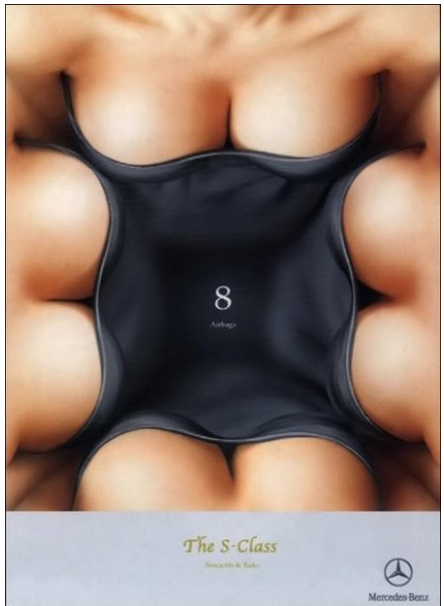
Interchangeability is a common advertising theme that reinforces the idea that women, like objects, are fungible. And like objects, “more is better,” a market sentiment that erases the worth of individual women. The image below advertising Mercedes-Benz presents just part of a woman’s body (breasts) as interchangeable and additive:

This image of a set of Victoria’s Secret models, borrowed from a previous SocImages post, has a similar effect. Their hair and skin color varies slightly, but they are also presented as all of a kind:
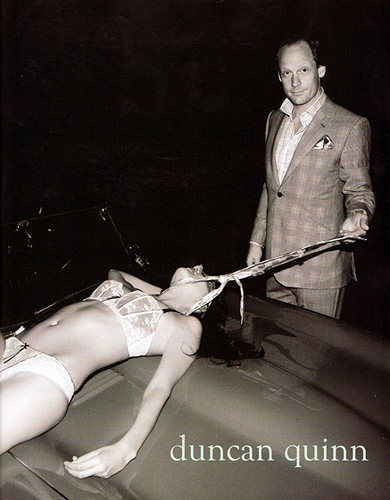
4) Does the image affirm the idea of violating the bodily integrity of a sexualized person that can’t consent?
This ad, for example, shows an incapacitated woman in a sexualized positionwith a male protagonist holding her on a leash. It glamorizes the possibility that he has attacked and subdued her:
5) Does the image suggest that sexual availability is the defining characteristic of the person?
This ad, with the copy “now open,” sends the message that this woman is for sex. If she is open for business, then she presumably can be had by anyone.
6) Does the image show a sexualized person as a commodity (something that can be bought and sold)?
By definition, objects can be bought and sold, but some images portray women as everyday commodities. Conflating women with food is a common sub-category. As an example, Meredith Bean, Ph.D., sent in this photo of a Massive Melons “energy” drink sold in New Zealand:
In the ad below for Red Tape shoes, women are literally for sale:

7) Does the image treat a sexualized person’s body as a canvas?
In the two images below, women’s bodies are presented as a particular type of object: a canvas that is marked up or drawn upon.


——————
The damage caused by widespread female objectification in popular culture is not just theoretical. We now have over ten years of research showing that living in an objectifying society is highly toxic for girls and women, as is described in Part 2 of this series.
Caroline Heldman is a professor of politics at Occidental College. You can follow her at her blog and on Twitter and Facebook.
Comments 152
kutsuwamushi — July 2, 2012
I think that #7 is touching on a good point, but is too broad. It would seem to cover any photograph of women who have chosen to modify their own bodies with tattoos, for example. To me, an important distinction is the agency of the woman. The image on the left appears to be a woman who had nothing to do with placing those words on her body; she's just something for another person to draw on. An image of a woman showing off tattoos she's proud of, on the other hand, would present her as a person who made this decision and is therefore not another person's object. She may consider her body a "canvas," but that is partly a claim of her own control and ownership of it.
The GaGa picture is an interesting one, though, because you have a woman who is active and facing you and who has a popular image of being someone who *chooses* to dress up in provocative and unusual outfits. She doesn't tattoo her body but she does use it as a place to hang her artistic expression (which centers mainly on fashion). However, she is deliberately posing her body in a way that copies the highly sexualized poses found in many images where women are presented with little or no agency.
If it weren't for the fact that this particular outfit just happens to have writing on it, this image would not be considered sexually objectifying under your list of criteria. But, imagine the exact same photo, except the areas where there is writing there is solid black. Is it really not sexually objectifying at all?
(Is it even an either-or question?)
Veronica — July 2, 2012
Those ads are just horrible horrible things.
I mean, I'm attracted to women, and appreciate a beautiful body, but such blunt objectification triggers completely different feelings in me. I find them repulsive.
Aasdas — July 2, 2012
amount of fucks i give:
0.
Tusconian — July 2, 2012
I do have an issue with the VS ad being used in the same context of something like the "nice cans" or Mercedes ads. The VS models are sexualized, but that is the point. They're saying "buy this lingerie, and you will look sexy." Them being interchangeable, I don't know, but it has much more to do with the standards of hiring models than presenting the women as interchangeable. Unlike the Mercedes ad, it's clear that the women are different people, though they all fit into a general beauty standard. Though the VS ad does cater to the male gaze, you can tell quickly that the ad is ultimately for women, and the ad itself is relevant to the product it's selling. Beer, cars, gym shoes, and sunglasses don't have any inherent connection to sexiness. People will buy them whether they make the buyer appear sexy or not. Plus, compare the VS ad to the others. Sure, they're posed in rather silly ways, but it's not overtly sexual like the AA ads, nor like inanimate objects like the table ad, or with their heads cropped out like most of the other ads. Again, it's clearly sexualized, but it also shows them as entire people, not disembodied boobs or actual objects or just sex objects.
kdlmn — July 2, 2012
This is a wonderful (and unfortunately very helpful) post. Thank you very much! I will share widely.
Like that person several years ago I couldn't believe the Mercedes-Benz airbags ad, but it's real. It's from 2002 and appeared exclusively on the Korean market. The ad agency was (equally Korean) Cheil Communications: http://adage.com/article/adage-encyclopedia/cheil-communications/98386/
decius — July 2, 2012
Would it be that hard to throw in one counterexample of an image that was of a sexualized person but not objectifying them, or an image where it was a male being sexualized?
It doesn't seem like there is a consistent standard used to evaluate whether these particular images are objectifying; it seems like they have been determined to be objectifying and the reasons why have been rationalized afterwards.
MPS — July 2, 2012
I like that you are there trying to clarify the "objectification" mantra. I think it would be interesting to clarify in the context of objectification of men.
Broadly speaking, I think the dynamic at play is: men assess women more in terms of their health, signaled in part by secondary sex characteristics, while women assess men more in terms of wealth, signaled in part by social status. Of course the culturally dominant forms of "sexiness" don't necessarily correspond to healthiness; however the culturally dominant forms of "status" don't necessarily correspond to wealth. We have a very sophisticated mating ritual; but the basis is women using their physical assets to lure men into supporting them and their children, and men using their financial assets to lure women into sex. (This dynamic is presumably rooted in historical, patriarchal society in which men control the community resources -- access to those resources being aligned with "status" -- but I don't know if it's innate or cultural.)
You have documented one side of this: women seek to compete with each other for men by displaying their value in relation to sex. Advertisers appeal to that; thus they strive to communicate that this product will make you sexy. Advertisers also appeal to the instinct in men that values women in this way; thus they strive to get men's attentions using sex symbols.
But there is another side: men seek to compete with each other for women by displaying their value in relation of providing material resources. Men appear in advertisements wearing fine suits, expensive watches, next to expensive cars, and so on. These are all signals of wealth; in advertisements intended for women, they are intended to get attention, presuming status symbols do this for women; in advertisements intended for men, they are intended to communicate that this product will signal that you are high status.
I don't mean to suggest that there is some "fairness" in the fact that there are two sides to this. In fact, I think looking at both sides like this helps clarify how the cultural norms are unfair. Because the modes by which women appeal to men are not very empowering to women: you are either physically attractive or not, if not there is not a whole lot you can do about it. What can be done about it is not widely regarded as life-enriching activity. But the modes by which men appeal to women are very empowering: there are lots of ways to get wealth, and moreover the signal of this has evolved to include things that have little to do with wealth. That is, a man can be attractive by being a good poet or musician or knowledgeable or funny; these are all status signals which are presumably attractive in connection to traits that associate with being a good provider, but in the modern world they give men a lot of options. Moreover, seeking status among the various acceptable directions IS widely regarded as life-enriching activity. That is, I become more attractive to women by being successful at my job -- the underpinnings of which objectifies me as a provider -- but in fact I chose my job because I like it and being successful at it is a life-enriching pursuit.
Heather — July 2, 2012
Overall, these are great examples and rules of thumb, but I also agree with the objections to #7 and to the VS models. As someone else pointed out the VS lingerie is advertised to make one believe that if you wear their underwear you will look as sexy as these models. I could argue that it's even just to make you FEEL as sexy as the models look. Now, there's the case to be made that that "sexiness" should be defined by that particular look, etc., that's not the same as the models being objectified.
I think the examples used for #7 are good examples of objectification (the Lady Gaga one only without context; I'd like to give her the benefit of the doubt that context would make a difference here.) However, the way it's phrased "Does the image treat a sexualized person’s body as a canvas?" is what I have a problem with. Are the vast majority of cosmetics ads examples of objectification? Maybe you believe they are. I don't, but they certainly earn a "yes" to this question. What about a photo of a person, man or woman, who happens to be traditionally sexually attractive, and the photo is a partial nude to show off an artistic tattoo? That's objectification? According to your question, yes, it is.
I object, too, somewhat to #1, though I understand the point of it. JUST because a photo is only of a portion of a person's body/torso alone doesn't make it an objectification. There's the qualification of "a sexualized person’s body," but perhaps that needs a full definition. My point above about a photo being of someone who fits the currently popular sexually attractive stereotype is always going to come across as "sexualized," unless your meaning is very different than mine. (And I may well be misunderstanding the word.) There are times when not showing a person's face isn't to objectify them -- it's to make them interchangeable in a good sense -- in a "this could be your or anyone you know" sense. I can easily imagine an ad campaign (I'm completely making this up, btw) against domestic violence that might show the torso of a sexy, well-toned female athelete wearing running shorts and a running sports top with a bruise -- only showing the torso. Pointing out that this can happen to anyone. Not showing a face isn't objectifying the person -- it's making her "everyone."Anyway, just my $0.02 I hope I don't sound too critical because I really do think this is a wonderful piece overall.
dreamer15 — July 2, 2012
This is a helpful link:
http://plato.stanford.edu/entries/feminism-objectification/
Daphne — July 2, 2012
I am 35 years old and I can say that growing/living in a world where I was/am constantly bombarded with images of sexually objectified women has been psychologically (and phisically) damaging.
Floydburney — July 3, 2012
....Appears to me that all the women in these ads like being objects, otherwise they'd not do them ?
an ordinary person — July 3, 2012
it seems to me most people commenting are victims of sexual objectification but as of yet have not realised because by testimony of their own views and comments they do not even recognise the sexual objectification.
Ben Zvan — July 3, 2012
I think that for the sake of accessibility, this set of questions needs to either define or replace the word "sexualized." There are a lot of people who need to be educated on this topic.
Emma — July 3, 2012
Another route to objectification is when a woman is shown to be performing an activity, but is wearing 'sexy' clothes/shoes/hairstyle which would significantly restrict her ability to perform that activity properly.
eg, playing tennis in stilettos (Caroline Wozniacki ad for Compeed). Or the ridiculous 'girls into science' promotional video which was on this blog recently.
Beatrice Noel — July 3, 2012
excellent ; should be translated to french
Camlelong — July 4, 2012
Here is another example (just in front of my door in Brussels)
http://www.google.com/imgres?um=1&hl=fr&biw=1360&bih=578&tbm=isch&tbnid=5AyXIy6n_o-iBM:&imgrefurl=http://www.bruxellesenvironnement.be/templates/news.aspx%3Fid%3D34089%26langtype%3D2060&docid=3hFrM_JOnirYRM&imgurl=http://www.bruxellesenvironnement.be/uploadedImages/Contenu_du_site/News/fete-de-environnemnent.jpg&w=176&h=250&ei=FCT0T_a-E8S6-AbKuvnyBg&zoom=1&iact=rc&dur=399&sig=106466955781018616115&page=1&tbnh=121&tbnw=84&start=0&ndsp=22&ved=1t:429,r:0,s:0,i:69&tx=24&ty=46
Morri199 — July 4, 2012
To play Devil's Advocate here: what does it say about the women who CHOOSE to be in these ads? It's not as if someone forced them to be in these ads, is it? They did it on their own accord and for their own purposes. Is there a grey area in the "objectivication of women" when women want and choose to be objectified?
Anonymous — July 4, 2012
Can somebody please post a link to part 2?
Jackie — July 9, 2012
I feel that sick feeling like after I've watched a disturbing horror film, except this isn't fake. This is all too real, and it's terrifying.
Spencer Koelle — July 10, 2012
Yeek. Number 4 made me recoil. ._.
I would have an easier time applying this article's message if it provided images that qualified as "sexy" rather than "sexually objectifying" as a contrast. .-. As it is, I have a good idea of what's wrong, but still a pretty hazy picture of what's acceptable
Ace — July 10, 2012
In the "you might also like" ads at the bottom of the page: picture of a lady's bottom with the panties being pulled down. Slight irony?
soukup — July 10, 2012
Kudos to you for taking on some very difficult questions here. However, I would like to respectfully submit that sexual objectification is not always a bad thing, and is not necessarily something that is degrading to the object in question. Some people (women and men both) actually enjoy thinking of themselves as sexual and aesthetic objects -- myself included, on occasion -- and I don't think there's anything wrong with that.
I do agree that it's problematic that our culture's media seem to feature images in which objects are virtually always female/feminine, and subjects are virtually always male/masculine. But rather than getting angry that these images often objectify women, I think what's really problematic is their overall narrowness with regard to all genders (ie, the dearth in them of male/masculine objects and female/feminine subjects). Because it would be just fine with me to be surrounded by images objectifying women and feminine people if I were also surrounded with an equal abundance of images objectifying men and masculine people, you know?
Hoops — July 27, 2012
I love how all these men come in here tying to argue things over and defend the images fukn get a life this page is for ppl who have an open mind and can see the ill effect it can have on ppl instead of thinking of themselves
Jspence — August 9, 2012
This sight really gave me insight to how bad the problem of objectifying women really is. I'v heard about it in rap videos and magizines but these ads reallly showed me that is in every industry. Every industry objectifies women at the same level which I never knew until I looked at this sight. It is a wide spread problem that needs to be addresed just like racism. This type of action needs to be confronted and stopped within the advertising market place. The main problem is he mind set of those who makes these ads and also those who respond to them, changing a mind set like his takes years so this problem needs to be adressed asap.
Arsomn — August 26, 2012
As "sexually objectifying" as theses images are, they are fantastic advertising. It is not morally acceptable (to most) to to use women as objects, but it does get attention; good or bad. This works both ways, for males and females. Guys are naturally attracted too woman with their clothes off just as most girls are attracted to David Beckham with his shirt off. Its natural for people to be attracted to less clothing because it it provocative, mysterious, and exhilarating. One thing I will agree with is that #5, although funny, is going a little too overboard in the sense that it is inappropriate.
Vadim Voroshilov — October 22, 2012
People that regard this topic constantly presume that sexual "attractiveness" seamlessly correlates with sexual "objectification". I felt the need to delineate that feminism has/does make a distinction between sexual "objectification", sexual "attraction"... and additionally has/does associate such conclusions with an abstract form of slut-shaming. Objectification only occurs when the individual in question is solely regarded/portrayed as NOTHING more than a pulchritudinous object, not when merely harnessing the trait of sexual attraction, in addition to other defining elements of their humanity. The main proponent of ridicule regarding this suggestion is that sexual attraction is a component of humanity, therefore unconscious sexual objectification (to a certain extent) is unavoidable. It's confusing to explain exactly what I mean, but I feel this distinction needs to be more fully delineated, respectably amidst the other theories.
Jarryd — October 25, 2012
This really does show sexual objectification is in the eye of the -navel gazing, sanctimonious, ahistorical, quasi-intelectual - holder.
All of those images can be framed into a narrative of 'sexual objectification', but they could also be seen as the creative use of bodily form and social taboo to draw attention to the image (which is ultimately what the advertising wants to do).
We need to stop this broken logic that just because somebody like you is depicted in a certain way, that this 'harms' you. It's a very middle class, very American and very narcissistic way of viewing the world.
Lola — November 6, 2012
in my humble opinion, Lady Gaga does not belong here. The chosen pic could be seen as social
critique of an objectifying society rather than another example of it.
Alongside her images, Gaga's "Monster Manifesto" which she continually repeats in her concerts reads as follows: “It is in the theory of perception that we
have established our bond, or the lie I should say, for which we kill. We are
nothing without our image, without our projection, without the spiritual
hologram of who we perceive ourselves to be, or rather to become, in the
future". The future, of course, is feminism, or "Gaga Feminism"
as queer-fem theorist J.J Halberstam calls it:
"We are watching something like the future of feminism. A future that the
new wave of feminist theorists will usher in. What one wants to inspire is new
work that one barely recognizes as feminism, and that’s what I’m going to call
Gaga feminism (that) denies one’s own sex: Instead of becoming women, we should
be unbecoming women—that category itself seems vexed and problematic".
(New school lecture, 2012, http://youtu.be/ZZ05vzaLibY). Although most examples of objectification shown here are right on the money, a less conservative reading of images like those of/used by Lady Gaga, can benefit us all aswe need a wider range of "femininities" which we can identify with, as women and as human beings, artists, thinkers, theorists, etc.. We can't limit our inclinations, sexuality, experiences and our selves to "proper" femininity and "proper" representations of femininity alone. "Proper", after all, is a matter of zeitgeist and opinion. Power on the other hand, is not - and dressed on not, Gaga's got power - financial, social and cultural. Her images too, call for a more thorough dissection as they never are your typical exploitative pin-ups. Limiting ourselves or hinting that the world will only respect women like Hillary Clinton and the Suffrage ladies is just bad PR for feminism as far as young girls and teens are concerned. Gaga actually empowers them - isn't that the point of out manifesto?
stacy — June 5, 2013
I actually have no problems with the first ad, the message is communicating good nutrition and the focus is on an athletic midsection of a female model. The model isn't being used in a sexually objectified or derogatory way.
Chris — August 6, 2013
The sad thing is, a woman designed the mouth urinal.
Zfule — September 9, 2013
The only thing i got from this was a hard-on
Jazz — January 26, 2014
Everything about this post is inaccurate and wrong. The comments are all wrong, nothing here makes sense. This makes me angry. Ladies, you have to go back to the drawing board because you have completely failed to grasp maleness-- so sorely failed to grasp it on any level, that you will get nowhere with this garbage.
Seraphyx — January 28, 2014
Personally I don't think men are fully to blame for this. Men are not forcing women to create or participate in these kinds of ads. The women, I assume, are fully capable of refusing to do any of these kinds of ads if they are uncomfortable with it.
I think the fact that so many women ARE perfectly fine with it also sends the message that it IS perfectly acceptable.
I hope that this type of advertising dies down. As much as I might enjoy some of the ads (or just find them amusing) as a male, some of them are just wrong and a bit disturbing. If anything I would like for this kind of advertising to stop just because of the implications it will have on future generations growing up. I already feel bad for women and girls because many of them are so self-conscious and obsessed with their appearance that they almost never seem satisfied or happy when in reality there is absolutely nothing "wrong" with them. I can't imagine how many girls resort to more drastic measures of trying to achieve the "model" look. At this point I find it to be so generic and boring despite them wearing virtually nothing.
DeuS_eX_DaRe — December 24, 2014
Some of the ads seemed problematic to me, but others were only sexist if the viewer stretched the definition of objectification (already so loose that almost anything could be considered such) or if the viewer is inclined to see that type of thing. Frankly, your definition is far too loose and far too dependent on categories and terms that you expect the reader to automatically agree with you on. In short, it begs the question.
Jamie Lyn — April 11, 2017
I don't think we should advertise in this manner. It sends a terrible message to young adults and basically shows women as objects.
Kaiya Kay — August 27, 2017
The link in this sentence: "Today women’s sexual objectification is celebrated as a form of female empowerment," leads to an article that you either have to pay for or you have to belong to an institution which pays for the services of the site for you. The sample page does not give any indication that it could be about how "Today women’s sexual objectification is celebrated as a form of female empowerment." The rest of this article does not offer enough argument or evidence (it is about WHAT sexual objectification is, NOT how it is celebrated as female empowerment). If the writer, or anyone could provide sources on this, I would be interested in reading more about it.
GUEST — October 4, 2017
The problem with all these pictures is assuming they are all women. They could be transgender. Regardless, these people are choosing to pose in these ads and agree to it's message.
Wyatt White — April 4, 2020
Who can write more clearly than you about such things!
I promise you, nobody, I have seen something like this only on https://peasncaratsintl.com/. I enjoyed the
article and suppose you have more such stuff? If yes, so please post it because it's
somewhat unusual for me at the current moment, and not only for me, that is my opinion. Hopefully, I
can get an in-depth manual of yours and take note of all of the news and
the most recent data.
Inderrajjeet Singh — February 4, 2025
Sexual objectification is celebrated as a form of female empowerment, which is spread through different gadgets, like television, video games, social media, and magazines. This is like treating women like an object, to which pupils are attracted. A sex object test has been implemented to measure these things in the images or objects.