Archive: Jan 2019

The pictures, of course, went viral. Donald Trump serving fast food, still in the box, to the college champion Clemson University football team. The cardboard containers and paper wrappers were artfully stacked on silver platters alongside ornate candelabras and embossed napkins and served on a formal table beneath a gold-framed portrait of Abraham Lincoln.

Sure the juxtaposition was glaring, and the media, the twitterverse, and the late night talk shows had a field day poking fun at the President’s seeming lack of class. The Washington Post headline quoted Patrick Guaschino, who accused the president of turning the “white house into a White Castle.” Comedian W. Kamau Bell joked that a white house staffer, “choking through tears [would say] ‘I guess we could use the Lincoln gravy boats for the McNugget sauces.’” My personal favorite meme photoshopped Ronald McDonald in place of the president.

These reactions also teach us something important about social class and “good taste.” Pierre Bourdieu famously wrote that “taste classifies the classifier (1984, 6),” and this insight has become essential to understanding contemporary American food cultures. In Discriminating Taste (2017), S. Margo Finn argues that the increasing fascination with “good food,” including trends toward the local, organic and artisanal, and the condemnation of fast and processed foods, are way for people to perform elite status. In a similar take on Foodies, Joseé Johnston and Shylo Baumann write that many foodies enjoy everything from high brow cuisine to street food, but often only enjoy fast food ironically (2010, 2012). And Julie Guthman (2011) and Charlotte Biltekoff (2013) offer contemporary and historical accounts of the ways that more affluent Americans have looked down on the food cultures and (always constrained) food choices of working class and immigrant groups as a way to boost their own cultural status and displace their own cultural anxieties.

Trump isn’t the only person who highlights our assumptions about food and social class. In an article that was just published in American Studies, media scholar Emily J. H. Contois examines Guy Fieri’s take on American food culture, arguing that he uses “unpretentious” foods, as well as his own bleach-tipped, tattooed presentation of self, to create a populist image that “speaks directly to eaters who oppose culinary elites and who experience a sense of disenfranchisement regarding their own sociocultural status.” Examining Fieri’s work offers a “method for considering the most recent rise of populist sentiment in the United States” (2018, 156). Her analysis aligns nicely with comedian Seth Meyers’ Late Night joke, which, playing on the fact that Trump said Burger Kings (plural) that, “had he lost the election, The Burger Kings would have been the name of the food show he would have co-hosted with Guy Fieri.”

Despite his own elite background, Trump has something of a masterful ability to appeal to white working class tastes, and to mobilize that group in opposition to political progressives who might actually work to improve their lives and livelihoods. Working class foods like burgers are part of the habitus through which these sort of Trump voters define themselves. To those who love fast food, serving it to football players might read like an embrace of their ways of being over the so-called cultural elites who (they believe) look down on them. Mocking Trump for this lends credence to this belief.

There is no shortage of reasons to object to fast food— land use and environmental degradation, worker exploitation, low pay, and the concentration of wealth in fewer and fewer hands—and, of course, there are no shortage of reasons to object to Trump’s behavior. But when we mock fast food culture out of context, we ignore the fact that many people have cultural attachments to these foods, and through them, tell themselves stories about who they are and what they believe in. As sociologists, I hope we can hear and empathize with those stories, rather than dismiss them.

Recommended Readings:

Baumann, Shyon and Joseé Johnston. 2012. “Democracy vs. Distinction in Omnivorous Food Culture. Sociologica. 2: 1-12.

Biltekoff, Charlotte. 2013. Eating Right in America. Chapel Hill, NC: Duke.

Bordieu, Pierre. 1987. Distinction: A Social Critique of the Judgement of Taste. Cambridge: Harvard University Press.

Contois, Emily J. H. 2018. “Welcome to Flavortown: Guy Fieri’s Populist American Food Culture.” American Studies. 57(3): 143-157.

Guthman, Julie. 2011. Weighing In. Berkeley: UC Press.

Johnston, Josee and Shyon Baumann. Foodies. NY: Routledge.

Alison Hope Alkon is associate professor of sociology and food studies at University of the Pacific. Check out her Ted talk, Food as Radical Empathy
As a feminist sociologist, I couldn’t help but notice how reality competition shows like Dwayne “The Rock” Johnson’s  The Titan Games and American Ninja Warrior can teach us a lot about how society understands physical strength in relation to gender. 

Each of these shows takes a different approach to including women in strength competitions. On The Titan Games, women compete against women, while men compete against men. For each round, there is a man and woman winner. Given this format, men and women get equal screen time throughout the show. We see pairs of women and men compete in the same competitions like the Herculean Pull—the most intense one-on-one game of tug-of-war you have ever seen. This same-gender competition can actually minimize gender differences to the audience. Even if the pairs of women are slower than the pairs of men on some events, competition times are not shown to the television audience, so this difference is not highlighted.

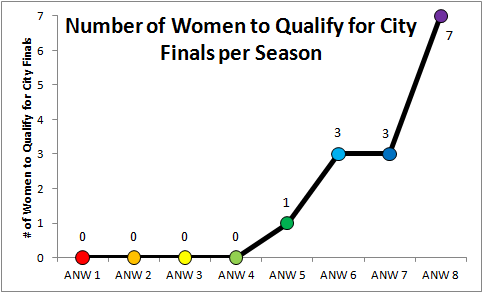
In contrast, in the original rules of Ninja Warrior, everyone competed and the highest ranked individuals moved on to the next round. This quickly resulted in few women being represented beyond the first round (although some women were advanced as “wildcards” at the producers’ discretion). On Ninja Warrior, the audience sees the ranks of all the competitors, so it is very clear how the women do in comparison to the men (not so well, for the most part).

Source: “Numbers of Ninja Warrior: Ladies Night in Philadelphia”

In 2017 (Season 9), the rules were modified to secure slots for women in later rounds. Interestingly, the rule change was in response to fan interest in seeing more women compete. Under the new rules, the top five women in qualifying rounds would advance and the top two women in the city finals would move on to national finals. This format results in some women moving forward based on performance in relation to all competitors and other women moving on based on their performance in relation to other women. For example, in Philadelphia qualifiers in Season 10, three women earned a spot in the city finals based on their overall rank in the competition and the next two highest-ranking women (although lower ranking than some men) also advanced to the City finals to attain the minimum of five women advancing.

From a feminist perspective, which approach is best for showing women’s strength in competition? Do you prioritize representation and visibility for women, giving equal time to men and women throughout the competition as in The Titan Games? Or do you prioritize eliminating gender as an organizing category, providing the opportunity for (some) women to be ranked higher than (some) men, and including the potential for participation of folks outside the gender binary as in the original Ninja Warrior rules? Or do you try to do both?

Five women moving on from American Ninja Warrior Philadelphia qualifiers to city finals in Season 10. (Click for Source)

This question matters because there are real stakes to the way we see strength in pop culture. The way we consider gender and physical strength affects many women, even those who are not elite athletes. For example, in my own research on the construction trades, many tradeswomen face assumptions and stereotypes about women’s physical ability that disadvantage them throughout their careers. It’s important to disrupt discourses about strength when they are leveraged to unnecessarily disadvantage women. Not all women (or men) have the physical ability to do construction work. But many do. 

Strength competitions like these might seem to support stereotypes, but our scientific understanding of strength raises some troubling ideas about perceived “natural” differences of the body. Biological differences between men and women are not a clear as some would like to believe, this had led to problems with determining athletes’ genders for competition. In the US, large and muscular bodies are seen as desirable for men and problematic for women; this shapes who trains to complete in these types of competitions. If more women trained for strength-based competitions, we can assume the gap between men and women in these competitions would shrink, but not fully disappear. Similar trends have occurred in long distance running.

It’s difficult to imagine that anyone who has seen the women competitors on these shows could believe that women are not strong enough to do construction. Especially if you watched the first episode of The Titan Games and saw Tina Rivas, a sheet metal installer. And as she said about her work, “I am the only woman. So obviously that’s a little bit hard. But I can handle it.” Indeed.

Maura Kelly is an Associate Professor of Sociology at Portland State University. Her research and teaching interests include gender, sexualities, social inequality, work and occupations, and popular culture. Her current research is primarily focused on the experiences of women and people of color in the construction trades as well as policy and programs intended to increase the diversity of the construction trades workforce. She is the co-editor of the forthcoming book Feminist Research in Practice (Rowman & Littlefield 2019).

When I teach social statistics, I often show students how small changes in measurement or analysis can make a big difference in the way we understand the world. Recently, I have been surprised by some anger and cynicism that comes up when we talk about this. Often at least one student will ask, “does it even matter if you can just rig the results to say whatever you want them to say?”

I can’t blame them. Controversy about manufactured disagreement on climate change, hoax studies, or the rise of fake news and “both side-ism” in our politics can make it seem like everyone is cooking the books to get results that make them happy. The social world is complicated, but it is our job to work through that complexity and map it out clearly, not to throw up our hands and say we can’t do anything about it. It’s like this optical illusion:

The shape isn’t just a circle or a square. We can’t even really say that it is both, because the real shape itself is complicated. But we can describe the way it is built to explain why it looks like a circle and a square from different angles. The same thing can happen when we talk about debates in social science.

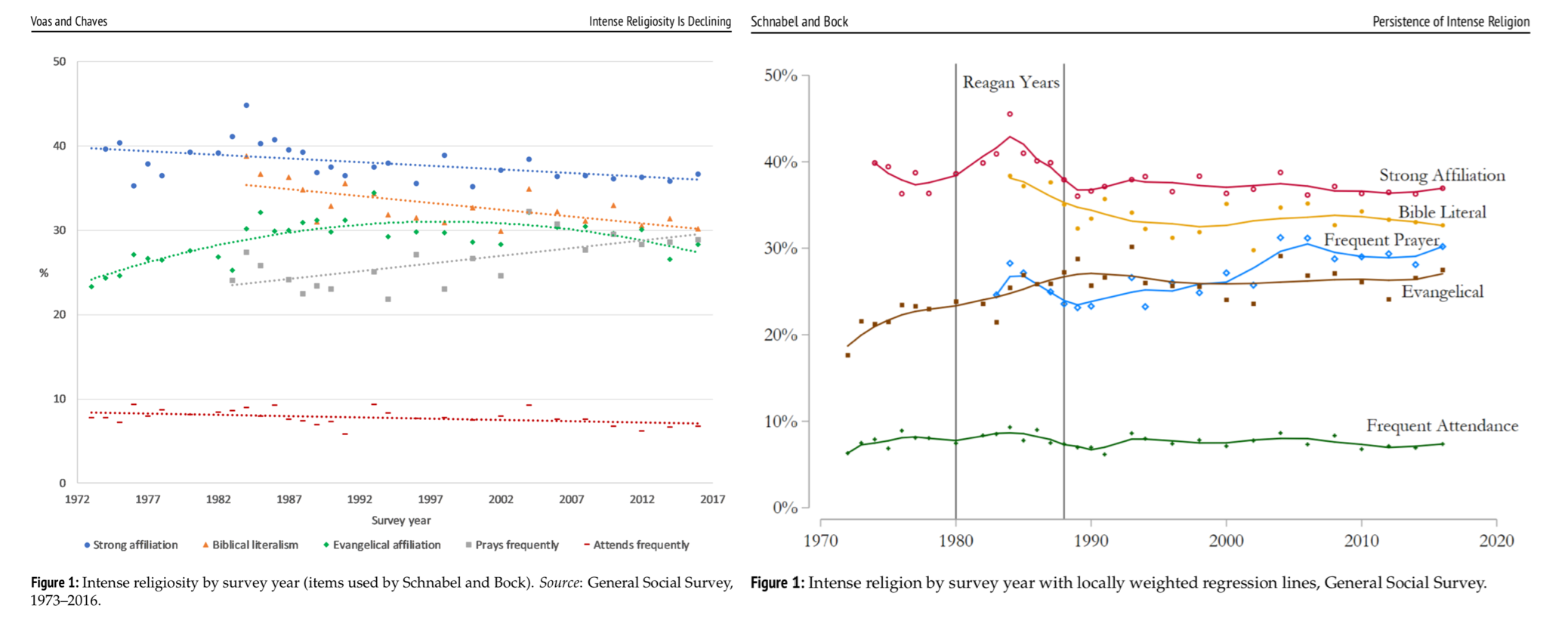
A fun example of this popped up recently in the sociology of religion. In 2016, David Voas and Mark Chaves published an article in the American Journal of Sociology about how rates of religious commitment in the United States are slowly declining. In 2017, Landon Schnabel and Sean Bock published an article in Sociological Science responding to this conclusion, arguing that most of the religious decline was among moderate religious respondents—people with very strong religious commitments seemed to be holding steady. Just recently, both teams of authors have published additional comments about this debate (here and here), analyzing the same data from the General Social Survey.

So, who is right?

Unlike some recent headlines about this debate, the answer about religious decline isn’t just “maybe, maybe not.” Just like the circle/square illusion, we can show why these teams get different results with the same data.

Parallel Figures from Voas & Chaves (2018) and Schnabel & Bock (2018) (Click to Enlarge)

When we put the charts together, you can see how Voas and Chaves fit straight and smoothly curved lines to trends across waves in the GSS. This creates the downward-sloping pattern that fits their conclusions about slow religious decline over time. Schnabel and Bock don’t think a single straight line can accurately capture these trends, because the U.S. saw a unique peak in religious commitment that happened during the Regan years and may have receded more quickly. Their smoothing technique (LOESS smoothing) captures this peak and a quick decline afterwards, and doing so flattens out the rest of the trends after that period.

The most important lesson from these charts is that they don’t totally get rid of the ambiguity about religious change. Rather than just ending the debate or rehashing it endlessly, this work helps us see how it might be more helpful to ask different questions about the historical background of the case. I like this example because it shows us how disagreement among experts can be an invitation to dig into the details, rather than a sign we should just agree to disagree. Research methods matter, and sometimes they can help us more clearly explain why we see the world so differently.

Evan Stewart is an assistant professor of sociology at University of Massachusetts Boston. You can follow his work at his website, or on BlueSky.

At the start of a new year, our thoughts often turn to self-improvement. People make all kinds of resolutions to live healthier, happier, more engaged lives…at least until the middle of February.

Sociological thinking often gets skeptical of this work. Sure, it is great to set personal goals, but fixating on personal problems can also make us blame ourselves for larger social and cultural factors that make it hard to meet those goals. You can buy a new trendy Bullet Journal and fill it with to-do lists, but that alone probably won’t beat a whole culture of burnout.

I get a kick out of imagining a new wave of snarky sociological self-help. The headlines would be fantastic.

  • I lost 20 pounds on this new hot diet: not having to live in a food desert!
  • Trouble in the bedroom? Your problems may be political!
  • And, of course, the classic:

This year I found a book that gets as close the dream genre as ever. After multiple nods from the Ezra Klein Show and buzz from Silicon Valley, I picked up James P. Carse’s Finite and Infinite Games (1986) for a holiday read. The first sentence of the second section sums it up:

No one can play a game alone. One cannot be human by oneself. There is no selfhood where there is no community. We do not relate to others as the persons we are; we are who we are in relating to others. Pp. 37

That line didn’t sound like the typical self-focused pop philosophy, and it kicked off a lot more sociology than I was expecting. Carse’s book focuses on “finite games” as social interactions that are meant to come to a clearly defined end and “infinite games” where the aim is simply to keep playing with other people. Along the way, he riffs on some major sociological themes like role theory, and there’s even an appearance from Veblen. Much of the argument boils down to the classic structure and agency debate in sociology—new situations often give us both strict social rules to follow in finite games and resources that invite creative improvisation in infinite games. Recognizing both kinds of games in life draws our attention to social structures and opens up the possibility to turn off autopilot once in a while.

It isn’t a perfect read, but I appreciated seeing a book with a popular following putting these kinds of ideas in the spotlight, especially because economists and psychologists often get more of the credit in popular nonfiction. Maybe we can replace the resolutions with a few more good reads. Can you think of other examples of self-help sociology?

Evan Stewart is an assistant professor of sociology at University of Massachusetts Boston. You can follow his work at his website, or on BlueSky.