Archive: Apr 2013

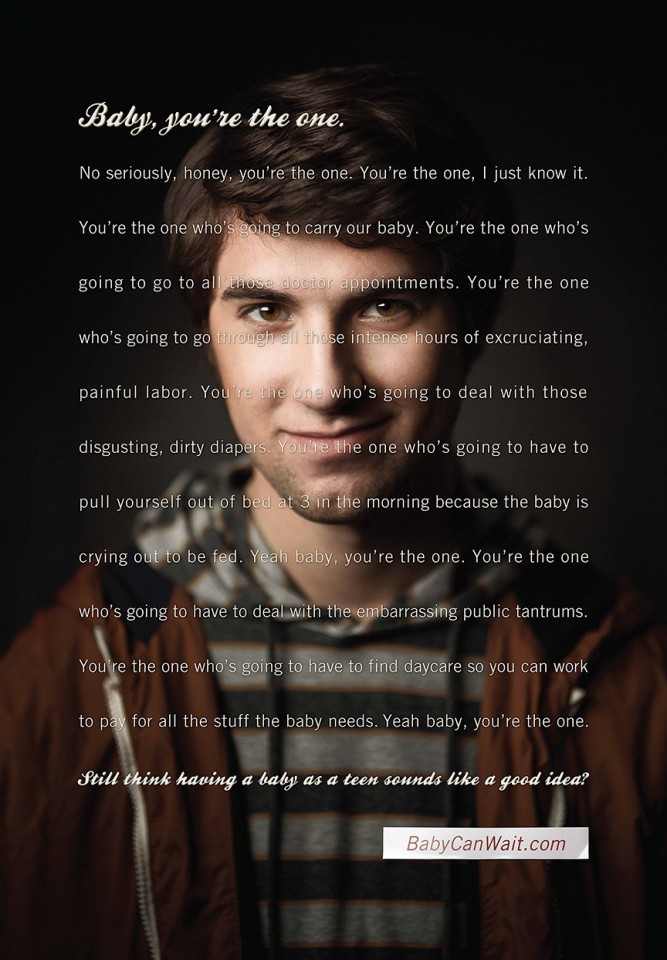
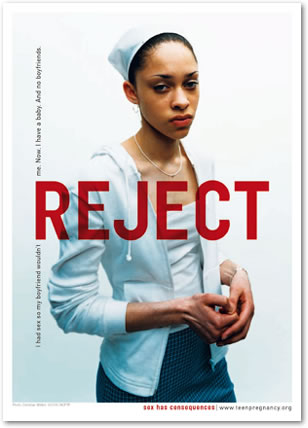
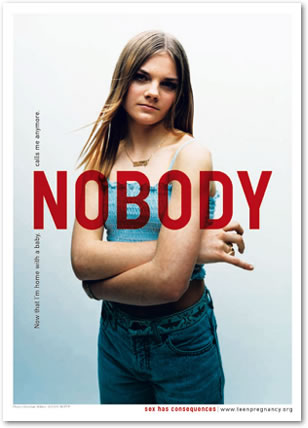
I first posted these posters on SocImages in 2008. They are designed to scare teenagers into taking precautions against pregnancy by demonizing teenagers who get (someone) pregnant. The way in which teens are portrayed in these images — labeled cheap, dirty, rejects, pricks, and nobodys — suggests that the organization, the National Campaign to Prevent Teen Pregnancy, doesn’t care about teenagers, only in controlling their behavior.

This is the sentence that runs along the left vertical with the word “reject” extracted in bold: “I had sex so my boyfriend wouldn’t REJECT me. Now, I have a baby. And no boyfriends.”
“Now that I’m home with a baby, NOBODY calls me anymore.”
“All it took was one PRICK to get my girlfriend pregnant. At least that’s what her friends say.”

“Condoms are CHEAP. If we’d used one, I wouldn’t have to tell my parents I’m pregnant.”

“I want to be out with my friends. Instead, I’m changing DIRTY diapers at home.”

In response to ads like these, sociologist Gretchen Sisson has started a tumblr of examples of anti-teen pregnancy PSAs that use fear, shame, and threats as motivators, sent to me by @annajobin.  Here’s the one I found most stunning; I think it goes something like don’t-drink-and-party-or-you’ll-get-raped-and-pregnant-and-your-life-will-be-horrible-and-oh-your-child-will-become-a-rapist-too:

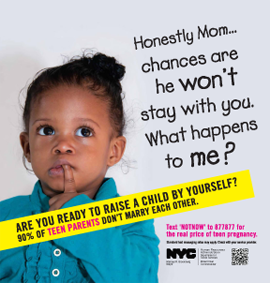
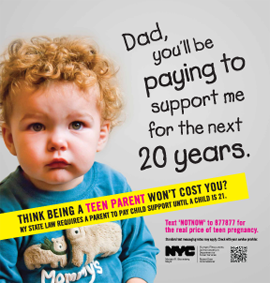
Here are a set of ads that try to convince women not have (unprotected) sex with their male peers by suggesting that the men showing interest in them are bad guys who will inevitably abandon them:


1 2 3And here are a set that use simple threats to get across their message:
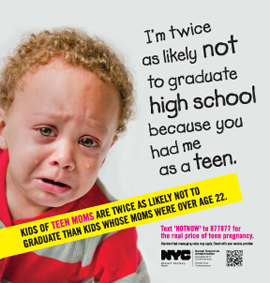
1 2 3About her tumblr, Sisson writes:

Public service announcements that claim to be about “preventing teen pregnancy” are more frequently about shaming and stigmatizing young parents. This is not a way to encourage young people to take control of their reproductive lives, and it’s certainly not a way to support young families.

Nor is it a way to support teenagers who are negotiating complicated interpersonal terrain and making difficult decisions.  These ads are about getting teenagers to do what we want, not helping them figure out what’s best for them.  They caricature the actual lives of teenagers and make early parenthood into a comical boogeyman.  Moreover, they send a clear message to the teenagers that do get pregnant: “you’re a slut/idiot and your life is over.”  This is not good for young parents and it sets them up to fail.

Lisa Wade, PhD is an Associate Professor at Tulane University. She is the author of American Hookup, a book about college sexual culture; a textbook about gender; and a forthcoming introductory text: Terrible Magnificent Sociology. You can follow her on Twitter and Instagram.
Cross-posted at The Huffington Post.

One of our Pinterest boards collects images that reveal that men are the “neutral” sex in contemporary Western cultures. This means that (1)  the image that pops up in our minds when we say “person” or “human” or “worker” is usually implicitly male, (2) non-sexed representations of people are usually assumed to be male (e.g., cartoon animals appear female to us unless we slap on eyelashes and lipstick), (3) items for sale often get marketed as either “item” or “women’s item” (e.g., “deodorant” and “women’s deodorant”), and (4) men and male bodies get to stand in for humanity (e.g., in scientific research).

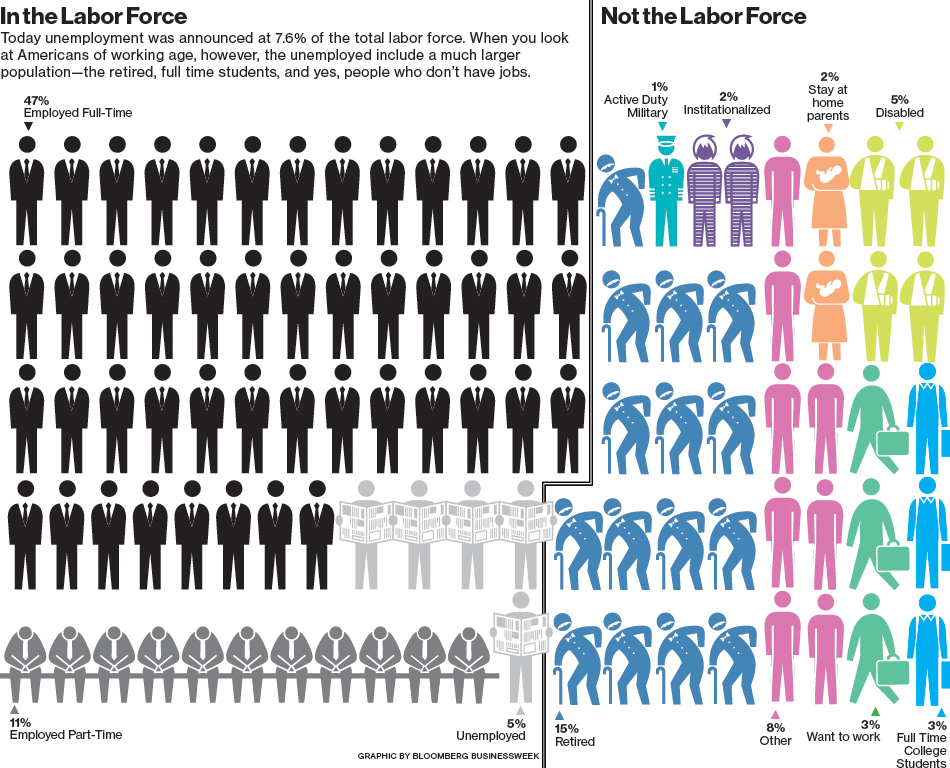
Instances of this phenomenon have been a fun series on the blog; we featured another one just this past weekend, on how (not) to write obituaries.  Then today SocImages Contributor Philip Cohen sent along another great example that we couldn’t resist sharing. The graphic below, released by Bloomberg Business Week, is meant to help us understand who is in and out of the labor force.  While 3% of Americans want to work but can’t find a job, large proportions are also permanently or temporarily out of work on purpose: they’re retired, in college, in the military, disabled, or a stay-at-home parent.

For our purposes in this post, what’s interesting is the way they illustrate the categories.  See what you see:

1

In all cases but one, the stick figured is either non-sexed and therefore implicitly male (e.g., the newspaper reader and the disabled) or explicitly male (the business-suited full-time employees, the mustachioed retiree).  The one exception, of course, is for the stay-at-home parent.  Suddenly the stick figure is a female.  We see this all over.  As soon as parenting or housework is involved, all those neutral/male stick figures sprout skirts.

Now, to be fair, 97% of stay-at-home parents are female, but so is 50% of the American workforce. You wouldn’t guess so, however, by this graphic.  Also, for what it’s worth, it doesn’t have to be like this.

Lisa Wade, PhD is an Associate Professor at Tulane University. She is the author of American Hookup, a book about college sexual culture; a textbook about gender; and a forthcoming introductory text: Terrible Magnificent Sociology. You can follow her on Twitter and Instagram.
Cross-posted at Family Inequality.

The U.S. Census Bureau has released its new report on childcare, written by Lynda Laughlin. This provides a good followup treatment for the hyperventilation induced by fear of fathers taking over (or being relegated to) childcare.

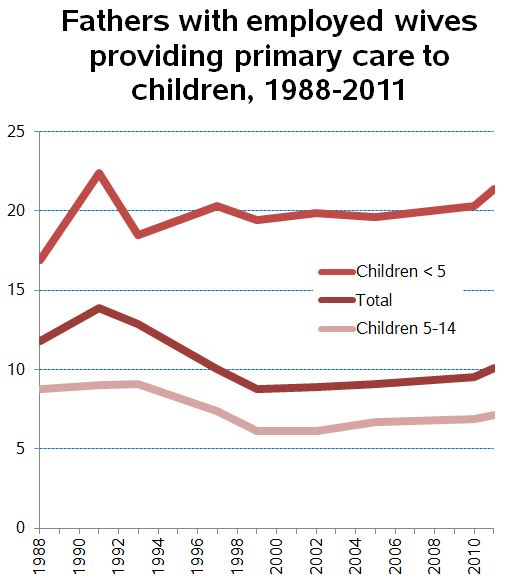
First, the trend that fits my story of stalled gender progress. Among married fathers with employed wives, how many are providing the “primary care” for their children? That is, among the various childcare arrangements the children are in while their mother is at work, how many are in their fathers’ care more than in any other arrangement? Answer:  10%, which is virtually unchanged from a quarter-century ago:

1

Not a lot of change for a quarter century in which we’re told everything has changed.

However, in fairness to the change-is-happening community, here is the trend for the percentage of fathers who say they are providing ANY care to their children while their mothers were at work.

2

I don’t give this much weight since it might reflect greater sensitivity to the importance of saying fathers provide care, but there you have it: it’s higher, and it shows some increases up until the early 1990s, which is when gender equality in general stalled on many indicators. Since the mid-1990s: Nothing.

Please note these figures don’t show the total contribution of fathers, but only reflects those married with children, whose wives are employed.

One interesting source of father care is mothers’ shiftwork. As Harriet Presser reported two decades ago, the 24/7 economy stimulates some task sharing among couples. In the current report, Laughlin writes:

Preschoolers whose mothers worked nights or evenings were more likely to have their father as a child care provider than those with mothers who worked a day shift (42 percent and 23 percent, respectively)

Philip N. Cohen is a professor of sociology at the University of Maryland, College Park, and writes the blog Family Inequality. You can follow him on Twitter or Facebook.

Screen Shot 2013-04-10 at 10.55.52 PM

Back in 2010 we featured a post about a segment from the “What Would You Do?” series from abc News that illustrated the way that race plays a role in who is labeled as deviant and who is given the benefit of the doubt.

The producers had teens vandalize a car in public to see what onlookers would do. To see if race played a role, they tried it with a group of White boys and then with a group of African American boys. Only one 911 call was made on the White boys, but 10 calls were made on the African American teens. Moreover, while the White teens were vandalizing the car, 911 received a call to report the African American boys simply for being asleep in a car, which the caller took as a possible sign they were planning to engage in criminal activity.

We see this same pattern in another “What Would You Do?” segment. This time, a young White man and a young African American man try to remove a lock from a bike as the cameras capture the reactions of onlookers.

The onlooker interviewed toward the end says race played no role in his reaction. But the extremely different reactions to the two teens indicate differences in who is perceived as likely to be engaged in criminal activity, and whose criminal activity we may think deserves being reported to the police, rather than given a disapproving tsk-tsk as we walk on by.

Gwen Sharp is an associate professor of sociology at Nevada State College. You can follow her on Twitter at @gwensharpnv.

UBC Sociology student Pat Louie tweeted us a touching set of photographs by artist Gabriele Galimberti.  Each image is a child with his or her favorite toys. They are in Malawi, Italy, Ukraine, Thailand, Zanzibar, Albania, Botswana, and elsewhere and the diversity is stunning.

The photographs reveal a universality — pride in favorite toys and the love of play — but, writes Ben Machell at Galimberti’s website, “how they play can reveal a lot.”  The children’s life experiences influenced their imaginative play:

…the girl from an affluent Mumbai family loves Monopoly, because she likes the idea of building houses and hotels, while the boy from rural Mexico loves trucks, because he sees them rumbling through his village to the nearby sugar plantation every day.

Galimberti, interviewed by Machell, also observed class differences in entitlement to ownership:

The richest children were more possessive. At the beginning, they wouldn’t want me to touch their toys, and I would need more time before they would let me play with them. In poor countries, it was much easier. Even if they only had two or three toys, they didn’t really care. In Africa, the kids would mostly play with their friends outside.

These photographs are reminiscent of another wonderful photography project featuring kids and their toys.  JeonMee Yoon photographed boys with all their blue stuff and girls with all their pink stuff.  The results are striking.  Likewise, there’s a wonderful set of photographs by James Mollison, counterposing portraits with children’s sleeping arrangements across cultures.  These are all wonderful projects that powerfully illustrate global and class difference and inequality.

Lisa Wade, PhD is an Associate Professor at Tulane University. She is the author of American Hookup, a book about college sexual culture; a textbook about gender; and a forthcoming introductory text: Terrible Magnificent Sociology. You can follow her on Twitter and Instagram.

Cross-posted at PolicyMic and The Huffington Post.

2We all-too-often take for granted that photographs like this one, revealing the impact of an oil pipeline leak on Mayflower, Arkansas, will be able to inform us about the state of the world. In fact, such images are taken by actual human photojournalists whose rights of access are protected by the First Amendment establishing the freedom of the press.

This is a real thorn in the side of both corporations and governments that might prefer to control media’s access to embarrassing or illegal activities.  So, often they try to strong arm journalists, co-opt local officials, or pass (likely illegal) legislation designed to protect them from the free press’ gaze.  Here are two current examples.

First, Mother Jones reports that Exxon officials are making efforts to limit reporter access to the oil pipeline leak in Mayflower, Arkansas.  This is happening in at least two ways.  First, Exxon representatives and local law enforcement are blocking journalists from accessing the spill site, threatening  “arrest for criminal trespass.”  Second, BoingBoing reports that the Federal Aviation Administration (FAA) has instituted a temporary “no-fly zone” in the area of the spill.  Here’s a screenshot from the FAA’s website:

1

Second, in the last two years Americans have shuddered in response to the release of undercover video revealing the abuse of animals on industrial farms and the torture of Tennessee Walking horses.  These have resulted in convictions, but they’ve also raised the hackles of the agricultural industry.  The New York Times reports that, in an effort to limit their risk, they’ve sponsored bills (proposed or enacted in about a dozen state legislatures) making it illegal to videotape animals on their property without their permission and requiring all prospective employees to reveal associations with animal rights groups.

These examples remind us how important it is that journalists have the freedom to do their job.  They also remind us that we must vigilantly protect that freedom.  Corporations, and governments too, have an incentive to limit the freedom of the press.  These are powerful entities, often in cahoots, that can and will ignore the First Amendment when they can get away with it.

Lisa Wade, PhD is an Associate Professor at Tulane University. She is the author of American Hookup, a book about college sexual culture; a textbook about gender; and a forthcoming introductory text: Terrible Magnificent Sociology. You can follow her on Twitter and Instagram.

“You just have to be cheerful about it and not get upset when you get insulted,” said rocket scientist Yvonne Brill.

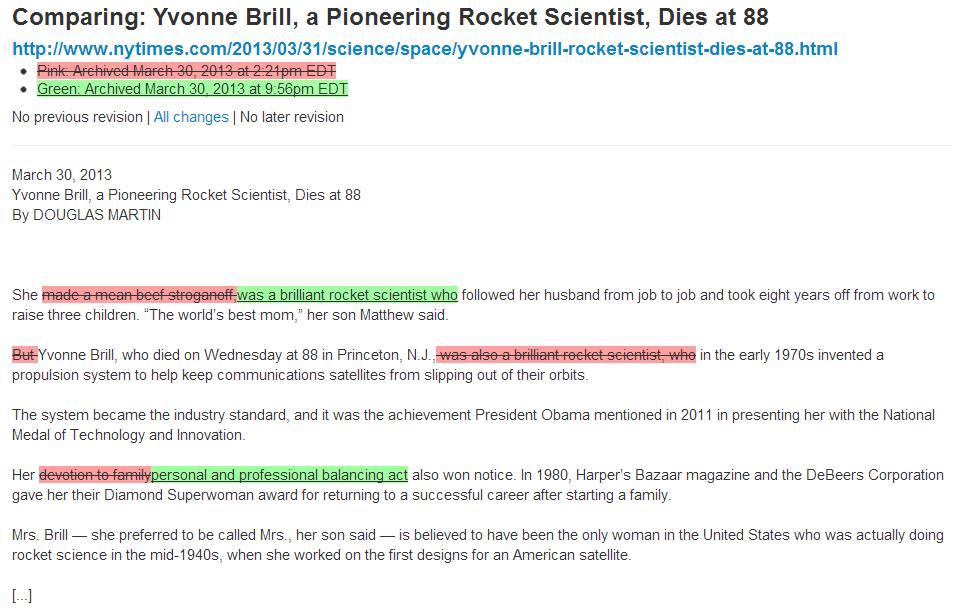
She must be chuckling in heaven, because her obituary at the New York Times made the common mistake of making her femaleness and femininity a central part of their retrospective.  After objections, NYT corrected the obit.  Here are the tracked changes, courtesy of NewsDiffs:

1

At Feministe, Caperton offers a nice discussion of this phenomenon and draws our attention to the Finkbeiner Test, named after journalist Ann Finkbeiner.  Inspired by the Bechdel Test for movies, the Finkbeiner Test is used to judge whether stories about women focus excessively on the fact that they are women.  To pass the test, the story cannot mention:

  • The fact that she’s a woman
  • Her husband’s job
  • Her child care arrangements
  • How she nurtures her underlings
  • How she was taken aback by the competitiveness in her field
  • How she’s such a role model for other women
  • How she’s the “first woman to…”

Awesome.

We’ve documented lots of instances of the men-are-people and women-are-women phenomenon.  It’s no wonder it shows up in obituaries too.  I’m glad that we’re becoming sensitive enough to the issue to notice it and that institutions like the NYT are responsive enough to change the most egregious examples of it.  Next step: prevention.

Lisa Wade, PhD is an Associate Professor at Tulane University. She is the author of American Hookup, a book about college sexual culture; a textbook about gender; and a forthcoming introductory text: Terrible Magnificent Sociology. You can follow her on Twitter and Instagram.

Cross-posted at Osocio.

We’ve been covering the saga of Russian protest punk group Pussy Riot for over a year now. The feminist collective performed guerrilla musical protests around Russia against Vladimir Putin. One in particular, in a church, ended with members Nadezhda Tolokonnikova and Maria Alyokhina sentenced to two years imprisonment for “hooliganism motivated by religious hatred”. The human rights implications of this sentence attracted much worldwide attention, with Amnesty International and celebrities like Sting, Yoko Ono and Madonna speaking out for the women.

But something else happened. The “Free Pussy Riot” movement, with its iconic knitted balaclavas and provocative language, became a popular meme. The cause célèbre was even appropriated by the fashion industry.

Which is what makes this video by Blush lingerie an intriguing conundrum. While it legitimately promotes the freepussyriot.org fundraising site to help the women, it is also promoting a product using a woman’s sexuality as the bait:

On the first anniversary of the Pussy Riot concert in the Cathedral of Christ the Savior, the Berlin based Lingerie label blush supports the free pussy riot movement with a sexy protest march through icy Moscow (-15° C). Support Freepussyriot.org!

This is no Femen action, in which women’s bodies become weapons of protest. It is a commercial for sexy underwear that pays for its appropriation of a radical feminist cause by directing people to that cause.

Is this irony?

Tom Megginson is a Creative Director at Acart Communications, a Canadian Social Issues Marketing agency. He is a specialist in social marketing, cause marketing, and corporate social responsibility. You can follow Tom at workthatmatters.blogspot.com.