Archive: Apr 2013

Re-posted in honor of Roger Ebert’s passing. Cross-posted at BlogHer.
University of Minnesota doctoral candidate Chris Miller sent in a fascinating episode of Siskel and Ebert, a long-lasting TV show devoted to reviewing movies.  What is amazing about this episode is the frankness with which the movie critics — Gene Siskel and Roger Ebert — articulate a feminist analysis of a group of slasher movies.

The year? 1980.

First they describe the typical movie:

A woman or young girl is shown alone and isolated and defenseless… a crazy killer springs out of the shadows and attacks her and frequently the killer sadistically threatens the victims before he strikes.

They pull no punches in talking about the problem with the films:

These films hate women.

They go on to suggest that the films are a backlash against the women’s movement:

I’m convinced it has to do with the growth of the woman’s movement in America in the last decade. I think that these films are some sort of primordial response by some very sick people… of men saying “get back in your place, women.”

One thing that most of the victims have in common is that they do act independently… They are liberated women who act on their own. When a woman makes a decision for herself, you can almost bet she will pay with her life.

They note, too, that the violence is sexualized:

The nudity is always gratuitous. It is put in to titillate the audience and women who dress this way or merely uncover their bodies are somehow asking for trouble and somehow deserve the trouble they get. That’s a sick idea.

And they’re not just being anti-horror movie.  They conclude:

[There are] good old fashioned horror films… [but] there is a difference between good and scary movies and movies that systematically demean half the human race.

It’s refreshing to hear a straightforward unapologetic feminist analysis outside of a feminist space.  Their analysis, however, isn’t as sophisticated as it could be.

In doing research for a podcast about sex and violence against women in horror films (Sounds Familiar), I came across the keen analysis of Carol Clover, who wrote a book called Men, Women, and Chainsaws.

Clover admitted that most horror films of the time sexualized violence against women — meditating on the torture and terrorizing of beautiful female victims — but she also pointed out that the person who ultimately vanquished the murderer was almost always also female. She called this person the “final girl.”

The final girl was different than the rest of the women in the film: she was less sexually active, more androgynous, and smarter.  You could pick her out, Clover argued, from the very beginning of the movie.  She was always the first to notice that something frightening might be going on.

Boys and men watching horror films, then (and that is the main audience for this genre), were encouraged to “get off” on the murder of women, but they were also encouraged to identify with a female heroine in the end.  How many other genres routinely ask men to identify with a female character?  Almost none.

In this sense, Clover argues, horror films don’t “hate women.”   Instead, they hate a particular kind of woman. They reproduce a Madonna/whore dichotomy in which the whores are dispatched with pleasure, but the Madonna rises to save us all in the end.

Lisa Wade is a professor of sociology at Occidental College. You can follow her on Twitter and Facebook.

Siskel and Ebert full episode:

———————–

Full transcript after the jump:

more...

American companies that once looked to places like Mexico and China for cheap labor are bringing those jobs back to the U.S.  Why? Because prison labor is much, much cheaper.  Paid between 93¢ and $4.73 per day, and collecting no benefits, prisoners are a cheap labor source for about 100 companies (source).

What does this have to do with you?

If you have insurance, invest, use utilities, have a bank, drive a car, send a child to school, go to a dentist, call service centers, fly on planes, take prescription drugs, or use paper, you might be benefiting from prison labor.

If you’ve bought products by or from Starbucks, Nintendo, Victoria’s Secret, JC Penney, Sears, Wal-Mart, K-Mart, Eddie Bauer, Wendy’s, Proctor & Gamble, Johnson & Johnson, Fruit of the Loom, Motorola, Caterpiller, Sara Lee, Quaker Oats, Mary Kay, or Microsoft, you are part of this system.

When prisoners are in state and federal prisons, the U.S. taxpayer is subsidizing low wages and corporate profits, since they are paying for prisoners’ room, board, and health care.  When prisoners are in private prisons, prison labor is a way to make more money off of the human beings caught in the corrections industry.  In other words, prison labor is an efficient way for corporations to continue to increase their profits without sharing those gains with their employees.

For an extensive list of the companies contracting prison labor, click here.  You might also find interesting the video clips, embedded in this news story, of promotional videos by prison corporations that attempt to sell the idea of prison labor to companies:

Lisa Wade, PhD is an Associate Professor at Tulane University. She is the author of American Hookup, a book about college sexual culture; a textbook about gender; and a forthcoming introductory text: Terrible Magnificent Sociology. You can follow her on Twitter and Instagram.

1In an article titled “Egos Inflating Over Time,” psychologist Jean Twenge and her colleagues show that rate of narcissism among U.S. college students has risen significantly. Narcissism is a “positive and inflated view of the self.” Narcissists are attention-seeking extroverts who have a high opinion of their value, importance, and physical attractiveness. They feel entitled to admiration from others and may act aggressively if they don’t receive the attention they feel they deserve.

Twenge and her colleagues found a 30% increase in narcissism between 1979 and 2006; almost 2/3rds of college students in the mid-2000s were above the mean score reported in the early ’80s.

I can’t help but think of her research every time I see a current commercial for the iPhone 5. What strikes me is the message that every moment of our lives is so amazing that it would be a horrible shame to not share it with everyone:

We can share every second… a billion roaming photojournalists uploading the human experience, and it is spectacular…

And that we should feel entitled to the technological ability to share ourselves:

I need to upload all of me.  I need — no, I have the right — to be unlimited.

Wow. I mean, that’s some pretty serious self-importance there.

Twenge and her colleagues argue that the increase in narcissism is related to the fact that American culture has increasingly celebrated individualism.  This is exactly the kind of message that they might point to as reflecting the cultural dimension of this personality shift.

Lisa Wade, PhD is an Associate Professor at Tulane University. She is the author of American Hookup, a book about college sexual culture; a textbook about gender; and a forthcoming introductory text: Terrible Magnificent Sociology. You can follow her on Twitter and Instagram.

Cross-posted at Asian-Nation and Racialicious.

1
Photo by Lulu Vision (Flickr/Creative Commons)

As an undergraduate majoring in linguistics, I was fascinated with the concept of endangered languages. Colonization, genocide, globalization, and nation-building projects have killed off untold numbers of languages. As linguist K. David Harrison (my undergrad advisor) tells NPR, speakers of stigmatized or otherwise less-favored languages are pressured to abandon their native tongue for the dominant language of the nation and the market (emphasis mine):

The decision to give up one language or to abandon a language is not usually a free decision. It’s often coerced by politics, by market forces, by the educational system in a country, by a larger, more dominant group telling them that their language is backwards and obsolete and worthless.

These same pressures are at work in immigrant-receiving countries like the United States, where young immigrants and children of immigrants are quickly abandoning their parents’ language in favor of English.

Immigrant languages in the United States generally do not survive beyond the second generation. In his study of European immigrants, Fishman (1965) found that the first generation uses the heritage language fluently and in all domains, while the second generation only speaks it with the first generation at home and in limited outside contexts. As English is now the language with which they are most comfortable, members of the second generation tend to speak English to their children, and their children have extremely limited abilities in their heritage language, if any. Later studies (López 1996 and Portes and Schauffler 1996 among them) have shown this three-generation trend in children of Latin American and Asian immigrants, as well.

The languages that most immigrants to the U.S. speak are hardly endangered. A second-generation Korean American might not speak Korean well, and will not be speaking that language to her children, but Korean is not going to disappear anytime soon — there are 66.3 million speakers (Ethnologue)! Compare that with the Chulym language of Siberia, which has less than 25.

Even if they’re not endangered per se, I would argue that they are in danger. While attitudes towards non-English languages in the U.S. seem to be improving, at least among wealthier and better educated people in some more diverse cities and suburbs, the stigma of speaking a non-English language still exists.

How many of you have:

  • been embarrassed to speak your heritage language in front of English speakers?
  • been reprimanded for speaking your heritage language in school?
  • been told to “go back to [country X]” when someone overhears you speak your heritage language?

I’ve heard innumerable stories about parents refusing to speak their native language to their children. Usually, the purported rationale is that they do not want the child to have language or learning difficulties, a claim that has been debunked over and over again by psychologists, linguists, and education scholars.

I’m sure that these parents truly believe that speaking only English to their children will give them an edge, though the reverse is true. What I wonder is how much this decision had to do with an unfounded belief about cognition and child development, and how much it had to do with avoiding the stigma of speaking a language that marks you as foreign, and as “backwards and obsolete and worthless”?

Calvin N. Ho is a graduate student in sociology at the University of California, Los Angeles studying immigration, race/ethnicity/nationalism, and Asian diasporas.  You can follow him at The Plaid Bag Connection and on Twitter.

Cross-posted at Family Inequality.

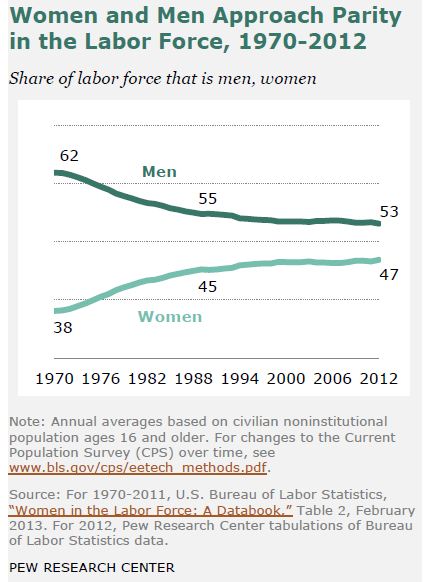
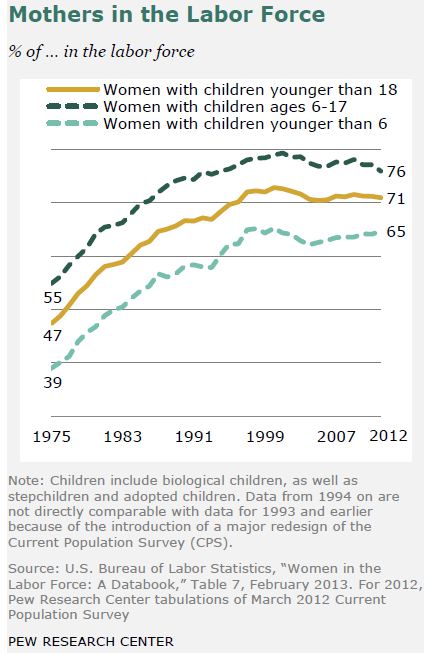
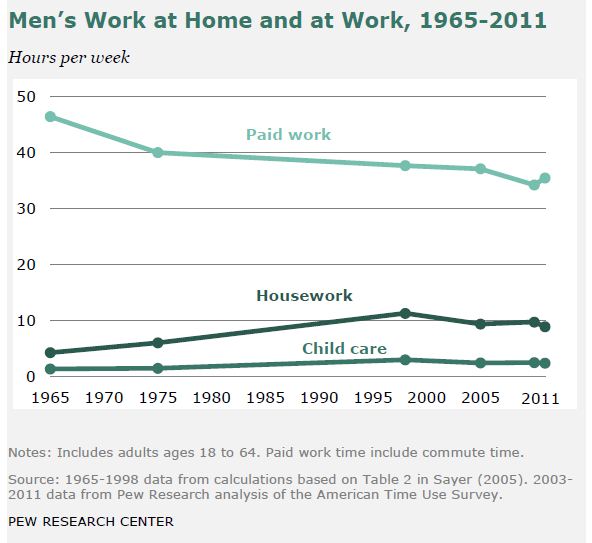
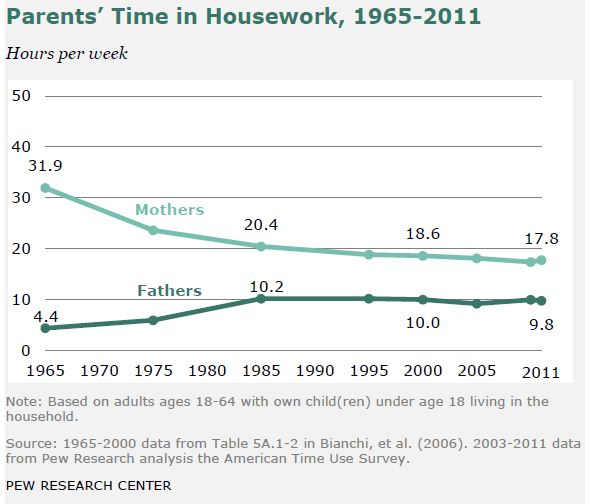
The Pew Research Center put out a report this month titled, “Modern Parenthood: Roles of Moms and Dads Converge as They Balance Work and Family,” written by Kim Parker and Wendy Wang. It analyzes trends in time use among men and women in families, showing the big changes since the 1960s, and adds Pew’s own survey data on attitudes and perceptions. Lots of interesting information.

But what jumped out at me was that the stall in progress did not feature much in Pew’s narrative. I really noticed that when the Joy Cardin show featured the report on Wisconsin Public Radio, and Cardin’s intro was this:

Family gender roles are converging, according to a new survey from the Pew Research Center. Father’s have more than doubled the time they spend on housework. More moms are paid to work outside the home (audio here).

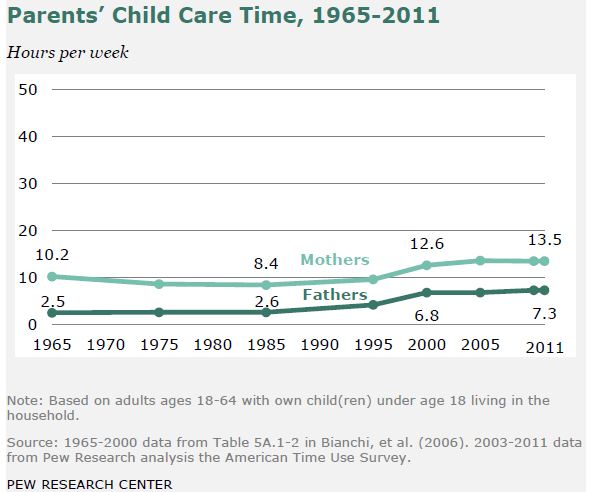
Those facts are true, but old news — older than the new news, which is that nothing much has happened since the early 1990s.  Here are the trends, in Pew’s nice graphics. See if you can find the stall point in each figure.

1 ****** 2 ****** 3 ****** 4 ****** 5 ****** 6

The last one, parents’ child care time, is the only one that shows continued real progress, albeit slower, in the last decade.

I favor three explanations for this gender stall:

  • Work-family policy that encourages specialization in domestic or labor force roles, as described by Stephanie Coontz here.
  • Cultural trends toward “egalitarian essentialism,” which “blends aspects of feminist equality and traditional motherhood roles” (e.g., intensive parenting mania), as described by David Cotter, Joan Hermsen and Reeve Vanneman here.
  • Weaker government enforcement of anti-discrimination law, as described in the new book Documenting Desegregation, by Don Tomaskovic-Devey and Kevin Stainback.

These explanations do not exclude others.

Philip N. Cohen is a professor of sociology at the University of Maryland, College Park, and writes the blog Family Inequality. You can follow him on Twitter or Facebook.

TODAY WE HAVE THE BEST NEWS EVER!

Sociological Images founder and author and, more importantly, my Best Friend is now tenured!  Congratulations Gwen Sharp!  You are a genius, a damn good person, and you make people laugh.  Nevada State College is incredibly to have you.  Everyone else should follow you on Twitter!

SocImages News:

Tomorrow we’re launching a competition for a new logo.  The top five sketches will receive $50 each and the winner will be invited to work with us to design a polished logo for $500. We hope you can help us spread the invitation far and wide!

Someone liked our post on high heels as a marker of distinction among women enough to cross-post it at Alternet.  Us?  We’re just happy to spread the word of good ol’ Pierre Bourdieu.  In any case, we hope it’s the first of many!

I’m quoted, starting with the phrase “Let’s be frank,” in an article at Bitch about an administrative reluctance to take steps to improve the sexual assault policy at Occidental College and the ongoing efforts to make us a leader in this regard.

Speaking of sex at Oxy, a video recording of my talk on hook up culture at Occidental College is available here.  The sheer enthusiasm of our wonderful students makes up for the bad lighting.  You’re the greatest y’all!

Thanks to PolicyMic, the Huffington Post, and Jezebel for featuring our posts on everything from data on porn stars to vintage baby cages and our fight at Oxy.

Updates on Image Guides:

Sociology doctoral student Calvin Ho put together a set of his favorite SocImages posts about Asian and Asian America.  It’s a great collection and we’re hoping he’ll revise it into an Image Guide.

I organized our a selection of our vintage stuff for Women’s History month and have published it here.

If you are a graduate student or professor who would like to make an Image Guide, we would love to hear from you!  It requires picking a topic, browsing our archives, pulling out the most compelling posts, and arranging them in ways other instructors would find familiar and convenient.  The guides can cover entire courses or be designed to help illustrate a theory, article, or book.  Only the most fabulous sociologists do it.

Upcoming Lectures and Appearances:

The semester is starting to wind down and I enjoyed giving campus-wide talks at Harvard, Queen’s University, Pomona College, and my own lovely Occidental.  Just two more before the semester is up:

  • Apr. 2 — Citrus College — “The Promise and Peril of Hook Up ‘Culture’” (11:30am Handy Campus Center East Wing)
  • Apr. 19 — University of Akron — “Anatomy of an Outrage: Female Genital Cutting and the Politics of Acculturation”; AKD Induction Ceremony Speech

I go on sabbatical next year to write in earnest, but I’d love to use my flexible schedule to do lots of public speaking as well.  Visit my website if you’d be interested in having me.  I have great talks on the value of friendship, the biology of sex differencesthe politics of genital cutting and, of course, hook up culture.  For Akron this year I’m doing an AKD Induction Ceremony Speech.  Who can think of something nice to say about sociology? I can!!!

Tweets that Make Us Blush: 3Thanks Cassie!

Also, may we take a minute to have a giant nerd crush on Shankar Vedantam? He tweeted us twice this month!  TWICE!

2 1

Social Media ‘n’ Stuff:

This is your monthly reminder that SocImages is on TwitterFacebookGoogle+, and Pinterest.  Lisa is on Facebook and, sigh, Google+.  Most of the team is on Twitter: @lisawade@gwensharpnv@familyunequal@carolineheldman, and @jaylivingston.

In Other News…

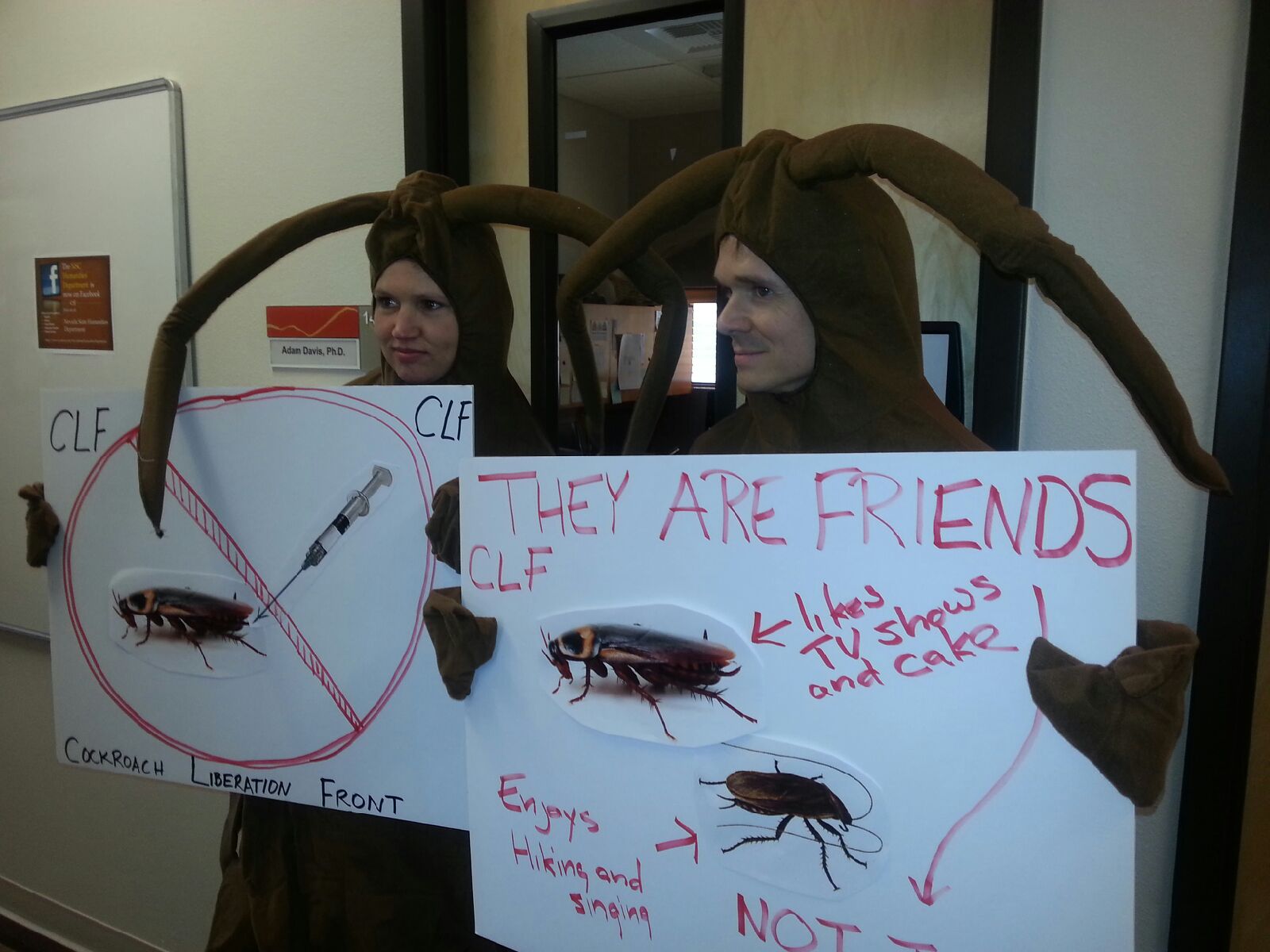
Gwen Sharp has decided to use the new protection of tenure to start the Cockroach Liberation Front (CLF), dedicating to refurbishing the invertebrate’s image and fighting for their equal rights (recognition and redistribution).

The CLF’s first mission is to oppose the use of the cockroach in scientific experimentation. To that end, they staged a protest at the laboratory of a biologist at a local college, publicly exposing the senseless torture of these sensitive and complicated creatures.

CLF (1)

Sociological Images stands with the CLF. Anyone who likes TV shows and cake is a friend of ours… and they should be a friend of yours too.

Lisa Wade, PhD is an Associate Professor at Tulane University. She is the author of American Hookup, a book about college sexual culture; a textbook about gender; and a forthcoming introductory text: Terrible Magnificent Sociology. You can follow her on Twitter and Instagram.