Archive: 2012

Sitting through Disney’s Tangled again, I saw new layers of gender in there. They’ve moved beyond the old-fashioned problem of passive princesses and active princes, so Rapunzel has plenty of action sequences. And it’s not all about falling in love (at least at first). Fine.

But how about sexual dimorphism? In bathroom icons the tendency to differentiate male and female bodies is obvious. In anthropomorphized animal stories its a convenient fiction. But in social science it’s a hazardous concept that reduces social processes to an imagined biological essence.

In Tangled, the hero and heroine are apparently the more human characters, whose love story unfolds amidst a cast of exaggerated cartoons, including many giant ghoulish men (the billed cast includes the voices of 12 men and three women).

Making the main characters more normally-human looking (normal in the statistical sense) is a nice way of encouraging children to imagine themselves surrounded by a magical wonderland, which has a long tradition in children’s literature: from Alice in Wonderland to Where the Wild Things Are.

That’s what I was thinking. But then they went in for the lovey-dovey closeup toward the end, and I had to pause the video:

Their total relative size is pretty normal, with him a few inches taller. But look at their eyes: Hers are at least twice as big. And look at their hands and arms: his are more than twice as wide. Look closer at their hands:
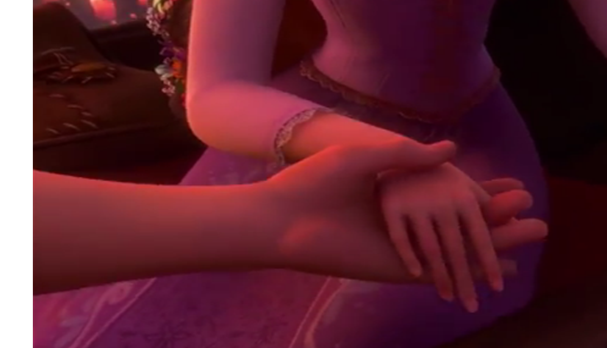
Now she is a tiny child and he is a gentle giant. In fact, his wrist appears to be almost as wide as her waist (although it is a little closer to the viewer).

In short, what looks like normal humanity – anchoring fantasy in a cocoon of reality – contains its own fantastical exaggeration.

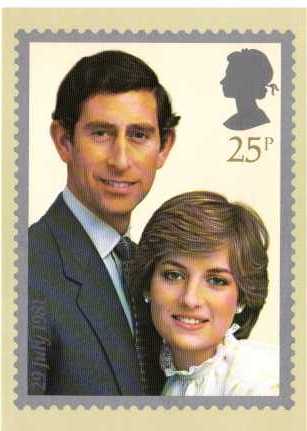
The patriarchal norm of bigger, stronger men paired up with smaller, weaker women, is a staple of royalty myth-making – which is its own modern fantasy-within-reality creation. (Diana was actually taller than Charles, at least when she wore heels .)
In this, Tangled is subtler than the old Disney, but it seems no less powerful.

Philip N. Cohen is a professor of sociology at the University of Maryland, College Park, and writes the blog Family Inequality. You can follow him on Twitter or Facebook.
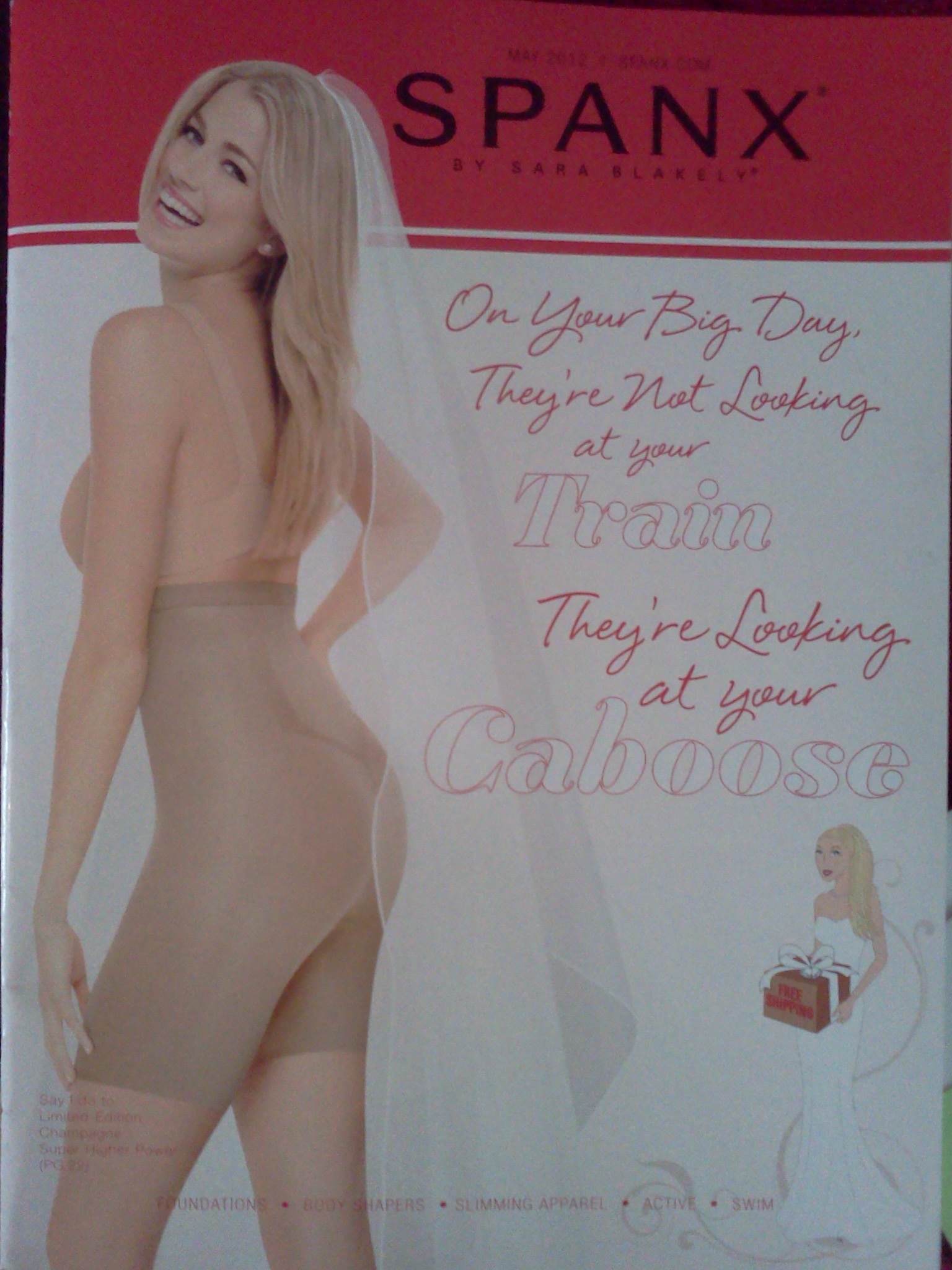
Melissa Fletcher Pirkey, a grad student at Notre Dame, sent in an image she saw in a catalog for Spanx, a company that sells shapewear. This page from the catalog reminds women that our bodies are always on display and subject to scrutiny, requiring the help of a range of garments to help us keep them under control lest we fail inspection:

d

Earlier this week a series of photographs of sweaty men climbing a greased up phallic symbol went ’round the blogosphere.  The pictures were of a naval tradition: at the end of their first year, students enrolled at the U.S. Naval Academy come together to climb a monument covered in lard.   In a ritual designed to mark their completion of their first year, they swap a newbie’s sailor’s hat for the next iteration of their headgear, one that looks a little bit more like the one worn by naval officers.

What was interesting to me about the series of photos is the absence of women.  It might not immediately strike you as odd — given that, symbolically, the U.S. military is a strongly masculine space — but, in fact, 31% of the USNA class of 2015 is female.  So almost one in three of the students pictured should be female.  But they are almost entirely absent and are never featured close up.  Shots of the crowd of students suggest that this wasn’t the photographers’ choice; even among the students on the ground, women are few and far between.  They weren’t excluded from participation, since we see one here and there.  So, where are they?  What kept them from participating in this time-honored tradition?

Lots of photos at Buzzfeed.

Lisa Wade, PhD is an Associate Professor at Tulane University. She is the author of American Hookup, a book about college sexual culture; a textbook about gender; and a forthcoming introductory text: Terrible Magnificent Sociology. You can follow her on Twitter and Instagram.

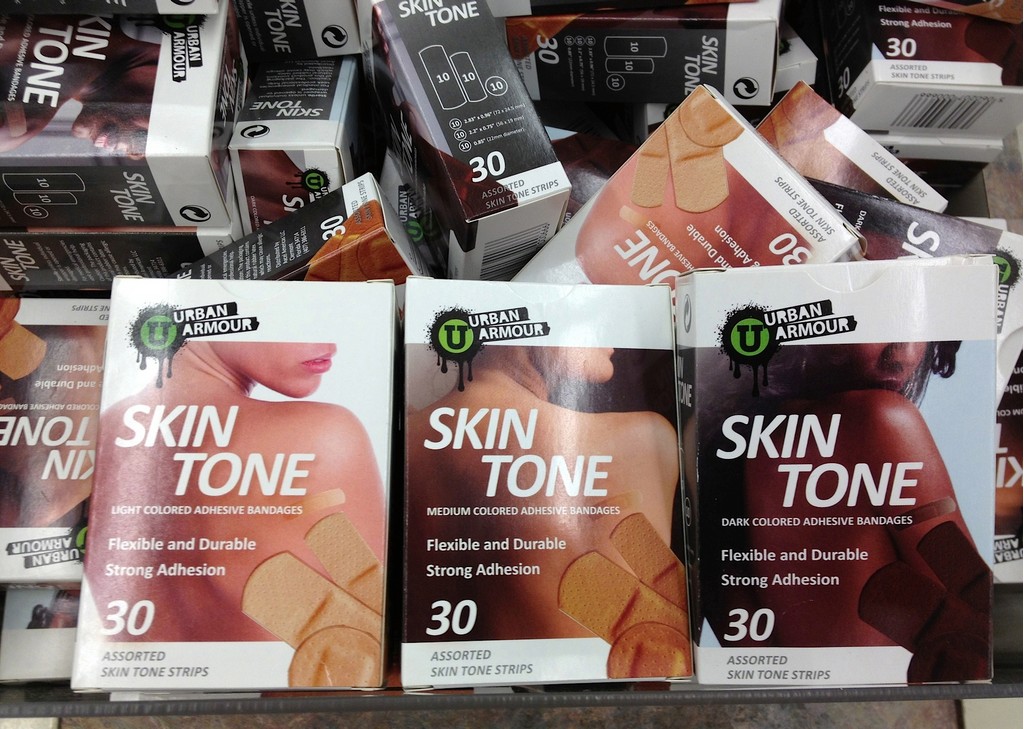
I recently posted a series of examples of the words “nude,” “skin-toned,” and “flesh-colored” being used to describe light-tan. In other words, a linguistic erasure of people who don’t have light skin.

In response, Kristen S. and Jessica J. sent in pictures of Urban Armor bandaids.  As you can see, they come in three colors and all of them are called “skin-tone.”  Awesome.

We’ve collected other counter-examples, as well.

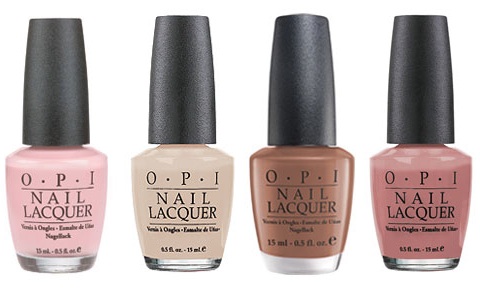
Andrea C. noted in 2010 that Elle did a segment on “Nude Nails” and highlighted OPI polish, mentioning the fact that they had “actual nude options for every skin tone”:

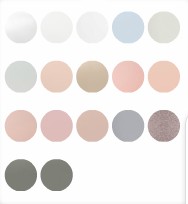
Here are the colors that OPI calls “nude” today:

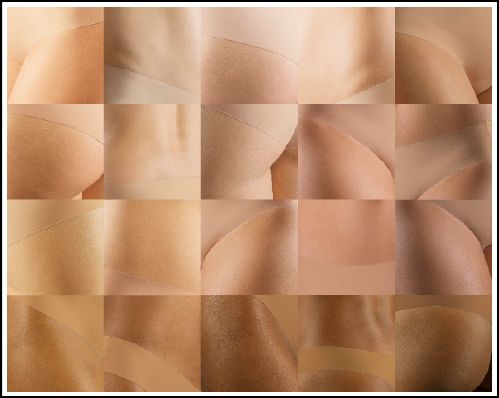
Breck C. found a website, My Skins, specializing in skin-matching underwear for a range of skin tones:

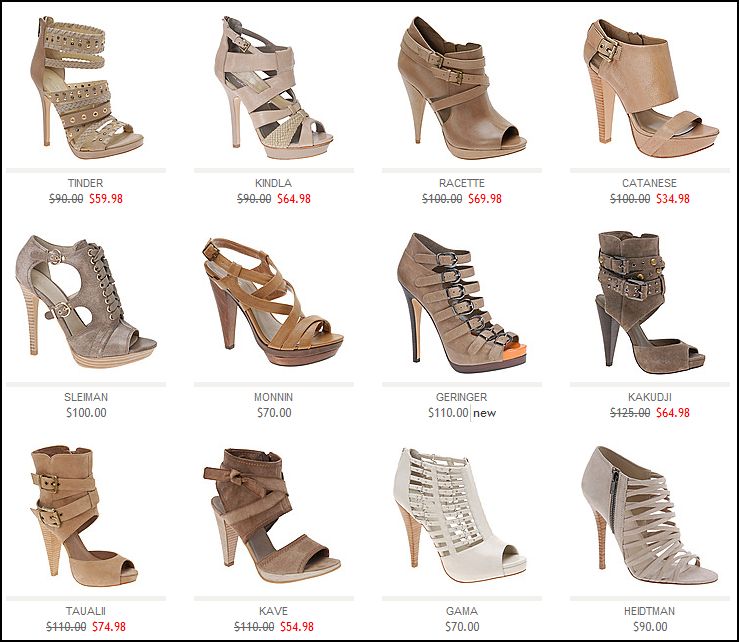
Eve F. discovered that Aldo included shoes of some different possible flesh-tones in it’s “nude” section (at least in 2010; the section doesn’t look like this today):

So, we can hope that consciousness is being raised, even if this can still happen.

Lisa Wade, PhD is an Associate Professor at Tulane University. She is the author of American Hookup, a book about college sexual culture; a textbook about gender; and a forthcoming introductory text: Terrible Magnificent Sociology. You can follow her on Twitter and Instagram.

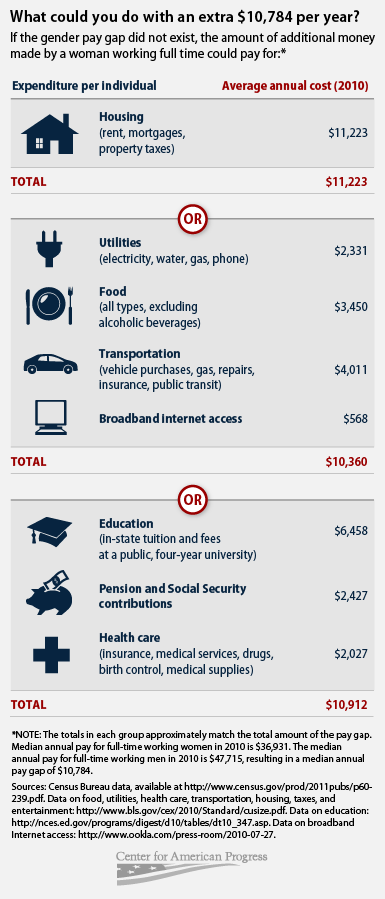
While income inequality between the sexes has decreased in recent decades, women still only make seventy-seven cents for every dollar a man is paid. Matt Separa from the Center for American Progress illustrated what could be bought with those lost wages to help us conceptualize how wide the wage gap is.

His first chart shows how the $10,784 in underpaid wages would almost cover annual housing costs or could pay the combined costs of a year’s worth of utilities, food, transportation, and internet access with a few hundred dollars to spare. The lost wages could also almost pay all the expenses for annual in-state tuition at a public university, twelve months of contributions to Social Security, and basic medical care for a year:

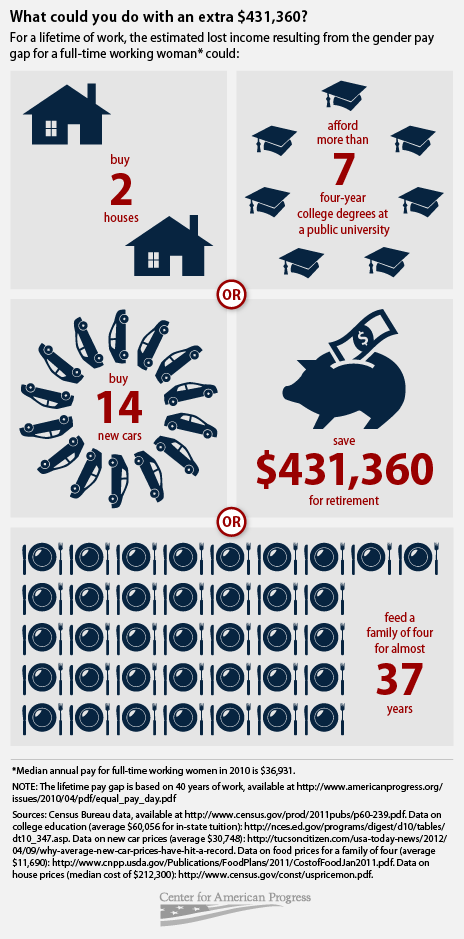
His second chart illustrates how across a lifetime, the lost wages ($431,360) could buy two houses, seven degrees from public universities, fourteen cars, or pay for a family of four to eat for thirty-seven years.   Many of Spera’s examples, including real estate, tuition and retirement savings, are especially powerful because they show how the lost wages could be turned into capital and wealth that would pay even more dividends on top of the lost income:

Overall, the graphs do a nice job of making the implications of the gender wage gap concrete.

—————

Jason Eastman is an Assistant Professor of Sociology at Coastal Carolina University who researches how culture and identity influence social inequalities.

Cross-posted at Montclair SocioBlog.

In recent Democratic primaries in Appalachian states, Obama lost 40% of the vote.  The anti-Obama Democrats voted for candidates like “uncommitted” (Kentucky), an unknown lawyer (Arkansas), and a man who is incarcerated in Texas (West Virginia).

Could it be that there’s racism at work in Appalachia?  Or is the anti-Obama vote based entirely on opposition to his policies?

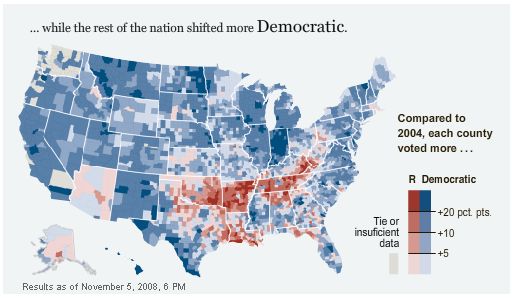
The 2008 Presidential election — Obama v. McCain — offers some hints.  For those with short memories, the Bush legacy — an unpopular war and an economic catastrophe — may have hurt the GOP.  In that election, the country went Democratic.  The Democrats did better than they had in 2004, the Republicans worse.  But not everywhere.  The Times provides this map:

Still, it’s possible that those voters in Appalachia preferred the policies of candidate Kerry to those of candidate Obama.  As Chris Cilizza says in in a Washington Post blog (here), the idea that race had anything to do with this shift is…

…almost entirely unprovable because it relies on assuming knowledge about voter motivations that — without being a mindreader — no one can know.

Cilizza quotes Cornell Belcher, the head of a polling firm with the Monkish name Brilliant Corners:

One man’s racial differences is another man’s cultural differences.

Right.  The folks in Appalachia preferred John Kerry’s culture.

I’m generally cautious about attributing mental characteristics to people based on a single bit of behavior.  But David Weigel, in Slate, goes back to the 2008 Democratic primaries – Obama versus Hillary Clinton.  A CNN exit poll asked voters if race was an important factor in their vote. In West Virginia and Kentucky, about 20% of the voters in the Democratic primary said yes.  Were those admittedly race-conscious voters more anti-Obama than other Democrats?

As Weigel points out, this was before Obama took office, before voters really knew what policies he would propose.  Besides, there wasn’t all that much difference in his policies and those of Hillary Clinton.

Cilizza is right that we can’t read voters’ minds.  But to argue that there was no racial motivation, you have to discount what the voters said and what they did.

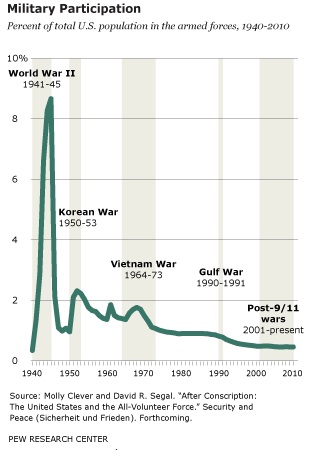
Yesterday the Pew Research Center posted a graph showing the proportion of the overall U.S. population on active military duty since 1940. From a high of almost 9% of the population during World War II, we’re down to roughly 0.5% of the population on active duty today (shaded areas are periods when the U.S. was actively engaged in a war):

According to the full report, of those in the military, about 2/3 are under age 30. Racial/ethnic minorities make up 36% of the armed forces today. As standards for recruits have increased, so has the educational level of troops: 92.5% have graduated high school, compared to 82.8% of civilians in the same age group.

The Pew Research Center points out that the reduced proportion of the population in the military at any give time means fewer connections between civilians and military personnel, which may influence the experiences of veterans as they re-integrate into civilian life, as well as the degree to which the population is aware of the impacts of military duty — physical, mental, financial, and otherwise — on those who serve.

Thanks to Shamus Khan for the tip!

James Mollison, the photographer who brought us Where Children Sleep, has a fantastic series called The Disciples in which he captures die-hard music fans (he calls them “tribes”).  The results are a great example of the power of sub-culture.


Mollison photographed fans of Madonna, Iron Maiden, Kiss, Dolly Parton, 50 Cent, The Casualties, and many more. You should go check out them all..

Lisa Wade, PhD is an Associate Professor at Tulane University. She is the author of American Hookup, a book about college sexual culture; a textbook about gender; and a forthcoming introductory text: Terrible Magnificent Sociology. You can follow her on Twitter and Instagram.