Archive: Sep 2011

In a recent interview at The Consensual Project, I was asked if I’d ever seen any “…videos, images, or sound bites that have provided [me] with valuable sexual health information.” I recounted this experience:

There is one video I saw, when I was about 21, that stands out in my mind even today…  The filmmaker asked about 40 women to stand naked, side-by-side, on the edge of a stage.  The camera captured the appearance of their bodies from about the neck to the knees, no faces, just bodies. (I don’t know if it was ever publicly available, but if anyone can send it to me, I’d be thrilled.)

Think about how rarely you actually see a new (near-)naked body that is not a model or the equivalent (actress etc).  With new sexual partners, perhaps.  And if you’re straight, this is (probably mostly) going to be the body of the other sex.  At the gym perhaps?  But you’re not supposed to look, so you probably don’t look closely.  I realized when I saw this video (it probably lasted all of two minutes), that I had never really seen women’s bodies outside of the mass media. I didn’t know what women’s bodies looked like.  And I had been comparing my body to that of actresses and models.  I realized that day that things about my body that I thought were horrible deformities were completely normal.  Even though the bodies in that video were all different, they were also very similar, and my body looked just like theirs in some cumulative way.  From that point on, I knew I wasn’t gross.  A simple lesson.  And so important, but a really hard one to encounter in a powerful way.

I was reminded of this story when I saw a photograph by Spencer Tunick.  Tunick specializes is getting large numbers of naked people together, arranging them, and taking pictures.  Most of them seem more polished than raw, but this one, featured at BoingBoing, seems to reveal bodies in some of their variety and similarity simultaneously.  It’s worth a good long look at each body; each is a precious point of push back against mass media’s representation of the female form.

Lisa Wade, PhD is an Associate Professor at Tulane University. She is the author of American Hookup, a book about college sexual culture; a textbook about gender; and a forthcoming introductory text: Terrible Magnificent Sociology. You can follow her on Twitter and Instagram.

While America has taken great steps in recent decades toward gender equality, this progress seems lacking in politics. No elected legislative body in the U.S. has ever come close to being half female—the proportion we would expect if it were truly representative of the populace. R.W. Connell argues patriarchy is replicated and reinforced partially through our individual gender practices that cumulatively make social institutions operate.  In daily life, all men and women are socially pressured to embody the gender traits prescribed for their sex.

Kathleen Hall Jameson argues the ways we judge others’ masculine and feminine selves creates a double bind dilemma for women in leadership; a problem that is especially salient in politics, where winning is contingent upon candidates being both personally liked and thought of as competent leaders.  Men have no problem being respected both personally and as leaders because acting strong, confident, and in-charge is expected of both males and authority figures.  However, when women present themselves as leaders by acting dominant, they are likely to be judged as overly harsh, or even “bitchy.”  Yet when women act feminine, they are often judged as unfit for authority because they lack leadership qualities.  In electoral politics, it is very difficult for women to walk the tightrope between being a competent leader and also connecting with voters personally.

We can see the double-bind at work in Saturday Night Live’s now famous, or infamous, parodies of Hillary Clinton and Sarah Palin during the 2008 Presidential campaigns.  Tina Fey’s Grammy-winning depiction of Sarah Palin exaggerates femininity, often portraying the former Alaska governor as if she is competing in a beauty pageant.  Amy Poehler’s masculine portrayal of Hillary Clinton as overly-aggressive, combative, and filled with anger exemplifies the other side of the double bind dilemma.  One skit bringing these characters together to speak out against sexism in the campaign is especially revealing:

Fey presents Palin as accommodating, saying “I was so excited when I was told Senator Clinton and I would be addressing you tonight,” to which Poehler-as-Clinton uncooperatively says, “I was told I would be addressing you alone.” Similarly, a capitulating Palin says “Hillary and I don’t agree on everything,” to which Clinton combats “we don’t agree on anything.” Later in the skit, Poehler-as-Clinton takes firm policy stances while Fey-as-Palin gives ‘pageant’ answers. After Clinton speaks out against the Bush Doctrine, Fey as Palin claims “I don’t know what that is.” Clinton says “I believe diplomacy should be the cornerstone of any foreign policy;” Palin responds “and I can see Russia from my house.” In the SNL skit, Palin tells political pundits to quit using words “that diminish us like pretty, attractive, beautiful …” while Clinton interrupts, “harpy, shrew, boner-shrinker.” Throughout the skit Clinton becomes increasingly agitated and then rips apart the podium in anger. Poehler’s masculine portrayal becomes literal when she says “I invite the media to grow a pair, and if you can’t, I will lend you mine.”

The overly-effeminate portrayal of Palin reflects one side of the double-bind where many people judge feminine women as lacking the appropriate characteristics for leadership. On the other side of the double-bind, the unfeminine portrayal of Clinton illustrates how women who act powerful and confident are subject to character attacks. However, because leadership qualities are expected of men, male politicians are not subject to this critique when they act like leaders. For example, Poehler as Clinton describes her “road to the White House” as “I scratched, and I clawed,”—words with negative connotations which would never be used to describe competitive men with ambition.

While political comedy depicting our leaders as inept has been a mainstay of our electoral process since our country’s founding; we should be cognizant that parodies of female politicians often draw upon very real aspects of gender that make it difficult for women to achieve positions of leadership.

———-

Jason Eastman is an Assistant Professor of Sociology at Coastal Carolina University who researches how culture and identity influence social inequalities.

If you would like to write a post for Sociological Images, please see our Guidelines for Guest Bloggers.


Terri Oda, a PhD student in computer science, put together this fun and quick slideshow explaining why sex differences in math ability can’t explain why there are so few women in computer science. It’s great:

Found at Geek Feminism. Thanks to Peter S. for the submission!

Lisa Wade, PhD is an Associate Professor at Tulane University. She is the author of American Hookup, a book about college sexual culture; a textbook about gender; and a forthcoming introductory text: Terrible Magnificent Sociology. You can follow her on Twitter and Instagram.

Geographer Derek Watkins put together an interesting visualization of the expansion of the U.S. by showing the distribution of post offices between 1700 and 1900. The distribution of post offices reflects a number of important social and political events — the sudden emergence of post offices on the West Coast in the late 1840s, around the time of the gold rush and California becoming a state, patterns in Kansas and Nebraska in the 1870s clearly showing how population growth followed railroad lines, and so on:

Posted: Visualizing US expansion through post offices. from Derek Watkins on Vimeo.

You can read Watkins’s caveats about the data (it doesn’t include closures of some post offices during that time, and he was unable to determine the location of about 10% of post office branches) here. Thanks to Jeremy Freese, at Scatterplot, for posting it!

Dmitrity T.M. and Larry Harnisch (of The Daily Mirror) let us know that Stanford University’s Rural West Initiative put together a map showing the spread of newspapers across the U.S. between 1690 and 2011, based on Library of Congress listings. The results illustrate many of the same major social and political changes and trends as the post office map:

The Growth of US Newspapers, 1690-2011 from Geoff McGhee on Vimeo.

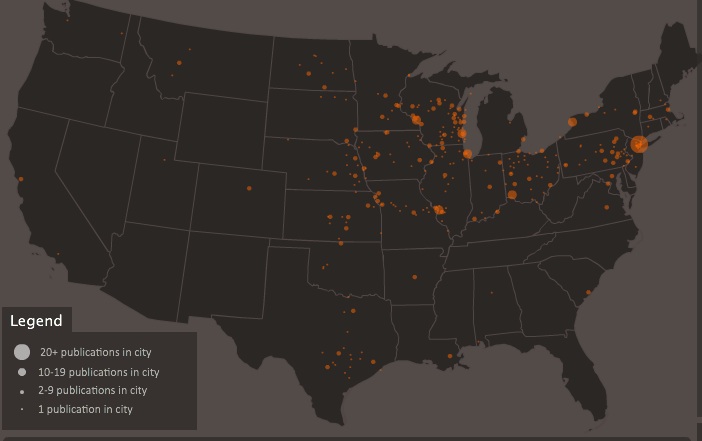
The website allows you to see the map for any individual year, and awesomely, you can filter by language, illustrating a number of periods of high immigration and common destination locations. Here’s the map of German-language newspapers in 1900:

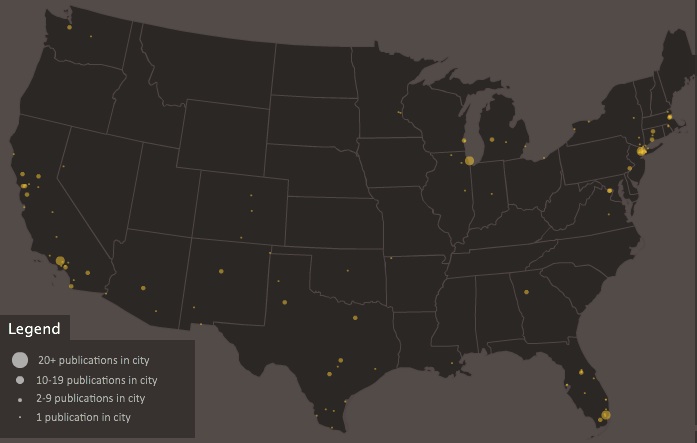
And Spanish today:

HAPPY SEPTEMBER!

News, Publications, and Appearances:

We are super grateful to Karen McCormack for her positive and insightful review of SocImages in Visual Sociology.  Thanks so much Karen!

We’re pleased to report that our short essay on Banal Nationalism was published in Contexts magazine this month.

Guest Blogger Christina Barmon made a big splash this month with her post, To Sit or Not to Sit: Gendering How We Pee.  Maybe we can get it up to 500 Facebook likes today!  If you’d like to be a part of our Guest Blogger Team, with access to the best reader submissions, send us a note at socimages@thesocietypages.org.

Contributor Caroline Heldman made nine appearances on Fox and the Fox Business channel this month, in addition to writing a fantastic series marking the anniversary of Hurricane Katrina and kicking off our Election 2012 Sexism Watch.

Lisa was also quoted in an Inside Higher Ed article about the American Sociological Association’s annual conference in Las Vegas.  And she chatted for a few minutes about the sexualization of girls with sexologist Logan Levkoff on CKNW’s Bill Good Show.

Course Guides:

Classes are in full swing for the SocImages team!  Gwen is getting started on a Course Guide for Introduction to Sociology, a list of topic-specific quality SocImages material arranged in a way that we hope instructors will find familiar and convenient.  We’d love to see more!  If you are teaching this semester and would like to be forever inscribed on our pages as a generous soul, check out our Instructors Page for more information.

Featured Reader!

This is a shout out to our long-time reader and prolific idea submitter, Katrin.  Katrin is at the University of Cambridge in Politics, Psychology, Sociology, and International Studies, researching climate change. She stumbled across the blog while searching some OECD statistics… and says she then spent the entire rest of the day flicking through ALL the other posts.  She’s also a Shakesville superfan, as we are.

Social Media ‘n’ Stuff:

Finally, this is your monthly reminder that SocImages is on Twitter and Facebook.  Learn more about your editors at Lisa’s and Gwen’s websites.  And a bunch of us are having fun on twitter: @lisadwade@gwensharpnv@familyunequal@carolineheldman, and @jaylivingston.