Archive: May 2009

I came across a series of photos that reminded me of Menzel and D’Aluisio’s book, Hungry Planet: What the World Eats, that looked at how globalization, migration and rising affluence affect the diets of communities around the globe.  See also photo galleries 1, 2, and 3 in Time Magazine.

From photographer, Mark Menjivar, You Are What You Eat is a series of photographs looking at the interiors of refrigerators in homes across the United States. Nothing was added or taken away.

What type of insight do we gain by looking at our refrigerators?

According to the Economist, beauty spending–on make-up, diet and exercise, fragrances, skin care, hair products, and cosmetic surgery–adds up to a $160 billion-a-year worldwide.  To illustrate this, Lauren Greenfield calculated the monthly spending of six women and photographed them undergoing their beauty treatments (slideshow here).  Thanks to Karl B. for sending along the link!

26 year-old, Ginger spends $650 a month on her physical appearance. At Manhattan’s store Sephora, Ginger shops alone for cosmetics because her friends know she will spend hours. She is so obsessed with makeup that she founded her own line of cosmetics, Ginger Luxe.

PR-Company owner, Claudine (29) compares prices at Duane Reade drug store in Upper East Side Manhattan. Claudine spends only $80 each month on her personal grooming. Her philosophy is ‘the less stuff I use, the better I look’.

New York City actress Cameron (25) spends $620 a month on her personal grooming. Cameron reveals that her hair is the key to her personality, ‘I spend so much time with my hair-stylists, they’re like my family’.

New York City hedge-fund exec Suzanne (36) spends $1720 a month on personal grooming.  At ‘Skin & Spa’ cosmetic surgery center, Suzanne receives Botox from Dr. Howard Sobel, a treatment that she receives 3 times a year.

25-year-old Manhattan publicist, Laura gets her eyebrows threaded, an Indian technique where hair is pulled out at the roots. Laura spends $145 a month on her personal grooming, but her mother is a hair stylist who cuts and colors Laura’s hair monthly for free.

Fashion company spokeswoman, Jennifer, 27 receives a spray tan at a top New York salon. Jennifer spends $865 on personal grooming, ‘My spa time’s not a splurge-it’s a necessity!’

For more on beauty and spending, see our posts on the scientizing of beauty products (here, here, and here), our post on how Dove and Axe are in bed together, and this post on the economics of beauty over a lifetime.

Also see Lauren Greenfield’s work on girl culture and photographs of children at a weight loss camp.

Lisa Wade, PhD is an Associate Professor at Tulane University. She is the author of American Hookup, a book about college sexual culture; a textbook about gender; and a forthcoming introductory text: Terrible Magnificent Sociology. You can follow her on Twitter and Instagram.

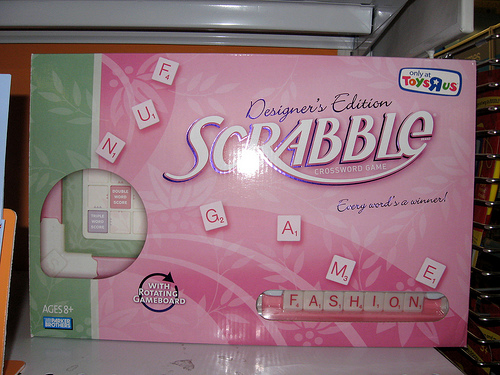
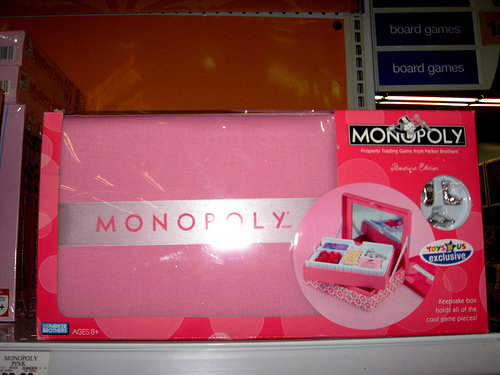
Abby J. sent in some photos she took at Toys ‘R’ Us of a bunch of classic board games that are now marketed specifically to girls. We know they’re for girls because they’re all pink:

3520573334_beb11ee74a

3520711464_705643d4c4

Of course the girls’ version of Scrabble would spell “fashion.” I assume the boys’ version spells “motorcycle” or something of the sort…though probably with fewer letters, I guess.

The Monopoly game (called the Boutique Edition) looks like a jewelry box:

3520712872_89165de5e9

I don’t know what Mystery Date is all about–I mean, I can guess, but I’m not familiar with the game, and not actually sure I’d want to encourage kids to go on mystery dates, but whatever. Both Abby and I found the pink Ouija board odd. I didn’t know they really still sold them. My grandma came across an old one when they were cleaning out my great-grandma’s stuff a couple of years back and she took it and gave it to my teen-aged cousin. My aunt took great offense and sent it back. My grandma, who is a devout Christian, took offense at my aunt taking offense (and implying that Grandma was giving her grandchildren satanic toys) and now keeps it around and lets kids play with it at her house. She also declared my aunt “no fun” and “too churchy.” If you knew my grandma, or had ever sat there and watched her call out to Jesus to help her find her missing spatula (he complied and made it appear in the drawer where she always keeps the spatulas), you would understand why I nearly choked on my food when she referred to someone else as “too churchy.” Now she’s decided that the Harry Potter movies are not, as so many people she knows had told her, satanic but are instead quite funny.

Anyway, that’s a long rambling unimportant point for a post that just illustrates how much we identify girlhood today with pink and feel the need to make gender-specific version of games where a single version seemed to work perfectly well in the past.

Reader Rachel sent in this photo she took of Legos being clearly marked as “boys’ toys”:

3453691914_2a64dfff3a

NEW! Sara P.-S., Liz, and Danielle F. sent us links to the new “girlz” version of the PSP (Playstation Portable) because, as Sarah says, it is apparently so “skewed towards boys that they have to specifically advertise the fact that girls [can] play with it”:

omglilacpsp-670x355

NEW (Apr. ’10)! Sunlight Snow sent in a version of Jenga aimed at girls called “Girl Talk” Jenga. Not stopping at the pinkification of the game, the producers decided to add sharing and gossip to it. Each plank now offers a question that girls are supposed to discuss. Apparently precipitous balancing and impending collapse is not fun enough, girls must add desperate crushes and dreams of becoming a veterinarian!

Gwen Sharp is an associate professor of sociology at Nevada State College. You can follow her on Twitter at @gwensharpnv.

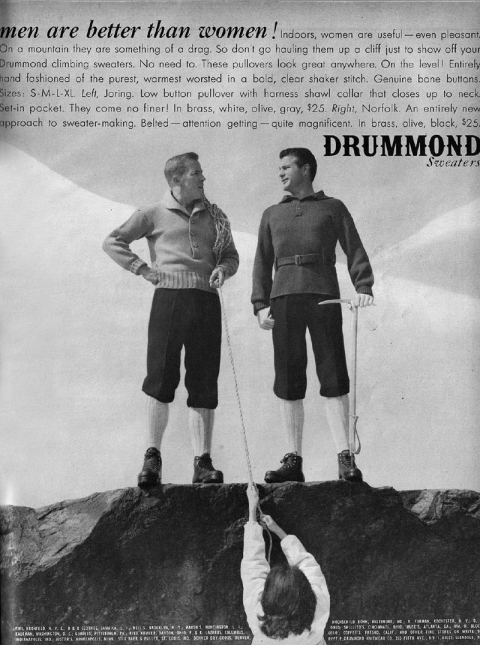
Taylor sent in this ad, found at Blame It on the Voices:

small_men-are-better-then-women

It ran in Esquire in 1959 and our post on the emergence of Playboy Magazine may give the ad some interesting context.

Both Aani B. and Sarah F. sent in a link to a commercial for the new diet Pepsi (Pepsi Max, of course) being aimed at men. 

Also don’t miss this commercial (embedding disabled) in which they describe the ingredients of Pepsi Max as the crushed bones of a Viking, the spit of a rapid Wolverine, pepper spray, and scorpion venom.  The can? Made from the hull of a nuclear submarine.  The crushing of cans on heads ensues.

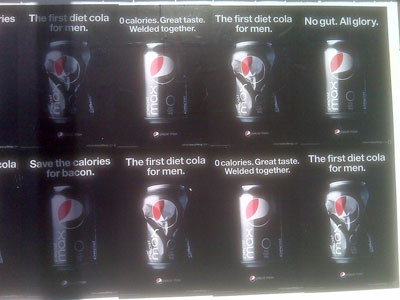
Over at I Blame the Patriarchy, a reader named Kate sent in a snapshot of some advertising for the product at the intersection of 6th and Anza in San Francisco:

3523488128_d3d6c0445e 

Slogans:

“The first diet cola for men.”

“Save the calories for bacon.”

“0 calories. Great taste. Welded together.”

“No gut. All glory.”

This is, of course, all in jest. Yet is still re-affirms the idea that being this way is the epitome of manhood, if taken to a ridiculous extreme.  Eh, I’ll just let Twisty say it. As usual, she says it better than I:

What’s the big whoop? Well, you can’t have a “soda for men” unless “men” are considered a class unto themselves, defined in terms of the bacon-eating, welding, glorious nukular submarine-squashing aspirations that separate them from dainty vulnerable “women.” These ads are jokey, depicting average-looking dudes, but they tacitly allude to the noxious he-man/fragile damsel dichotomy that’s been chapping actual women’s hides lo these many millennia.

It also, of course, points to the fact that dieting really has been for women all along (see posts here and here for examples). In fact, it denies that diet-soda-for-men is about dieting at all: note the slogan “save the calories for bacon” and the name, Pepsi Max, which implies adding something to the beverage as opposed to taking something out.

See other examples of marketing for diet products aimed at men: Nutrisystem (“get ‘er done!”) and Weight Watchers.

As discussed on Salon.com and Jezebel today, Dell Computers has started to market directly to women with a new website, Della. Joshua and Frederick both told us about it. Here are some images from the site:

dell3

dell2

dell1

dell4

Apparently women shopping for computers care about (1) style– whether or not it matches their outfits, (2) how light it is to carry around when they hang out with equally-coordinated friends and their laptops, and (3) the ability to check movie times, and restaurant directions whenever you need to.

It takes 3 clicks to even get to anything about the actual computers’ processor speed, RAM, hard drive capacity etc. I don’t know about everyone else, but I’m a proud geek and I want to know all the technical computer specs.

So what is Dell really saying, here, about women’s computer needs? That women care more about the color of their computers than how well it is going to perform for them? That women won’t understand all the tech specs anyway, so why bother? That women don’t use their laptops for work— to run businesses, write papers, network with clients, or design websites?

Instead we get incredibly informative descriptions  like “attractive, clean designs… with everything you want for your everyday needs.”

And content aside, I also take issue with the very existence of a separate website for women computer buyers. The not-so-subtle message is that the Dell website– with all the high speed (plain black) computers, business information, and detailed tech specs– is for men.

dell6

dell5

Oh, there are some tech tips on the Della site– about how to use your wicked cute laptop to keep in touch with friends and family and to exercise and eat better.

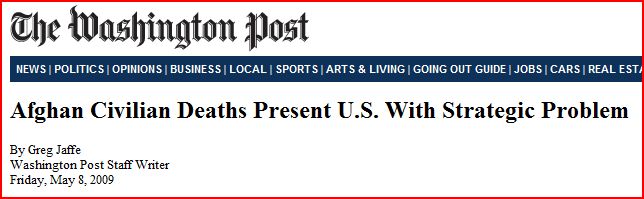
Fair.org (via Alas a Blog) points out that the news media has consistently framed the recent U.S. killing of dozens of Afghan civilians as “bad PR.”  Consider these headlines:

Wall Street Journal

wsj

Washington Post

wp

New York Times

nyt1

Fair summarizes the coverage:

Early reports of a massive U.S. attack on civilians in western Afghanistan last week (5/5/09) hewed to a familiar corporate media formula, stressing official U.S. denials and framing the scores of dead civilians as a PR setback for the White House’s war effort.

The New York Times reported that civilian deaths “have been a decisive factor in souring many Afghans on the war.” As CBS Evening News anchor Katie Couric put it (5/6/09), “Reports of these civilian casualties could not have come at a worse time, as the Obama administration launches its new strategy to eradicate the Taliban and convince the Afghan people to support those efforts.” Other outlets used very similar language to explain why the timing was “particularly sensitive” (Washington Post, 5/7/09) or “awkward” (Associated Press, 5/7/09) for the Obama administration.

The ease with which these deaths can be framed as a problem for the U.S. is a good example of how we can dehumanize the Other.  We clearly do not identify with the victims or their loved ones when the pain and suffering we leave in our wake is made invisible so easily.

Danielle C. sent us a video about “Muslim demographics.” When I saw the title, I assumed it was just a basic informational video about the Muslim population. Oh, indeed not:

There are so many things going on there, I’m having trouble knowing where to start. I’m going to just sidestep the many demographic assertions thrown at us, though readers may have thoughts there. It is interesting how the presence of Muslims is associated with the idea of an Islamic state–at about 3:20 the narrator says that Muslim population growth will turn France into an “Islamic Republic” by 2039 or so. But a Muslim population is not the same as an Islamic republic–one is a religious population, the other is a form of government, and they don’t automatically go together, as, say, Turkey might illustrate.

Also notice the explicit assumption that Muslims are inherently bad and that a country with an increasing Muslim population is automatically in danger (as well as the clear assumption about who “we” and “our” children and grandchildren are). In fact, while the word “immigration” is usually used in a threatening tone of voice in the video, apparently the threat from the Muslim hordes is sufficient that we may even have to accept the need for Latino immigrants, since they may be the only group that can save the U.S. for ending up like Europe, which is a lost cause already.