Archive: May 2009

American workers have lost power relative to their employers since the heyday of unionization during the industrial era. One way in which employees gained was through the extension of benefits to full-time workers: salary, relative job security, health insurance, sick pay, paid vacation, parental leave, etc.  Full-time jobs, however, are being replaced by part-time jobs, and with them have gone much of the power and most of the benefits that workers were able to gain through unionization.

You would think, though, that jobs that require a high level of education and training might be immune from these trends. Perhaps not.

The American Federation of Teachers released a report that included data on the percentage of employees at U.S. colleges and universities that are full-time tenure-track professors, full-time non-tenure track, adjunct (part-time) professors, and graduate students.  As you can see, the percentage of full-time tenure-track professors is decreasing and we are being replaced by other types of employees who cost the institution much less (graphs borrowed from MontClair SocioBlog).
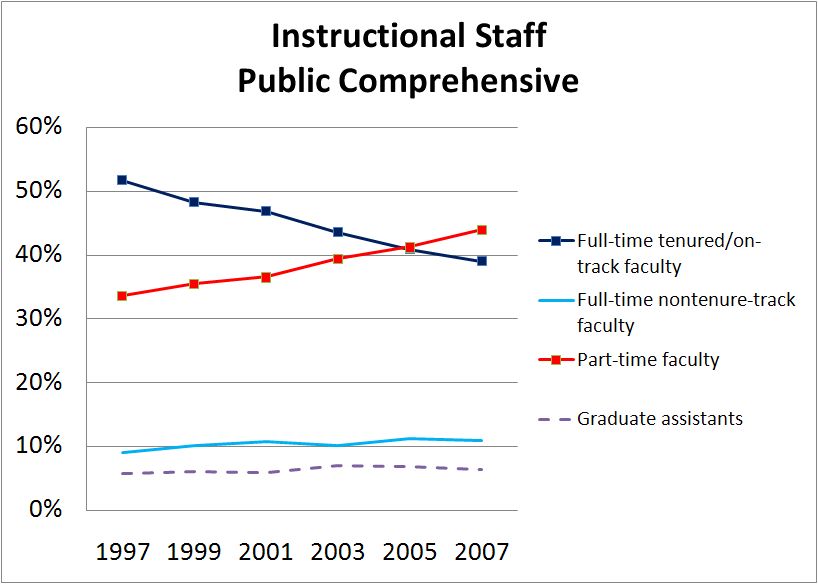
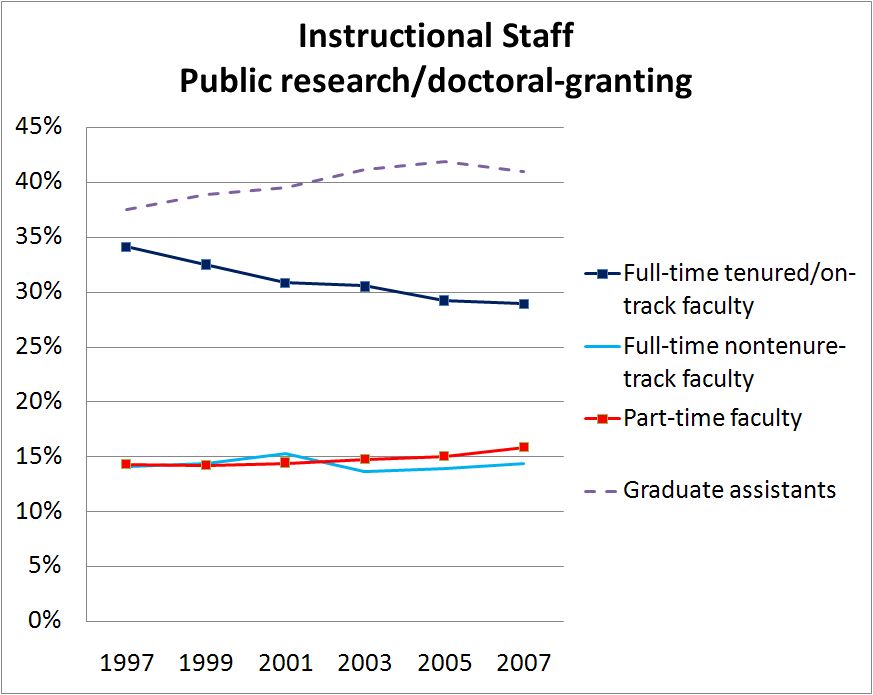
00_adjuncts_comp1

00_adjuncts_rsch2

This is a problem from a labor perspective in that it strips power away from employees, putting it squarely back into the hands of employers.  It may also be a problem in terms of the quality of education.  Adjunct professors are often terrific, but anyone who is overworked and underpaid is likely to invest less in their product.  I wonder, too, if this impacts the rate of scientific research (fewer full-time tenure- track professors= less research).  Any other thoughts on this trend?

Lisa Wade, PhD is an Associate Professor at Tulane University. She is the author of American Hookup, a book about college sexual culture; a textbook about gender; and a forthcoming introductory text: Terrible Magnificent Sociology. You can follow her on Twitter and Instagram.
I’m not from a military family so Memorial Day has mostly been about a three day weekend, grilling, and maybe giving a tiny bit of thought to members of the military who have fought in various U.S. wars. But, in the last couple of years, Memorial Day has taken on so much more significance for me, and it seems rather fitting that this weekend I’m working on my dissertation– writing about the mothers of current U.S. service members who have been deployed in the U.S. war on terrorism.

Mothers, and all members of a service person’s family, often refer to themselves as “the silent ranks.” And they are a key part of the “ranks” of the military in many ways. Next to the troops, family members shoulder the majority of this particular war. Unlike previous U.S. wars (WWI and WWII), the public has not been asked to do much– we are not planting victory gardens, living with rations, working in factories, or collecting scrap metal and even lard for the manufacturing of weapons and supplies.

The military knows how important the families of service members are– for both recruitment and deployment support. You may have noticed the Army recruitment commercials specifically target parents. The Army knows they need parental support to enlist new Soldiers. Often these commercials focus on Army service as an opportunity for training, for an education, for a career, while also telling parents how strong their children will become when they join. Thus the motto “You made them strong: We’ll make them Army Strong.”

[youtube]http://www.youtube.com/watch?v=S8MBbaz61kU[/youtube] [youtube]http://www.youtube.com/watch?v=2TUbnGXqI1s[/youtube]

Despite the fact that the military is changing, and more women are joining, homefront support remains largely gendered. The video below “Army Families = Army Strong” is one that the Army put together as a tribute to the work these silent ranks do during wartime.

[youtube]http://www.youtube.com/watch?v=K5RIHo5rh3c[/youtube]

What is striking (but not surprising) to me about this video tribute is how gendered the home front is. With a few exceptions (a few female Soldiers), this video mostly depicts wives left at home taking care of young children. These families (women and children) need to be strong to deal with the stress and anxiety of having a loved one deployed, and to carry on their day to day lives. The military also needs them to be strong– to hold down the home front, send supportive packages and emails to deployed Soldiers, and to be there for Soldiers to come home to. As the voice over says “they wear a different uniform… theirs is a uniform of strength… the strength of courage, integrity, and sacrifice.” Even if they aren’t deployed to a war zone, families are enlisted to military service along with the Soldiers.

For my dissertation I interviewed 60+ mothers of service members (and hundreds more in online support groups) who also describe themselves as part of these “silent ranks.” I would love to be able to share their incredible stories here, but I only have their permission to write about the for research purposes. So instead I’ll write about what I’ve learned from them about how complicated home front war support is for mothers.

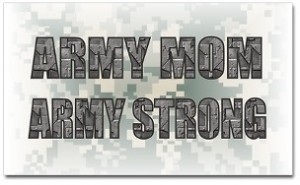
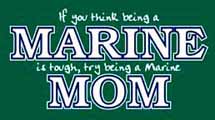
Like other military family members, the mothers of service members also see themselves as members of the military– even when they are more removed from receiving the kinds of benefits a military wife (or husband) would receive. Here are some of the slogans mothers use to identify themselves as a strong, tough, part of the military:

130730295v2_350x350_frontmarinemomlogo

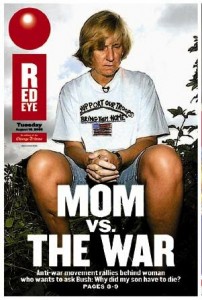
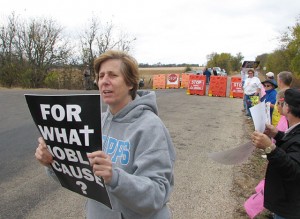
Usually when we think about the mothers of service members, the most publicly active (and anti-war) ones come to mind. Like Cindy Sheehan:

sheehan-momvswar

sheehan-forwhat

While many mothers of service members take the same war stance as Cindy Sheehan, most have widely different, and often contradictory relationships to war (just as other military family members do, I imagine). My research is about these contradictions. Some mothers disagree with the war, but publicly support their child’s mission– and want the war to succeed. Others disagree with the war but would never say so publicly for fear of being seen as unpatriotic. Some just want the troops to come home safely. Others support the war fully, and some who support the war fully see anti-war mothers like Cindy Sheehan as degrading to the job their children are doing.

halfmyheart-iraq

Mothers of service members may have opposing ideas about war, but they all feel unbelievable anxiety for their deployed child. They cry in the grocery store when they see their son’s favorite food. They panic every time an unknown car pulls into the driveway, fearing that dress uniforms will show up at their door. And they all feel a duty to their deployed child (to send care packages, buy their child supplies etc.), and feel a sense duty to all the troops and military families– taking part in efforts to make sure the troops and their families feel supported.

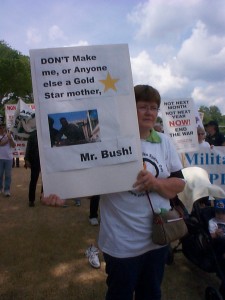
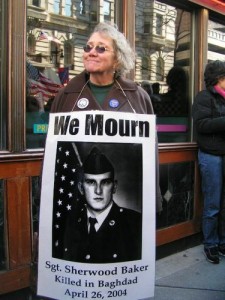
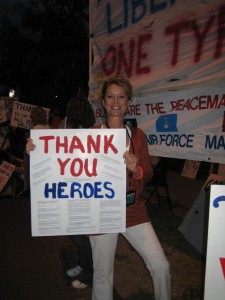
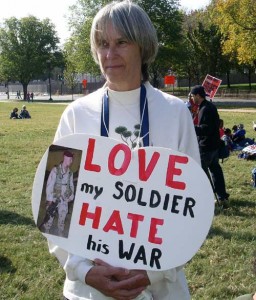
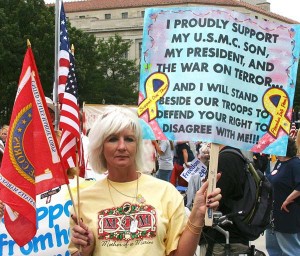
Here are some images of different mothers supporting the troops in different ways (these images are all public domain, and none are mothers in my study):

protest-goldstarmom

protest_05121205

support-thankyou

washington-dc-protest

usa11

Finally, take a few minutes to watch this video interview with Vicki Castro, whose son was killed in Iraq (“life as you know it stops…”). I can’t embed the video here, but it is worth clicking on and watching.

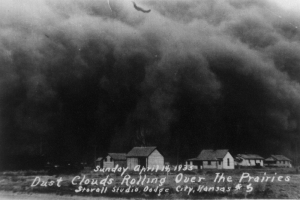
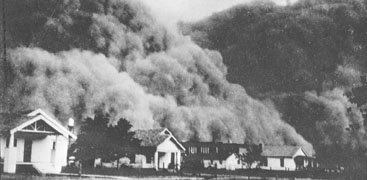
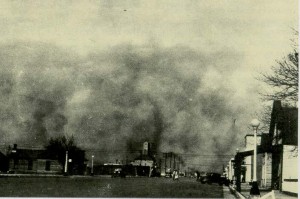
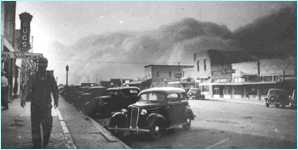
Since I’m visiting my family in rural Oklahoma, I decided to post some pictures of dust storms during the 1930s. Almost everyone has seen some of the Dust Bowl-era photos of poor families, of houses covered in blown dirt, and so on, but fewer people have seen photos of actual storms blowing in. All of these are available from Kansas State University’s Wind Erosion Research Unit.

This one is from a storm that was widely considered the worst of all; April 14th, 1935 was referred to as “Black Sunday”:

dust103

dustbowlfollett

weokla

dustphoto1_2_a

Most people associate the Dust Bowl with Okies and The Grapes of Wrath. The Joads weren’t Dust Bowl refugees; most Okies were from eastern Oklahoma and lost their farms because they couldn’t pay the mortgages. Only a small part of the Dust Bowl was in Oklahoma, though my great-grandparents and their many children had the good luck to be living in it.

While a bad multi-year drought certainly set the stage for the Dust Bowl, it was really a social disaster, not a natural one. Semi-arid regions had been over-plowed, and no windbreaks were planted to help hold soil in place. And once the dust storms began, many farmers did about the worst thing they could have done: they went and plowed during it. My great-grandpa and his sons would go out with the horses and start plowing as a dust storm came in, hoping they could turn up moister soil from underneath that would be too heavy to blow away. But because of the drought there wasn’t any moist soil to turn up, so all they were doing was breaking up dry dirt, making it even more likely to blow away…and presumably so were thousands of other people. My great-grandma always told me the big joke was that if you had a bucket you could hold it up outside and catch yourself a farm.

Anyway, no huge sociological insight here, just some fascinating and creepy photos and a reminder that things we often refer to as “natural” disasters are either caused by human activity or greatly exacerbated by it.

And I have to drive 30 miles each way to get to the internet, so I’m not able to read comments or add commenter’s interesting links as much as I usually try to do, so be patient for the next couple of weeks.

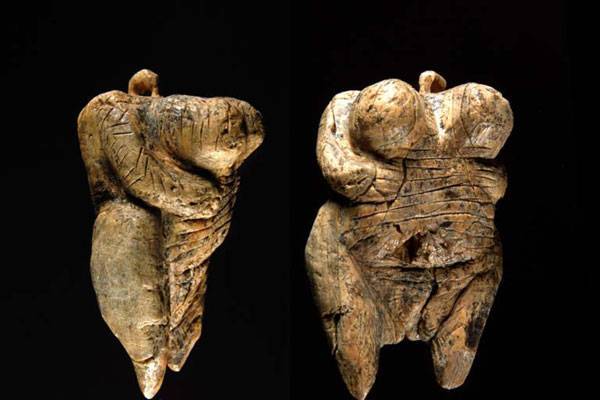
I have been fascinated over the past week by news coverage of the newly discovered “Venus” figurine that is believed to be the oldest human carving ever found. In this post, I’m trying to work out my thoughts.

picture1

News coverage has described the figurine with terms like “sexy,” “erotic,” “sexually-suggestive,” “sexually-charged,” “busty,” “pornographic,” and “pin up.” I’m not sure what to make of this.  There is no possible way that we could understand the meaning–or, let’s face it, multitude of contested meanings–that such a figure could have carried for those who made it.  All interpretations are projections of our own contemporary sensibilities.

Perhaps especially because of this, I am dumbfounded as to the ease with which news coverage describes the figurine as sexy.

From a contemporary U.S. perspective, the figure would not be considered sexy. Bodies such as that portrayed in this “Venus” are considered grotesque today and people who are sexually attracted to such bodies are considered deviant. It’s amazing to me that this is so completely unnoticed in news coverage. Instead, the figure is seen as obviously sexual exactly because the body is fat.

I think this could be explained with our contemporary social construction of fatness. Fat symbolizes excess. Fat people are presumed to have appetites in excess, for sex as well as for food. Fat women in the media are often portrayed as highly, even aggressively, sexual (think Mimi from The Drew Carey Show, the way that Star Jones’ role developed on The View, even Karen Walker on Will & Grace who, by modern standards and compared to Grace, was “curvy”).  The figurine is described as somehow obviously in excess.  The coverage includes terms like “protruding,” “exaggerated,” “grossly exaggerated,” “enormous,” “aggressive,” “enlarged,” “bloated,” “huge,” “bulbous,” “oversized,”  “outsized,” “distorted,” “swollen,” and “with breasts that make Dolly Parton look flat-chested.”  Granted, the figure may be somewhat disproportionate (and I emphasize may be), but our interest in its disproportionality seems somewhat disproportionate as well.

Maybe this is intersecting with our own assumptions as to the primitiveness of the people who carved the figure. The primitive is also a socially constructed idea and we often think that primitive people have closer ties to their baser instincts.  From that perspective, maybe being sexually attracted to excessive sexuality makes sense.

So maybe the combination of our social construction of fat and our social construction of the primitive explains why the contradiction–the figurine is obviously sexy, but women who have that body today are considered the antithesis of sexy–is going unmarked. I’m not sure. I’d like to hear your thoughts.

Lisa Wade, PhD is an Associate Professor at Tulane University. She is the author of American Hookup, a book about college sexual culture; a textbook about gender; and a forthcoming introductory text: Terrible Magnificent Sociology. You can follow her on Twitter and Instagram.
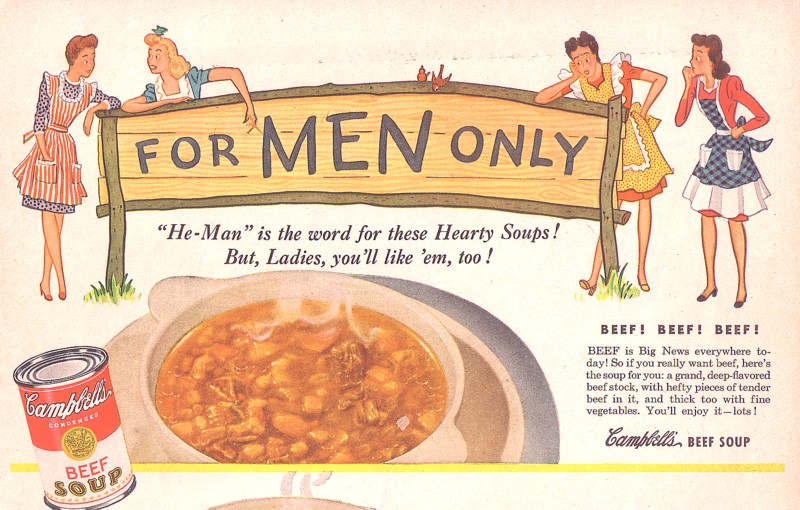
Since I’m visiting my family in Oklahoma, and they raise cattle, I thought it was appropriate to post this Campbell’s soup ad from the 1940s (found at Vintage Ads):

campbells_soup_formenonly_1940s1

Of course, there’s a long history of associating masculinity with meat, with poor families often reserving meat and other foods considered particularly nutritious for men, since they were believed to need it most in order to perform hard physical labor. Writing about the British working class during the late 1800s in his book Sweetness and Power, Sidney Mintz argues, “…wives and children were systematically undernourished because of a culturally conventionalized stress upon adequate food for the ‘breadwinner'” (p. 130). Men’s privileged access to meat actually spurred the consumption of sugar: “…while the laboring husband got the meat, the wife and children got the sucrose…” (p. 145). Sugar provided a relatively cheap source of calories for women and children’s diets to make up for the fact that they got less of other foods. Of course men also ate sugar, but historical evidence indicates that their diets were made up of more protein and less sugar compared to women and children. Sugar provided an energy boost and source of calories for women and children, but at the cost of providing little nutritional value.

Mintz also describes how cultural beliefs emerged to justify this consumption pattern:

One (male) observer after another displays the curious expectation that women will like sweet things more than men; that they will employ sweet foods to achieve otherwise unattainable objectives; and that sweet things are, in both literal and figurative senses, more the domain of women than of men. (p 150).

And of course this belief that women like sweet things more than men, and use them to “achieve” objectives (say, eating chocolate to soothe a broken heart after a breakup) is still with us today.

Gwen Sharp is an associate professor of sociology at Nevada State College. You can follow her on Twitter at @gwensharpnv.

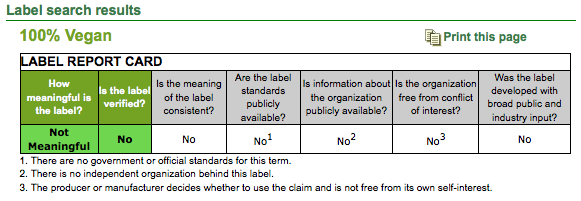
Consumer Reports has an awesome interaction Eco-label website that provides information on what different types of “green” labels mean (organic, natural, free trade, and so on) and how meaningful they are in terms of indicating that a product is more environmentally friendly than other brands. For instance, you can search the label “organic” and get really detailed information about different organizations that certify products as organic and what their standards are. Or you can search by product (food, household cleaners, and so on) and get more information about the types of labels you’ll often see on them. Here’s a small segment of the page about “100% Vegan” labels under the household cleaners section:

picture-21

The criteria they used to rate labels, such as transparency, consistency, and freedom from conflicts of interest, are available here.

The website would be great for a discussion of greenwashing (claiming to be environmentally friendly as a marketing technique, with little significant changes in production practices) and how eco-friendly is defined, but it’s also just useful if you’re interested on a personal level.

An extended version of this post also appeared at Ms.

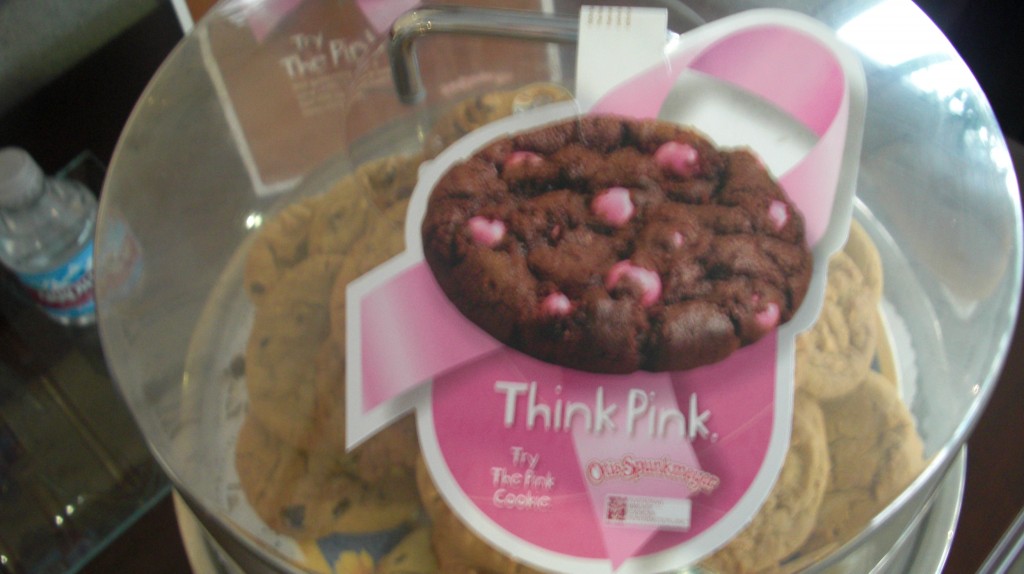
I’ve been taking photographs of breast-cancer-research-and-prevention-branded products for a few months now. I was first driven to do so when I saw this at the Million Aire (private plane terminal) at the Burbank airport:

cimg1256

That’s right. You are looking at pink chocolate chips cooked into cookies to signify a commitment to reducing breast cancer-related morbidity and mortality.

Anti-breast cancer messages are, I think inarguably, the most widely product-linked disease-related message ever.  I am constantly shocked by how many products have a breast cancer version. Here are some pictures I’ve taken over the last few months.

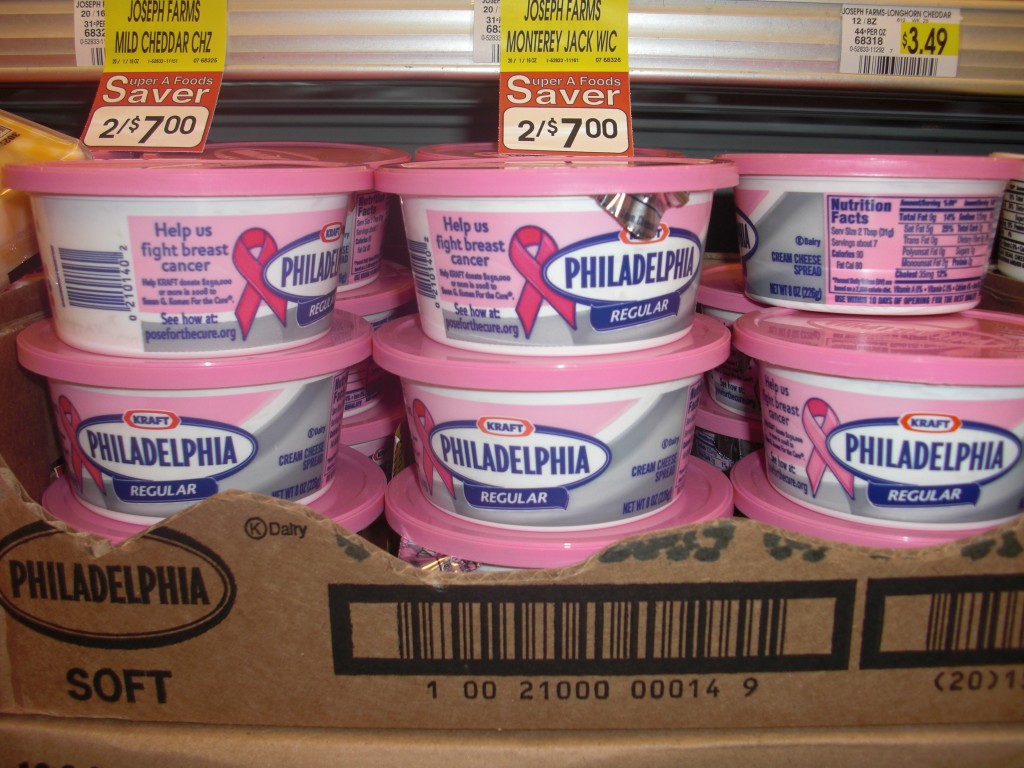
Cream cheese:

lisa-cimg2124

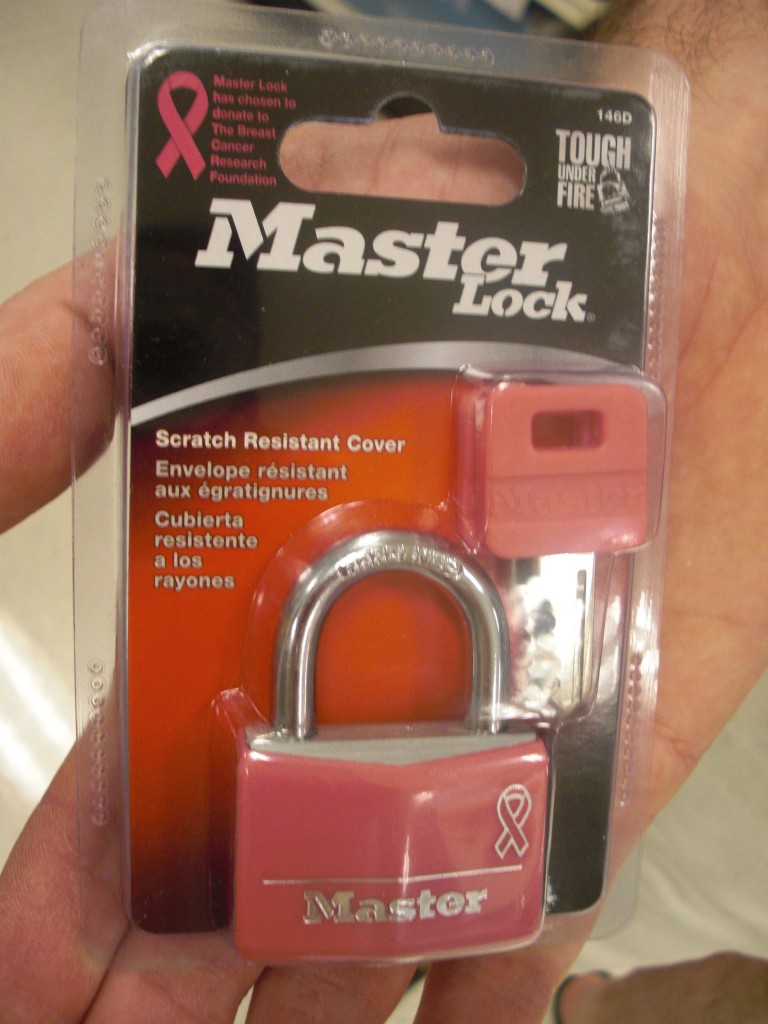
Padlock:

lisa-cimg2186

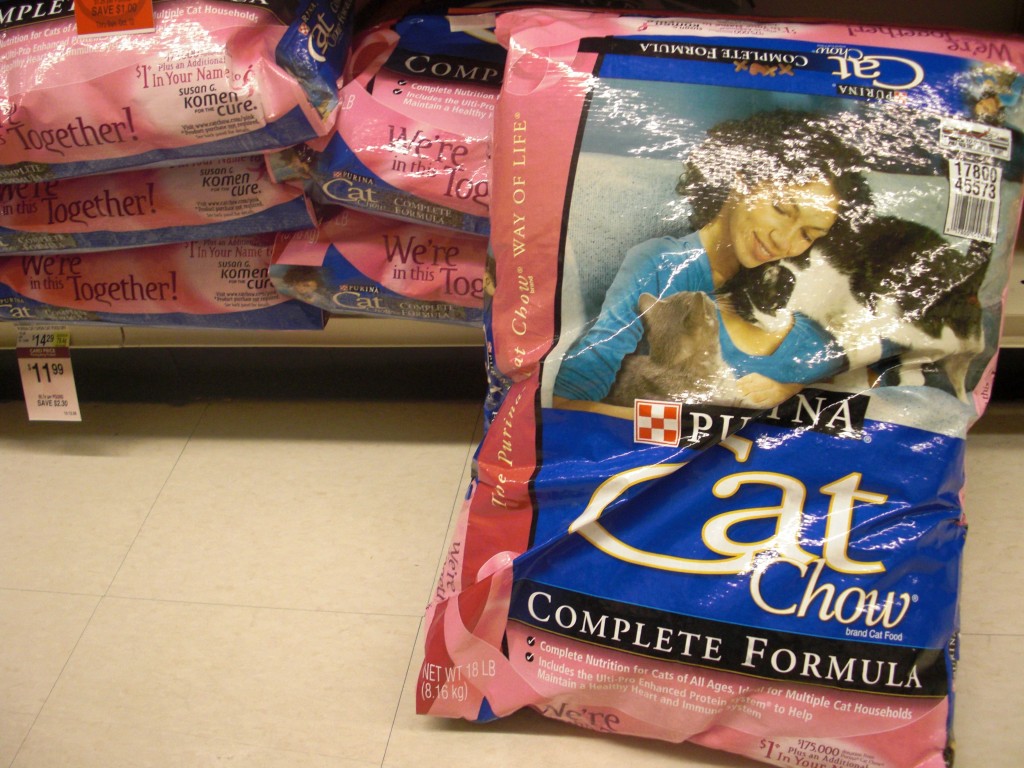
Cat food:

cimg1637

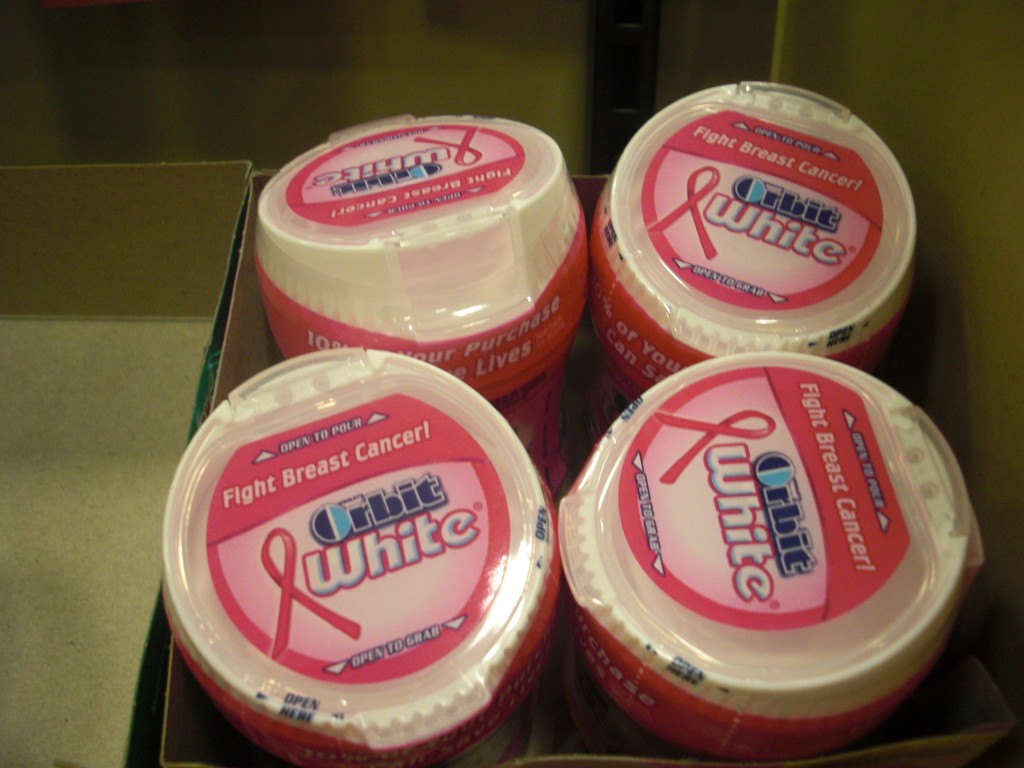
Gum:

cimg1706

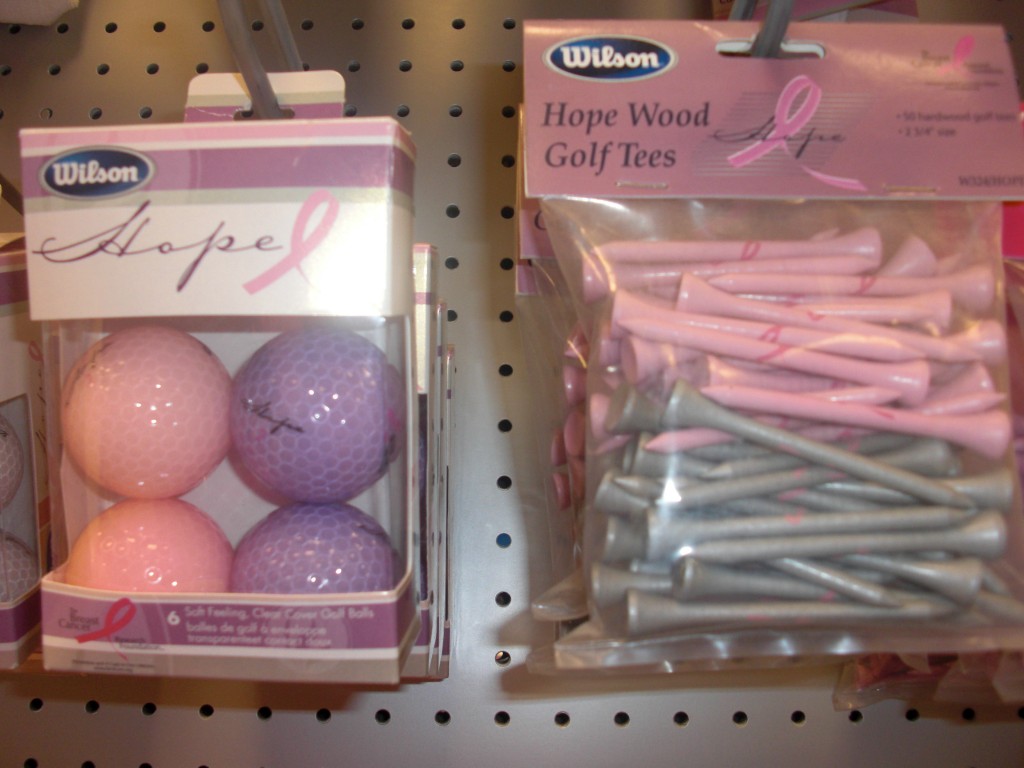
Golf balls and tees:

cimg1953

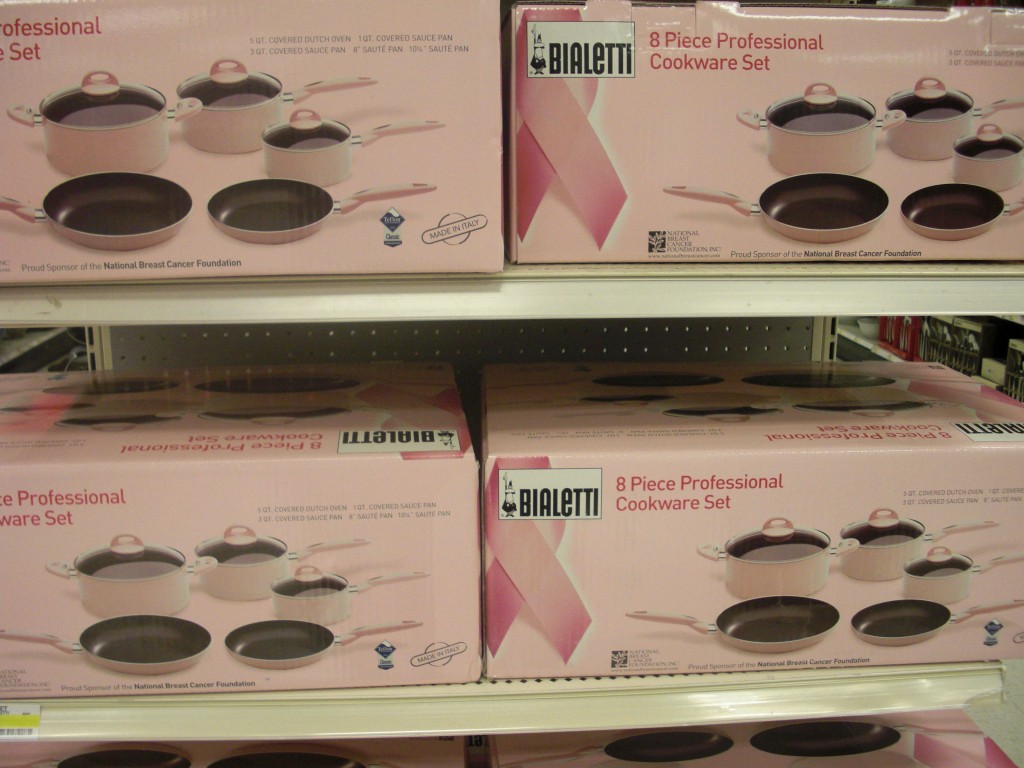
Pots and pans:

cimg2005

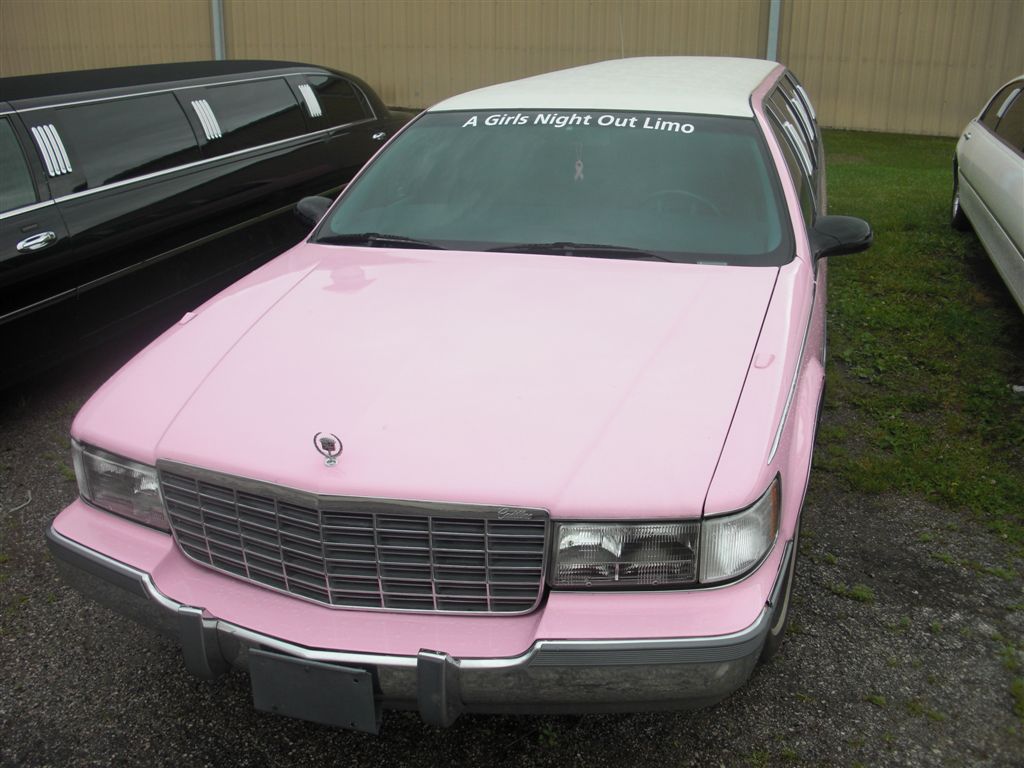
Steve W. sent in this picture of a pink “ladies night out” breast cancer-themed limo (note the pink ribbon hanging from the rear view mirror):

cimg3549

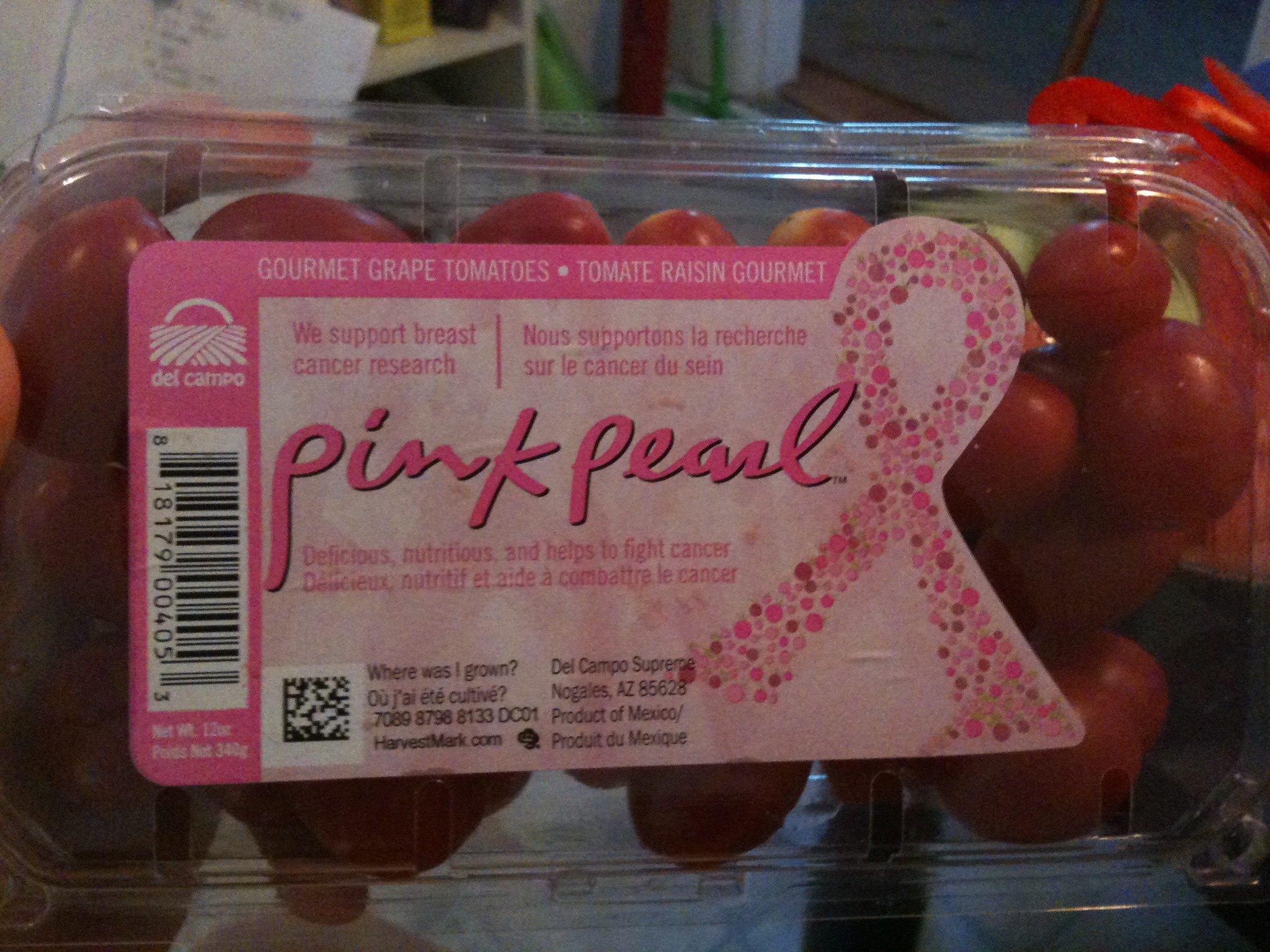
NEW (May ’10)! Renée Y. sent along this photo of breast cancer-awareness-themed grape tomatoes.  I repeat: grape tomatoes.

We’ve discussed the commodification of activism extensively (see here, here, here, here, and here) and so I’m going to skip this point.  Instead, I’d like the ask the following:

What does it mean when awareness of and funding for disease is subject to marketing?  Is this really the most efficient or rational way to set health care priorities?  I did a bit of research.

According to the CDC (2005 seems to be the latest available data), cancer is not the leading cause of death.  Heart disease is the leading cause of death.  Granted, cancer is a close second.  In 2005, 652,091 people died of heart disease and 559,312 died of cancer.  But not breast cancer, all cancers.  In 2005, 49,491 people died of breast cancer.  More than 10 times as many people died of heart disease.

And, if you want to prioritize cancers, more people are diagnosed with prostate cancer than breast cancer (source) and more people die from lung cancer (159,292), colon, rectal, or anal cancer (53,252), and lymphoid/hematopoietic cancers (55,028) (source).

So why such an emphasis on breast cancer?   I’m not sure why.  Certainly there is a massive social movement organization behind this anti-breast cancer marketing and people in charge have made a decision to take this approach.   I think, also, the body parts and the presumed cause of disease matter.   Do we have less sympathy (and would, therefore, a similar marketing campaign be less effective) for lung cancer because we think that lung cancer patients are to blame for their own disease?  Would we find colo-rectal-anal cancer-themed cream cheese somehow less appetizing?  Or prostate cancer-themed gum?  Do lymphoid and hematopoietic cancers affect parts of the body that are simply less iconic?

saveteepink

“Save the lymph nodes” just doesn’t have quite the same ring?

I’m not trying to suggest that raising awareness of and funding research for breast cancer isn’t important, but I am interested in the strategies by which being “against” breast cancer is (literally) sold to us.  And I’m curious about how this affects treatment and research funding, if at all, and the rationality of our resource distribution given the application of a marketing approach to (some) diseases (and not others).  (Also in breast cancer marketing, see here, here, here, here, and here.)

 —————————

Lisa Wade is a professor of sociology at Occidental College. You can follow her on Twitter and Facebook.

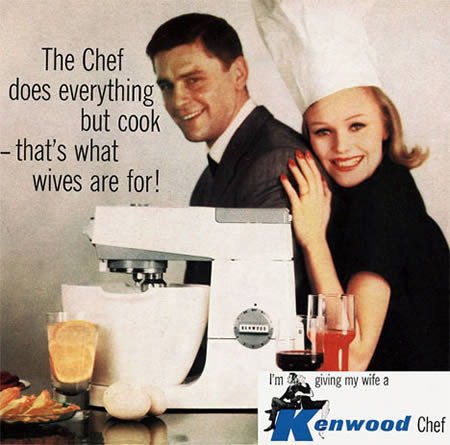
This vintage add (found here) for Kenwood appliances is a nice example of how the act of preparing food is gendered, and how one side of the gendered dichotomy is valued more than the other. Men are chefs– professionals, with careers. And their wives are cooks– they cook at home. Men have prestige as professional chefs outside the home, and women have value as caregiver cooks inside the home.

I guess that this ad is from the early-1980s. How much of this gendering of cooking changed over the years?

a96674_wivesarefor