girls

Somewhere within my past year’s reading the book Maiden USA: Girl Icons Come of Age by Kathleen Sweeney came into my orbit.  It seemed ideal as I traced the history of girls onscreen, on television, and within other forms of media.  Yet I wish I could give Sweeney’s book a more enthusiastic thumbs up.  Listed as a “media artist and writer” Sweeney has taught at various colleges and been active in media training programs for girls.  Her book began as a “curatorial project of films and videos by teenage girls entitled ‘Reel Girls/Real Girls'” which premiered in San Francisco.

Sweeney casts a wide net and she ranges from exploration of the Riot Grrrl movement to a chapter called “Mean Girls in Ophelia Land” which tracks the rise and fall of the “mean girl” movement within popular writing as well as on screen.  She correctly identifies that for the most part the Teenage Girl, (as she capitalizes it) was a “passive helping noun linked to Daddies, Brothers, and Boyfriends,” until certain cultural zeitgeists began to shift. As cultural interest in girls gathered momentum, the growth of what Sweeney names a Girl Icon has grown.  Sweeney is right on point when she chases this emergence through the past almost 20 years.

The book moves at a fast clip – her quick categorizations of Neo-Lolitas, Career Girls, Geek Girls, Cyber Chicks, as well as Supernatural Girls, Amazons, and Brainiacs, among other labels, often struck me as too glib.  Her most intriguing point is what now defines an Icon in contemporary culture, as well as her reinsciption of the term into the word “Eye-con.”  Sweeney calls an “Eye-con” an “image scam that must be navigated and brought to awareness by analyzing and naming its syntax,” not unlike a stereotype.  Eye-cons do their most damaging work, she says, when viewers are unconscious of their influence.  Within the pantheon of the “Eye-con” is the “Girl-con” she says, which are “Icons of girlhood which posit girls as inevitable Victims.”  Examples are “anorexic adolescent models selling a form of starvation beauty.” Media literacy demands that viewers name the Girl-con and then look beyond to alternative role models as Sweeney says she wants to consider Girl Power Icons for the new millennium against a “backdrop of current and retro Girl Iconography.”  Her writing about visual representation and even semiotics is at its strongest when she is doing this kind of analysis.

Yet, while impressive in scope, the book’s very breadth also serves as its limitation as depth is sacrificed for a sweeping survey of the cultural landscape. Sweeney’s enthusiasm for her subject is most strongly felt when she describes her first-hand work with girls.  Her final chapter “Girls Make Movies: Out of the Mirror and Through the Lens” was the most intriguing to me.  Sweeney’s passion as an activist comes out as she describes some of the current programs working with girls to advocate media literacy and develop their skills.  She mentions Reel Grrls in Seattle, Wash., and GirlsFilmSchool in Santa Fe, N.M., among others.  The book’s list of resources is also wonderfully thorough. I suspect undergraduate students would enjoy having this book assigned for its abundance of popular culture references, generous use of chapter subheads and discrete categorizations.

By contrast, another book I came across during my research was Mary Celeste Kearney’s Girls Make Media which became indispensible to me for both its range and its depth.  Kearney is an academic, now tenured at UT-Austin and the book’s research is admirable.  Neatly divided into three sections “Contexts,” “Sites,” and “Texts” Kearney also traces girls’ historical participation with media.  She delves into girls’ entry into the web, also the impact of the Riot Grrrls, zine culture as well as independent filmmaking.  Her focus on what happens when girls take over media production is what makes this book compelling.  At the same time, she contextualizes the institutionalized practices that have keep girls from participating fully.

Particularly exposing is the deeply entrenched sexism in the field of filmmaking (the idea that cameras are too heavy for female techs to lug and “peer networks” or “structures of acquaintanceship” that boys use covertly, but effectively, advance their ambitions and deny girls access).  Kearney’s cataloging is vast and its impact is felt as she reveals just how much girls who make media have to say.  She includes writing about the need for single-sex media education but steps beyond it to show what girls really do when they’re given access to media tools.  Their work often centers around exploration of identity and re-inscription of messages about gender roles that crack open a universe of deeply felt and powerfully smart dialogues about what most girls experience but hadn’t yet had a place to express.

Some of the titles Kearney includes tell a whole story: films such as Taizet Hernandez’s “Are You a Boy or a Girl?” which explores “real-life gender-bending of a young female” or Hernandez’s film “We Love Our Lesbian Daughters,” which explores coming out experiences and Kearney says offers “A rare glimpse into the lives of queer young Latinas” but focuses on sexual identity over ethnic identity.  She groups films about sexual abuse such as “Love Shouldn’t Hurt” by Tamara Garcia or “It’s Never OK” by Arielle Davis, and includes a cache of films about the ubiquitous doll such as in Lillian Ripley’s “What if Barbie Had a Voice?” Just a fraction of other titles include: “Looks Like a Girl” which “broadens young lesbian representations beyond white, Anglo culture,” and “Body Image” by Mieko Krell, meant to “raise awareness about girls’ different relations to and strategies for negotiating dominant beauty standards.”

When exploring girls’ zines Kearney includes telling excerpts as this one from “Bikini Kill: A Color and Activity Book” about why female youth should enact social change: “To discuss in both literal and artistic ways those issues that’re really important to girls: naming these issues, specifically, validates their importance and other girls’ interest in them; reminds girls that they aren’t alone.  To make fun of and thus disrupt the powers that be.”  Even a smattering of the zine titles reads like a found poem: The Bad Girl Club, Bi-Girl World, Lezzie Smut, The Adventures of Baby Dyke, Geek the Girl, Angry Young Woman, Pretty in Punk, Housewife Turned Assassin, Angst Girl, Pixxiebitch, Ladies Homewrecking Journal, From the Pen of a Liberated Woman. The book’s website is also a wonderful resource as the power of the girls’ voices can be felt shouting through the distance.

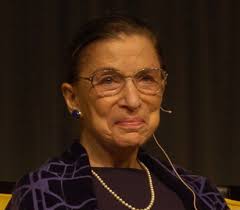
I loved reading Emily Bazelon’s interview with Supreme Court Justice Ruth Bader Ginsburg in Sunday’s New York Times Magazine.

I loved that she gave this interview so strategically, with its publication on the eve of the Sonia Sotomayor confirmation hearings.  The interview both anticipates and undermines the predictable sexism and racism (see, for example, all of the ink spilled about the “wise Latina woman” quote, and Ginsburg’s spin on that tempest in a teapot) that have informed both the hearings and the media coverage surrounding the Sotomayor nomination.

I loved that it was feminist.  From talking about why women matter on the court and in public life to arguing that “[t]ime is on the side of change,” with regard to abortion rights, Ginsburg’s responses are unabashedly feminist.  How wonderful to see this on display—at length—in a mainstream media publication.

But most of all I loved the way it represented women supporting one another.  Maybe this is what our feminist foremothers had in mind when they used the phrase, “sisterhood is powerful.”  I have to say that I’ve never had much use for the idea of “sisterhood” in my definition of feminism, since the term seemed to rely on artificially flattening differences among women.  It seems to assume that gender struggles are the most important ones, something that has been most often true for white women.  (As many GWP readers already know, GWPenner-in-Chief Deborah Siegel has a terrific analysis of the conflicts and controversies at work in feminist ideas of “sisterhood” in Sisterhood, Interrupted).

So with all of that history in mind, that show of support is what I especially loved about Ginsburg’s interview.  Positioning herself as white, Jewish woman from Brooklyn, she was standing up for her Latina. . .colleague (sister??) in a very public, political way.  Speaking as a white woman myself, we need to this more often, and not just when it comes to gender struggles.

I’ve also been thinking about this public, political, feminist show of support in the context of girls’ relationships.  My daughter has recently been grappling with what is probably the beginning of many girl friend conflicts that center around attention, inclusion and exclusion, and degrees of “best friend-ness.”  (For example, “I have no one to play with on the playground.  Sally and Susie are spending all of their time together and they don’t include me.”)

I’m saddened that these conflicts are arising already, in second grade.  But I’m also thinking from a feminist perspective about how my daughter can learn to value her female relationships, and about how I can model female friendship myself.

I return to thinking about the Ginsburg interview.  It’s clear from the Q&A that Ginsburg and Sotomayer don’t know one another well.  Certainly they would not call one another friends.  But no doubt they share a passion for their work, a commitment to advancing social justice, intellectual curiosity, and much more perhaps.

Friends are important in life, no doubt.  But so are feminists.  I hope my daughter finds plenty of both as her relationships unfold.

Landing on moonIt’s hard for me to believe it, but it’s been 20 years since I first visited the Kennedy Space Center in Florida. My mom, goddess rest her soul, dragged the whole family there one day while we were on a Disney vacation. She did it because I, the eldest and nrrdiest of her daughters, was obsessed with NASA and being an astronaut. It also happened to be the 20th anniversary of the Apollo Moon Landing.

I remember the thump in my chest as we drove up, got out and oh my goodness, I was there! At 14 the only thing that would have been better would have been Space Camp with River Phoenix. Sadly I never made it to Space Camp or met River Phoenix. Broken youth dreams! But back to the Kennedy Center…I went wild. I read most of the placards carefully, sucking in all the geeky information and breathing in salty air. I spent far more in the souvenir store than I thought my parents would let me or could afford. But it was their way of supporting my dream.

We even went on a bus tour of the center. The tour director had his usual trivia questions ready to stump and educate the masses. Only he ran into me. I answered every single question without hesitation or competition. I don’t think I ever saw my mom in tears from laughing and pride every again.

This year we mark the 40th anniversary of man’s landing on the moon. It’s obvious that I didn’t end up becoming an astronaut. A few days after the Kennedy Space Center my parents took us to SeaWorld and I fell in love with marine biology – which I did end up doing for a few years. I know my box of newspapers that I bought at garage sales about the moon landing are somewhere in my basement. I also still have a commemorative plate to boot. I’m counting the days (just over 400) until my daughter and I can go to Space Camp together.

Before we go, I’ll be sure to read parts of Tanya Lee Stone’s latest book, Almost Astronauts: 13 Women Who Dared, with her. It’s a heart-wrenching book for me. To love space exploration so much and yet read how society and powerful government officials colluded to keep 13 highly qualified women from fulfilling their dream and potentially inspiring a generation of young girls. But I want my daughter to know what it took for her to have the chance to even consider being an astronaut or any scientist. I plan on a full review of the book on July 20th at my blog.

I sometimes wonder what it would have been like if Nelly Armstrong had landed on the moon with Betsy Aldrin. Who knows what kind of world we’d be living in…Or if we’d finally have that moon colony.

A hearty welcome to a brand new blog by Julie Zeilinger, a 16-year old from Pepper Pike, Ohio and a colleague of mine at the National Council for the Research on Women, where she is currently an intern.
According to Julie, Thefbomb.org aims to demystify “Mean Girl” image of young women — that “f”, of course, standing defiantly for “feminist.”  She’s got some great content going on, including this exclusive interview with Gloria Steinem.  Says Julie of her blog: “It is loud, proud, aggressive, sarcastic…everything teenage feminists are and should be today.”

Hells yeah to that.

Tis the season of awesome events here in NYC, if you’re into next-generation feminism that is.

On THURSDAY, the National Council for Research on Women will hold a special session as part of their Annual Conference on Igniting Change, called “Youth: Opportunities and Challenges for Building Leadership Pipelines”. The session takes place from 9:00 am – 10:30 am in Room 9205 at CUNY Graduate Center. Here’s the descript: As tomorrow’s voters and leaders, young women need to be vital partners in advancing the movement for social justice. This means working in partnership with young women, recognizing and valuing their diversity, to understand their perspectives and concerns and foster programs that emphasize both their rights and civic responsibilities. The panel will highlight current issues facing young women and address structural and cultural factors that support or hinder their empowerment. Attention will also be given to strategies for working across generational and cultural differences to build a viable movement.” Speakers include Rosalina Diaz-Miranda, Medgar Evers College, CUNY; Supriya Pillai, Funders’ Collaborative on Youth Organizing; Kim Salmond, Girl Scouts of the USA; Ellen Silber, Graduate School of Social Service, Fordham University; Sally Stevens, Southwest Institute for Research on Women, University of Arizona; and Liz Abzug, Bella Abzug Leadership Institute.

On FRIDAY, the blog of all blogs, Feministing, is throwing a 5th anniversary fundraising bash. Even if you can’t go, you can still contribute!

On SUNDAY, Girls Write Now will hold their Annual Spring Reading from 4-6pm at The New School, Tishman Auditorium, 66 W. 12th Street. Some of NYC’s best teen writers will showcase original work, and keynote speaker Amy Robach and featured reader National Book Award Nominee Jean Thompson will be there too. The event is FREE and open to the public.

And that’s just this week!

Much as I want to think of myself as a feminist parent, sometimes I doubt my credentials.  After all, I don’t forbid Hannah Montana for my daughter or swordplay for my son even though both of these activities certainly do reinforce gender stereotypes (although I should probably add that my daughter took jui-jitsu for a time and my son happily watches Hannah Montana).

But I know that when it comes to discussions of loving relationships, this is one area where my feminism comes through loud and clear.  With the current setbacks—like yesterday’s California High Court ruling in support of the gay marriage ban and victories over gay marriage, I see this as an important social justice issue.  After all, I want my daughter and my son to grow up in a culture that will recognize and equally value their loving relationships whoever their partner may be.

Katy Perry as “Compulsory Heterosexuality 101”
My 8-year-old daughter loves Katy Perry’s “I Kissed a Girl.” She’s especially familiar with the chorus, which goes like this:

I kissed a girl and I liked it
The taste of her cherry chapstick
I kissed a girl just to try it
I hope my boyfriend don’t mind it
It felt so wrong
It felt so right

Recently after the song played my daughter asked, “Why is she worried about what her boyfriend will think?”  I explained that the song was about two girls kissing.  Perhaps not surprisingly, she had been listening to the song and singing the words without really understanding it.  When I explained the idea of two girls kissing, some predictable “ew’s” and “yuck’s” ensued (the standard grade school reaction to all romantic kissing).  I also explained that some people think two girls or two boys kissing is a bad thing.

I went on to tell her what I thought—that two people who love each other can kiss, whether they are two girls, two boys, or a boy and a girl.  I talked about the way that “gay” can be used as an epithet, and how in my view such a usage was inappropriate.

My daughter wanted to try the idea on for size.  What would be the difference between using gay in a “mean” way and in a “nice” way, she wanted to know?  She thought out loud, “I could say, ‘You’re gay, hooray!”

I loved this response.  Tolerance is one thing: plenty of research suggests that young people are more supportive of gay marriage than their older counterparts.  But celebration is another, and my daughter is right there already.  Dismantling heterosexism and homophobia are important parts of this mix as well: my daughter may not be there yet, but that’s where my feminist parenting comes in, and we’ll take it day by day.

While I don’t think Katy Perry’s “I Kissed a Girl” lyrics are especially feminist—heterosexual male enjoyment of “lesbian” sexuality has been around for a long time, it opened a great window of conversation and analysis for our family.  Now that’s feminist, so thanks, Katy Perry.

GWP, readers how does feminism influence your parenting?  I’d love to hear your stories.

A post Marco wrote the other week over at Open Salon got primo real estate on the front page of Salon, but I’m just getting to it now.  In his May 7 post, “The Objectification of Emma Watson,” Marco takes issue with the sexification of the actress who plays Hermione Granger in the Harry Potter movies.  He writes:

Over and over the ritual is reenacted: Lisa Bonet, Drew Barrymore, Alyssa Milano, Scarlett Johansson. Early raves for a child’s or precociously young actor’s emotional range or resonance, then the steady drumbeat of questionable roles and/or increasingly suggestive magazine covers. Occasionally an actor navigates her sexuality with depth and an almost tactical creativity, as did Christina Ricci; she made smart choices so that her sexualized image always functioned as a shorthand for her unusual and challenging roles. But more typically, an uncompromising talent (i.e. Parker Posey) will fall by the wayside to be appreciated by ever smaller audiences for her efforts if she doesn’t “fall into line.”

It’s not too late for Watson, though. Interview is offbeat enough to be a blip in an actor’s career, and this issue is early enough in the season to be a vague memory by the time the next Potter is released. But the choices she makes now and in the immediate wake of the Potter series may very well determine whether she will be ultimately be known for her body of work, or just, well, her (toned/decrepit/buffed/doubled/ Photoshopped/objectified) body.

Nicely put, dude.

CuriesThis month Science Grrl looks at the mother-daughter bond in science & engineering.

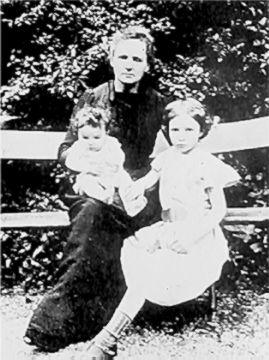
First, the only mother – daughter duo to ever win the Nobel Prize was the Curies. Marie Curie won twice: first in 1903 for her discovery of radiation and second in 1911 in chemistry for her work on radium and polonium. Marie’s daughter Irène Joliot-Curie won the Nobel Prize in chemistry in 1935. Irène had built upon the work that Marie and her father, Pierre, had started. While we can stand in awe of the mother-daughter science-duo and the amazing knowledge they brought to our world, their relationship wasn’t ideal. Marie “was so obsessed with her science and the discovery of radioactivity that she pretty much ignored her two daughters and after her husband’s tragic death retreated into her mind even more.”

I try to temper this view of Marie with the knowledge that she lived in a vastly different time than we do. It was a time when she almost HAD to marry a scientist to gain access to good lab space and equipment. Her partnership with Pierre was born not just from love, but also from need of resources. She was often not chosen for faculty positions because she was a woman or because Pierre already had one. Today universities have spousal hire rules to allow them to hire one “lead” partner for a tenure track position and then hire the “trailing” partner for maybe a tenure track position or adjunct faculty position. A generation ago there were rules at universities that outlawed nepotism or the hiring of both husband and wife into academic faculty positions. While yes, it is nepotism it’s not the same nepotism that we warn against when we think our cousin might be the best person for a job.

Luckily things are far better for moms in science today. It’s far from perfect, but I can only imagine the amazing work the Curie women could have done today!

We also shouldn’t forget to mention that moms are often the #1 advocate for daughters who want to get into science and engineering. My late mom didn’t totally get my aspirations for marine biology, but she supported my decision and that meant the world to me. I found a curriculum online for creating a mother-daughter Science Club. They do recommend you buy their biography books, but I’m sure you can switch out biographies you find online or in your local library. As someone who works with college students, I find that one of the many issues young women have is getting their parents to understand why they want to major in physics rather than biology and go to medical school. The education goes both ways in this issue!

So girls, get your mom involved in your decisions and moms push your daughter to reach for the stars.

In a Time magazine article about an Oregon school for troubled youth that is under scrutiny, journalist Maia Szalavitz (author of Help At Any Cost: How the Troubled-Teen Industry Cons Parents and Hurts Kids) deserves huge props for throwing the spotlight on it all.

Check this out: In required seminars that the school calls Lifesteps, students at Mount Bachelor Academy in Oregon say staff members of the residential program “have instructed girls, some of whom say they have been victims of rape or sexual abuse, to dress in provocative clothing — fishnet stockings, high heels and miniskirts — and perform lap dances for male students as therapy.” Think you can treat ADHD by making girls dress up as French maids? Think again.

Coverage at Jezebel, here.

MCMiley Cyrus is all grown up.  Yes, I am going to squeeze Simone de Beauvoir and Miley Cyrus into the same sentence.  If you’re following Miley’s career these days, you’ll know that she’s “becoming a woman” in the media and entertainment worlds.  Simone de Beauvoir definitely had it right, and rarely do we see so clearly exactly how someone “becomes” a woman.  But really, this is her “adult,” womanly roll-out, and just to be sure we get it the media coverage makes clear that Miley is all “grown up” now.  She’s on the cover of Glamour magazine this month, hit the American Idol stage this week in a sexy strapless gown, and has a movie in theatres nationally.  With a career like that she definitely has adult responsibilities, I’m sure.

But just ask my daughter—Miley is sixteen, which does not seem especially grown up to me, particularly as the parent of an 8-year-old (So my daughter is halfway to adulthood?? I hope not!).  Here are my questions: what does it mean for a sixteen-year-old (or her handlers) to be reinventing herself as a “woman” in media terms?  Can we expect her to shed the squeaky-clean image and angle for meatier (read: sexier) parts?  And what does it mean for her tween fan base to witness this transformation?  Finally, you tell me: when do girls become women?  What marks that transformation in your mind?

Becoming a man.  Judith Warner has a thoughtful column this week, “Dude, You’ve got Problems,” about the use of “gay” as an epithet.  She writes, “It’s weird, isn’t it, that in an age in which the definition of acceptable girlhood has expanded, so that desirable femininity now encompasses school success and athleticism, the bounds of boyhood have remained so tightly constrained?”  I’m not so sure, however, that I agree with Warner’s assertion that being called a “fag” has “almost nothing to do with being gay.”  Instead, she argues, “fag” is used to deride weakness or femininity.  Well, yes, and that’s what I call homophobia, which certainly does go hand in hand with sexism.

Is Women’s Studies the next Sex and the City?  Let’s hope HBO can do for women’s studies what it has already done for big city career girls, mobsters, undertakers, and polygamists.  The cable network apparently has a show in development about a former “feminist It Girl” who is now turned to being a professor at a small liberal arts college.  Will such a show poke fun at women’s studies?  Sure, this field offers plenty of material for laugh lines, but if we also wind up as the next hit series everyone is talking about, then the HBO line on my cable bill will have been money well spent.

–Allison Kimmich