girls

So many end-of-year appeals, so many worthy causes to support!  I wanted to share one from an organization that is particularly close to my heart: Girls Write Now.

The amazing girls and women of GWN set out to raise $50,000 at the end of the year, and they are only $7,000 short.  Here’s a little about them, below.  To join me in helping them meet their goal, please click here.


About Girls Write Now
Maya, Tina, Michelle Obama_border
Girls Write Now is the first and only East Coast non-profit organization to combine mentoring and writing training within the context of all-girl programming, matching professional women writers one-to-one with underserved girls from public high schools
across New York City. While almost half of NYC’s youth fail to complete high school on time, 100% of Girls Write Now seniors graduate and go on to college. Girls Write Now has been featured on NBC Nightly News with Brian Williams and in The New York Times, and honored by First Lady Michelle Obama and The President’s Committee on the Arts and the Humanities as one of the top 15 after-school arts and humanities-based programs in the nation.

As a Women’s and Gender Studies faculty member, I’m hyper-attuned to representations—of beauty, of consumption, of masculinity—in the world around me.  As the parent of a daughter with Down syndrome, I’ve become equally attuned to representations of people with disabilities.  Now that we’re well into the holiday season, I’ve been interested to see how children with disabilities appear in all the holiday-themed programming and advertising, if they appear at all.

The big problem is that kids like my daughter rarely show up at all in mainstream media.  Holiday specials pass by, one after the other, and my husband and I find that we’re searching increasingly desperately for disabled characters.  “Oh,” I said the other day while listening to the Muppet Christmas CD, “I think Animal is a person with special needs!”  He doesn’t speak clearly, he obviously has some behavioral challenges, including difficult controlling his emotions, but he’s a beloved and valuable member of the rock band Dr. Teeth and the Electric Mayhem.  It’s occurred to me that we may be able to use Rudolph as a role model in the future, as well—his community initially interprets his difference as abnormal and undesirable, but they come to see it as a talent and a benefit.  But in terms of actual human beings, the representational terrain is fairly bleak.

There are exceptions.  Toys R Us, for instance, has a catalog specifically for kids with disabilities—kids that they kindly, but awkwardly, call “differently-abled.”  Whoopi Goldberg and a child with Down syndrome are on the cover, and all the toys in the catalog feature kids with various disabilities playing with them.  The toys are described in terms of their educational and/or therapeutic potential:  for instance, the Fisher Price “Go Baby Go! Crawl-Along Drum Roll” is marketed as providing gross motor, tactile, auditory, visual, and thinking stimulation.  I do appreciate that, since Biffle and I are eager for Maybelle’s playtime to be stimulating, and we are often on the lookout for toys that will help her in one or another of the areas we’re working on in therapy.

But the fact that kids like Maybelle only appear in the “differently-abled” catalog is distressing.  These kids are all in their own catalog, even though all the toys are the same as the ones in the regular Toys R Us lineup.  As one of my colleagues pointed out, “If you want to know who a society doesn’t value, look at who they segregate.”  So, while I’m very glad that Toys R Us is documenting the existence of disabled kids—not just kids with Down syndrome but those with autism and a range of physical disabilities, as well—I do wish that these kids were fully included in all their marketing, so that their catalogs would help make these kids’ full inclusion in society at large seem normal, desirable, even unremarkable.

st1:*{behavior:url(#ieooui) }

/* Style Definitions */
table.MsoNormalTable
{mso-style-name:”Table Normal”;
mso-tstyle-rowband-size:0;
mso-tstyle-colband-size:0;
mso-style-noshow:yes;
mso-style-parent:””;
mso-padding-alt:0in 5.4pt 0in 5.4pt;
mso-para-margin:0in;
mso-para-margin-bottom:.0001pt;
mso-pagination:widow-orphan;
font-size:10.0pt;
font-family:”Times New Roman”;
mso-ansi-language:#0400;
mso-fareast-language:#0400;
mso-bidi-language:#0400;}

I am pleased to introduce Susan David Bernstein, “Beyond Pink & Blue’s” first guest columnist! Susan teaches literature and gender studies at the University of Wisconsin-Madison, and has published widely on contemporary feminist theory and the Victorian novel. She is currently working on a study of women writers and activists in the Reading Room of the British Museum, as well as a memoir titled Unlikely Loves.

Here’s Susan:

I discovered new realms of gender profiling before my child was born in August of 1992. Although the sex chromosomes of this eventual baby were recorded in my OB/GYN file, I was adamant that I did not want to know. “Don’t tell me!” I’d shield my eyes, when a nurse or doctor opened my file at an appointment. At that time, it was increasingly common for people to have this knowledge, and from what I witnessed, prenatal gendering took off with a vengeance. I’d hear comments like, “I know this little guy is going to be a quarterback! What a kicker already!” Baby showers became gendered affairs, and the first outfits for the ride home from the hospital were tooled to match that chromosomal information. I was happy instead to receive an array of baby clothes, some blue, some fuschia, one with a rodeo pattern, another with vegetables in reds, greens, and oranges.

So even back then, it was unusual to answer the “what kind of baby are you having?” question with, “I don’t know.” I had an elaborate birth plan which even included a provision about birthing room announcements: I asked my doctor not to say, “It’s a boy!” or “It’s a girl!” but simply, as he did, “Congratulations, you have a healthy baby!” My partner and I even joked about how we’d try not to know those gender-defining genital features of our baby (we’d have someone else do the diapering and bathing for the first month), so that our ingrained notions about gender would be kept at bay. And, we thought, so would those of the world we lived in. Not possible, I discovered, from day one.

I did of course learn I had a daughter within in minutes of her birth, and she was quickly swaddled in a pink blanket. A nurse held out a basket of caps for newborns, all knitted by a women’s league, and I chose a white one with lavender and blue stripes. But later that day my partner and I requested a different blanket, yellow perhaps, or green or white. We learned that the maternity unit only had blue and pink blankets.

This was Madison, Wisconsin, a university town with a history of progressive values; Tammy Baldwin is our congressional representative—the first open lesbian to be elected to the House. Today, in 2009, my daughter is taking a terrific women’s studies class in her high school (the same one Baldwin graduated from); all four public high schools in Madison offer such courses. But in 1992, there were only pink and blue blankets at the hospital. So I asked for a blue one. A nurse entered my room the next morning, glanced at the bassinet, and then asked me cheerily, “And how is your little boy today?” I responded, “I do not have a boy.” The woman peered in the basket, looked a bit alarmed, and hurried out of the room.

Within a few years, the hospital expanded its newborn wardrobe to include prints and other colors. Still, there remain many ways in which the straitjackets of gender identity flourish from before birth through high school. My daughter spent all four years of high school competing on the cross country team where the girls run 4K meets to the boys’ 5K races. And now she’s one of two girls on her high school team of forty wrestlers. She’s also in the gender minority in her advanced chemistry and physics classes. As a family, we’re still learning to navigate the updated variations of pink and blue that we first encountered in 1992.

My book, Girl Zines: Making Media, Doing Feminism, has just been released. More about that later, but for now I wanted to let those of you in the NYC area know about an upcoming book event:

Girl Zines at Bluestockings

Saturday, Dec. 5, at 7 p.m.

Free!

I’ll do a brief reading from the book, and then fabulous zine creators Ayun Halliday, Victoria Law, Jenna Freedman, and Lauren Jade Martin will read from some of their zines.  Someone from BUST will also be there.

Here’s how Bluestockings is advertising the event:  The East Village Inky… Mend My Dress… Dear Stepdad… I’m So Fucking Beautiful… In the past two decades, women have produced 1000’s of unique zines which serve as engaged and tangible evidence of the third wave feminism. Join Alison Piepmeier for a reading and discussion of her book “Girl Zines: Making Media, Doing Feminism,” which explores these quirky, personalized booklets and the meaning of being a revolutionary girl.

I would love to see Girl with Pen readers there!

Out of sheer luck of the calendar, this month’s Science Grrl falls on Veterans Day so I had to dedicate this month’s column to the Goddess of Science Grrl Veterans…Rear Admiral Grace Murray Hopper who has an entire conference named after her. Hopper entered the Navy under the WAVES program.

***

Fellow GWPenner Lori mentioned Lise Eliot’s recent book Pink Brain, Blue Brain last month. In my reading of the book, I found Eliot’s balance between nature versus nurture commendable. Despite being a science grrl, I do find myself wanting nurture to win out since then it would be just darn easier to toss out the pink and blue crap.

I hate seeing toys that have no gender to them, like laptop computers, painted pink for girls and not-pink for boys. This country has a problem with the low number of students who want to study computer science, especially girls. I don’t think that having pink laptops will get girls to want to study computer science. But in my conversation with Eliot, she suggests that we hijack this pinkification of our girls world and give it to them, but be subversive too.

But how far do we allow it to go? The Discovery Channel is a great place to find science toys online, but even they separate out girls and boys toys. If you look at the toys offered, a very small number are stereotypical. I assume that they are buying into parents who will come to an online store and immediately look for the boys tab. But I think that the Discovery Channel would do a world of difference for girls in science if they simply had age segregation for their toys. Send a message to parents and gift-buyers that science is gender neutral.

We are shortchanging our girls by making all their things pink. It tells them that their things are different. Luckily the Discovery Channel gender-segregated toy store doesn’t house a pink microscope. So perhaps they are being subversive when a parent goes on and sees “Oh, a girl microscope!” and really it’s just a plain old microscope. I can’t only hope.

Pink Girl, Blue Girl is an excellent read and I believe if we followed Dr. Eliot’s recommendations as we raise our kids, we will see more girls in science.

Difficult Dialgoues

Get the latest on girls and girls studies this week at the National Women’s Studies Association annual conference in Atlanta, Georgia from November 12-15.  The conference theme is “Difficult Dialogues,” and we expect our largest event in recent history.  On tap: more than 1,600 feminist scholar-activists gathering to exchange ideas in more than 300 sessions.

You’ll hear analyses of girls’ lives and experiences, including sessions like “Girls of Color and Performance Ethnographies” and “Voices of Girls in Urban Schools.”

And if you can’t make it you can find updates on our Facebook page or after the conference on the NWSA site where we expect to make a podcast of the Angela Davis keynote address available.

Wimpy Kids

You can also hit the newsstand and pick up the latest issue of Ms. Magazine where you’ll find my contribution on Jeff Kinney’s Diary of a Wimpy Kid book series.  My daughter Maya is one of my expert sources along with Sharon Lamb, Lyn Mikel Brown and Mark Tappan, who’ve just released Packaging Boyhood: Saving Our Sons from Superheroes, Slackers, and Other Media Stereotypes.

st1:*{behavior:url(#ieooui) }

/* Style Definitions */
table.MsoNormalTable
{mso-style-name:”Table Normal”;
mso-tstyle-rowband-size:0;
mso-tstyle-colband-size:0;
mso-style-noshow:yes;
mso-style-parent:””;
mso-padding-alt:0in 5.4pt 0in 5.4pt;
mso-para-margin:0in;
mso-para-margin-bottom:.0001pt;
mso-pagination:widow-orphan;
font-size:10.0pt;
font-family:”Times New Roman”;
mso-ansi-language:#0400;
mso-fareast-language:#0400;
mso-bidi-language:#0400;}

Back in the 1970s, feminists took toy companies to task for their sexist marketing practices. They railed against the board game “Battleship” for depicting a father and son at play while an apron-clad mother and daughter washed dishes in the background. (One outraged mother even sent the cardboard game box to the editors of Ms. magazine to prove her point.) They questioned why pretend kitchens were fashioned out of pink plastic, when the majority of professional chefs were men. And they urged puzzle-makers to depict women piloting airplanes and fighting fires.

One of the youngest toy activists was a seven-year-old from New York City named Caroline Ranald. In 1972, the second-grader wrote a letter to the Lionel train company admonishing them for their boy-dominated ads. “Girls like trains too,” she explained. “I am a girl. I have seven locomotives. Your catalog only has boys. Don’t you like girls?” Caroline’s short letter made a big impression. Not only did the toy train makers feature girls in their subsequent catalogs, they also circulated a press release with endorsements touting the psychological and cognitive benefits of train play for girls.

Fast forward to 2009…and we have to ask: what happened to the gains feminists made in toyland? I literally did a double-take when I read that the Toy Association’s “Toy of the Year Awards” offer separate prize categories for “Best Boy Toy” and “Best Girl Toy.” Sure, they slot some contenders into gender-neutral categories like “Best Outdoor Toy” and “Best Educational Toy.” But they don’t even try to airbrush the fact that when it comes to selling toys, gender divisions—and gender stereotypes—still reign.

In case you’re wondering, the “Best Boy Toy” of 2009 went to the Bakugan Battle Brawlers Battle Pack Action Series. These intricately wrought orbs of plastic snap open into dragon- and vulcan-like shapes when they are hurled onto corresponding magnetized cards. Bakugan isn’t just a Manga-inspired action toy, it’s an entertainment brand, complete with a website, television show, and other paraphernalia. According to the Toy Association’s website, Bakugan beat out the Handy Manny 2-in-1 Transforming Tool Truck, the EyeClops Night Vision Infrared Stealth Goggles, and a few other trinkets for the top boy toy honors.

My own boys, ages 8 and 11, can’t seem to get enough Bakugan spheres, priced around ten dollars a pop. When I asked my younger son why he thinks girls aren’t into Bakugan, he replied that “they don’t like to fight and brawl the way boys do.” Maybe so, but when toy companies are so explicit about developing toys for gender-specific markets, we have to ask the proverbial chicken-and-egg question: do boys like Bakugan because it taps into some innate affinity for competitive, militaristic play—or because they are being socialized and culturally conditioned to prefer those forms of play?

For the record, the Best Girl Toy of 2009 was the Playmobil Horse Farm, a plastic play-set complete with stables, ponies, and equestrian figurines. (In 2007, the honor went to Hasbro’s FurReal Friends Butterscotch Pony—which raises the question of why a horse-related toys have become so feminized in recent years.) Runner-ups for Best Girl Toy include a Pedicure Salon activity kit, a Talking Dollhouse, and Hannah Montana’s Malibu Beach House—toys based on stereotypes of beauty and domesticity so blatant they speak for themselves.

Although most elementary-school boys probably wouldn’t beg for a kiddie pedicure set, children display more variation and boundary-crossing in their play than the toy industry might care to admit.  Decades after the heyday of second-wave feminism, few parents would bat an eye at a girl playing with StarWars action figures or a boy weaving a potholder on a loom.  But for the purveyors of playthings, pink and blue don’t make purple; they make green.  Toy makers have a vested interested in selling to a gender-bifurcated market, because they can make double the money selling twice as many toys.

In the spirit of feminist toy activism, perhaps it’s time, once again, to argue the point. If there are any little boys out there who have a thing for horses, maybe they can e-mail the folks at Playmobil and set them straight.

Some would say this has been true since 2006, when the FDA approved Gardasil for exclusive use in girls/women, and finally the FDA agrees. Last week Merck received FDA approval for Gardasil to be used as a genital warts vaccine in boys/men (ages 9 to 26 years old). However, yesterday, the CDC Advisory Committee on Immunization Practices voted for only “permisive” use in boys, rather than voting for the stronger recommendation of “routine use,” as they had for Gardasil’s use in girls/women.

As reported in Bloomberg.com, this decision had been predicted by some experts:

William Schaffner, chairman of the department of preventive medicine at Vanderbilt University in Nashville, Tennessee, said the panel will be asking itself “if we vaccinate all the girls, how much additional benefit will we get by vaccinating the boys?”

The Atlanta Journal-Constitution cited a similar argument from a different expert:

Debbie Saslow, director of breast and gynecologic cancer at the American Cancer Society, agreed with the findings. “If we can vaccinate a high enough proportion of young girls, then vaccinating boys is not cost-effective,” she said.

This line of reasoning and the ACIP’s conclusion are problematic on two levels. First, there seems to be a privileging of female health over male health. There are compelling reasons “ other than the prevention of cervical cancer” for the ACIP to recommend “routine use” of a safe and effective male HPV vaccine. Second, there seems to be a heterosexist assumption in the ACIP’s decisions — that all boys/men are sexually attracted to (and sexually active with) girls/women and vice versa.

Maggie Fox of Reuters offered a more complete assessment in her article published yesterday:

The main reason the vaccine was approved was to prevent cervical cancer, which kills 4,000 women a year in the United States alone. But various strains of HPV also cause disfiguring genital warts, anal and penile cancers and head and neck cancers. “We know that the later the cancer is discovered, the lower the chance of survival is,” David Hastings of the Oral Cancer Foundation told the committee, asking for a recommendation to add the vaccine to the standard schedule for boys. However, ACIP decided only to consider its use based on its ability to prevent genital warts.

Did the ACIP adequately factor in the clinically proven causal links between certain strains of HPV and potentially life-threatening oral cancers — which do not discriminate on the basis of sex? This seems important, particularly if, “The death rate for oral cancer is higher than that of cancers which we hear about routinely such as cervical cancer” (Oral Cancer Facts)?

A recent New York Times article reports that the committee will “take up the issue of the vaccine’s effectiveness in preventing HPV-related male cancers at its next session in February, when more data should be available.”  But data has been available since 2007, when results of clinical studies were reported and the Oral Cancer Foundation issued a press release urging male HPV vaccination?

If the FDA believes Gardasil is safe and effective, then we deserve a more thorough explanation of why the vaccine’s potential to protect against oral cancers — in both men and women — is not reason enough for the federal advisory group to issue as strong a recommendation for male vaccination as for female vaccination.

My current favorite thing on the internet is the show Smart Girls at the Party, created by Amy Poehler, Meredith Walker, and Amy Miles.  This isn’t a new show—it’s been online since late 2008—but I’m just now finding out about it.  The show’s mission statement is to “celebrate extraordinary individuals who are changing the world by being themselves.”  And the people they celebrate are girls.

The eight episodes that make up the first season feature girls who dance, do yoga, and have rock bands, girls who write stories and garden, and girls who are sisters.  My favorite episode features Ruby, who is a feminist.


Ruby is adorably goofy.  She giggles, scratches her nose, draws a picture called “Make Your Mind Crazy,” and apparently can’t skateboard at all.  She enthusiastically explains feminism and sings a song she wrote—she is loaded with self-confidence and extraversion.  But she’s not the only kind of girl featured on the show.  Eleven-year-old Valentine is quiet and thoughtful as she explains her passion for community gardening.  Ten-year-old Kenaudra seems almost shy as she describes her praise dancing, but she leads the adult women in a dance.

It’s no surprise that this great idea has come from Amy Poehler, who is one of my favorite famous feminists.  In an interview with BUST magazine in 2006, she was talking about media representations of girls and women, and she said—among other fabulous things—“I’m over the weird, exhausted girl.  I’m over the girl that’s tired and freezing and hungry.  I like bossy girls, I always have.  I like people filled with life.  I’m over this weird media thing with all this, like, hollow-eyed, empty, party crap.”  So she’s created a show that highlights girls who are filled with life.  You can see that Poehler and her co-hosts, Walker and Miles, work hard to create a comfortable atmosphere for the girls so that they can express all their incredible funkiness.

These are amazing girls, but not because they’re, for instance, award-winning dancers or published writers.  This is not a show that seeks out The Most Amazing Girls in some competitive way.  Instead, Poehler interviews ordinary girls and through the interviews lets the girls reveal their thoughts, interests, and talents.  As a viewer, you’re struck by how cool these girls are—but not in a way that makes them out of reach.  This is part of what makes the show special.  Watching it, I think, “I know girls like that!  They should be on the show!”  And I hope that girls who watch it might think, “I can do that!  That’s like me!”  It’s inviting rather than distancing.  It’s creating a sense of community and a sense of possibility, as well as validating girls for the ordinary things that make them special.

The show’s website has a casting call for season 2, so if you know a girl who is changing the world by being herself, encourage her to submit her information to Smart Girls at the Party.

Welcome to my first column exploring gender stereotypes and realities in children’s lives. Whether or not you’re a parent yourself, it’s impossible to miss the countless ways in which our culture divides kids along gender lines. Just walk into any toy store and notice how the playthings are segregated–with action figures, race cars, and dinosaurs for the boys, and Barbies, Bratz dolls, and craft kits for the girls.

For decades, debates have raged over the “nature vs. nurture” question: Are we neurologically “hard wired” to behave in stereotypically masculine or feminine ways—or is gendered behavior acquired through culture and socialization? The pendulum has swung back and forth over the past fifty years, with scientists, educators, and parents vacillating between two poles of thought. During the 1970s, second-wave feminists came down on the “nurture” side of the fence, and worked hard to raise a generation of kids free from the restrictive gender roles that permeated the postwar, Leave-it-to-Beaver era. (Think Free to Be, You and Me, Title IX, and the ubiquitous parenting refrain: “you can be ANYTHING you want to be…”) Recently, however, some experts have been touting the “nature” side of the equation, arguing that boys and girls are “biologically programmed” to behave and learn differently.

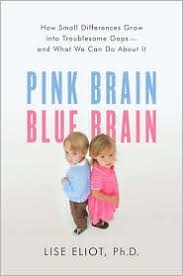
Today, in my opinion, the most sophisticated and sensible answer to the “nature vs. nurture” question is: “both.” In her new book Pink Brain, Blue Brain: How Small Differences Grow into Troublesome Gaps—And What We can Do About It,” neuroscientist and mother-of-three Lise Eliot explains that there are some real inborn differences between the sexes, but statistically, they are very small. It’s our culture—what we do and say at home and at school, on t.v. and in the toy store—that amplifies those small innate differences, turning them into self-fulfilling prophesies that limit the aspirations, experiences, and skills of boys and girls alike.

It’s not simply a matter of banning Barbies or forcing boys to do needlepoint. The issues swirling around kids and gender identity are complicated, so simplistic, one-size-fits-all “solutions” won’t do the trick. But in the best feminist tradition, it’s worth asking tough questions about the messages our culture sends out to parents and kids on a daily basis. Why, for example, does the Toy Industry Association persist in having categories like “Best Boy Toy” and “Best Girl Toy” of the year? (More on that next month!) Retail stores gain when they sell pink drapes for girls’ bedrooms and blue shades for boys’—but what do kids lose when they grow up in such a gender-bifurcated world?

Please share your thoughts, opinions and questions by posting a comment or emailing me at rotscant@yahoo.com.