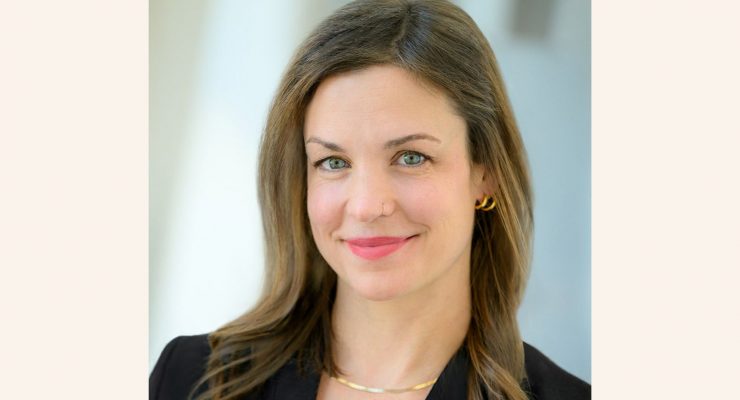
Dr. Sarah Lageson, Associate Professor of Technology and Social Power at Northeastern University with a joint appointment in the School of Criminology and Criminal Justice and Law, sat down with First Publics to reflect on her experiences in communicating public-facing methods. She shared with us her motivation for pursuing a law degree after her PhD and how the two inform her teaching, her writing for public outlets, and her time co-hosting the podcast “Give Methods a Chance.”
First Publics: You are a sociologist but also a lawyer—what motivated you to get your JD after you were already a professor in a school of criminal justice?
Sarah Lageson: That’s a good question. I get it a lot. You know, pragmatically, when I was an undergrad, I thought about law school and quickly dismissed it because of the cost and a knowledge gap in how one even navigates law school. So, when I decided to go to graduate school for sociology, that was after being directly exposed to research. I worked at a nonprofit in Minneapolis, and we had partnered with the University of Minnesota Sociology, and Chris Uggen was the principal investigator of this project, and I was an AmeriCorps volunteer. I got to see how sociology worked and that was so exciting. I mean, the research was really exciting. The policy changes that came from the research were exciting. So once you get firsthand experience with something, it becomes more real, as an option. The law school just wasn’t that for me. It was too amorphous, and so I put that idea away. And the great thing about sociology and sort of the breadth of topics, is that you can engage in legal analysis and legal research. And once I finished and started my job, I was lucky to get a faculty position at a place with a great public interest law school that was actually in the same building as the School of Criminal Justice. This was at Rutgers University in Newark. So finally, I had that firsthand exposure to the clinics, to the faculty, to the students. Students would sometimes take our classes; a lot of the undergrads I had would matriculate into the law school. So that’s when I decided to make the leap. So that’s the pragmatic side.
The more intellectual or substantive side was that I was hitting a point in my research where I was studying the law and trying to understand how the law operated in people’s lives, but I didn’t have a great understanding of the substance, the procedure of law and how it actually worked. And I really wanted to figure out a way to get the research findings in front of decision-makers and policymakers, but I really didn’t understand where a policy came from and who enforced it and how you could challenge it and change it. And I think, you know, law school, for better or worse, a lot of it is about procedure, and I found it extremely useful to me in the research. And I was also doing a big research project by myself. At this point, I was interviewing all these people about criminal record expungements. And it was mostly a qualitative study. There are other components, but I was sitting in my office, doing face-to-face, pre-COVID, interviews with people, and expungement’s a tricky but relatively straightforward, simple law thing, and people just say, “Well, can you just help me fill this form, or can you just explain this part?” And part of me was, I think I could help you figure this out, but I’m not allowed to, or I’m just asking you questions, and I felt like I just kept asking them for help, and I wasn’t able to give help back. So getting to be a law student and doing the clinical work was wonderful, and I did internships, and I learned a lot.
FP: How do you meld sociology and law together in your teaching?
SL: At first, a lot of it is demystifying and calming fears, I think, because the last thing a law student wants to do is look at statistical output, and often the last thing my social science students want to do is look at a case brief. And I think that’s a bummer. There’s so much to learn. And I think we might look at a brief or a table now, and it makes sense, but we should remember it didn’t before we were lucky enough to go to grad school or law school. In general, what I try to do is a lot of demystifying, a lot of starting from the beginning, and some of my favorite law professors went really slow, right? They really went deep instead of focusing so much on breadth, especially at the beginning of the class. I’ve embraced that. So I think it hasn’t changed the fundamentals that we learn about how to be an effective instructor, but I think it has given me a lot more pause to reflect and try to actually live by the things that I learned about a long time ago in terms of really showing up for the students and making things interesting and useful.
I think when you start doing multidisciplinary work, it gives people a lot more freedom to pursue questions that they actually find interesting and to borrow from different methods. A lot of the students that I advise, as a lot of doctoral students in criminology now, do a lot of legal analysis, whether it’s an empirical legal analysis or policy analysis as part of the empirical part of their dissertation, or they can write a really nice part of their literature review, reviewing the case law. I think it’s made their work really rich and helped them be really confident and excited about being able to translate that work to different audiences.
I think my number one piece of advice is always be mindful of the cost, right? Universities offer all sorts of different ways to, if you’re an employee of a university, go take a couple of classes, maybe that’s part of your employment contract. If there are these part-time evening programs that are increasingly available or online distance learning. Law schools have also really opened up since the pandemic in terms of the mode of delivery and the time. There are just a lot more options than ever before. So I think it’s always worth being mindful of what you hope to achieve and being practical about the time and the financial cost, but if anything, just go take a class or audit a class. Use the resources of the university. It’s there.
FP: You’ve published in a variety of outlets, academic and otherwise. Could you talk about that process, especially about the public writing that you’ve done, and what has surprised you in engaging in that kind of writing?
SL: Yes, it’s been great. It’s been an adventure. Each kind of experience has been quite different in terms of the outlets. The first time I ever did public writing was, it was actually for the Minneapolis Star Tribune, and it was my first couple of months atmy first job at Rutgers-Newark, and my office was across from Todd Clear, which is amazing, of course. I was kind of like, complaining about this article that they published, this news article, and I thought my research really showed that. And he was like, write an op-ed. This is when you do that, and he knew that I [had] done public-facing writing throughout all of grad school with our work on Contexts and The Society Pages, but when Todd Clear kind of encourages you to do something, and he’s kind of my hero too, is very, it meant a lot, so I did it, and the paper published it.
And I learned pretty quickly that op-eds, it depends on the place, but you kind of have control over the message or the content. And then that kind of turned into writing for more journalistic outlets. And so, that would be like Wired and Slate. And there they treat you like an academic, not a journalist. You have control over the message, but each place is a little bit different in how things are edited, and what you might submit might look a little different by the time it’s published, and you may or may not get a chance to engage on that. I placed an op-ed in the Washington Post once, and I had just not that much time to even respond to the editorial comments. It can go really fast, which isn’t always easy for an academic. And you don’t get to choose the headline or the graphics. So I have published on the harms of booking photos, only to have the stock image be put up of a famous person’s booking photo, you know? So you just have to kind of prepare yourself for that. And I think that’s no different than when you talk to a journalist. You can try to be really thoughtful about everything you say, but you have no control over what ends up in the article.
And so, you have to sort of be prepared to lose total control over the message or parts of it or some of the framing. And then you have to be prepared for a response, and that can be wonderful. I found retired judges love to read and engage in wonderful emails, and I now have these great retired judges that come and speak in my class, and they were people that I met because they sent me a note after reading something published in the public domain. But then there are people who send very unkind messages, and it sort of depends on what the zeitgeist is outside of the work, because the things I write about are quite narrow. But if it hinges on somebody’s idea of, let’s say, like there’s a big digital privacy debate happening, it’s really not that related, but people have big feelings about it. Like you might hear from them. And you also hear from people who want help, and say, you wrote about this, and they want to know what they should do. And so you have to be prepared to either have resources available and decide if you want to insert yourself into the struggle that they’re going through or are you going to not see yourself in that role? And if so, how do you balance it against your decision to put yourself in the public domain on this issue? And I think I think all of these are fine responses, but you should be prepared to know which you’re most comfortable and well-equipped to do.
The other thing that kind of surprised me is that I’ll hear sometimes from either a journalist or sometimes like an aide to a legislator or somebody who works at an administrative agency and government. And they’ll see something, and it coincides with an issue that they’re working on, so they’ll want to set up a meeting, and they want it. Basically, they want you to answer like every possible question about this issue, really quickly, and sometimes, you’re not prepared for that because you just kind of know about the thing that you wrote about. And I think, sometimes once your name is out there, you’ll get asked, or there’ll be, “Can you write about this?” or “Can you write about that?” There’s a tendency to start to stretch beyond your research expertise. And I just caution against that because I think the empirical research has to be this really strong foundation if you want to do this kind of public work. You’ve got to really know the work inside and out, and you have to already have been engaging with the criticism or the limitations of the work so that you’re just kind of prepared.
FP: How do you incorporate your experience and your knowledge about writing for public audiences with your students?
SL: Yeah, I mean, I really encourage students to do it well; we’re doing a lot of writing in class for obvious reasons. But like, figuring out how to write for different audiences is something I spend a lot of time on, especially with the doctoral students who—PhD students are so great these days. I mean, they come in really open to a lot of different career paths, and I love that. And so I think a lot of our graduate education now, and undergraduate education, is really about how to write for different audiences. So we write op-eds, we write policy briefs, I have the PhD students write an expert report, like they’ve been retained in a court case. I’ve had students recently kind of set, we set up a town hall debate where they represented a nonprofit, that was anti-surveillance, and other people represented the police department that wanted to buy the surveillance technology, and just sort of encouraging clarity of ideas but being very mindful of the context in which you’re communicating those ideas. We don’t formalize that often in our teaching, so I just try to sprinkle it throughout. I think it’s a little more fun, right? than just writing the one paper and being stuck in one voice.
FP: The series that we’ve been doing has been focused on teaching methods in particular. And I know that you and our friend, Kyle Green, were previously editors of Give Methods Chance, a podcast which turned into a book, through The Society Pages. Could you talk with us about what the goals were for the podcast in terms of communicating the value of social science methods to both students and also a broader public?
SL: Yeah, it was great. Well, Kyle has tremendous energy for teaching and for research and for everything in his life. And so, I give him a lot of credit for kind of galvanizing us around starting the podcast. The way he always framed it, and I think is right, is that you have this big project, and the methods get, like, two or three paragraphs, even though that’s, like, 90% of what we do. And then he said, if you go to a conference, you ask somebody a really kind of straightforward question about a challenging encounter or a decision they made, they light up. They become more animated because they really thought through it. And so he said, and I agree, the podcast is a great platform to capture that excitement. And we talked to people from such an array of approaches, disciplines, and topics. And Kyle and I are kind of operating in different areas of the discipline, also. So, that was great because we kind of worked from different networks. I learned about how to analyze video footage, and network analysis, and thinking differently about administrative data, and ethics of interviewing, how do you interview children? How do you interview people in this situation? So it was really great. And the book was a nice way, I think, to kind of capture that. The book was explicitly for teaching, and the idea at this point was that we just wanted to figure out a way to hit different learning styles. And I hear from people that still use the podcast in their methods class, and some students really want to listen to the whole podcast. Some students do not and they just want to read a transcript. Other students just want to read the summary, and then, of course, there’s the published article that you compare it with. So, at that point, we were kind of new professors ourselves, and we were really thinking about how we could try to get every student in their room the same information, but in all these different formats. So that was, I think, part of the goal. And then just getting into the nitty-gritty of how decisions are made. And I think what I learned in particular was that there’s both the human decision-making and the things that are driven by your interests and your training and what you know about methods and sampling and all these other things, but also the practical constraints. So, people would talk about running out of time or not having enough people to help, or grant funding is certainly animating the way that people do research now. And so, I think there’s a lot of that in there also, that I found really useful.
FP: How do you think about research methods now? In what ways are you still incorporating sociological approaches to research in your teaching?
SL: I think doing sort of the public-facing work has made me, number one, a descriptive researcher. And I think that I just encourage my students when they’re picking a dissertation topic. You have to be an investigative journalist, just absolutely wanting to get to the bottom of this puzzle, and that could be purely descriptive, but you have to be that excited about it, and you have to be able to tell the whole story. And so I think we can be as narrow and technical as we want, but if you don’t have a broader sense of what’s going on here, I don’t think we’re doing a great job as social scientists. And so, I’m much more than ever, just really interested in the big picture behind the research. And I’m really interested in learning from other disciplines. I think my first faculty position was a very multidisciplinary department, and now I’m actually into different disciplines by appointment. And so, if I look at who I collaborate with now, they’re sociologists and criminologists, but they’re also economists and political scientists and lawyers and computer scientists. And so, we’ve come together because of a shared interest, problem, topic or question. But we’re bringing these really different disciplinary perspectives and tools. And so, just trying to be really open to how other places think about it. And the constraints that come along with thinking from other disciplines, I think, are really useful as well. So, I still find it exciting. I still like methods, and I can still give methods a chance. Yes!
I think public writing has changed a lot for the better. I think that there’s much less gatekeepers. Substack being a great example. And so I think it’s just a really exciting time. If you want to be engaging publicly, to get out there and do it, noting some of the potential, not risks, but unanticipated parts of it as well. But otherwise, I think teaching is our first, as you all know well, our first way of engaging with a public, and learning how to communicate as an instructor is the crucial kind of first step before you want to maybe even venture out further than that.
Comments