
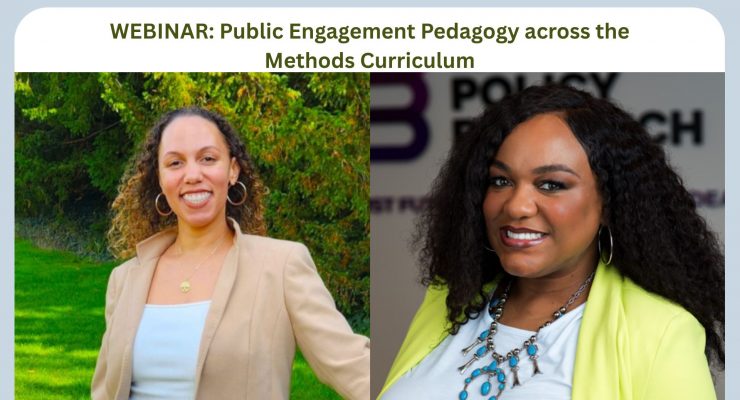
Our latest webinar focused on how — and why — we teach methods. Joined by Drs. Vanessa Gonlin (Assistant Professor of Sociology, University of Georgia) and Jennifer Turner (Senior Research Associate, Institute for Women’s Policy Research [IWPR]), we discussed engaging students in methods, fostering a critical lens, and preparing them for careers beyond the classroom. The full conversation can be seen here; below, we summarize (editing for clarity) and reflect on these themes.
A Grounded Approach to Teaching Methods
Both panelists know firsthand the anxiety students bring to methods courses. Rather than ignore it, they lean in. They employ approaches that bring the student into their learning and grounding methods in their own experiences. This makes methods feel accessible rather than intimidating.
Vanessa opens each class with a brief mindful meditation: “engaging in breathing, grounding, centering ourselves, finding peace and serenity within ourselves, knowing we can always come to ourselves for support and stability at any time during this process.” (6:23)
This reduces anxiety and reframes the process of engaging methods positively. Building on this, Jennifer shared:
“It’s not always about having the right answer. I think getting comfortable, or helping students get comfortable with asking questions, and knowing that you don’t always have to have the right answer. Sometimes it’s more important to know what questions to ask than it is to have all the answers.” (26:06)
For Jennifer, helping students get comfortable with the challenge of learning methods goes hand in hand with demystifying them. She urges students to start with observing the familiar spaces they move through every day, like campus:
“My strategy is to help students understand that methods are tools to help them understand the world. So, really demystifying what methods are and having them apply methods to their lives in a very real way. So one of the exercises I would do with my qualitative methods students is have them go to the student center on campus and take field notes and observations – just have them think critically about how we observe, because we’re always observing the social world.” (8:39)
This first step builds comfort with methods while nudging students toward the “so what” questions by connecting everyday patterns to larger social contexts and problems.
Engaging a Critical Eye to Methods
Grounding students is only the beginning. Both Vanessa and Jennifer emphasize the importance of positionality and helping students recognize that who they are shapes how they see the world, apply methods, ask questions, and engage with participants. Jennifer said:
“We know that when we’re doing research, there’s already a power dynamic between the researcher and the research participant. How do we deconstruct that? It’s something that I spend a lot of time thinking about. How can we engage with our communities in a way that is respectful, [and] not as transactional as possible.” (12:20)
Vanessa elaborated from a quantitative methods perspective, offering a concrete example of how discussion of positionality happens in her methods classroom:
“The way that I engage in this is having my students do critical reflexivity statements… critical reflexivity in a quantitative methods arena, would be more like, what questions are you asking? Who’s funding the research that you’re doing? What’s the question order that you have? ….If you’re doing [research on] gender, sexual orientation, race, ethnicity, how do you ask questions on a survey in a way that people understand and is supportive of their identities…..” (15:46)
This critical reflection on positionality opens the door to a broader, more critical approach to methods — one that connects systems of power to personal experience in service of the communities being studied. Vanessa draws on her quant crit background to explain:
“Quant crit builds on critical race theory, and so quant crit is basically saying: let’s consider the limitations and some of the weaknesses of quantitative methods… and let’s consider how we can actually address this and be more supportive of the communities that we want to study…” (16:41)
She later elaborated,
“ …you might question that and say well, we are all subjective, and we all bring our own beliefs into the research that we do, the questions that we ask in the first place, the people that we talk to, the way that we analyze data, etcetera. So if we’re recognizing that, maybe we can strive for objectivity, but we are all subjective, and maybe that can help us think about the value of other people’s perspectives and experiences, because if I’m on a research team, but I’m studying a group of people that’s outside of my own group, I’m bringing my own perspectives, beliefs, thoughts about that group into the research.” (48:32)
What Next?
Our panelists also offered insights on why methods skills and tools are important for our students beyond the classroom. Jennifer spoke directly to what research teams in non-academic settings are looking for:
“I would say intellectual curiosity….genuine interest in whatever the research topic is. They don’t have to be an expert on the topic by any means, but just a genuine interest and a passion, to some extent, for the project. And cross-disciplinarity flexibility is also really important, specifically in the context of a think-tank or, I guess you could say, an academia-adjacent context, because oftentimes you’re working with researchers that don’t come from your same field.” (26:43)
The conversation came full circle here. As both panelists noted earlier, methods isn’t about right and wrong. It’s about the questions we ask and the impact they have. Jennifer reflects that same spirit in how she thinks about assessment:
“… what did we find in this? What were we hoping to find? Did we achieve this goal?… and sometimes those [goals] are tied to funders, right? So you might have a funder deliverable that you’re trying to meet and funder deliverables often require that type of reflection at the end of a project, where you assess what you learned and what you could have done better. You think about how your research findings can be applied broadly. You think about the impact of your research.” (29:41)
Vanessa adds that responsibility extends to consuming research, not just producing it: “I think it leads people to have a more critical lens on the work that they read, even if they are not engaging in data collection or analysis themselves.” (18:28)
We’ll close with Jennifer, whose words capture what sociology distinctly brings to methods:
“One of the things that I really love about sociologists, and why I really like being a sociologist, is that we think about people, and why the work we do, the topics we study, matter to people. … About how [research] affects people in their everyday lives, or how people make decisions in their everyday lives, and what factors come into play when people make decisions.” (36:04)
Teaching methods is ultimately about producing responsible knowledge and responsible consumers of it. We familiarize students with tools, demystify their fears, and help them find the methods best suited to their questions. But technical skill building is only part of it. A critical lens grounded in positionality or quant crit approaches must travel with students from the classroom into every research setting they enter.
Our panelists made clear that success, then, isn’t measured by methods mastery alone, but by the responsibility students develop toward the communities they study. How they ask questions, collect data, and analyze findings has real consequences for how populations are understood, and for the decisions made about them. Sociology methods instruction can help students, as Jennifer puts it, “build relationships that are not transactional, but authentic and ethical” (28:11) and to carry that ethic with them into the world.
Comments