
education

RU011014This week saw outrage over personal loans offered to Nevada teachers just to buy classroom supplies (for their public school rooms!), a flurry of suggested “great books in sociology” reading lists, 40 years of the War on Poverty, another fight in the toy aisle, and, of course, Canada’s gift to the U.S., the Polar Vortex (we’re particularly sorry for the South… at least we Minnesota types have some snowpants we can dig out of the basement). Enjoy! more...

“Great Books in Sociology” is a new course I’ve proposed for our graduate curriculum here at Minnesota. I’m not sure I’ll get to teach it or not, but I’m having lots of fun thinking of the books I might include. Here’s my initial list.

1. The Protestant Ethic and the Spirit of Capitalism (Max Weber)

2. Black Reconstruction (W.E.B. DuBois)

3. Stigma (Erving Goffman)

4. The Managed Heart (Arlie Hochschild)

5. The Culture of Public Problems (Joe Gusfield)

6. Weight of the World (Pierre Bourdieu)

7. Sidewalk (Mitch Duneier)

8. Ghostly Matters (Avery Gordon)

9. Religion in Human Evolution (Robert Bellah)

Reactions? Thoughts? Anything obvious I’ve missed?  The main criteria or principles I’ve been using so far are: it has to be a real book not a collection; the author has to be a sociologist; and it has to be a work that is actually worth reading, not just something that you should read or that represents some larger point or principle.

Also, if it is not obvious: I’m trying to think of the list as a whole set as well. My larger idea and goal is that this kind of list/course should help us not only think more about book-length writing and research projects, but also about what sociology itself is as an intellectual tradition and scholarly pursuit. Anyway, comments and suggestions–for books, authors, or topics–appreciated. This should be fun.

Comic © Jorge Cham via PhDComics. Click for original.

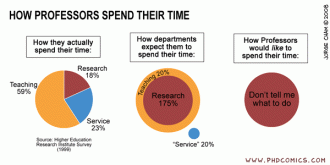
The life and work of a sociology professor was a topic of conversation in my senior capstone course this week. It started when I asked students to estimate what percent of my time was allocated to teaching, research, service, and public outreach/engagement—and then told them about how formal tenure requirements and departmental expectations compared with my actual hours worked on any given week. I was trying to illustrate competing pressures and demands, and I couldn’t help but laugh when one student sent along this cartoon (with no comment or analysis).

Perhaps I’d gone overboard  stressing the disconnections? I really do love my job.

But back to class: one of the biggest topics of inquiry and conversation involved the question of where outreach and engagement fit in the world of higher education? My students this semester have been fascinated with and actually kind of inspired by what we call“public sociology,” while also puzzled by its lack of recognition and reward in the big scheme of academia, especially in the context of a public land grant institution like we have here at the University of Minnesota.

Perhaps envisioning Chris Uggen as a Sociological Spiderman last week got me going, but over the past few days, I have found myself thinking about all kinds of super-hero analogies and metaphors for sociologists and the sociological enterprise. The one that has stuck with me is the idea of sociologists as “Society’s Super Egos.” more...

Hedgehog Spider FoxA few months ago, one of our bloggers, the “backstage sociologist” Monte Bute offered up a post that referenced political theorist Isaiah Berlin’s famous distinction between foxes and hedgehogs.  In the world of ideas, according to Berlin (borrowing from ancient Greek poet Archilochus), there are those who know many, many things (foxes), and those who know one big thing (hedgehogs). Berlin’s categories have been widely referenced in both the social sciences and the humanities to identify styles of thought, the contributions of various scholars, and lines of research and writing. In reflecting on Berlin’s categories back in the long, lazy days of summer, Chris and I had a little fun putting our favorite sociologists and works in one box or the other. And as we played with the categories and thought about sociology as a discipline, we began to realize anew—much as I think Berlin meant to suggest (this appeared in an essay about Tolstoy)—that real insight and understanding in any field requires both foxes and hedgehogs. more...

RU083013Clear Eyes, Full Hearts

In just three days, a new school year is upon us. For my part, I enjoy the ritual: I buy a new pair of Converse (high-top Chucks, black, always). I make sure I’ve got a fresh notebook or two. I think hard about how to be organized and motivated (this will fall away quickly), and I try to draw on the enthusiasm of all of the incoming students swarming the campus. And then I get geared up for the next wave of great ideas and new readers flowing into The Society Pages. Then Doug gives me a good “Coach Taylor” pep talk, and we dive in. Can’t wait to see what the inbox brings. All I know is, with readers and authors like these, we can’t lose.

If all else fails, show a movie (see the comments for many suggestions). more...

The Society Pages scored a nice little win in Las Vegas last week—not at the slots or the craps tables, but at the 6th Annual Meetings of the Sloan Consortium for Emerging Technologies for On-Line Learning. Our award was for Outstanding Peer-Reviewed, On-line Resource in Sociology. It came, unsolicited and much appreciated, from the Merlot (Multimedia Educational Resources for Learning and On-line Teaching) group, whose social science committee was chaired by Mike Miller, a sociologist at the University of Texas, San Antonio.

It’s a major award!

The conference was an eye-opener in many ways. An amazing array of new technologies and devices and platforms for higher education is already on the market or in production, and the amount of energy and capital devoted to new resources is astounding. (One plenary speaker claimed that venture capitalists invested over $1 billion in educational startup funds in 2012 alone.)

We were also honored to give a presentation on TSP. I gave a quick overview of the site and all its wonderful features and contributions, and talked about the unique publishing partnership with Norton that is our support system. And there was a good deal of talk and exchange—both enlightening and inspiring—about all of the ways in which the site is used for teaching and learning these days. more...

With a high school senior in the house and the Facebook everywhere, there’s no way I could resist this great little piece from the Social Media Collective. Bonus points for layering in two of my current favorite sociological concepts: diversity and homophily. Give it a read and let me know what you think—especially you high school seniors and college freshmen out there.

(Thanks to Karl Bakeman @wwnsoc for the heads-up on this one !)

Are you planning on watching the NCAA final four this weekend? Have you ever thought it unusual that we Americans put so much time and energy into college athletics? Have you ever thought about how strange it is that institutions of higher education in the United States field teams in the first place? (People from other countries and cultures sure do.) But no matter what your answers, take a look at this entertaining, little mock-advertisement featuring BYU math-letes and let us know what you think about why things are as they are (and they could be different).