In his Beyond the Beyond blog (hosted by WIRED magazine),  cyberpunk author Bruce Sterling recently made some comments on my post, “Cyborgs and the Augmented Reality they Inhabit.”

Here’s how he describes the piece:
[…] an argument about the definition of Augmented Reality and the definition of Cyborgs, until you can get ‘em to click together like puzzle pieces. But so much debris is left on the floor when they’re done with the theory tin-shears, that the debris looks more interesting than the remainder.
Though it may appear quite critical, I actually agree with Sterling on this point—authors on this blog have rendered augmented reality (and the cyborgs that inhabit it) quite banal.  Or, rather, the techno-saturated world that has emerged in the 21st Century appears to us far more mundane than the exotic dystopian imagery that enveloped the famous cyberpunk novels of yesteryear.  The fantasy of ocular implants and digital immersion have given way to the seemingly unremarkable reality of smartphones and Facebook. Through the “theory tin-shears” futurist art of the past becomes the sociology of the present.  But, the study of present realities will never be as exciting as the imagining of future possibilities.
Sterling goes on to offer a second bit of musing/critique:
*Today, for some reason, I find myself wondering about “machine-to-machine Augmented Reality,” meaning forms of AR with no human perceptions. Obviously that’s entirely technically possible, and I rather imagine that, already, most AR data is never seen by people — they’re “points of interest” that never attract any interest, or geolocative databases automatically loaded onto smartphones yet never accessed by people.

*Emphasizing M-2-M AR would be an interesting ontological attack on “Reality,” because, well, machines aren’t supposed to have any reality. In cyborg discussions, people are always privileging the org while nobody sticks up for the cyb. If an augmented tree falls in a forest and only machines hear, does it make a noise?

This critique that we tend to overemphasize the organic is somewhat amusing (if quite provocative) because, generally, criticism comes from the other direction.  Critics of the way the “cyborg” term is employed on this blog (e.g., colleague and technosociology blogger Zeynep Tufekci) tend argue that championing the cyborg fundamentally de-privileges the humanity of a subject, making her more vulnerable by undermining the basis of her political rights (I think this is the critique anyway…).

The problem is that, both these positions, are competing forms digital dualism.  They start with the assumption that humans and technology are separable — that they were separate in some prehistoric past or will be separate in some fantastical future.  I simply don’t believe that the techno-social can be extracted from the human in any recognizable way (or vice-versa).  I argued a similar point in response to Sang-Hyoun Pahk’s recent “why i don’t like ‘augmented reality‘” post:

[…] I believe that the online and offline worlds are formally necessary in determining one another. Yet, that is not to say that either is a sufficient cause in determining the nature of the other. In other words, we cannot make sense of one without the other, but we also cannot make sense of one by looking ONLY at the other. In this way the online and offline worlds are simultaneously distinct and mutually constituted.

Trying to essentialize human or machine is a game of abstraction that, at the the end of the day, distracts from the present political struggles characterizing our current techno-social mileu.

Follow us! We’ll be Tweeting updates about the blog and other, related cyborgology projects (including a DC meetup that’s in the works!)

The Cyborgology Blog has recently hosted much discussion on the topic of augmented reality (i.e., the co-constitution of online and offline, digital and physical).  A few threads to follow as background are:

Digital Dualism versus Augmented Reality by Nathan Jurgenson

Virtual, Mediated, and Augmented Reality by PJ Rey

why i don’t like “augmented reality” by Sang-Hyoun Pahk

Defending and Clarifying the Term Augmented Reality by Nathan Jurgenson

I’d like to extend this discussion by clarifying the relationship between augmented reality and the namesake of the Cyborgology blog (i.e, the cyborg). The two concepts are intimately connected.

Augmented reality describes a macro-scale historical phenomenon—a set of techno-social conditions in which (small “m”) modern subjects are embedded.   Humans have always, in some sense, been augmented by technology.  Consider, for example, the technology of language that I am currently employing to enhance our communication; it is much more efficient and effective than gesturing for the purpose at hand.  We use the term “augmented reality” most often, however, to describe the consequences of the paradigm shift from physical information storage to digital information storage.  Specifically, we use this concept to combat once-popular assumption that the content of communication through digital media was, somehow, completely separate and distinct from what we experience everyday as embodied subjects in the physical world. (We call this assumption “digital dualism.”)

Proponents of augmented reality contend that fundamental distinctions of offline/physical space are reproduced in online/digital space and, simultaneously, that what happens on digital media influences, or is even superimposed onto, events in the physical world.  While each sphere has separate properties (i.e., distinct forms) their natures’ are co-determined (i.e., content is constantly passed back-and-forth between the two).

How does augmented reality relate to cyborgs?

Cyborgs are the indigenous subjects that inhabit augmented reality. They are physical bodies enmeshed in the techno-social formations that characterize a particular historical moment.  In conventional sociological terms, cyborgs are the micro/agentic object of inquiry when augmented reality is the macro/structural unit of analysis.

Thus, if “cyborgology” is the study of cyborgs (i.e., humans as they exist under particular techno-social conditions), it is also always the study of augmented reality (i.e., the study of those particular techno-social conditions in which cyborgs operate).

WikiLeaks founder Julian Assange’s statement that “Facebook is the most appalling spying machine ever invented” reveals that there is a lack of consensus among the leading social media developers regarding the relationship between transparency and social justice.  Implicitly, Assange is asserting that transparency is good when imposed on governments but bad when imposed on individuals. Moreover, he is, arguably drawing a distinction, here, between cyber-libertarianism (which he rejects as, ironically, facilitating state surveillance and control)  and cyber-anarchism (which uses the same tools to affect grassroots surveillance or “sousveillance” on the state and, thereby, diminishing its capacity to engage in covert, extralegal activities, potentially directed at its own citizens).Facebook did respond to Assange in a Forbes interview saying:

We don’t respond to pressure, we respond to compulsory legal process. There has never been a time we have been pressured to turn over data — we fight every time we believe the legal process is insufficient. The legal standards for compelling a company to turn over data are determined by the laws of the country, and we respect that standard.

The full Assange interview is available on the Russia Today website. The abridged interview streams below:


Answer: They wield enormous (and terrifying) power, yet  they are ill-adapted to function in a changing environment.

In most corners of society, it’s a become a trope to say that the Internet has changed everything; but online communication is still far from integrated into the norms and practices of the academy, whose pace of change and adaptation is nothing less than glacial.  Anyone familiar with academic careers knows that conventional (read print) journal publications are the be-all end-all criterion in evaluating potential hires—the meaning behind the well-worn cliché: “publish or perish.”

The practice of using journal articles as the sole criterion in evaluating an academic’s productivity is an artifact of an epoch long-passed.  In the age of the printing press, journals were, by far, the most efficient and enduring form of communication.  They enabled disciplines to have thoughtful conversations spanning decades and continents.  They also facilitated the transmission of the knowledge produced through these conversations to younger generations.  In fact, it is nearly impossible to imagine the emergence of Modern science without existence of this medium. Thus, in the beginning, journals become symbolically and ritually important because they were functionally necessary. (While journals were medium du jour during Durkheim’s productive years, he surely would have recognized the reason behind their status in the cult of the academic.)

Today, academia finds itself in a state of hysteresis (à la Bourdieu); that is say, our habits have become maladapted to the field or environment in which they are performed.  Let us consider recent developments in the nature of academic discourse. Fifty years ago, the democratization of commercial flight made face-to-face communication between professionals in various disciplines a reality.  Conferences becomes a more rapid and efficient method of communicating ideas—but, this form communication was not durable.  Thus, the conference proceeding emerged as a supplementary medium to compensate for the shortcomings of face-to-face communication.  In some younger or more progressive disciplines, proceedings have been elevated to a status akin to that journals.  These proceedings are printed, circulated, and come to occupy the shelves of offices and libraries across country, if not the world.  And, for many decades, this was the only way to transmit and store the content of conferences.

In the proceeding two decades, however, the practical justifications for the production of print journals or conference proceedings has evaporated in light of the Internet’s emergence.  These vestigial organs of the academy should have slowly withered away, becoming fossilized in archives. Yet, print media remain firmly entrenched, retaining all their symbolic significance, while lacking any of their earlier practical import.  Our cult-like worship of print media is far from benign; the privileging of the print over the digital, in fact, has the opposite effect than was originally intended.  Instead of facilitating the rapid dissemination of ideas, it hinders it.  Print is a solid, heavy medium (as Bauman explains); it travels slowly and is expensive to reproduce.  Digital information is liquid and light; it travels instantaneously and is free to reproduce.

It would be superficial, however, to simply criticize print article (and to promote digital articles).  The article itself an artifact of print media and native to that form.  There ought to be a debate within the academy that seriously considers whether the article optimally utilizes the potential of digital platforms.  Are there more effective, indigenously digital mode of communication?  Is the article a undead corpse, reanimated to inhabit the digital realm?  Of course, this is a loaded question—no doubt exaggerated by the fact that the medium currently in use is an indigenously digital blog, not an article.

De facto, academics in every discipline are utilizing blogs, Twitter, video, and other “new media” to communicate their ideas (and, incidentally, to communicate them to much wider—read interdisciplinary and lay—audiences). De jure, however, we still valorize the article, particularly, the print article.  Who/what suffers? Young academics, socially-active academics, the quality of conversation within the academy, and any layperson or lay-community who stands benefit from the fruits of academic knowledge.  Who benefits? Those entrenched in the old system, whose habits are better suited to yesteryear and who still have sufficient power to resist within the academy to resist any change in the standards of evaluation.  What can we do?  It’s time for the a younger generation and those on the outside to fight our way on to hiring committees.  It’s time for us to establish a unified agenda that involves developing more expansive and inclusive criteria for evaluation.  It’s time (as Patricia Hill Collins once said) to leverage our power as “outsiders within”—to learn to function, even thrive, within the system as we systematically work to reform it.

Follow PJ Rey on Twitter: @pjrey

Audio and video from Saskia Sassen’s plenary address is also available; video is hosted here, audio streams below or can be downloaded here.

Audio from Saskia Sassen’s plenary address is also available; it streams below or can be downloaded here.

Theorizing the Web 2011 was held on April 9th 2011 at the University of Maryland’s Art-Socy building.  It far exceeded our expectations in every way.  We received over 100 abstract submissions of which were able to accept 53%.  We were joined by Internet research experts from around the world, including presenters who traveled from Hong Kong, New Zealand, and Europe.  The conference pushed the capacity limits of the venue with over 230 official registrants and easily 250 people in attendance throughout the day.  Events ran from registration at 8 AM and ended with an afterparty that wound down around 11 PM.  The program was packed with as many as five concurrent panels in early sessions.  The plenary sessions by George Ritzer and Saskia Sassen as well as danah boyd‘s keynote drew audiences of over 150 people.

Sessions covered a wide range of topics pertaining to the social web, including the politics of infrastructure; the role of social media in contemporary social uprisings; the reproduction of race, class, gender, sexuality, and their intersections in a digital milieu; the co-determinacy of the online and offline world (i.e., “augmented reality”) and the dangers of viewing them in isolation; the performance of the self through one’s online Profile and the increasing need to accept the cyborg subject as sociology’s proper unit of analysis; the Internet as more post-Modern than the original objects of analysis under consideration by the post-Modern theorists; the new economies of the Web and the limits of traditional (e.g., Marxian, neo-liberal) modes of thought; the reconfiguration of norms pertaining to privacy/publicity; the democratization of (formerly expert) knowledge via crowdsourcing (e.g., Wikipedia); and the capacity of art to capture/predict our changing relationship with technology.

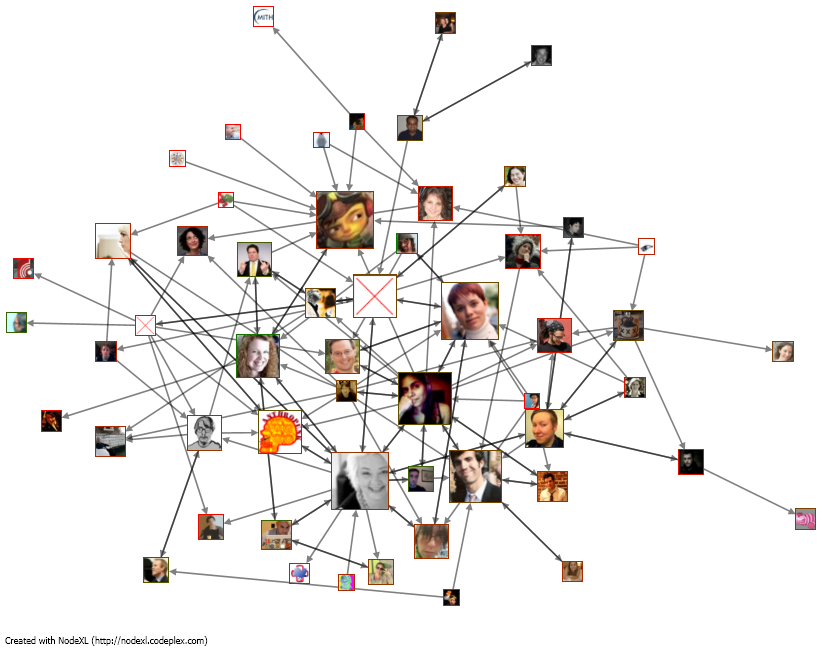
The conference itself was “augmented” by widespread use of Twitter.  In fact, the #TtW2011 hashtag has so far received 2,187 tweets (click here for more analysis).  Derek Hansen, an assistant professor in the iSchool, made a visualization of the new connections made at the conference.

The event was heavily documented.  Audio, video, images, and reviews are available on the Cyborgolgy blog.  To emphasize the recursivity of the online and offline world, much of this content was projected during the conference.  Additionally, the we featured two installations: one by Ned Drummond and one by Vicky Lai.

There was also an exciting pre-conference event hosted by the Irvine Contemporary gallery featuring a discussion of art in the Internet age.

I want to express my sincerest gratitude to my co-chair, Nathan Jurgenson (@nathanjurgenson), as well as to all the committee members: Tyler Crabb, who, as treasurer, did an incredible job wrangling funds from several different sources; Sarah Wanenchak (@dynamicsymmetry), our secretary and Jill-of-all-trades, who never failed to keep meeting notes interesting by slipping in a few references to the impending zombie apocalypse; Bill Yagatich (@praxis_in_space), who handled our publicity and tirelessly hassled the Diamondback for appropriate coverage; Dave Strohecker (@dpsFTW), who coordinated the food and the facilities while playing general to our small army of undergraduate volunteers; and Ned Drummond (@maneatingflower), who donated her professional design skills to attempt to satiate the committee’s endless appetite for new flyers, posters, letters, webpages, etc.  I also want to thank Rob Wanenchak who took the amazing photos of the event that are on display here.

Discussions are already under way regarding the possibility of Theorizing the Web 2012.  Stay tuned!

George Ritzer’s Theorizing the Web 2011 plenary talk is also available.  It streams below or can be downloaded here.

Several video clips were captured of danah’s keynote.  They are presented here in chronological order.

Additionally, the full mp3 audio file streams below or can be downloaded here.