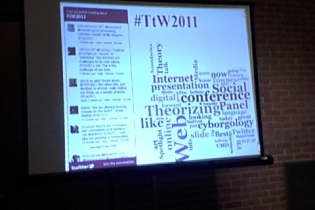
Theorizing the Web 2011 featured several projected installations. In this post, I want to highlight the Twitter visualize produced by Vicky Lai, an undergraduate at the University of Maryland. Vicky explained her project to me, saying:
The tweet cloud generator was inspired by research with the Social Media Micro-Modeling group at UMD and started as a final project for a Digital Cultures and Creativity course. Originally designed to visualize popular words in a Twitter user’s social network (of followers/following to a certain depth), the project was modified to collect tweets containing “#ttw2011” and visualize the most frequent words. Word clouds are generated by IBM’s word cloud generator, the program used on the popular Wordle site.
The visualization automatically regenerated a couple times each minute, which enabled attendees to watch different words trend over time as the conversation in the conference itself shifted.
Vicky Lai
Vicky Lai is a freshman computer science and economics major at the University of Maryland, College Park, and is part of the new Digital Cultures and Creativity Honors program. Her interests include web and graphics design, social media research, and mobile development, along with occasional tweeting at @vicky1a1.
Audio from Saskia Sassen’s plenary address, entitled “Digital Formations of the Powerful and the Powerless” is now available; it streams below or can be downloaded here.
Theorizing the Web included a pre-conference discussion about art in the digital age. The forum took place at the Irvine contemporary gallery and included Gaia, Yoko K, and Dr. Martin Irvine.
Nearly200 researchers from a wide range of disciplines turned out for danah boyd’s Theorizing the Web 2011 keynote, titled “Privacy, Publicity Intertwined.” This presentation is based off her latest fieldwork with young social media users.
The track includes:
Closing remarks: Nathan Jurgenson
Introduction: PJ Rey
Presentation: danah boyd
Q&A: danah and audience
The full mp3 audio file streams below or can be downloaded here.
Aimée Morrison (@digiwonk) posted a review of Theorizing the Web 2011 on her digiwonk blog. See full text below:
What makes a great conference?
I’m not yet home from Theorizing the Web 2011, just sitting in the Starbucks at the Marriott wondering what it is that made this conference so awesome. Because it was awesome: I ran out of paper in my notebook from writing so much down.
I’m thinking it’s the grad students.
I go to a lot of conferences and, if I may be frank, was rapidly becoming disenchanted, nay, jaded, about the whole system.
What makes me jaded about conferences:
The panels are unfocused, so usually there’s only one paper of the three–or, god help me, four–that I actually want to see
There are way, way too many concurrent panels, so that the conference has 400 people at it, but each session has 4 people presenting to 7 other people
The panels start and finish late, throwing off my eating / peeing / time management
The papers run overtime
The speakers read excerpts from an article, so it’s too dense and too long, and hard to decipher
The speakers have prepared their presentations on the plane, and it shows
The panel chair won’t actually stop papers that run too long, so at the end, there’s no time at all for questions
There’s never enough break time to actually talk to people and network
There’s no food, so when there are breaks, everyone scatters to the wind: no time to actually talk to people and network
Sometimes, people won’t talk to you if they don’t already know you
Often, people skip out on vast chunks of the conference to do the meeting and networking they otherwise have no time for
What was awesome about TTW2011
The panels were very focused
People actually attended panels, and the keynotes, for the whole day. My paper was in the last session of the day, right before the keynote, at 5pm, and there were 40 people attending.
All the panel rooms were in one hallway, leading to group cohesion and chance conversations
It was one day long.
People were very friendly: I suspect this might be because of Twitter, which breaks the ice. If we follow each other online, I’m more likely to walk up and introduce myself, because you’ve already indicated some sort of interest in my acquaintance, or my work.
There was food in the morning, and food at night. And a party with a live band and beer in Rubbermaid-bucket coolers.
Most importantly, perhaps: people put a lot of effort into their presentations, with the result that they were professional, and clear, and on point. Some even managed *funny*.
I am impressed at the level of smarts, research, and preparation of all the talks I went to. Did some people learn the hard way that 42 slides take more than 15 minutes to discuss? Probably. But the slides were really, really good, so I assume that’s a rookie mistake of over-ambition, which I’m kinda inclined to forgive readily.
(It’s very easy for me to tell other people they went overtime: we only had two speakers on my panel, so co-panelist and I had the luxury of 25-30 minute presentations, with still lots of time for questions–and what great questions!)
So. The upshot is this: I’m going to go to more conferences where graduate students predominate on the program. In new media studies, where something new in the tech or theory or cultural realm pops up on the radar almost faster than the speed of scholarship, it makes sense already to see what the kids are up to. Beyond that, though, I think grad students just put more effort into their papers. As a result, they present better work that’s more valuable to me in my own research, and that’s the point, right?
Along with the Cyborgology editors and few other colleagues, we are throwing a conference on April 9th called Theorizing the Web. Leading up to the event, we will occasionally highlight some of the events taking place. I will be presiding over a paper session titled “Wiki-Knowledge—Populist Epistemologies from the Web” and present the four abstracts below. The aim of this paper session is to explore emergent communities of knowledges, their epistemologies, and the impact of the knowledge economy that is being created and has been created on the Web and social media. Each of these papers address different knowledges and epistemologies, ranging from the perceptions of the Internet and it uses to the meaning of post-expertise in the era of Web 2.0.
First, Katy Pearce will present a paper on Armenian conceptualizations of the Internet and the Web. What will be emphasized her is the meaning of the Internet and the Web is based not on just individual preference but is both culturally and device-bound. Next, Avelet Oz explores the contradictory tendencies of Wikipedia’s legal consciousness and its ideological practices: Wikipedia’s attempt to set a cultural schema and organization of objectivity while keeping the system open to the lay public to encourage participation. Third, Kyle Reinson presents the intriguing case of post-expertise in the era of Web 2.0, which describes the potential shift of power relations that may result from the challenge of emergent businesses and social media organizations. In effect, the rise of said businesses and social media organizations offer individuals access to information and services at little or no cost that was previously held and distributed by experts in a particular knowledge community. Last, Sally A. Applin will present a paper written with Michael D. Fischer that specifically focuses on the dynamics of knowledge creation on Web 2.0 and how this new practice of knowledge formation challenges authority of experts by rendering such information available to the mass public.
Find the four abstracts below. Together, they will make for an interesting and informative panel for anyone interested in knowledge production and epistemologies. We invite everyone to join us at the conference in College Park, MD (just outside of Washington, D.C.) on April 9th. And let’s start the discussion before the conference in the comments section below. Thanks!
Katy Pearce, “I don’t use the Internet. I just use social networking sites and download content onto my phone.” Defining the Internet: Perspectives from mobile-only Internet users in Armenia”
Conceptualization of what “the Internet” or “the Web” is to an individual is both culturally- and device-bound. In the Republic of Armenia, where home PC adoption has reached 10-15% of the population and only about 7% of those homes have an Internet connection, but mobile phones have reached 80-90% and mobile-based Internet, as of late 2010, is used by 21% of the population. Thus, there is a great deal of Armenians for whom the mobile phone is their exclusive Internet providing device.
As Potosky (2007) states, there is little research on how one’s conceptualization of the Internet affects access and use. However, certainly, perception of what the Internet is shapes attitudes and behaviors (Peng, Tsai & Wu, 2006; Tsai, 2006). And there is a great deal of evidence that individuals from different cultures have different perceptions and uses of the Internet (Allwood & Wang, 1990; Brosnan & Lee, 1998; Makrakis, 1992; Martin, Heller, & Mahmoud, 1992; Omar, 1992).
Based on ethnographic observation and qualitative open ended survey questions answered by Armenian Internet users conducted in early 2011, this study finds that conceptualizations of “the Internet” or “the Web” do not include using applications on a smartphone, accessing popular social networking sites or downloading media files. Additionally, social activities rather than information seeking or browsing are the most common uses of Internet on mobile devices.
Ayelet Oz (@ayeletoz), “The Legal Consciousness of Wikipedia”
Over the last several decades, the Internet has opened new possibilities for social organization. A corpus of scholarly and popular writing describes the emergence of online collaboration as presenting a radical alternative to contemporary social institutions such as the market and the state. A similar challenge is presented to our familiar understandings of the cultural meaning of law.
My paper zooms in on the legal aspects of online organization. Through a bottom-up exploration of discussions, dispute resolution decisions, elections and other arenas of legal activity on Wikipedia, I aim to weave together a coherent understanding of the “legal consciousness” of Wikipedia – the set of fundamental ideas and conceptual categories that help construct, compose and interpret its social relations.
My goal it to capture the ways in which law, as a social construct, holds the potential to limit innovative governance, due to its persistence as a familiar cultural schema, already embedded with existing notions of hierarchy. The combination of the radical project of online communities with their use of formal legal structures illuminates this tension and opens a possibility for a better understanding of the mechanisms by which legal concepts and structures affect our world outside the formal legal system.
Utilizing ethnographic methods with methods for qualitative analysis of texts, I shed light on the internal legal activity in Wikipedia: norm-creation, dispute resolution, and the creation of a professional legal class.Preliminary findings show that the legal consciousness of Wikipedia revolves around an unsolved paradox between two contrasting ideologies: the hope for a “perfect machine” that does not rely on human preference at all, and an ideology of openness and hands-on participation.
On the one hand, we see a constant attempt to build a perfectly objective system that is not vulnerable to individual preferences: the governing norms focus on setting rules for discussion, and not on promoting any specific values (the important policies are “neutrality” and “no conflict of interest”); the decisions of Wikipedia’s Arbitration Committee are structured as a list of undisputable preliminary principles; and the discourse revolves objective elements such as evidence and conduct, and does not discuss values and content disputes.
On the other hand, we see a constant attempt to undermine the transcendence of the system by creating new arenas for lay participation, as well as conducting the full proceedings publicly. The process in the Arbitration Committee is radically open, inviting all of the users to take part in it; we can spot spheres of rich discussion in informal mentoring; new meanings for conduct rules are created; and user-centered practices of decentralized and participatory gathering of evidence emerge.
Trying to mitigate the conflict between these two ideologies, I use critical legal theory to construct a unified theory that will be able to explain these contradictions, and show how the internal paradox shapes the social organization on Wikipedia.
Kyle Reinson (@reinsoncreative), “Buying the experts when the expertise is free: Contemporary (mass) media consciousness and the knowledge economy in the Web era of post-expertise”
Theoretical perspectives pertaining to the Web can be an attractive subject due to the uncertainty of a still amorphous and expanding cyberspace infrastructure. In a variety of efforts by companies to gain competitive commercial advantage within more traditional service-based professions there has been a steady increase in the availability of free or low-cost alternatives to services traditionally based on vast expertise. For decades the hegemonic control of scarcity in information exchange has been held over from the pre-Web economy. This seemingly hidden economic bubble of expertise is just waiting to burst.
Examples of this increasing trend include LegalZoom.com, where average consumers can pay a fraction of typical legal fees for personal and business services as well as help with their trademark, patent and copyright issues. Another is Intuit’s TurboTax.com, where a variety of premium services that certified public accountants (CPAs) have traditionally offered now afford American Web consumers single-use software that guides them “like a GPS to help…find every tax deduction (they) deserve.” It was only a matter of time for technology to begin eroding the value of a knowledge-based economy.
As an economic system, market capitalism depends on a certain level of scarcity for products and services that is difficult to sustain when faced with the abundance of information and automated expertise available on the Web to increasingly tech-savvy consumers. The combination of searchable information and expanding access affords human users short-hand answers to questions they may have traditionally made appointments to hear the answers to – or paid sometimes exorbitant fees to obtain counsel.
To complicate this crisis of expertise, millions of people (through Facebook and social networks) now turn to a backchannel of friends to suggest which products to buy or even to find the best college or university programs in which to enroll. In a very real sense, consumers are faced with the question of why they would buy the cow when its milk is available free (or at least a lower cost). As users increase their search competencies and their motivations (or economic conditions) no longer favor paying for expensive professional services the result will be the continuation of a sea change in the Internet, the delivery of expertise and the changing nature of capitalism.
Andre Lemos differentiates between the mass media function, namely the “centralized flow of information with an editorial control by big companies in the process of competition funded by advertising,” and post-mass media functions that “operate from technologies and networks where anyone can produce information, ‘releasing’ the editorial center.” (Lemos, 2010) This paper extends his thinking toward the connection between expertise and post-media functions to suggest we have begun to encounter an era of post-expertise where professions will be rapidly reshaped for adaptation to the Web and where world economies will continue to struggle in creating well-paying jobs in areas traditionally seen as staples for feeding middle-class growth.
First, this paper theorizes that the continuing existence and use of the Web has created a favorable climate for the condition of post-expertise. In the same sense that human beings encounter the post-modern, they are all-at-once aware of the shift and unwilling to escape the legacy of the previous era. This does not signal an end to expertise but instead a new way to understand what cannot be sufficiently labeled as expertise.
Second, this paper theorizes a period of mass denial on the part of legacy media to recognize that post-expertise has had swift and decisively negative impacts on its own hegemonic agenda-setting power. This paper suggest that focusing on routine reporting of the symptomatic news of Wall Street, foreclosures and joblessness does not begin to direct resources and attention toward the problem of free and discounted information in thwarting economic recovery and perhaps preventing U.S. economic recovery altogether.
Third, as knowledge production and “news” becomes increasingly an ahistorical exercise with the Web’s ability to shape popular reality through search and selective news feeds – the social implications of knowledge production and scarcity remain unanswered in terms of the perceived value of everything from higher education to other forms of expertise in their post-expertise form. To paraphrase Orwell’s 1984, the past is written by those who control the present – and the virtual realities created by the Web are defining new contexts as they trace the communication of the future. Expertise is an inevitable casualty of the new contexts.
Sally A. Applin (@anthropunk), “Humans and Knowledge: Making it in the Web 2.0 World”
(with Michael D. Fischer)
This paper examines the sources of knowledge and the transference of knowledge between and to people in the Web 2.0 world. The advent of Web 2.0 marks a significant change to roles in knowledge and to the corresponding shifting role that authority takes in adapting to the rapid creation and transference of knowledge. We explore what it means to people to now have continual global access to a rapidly shifting, transient knowledge source, which they both experience and create.
The presence of Web 2.0 has rapidly shifted the relations between people and knowledge. If Web 1.0 stimulated dramatic changes in how knowledge was disseminated, Web 2.0 stimulates changes in the transformation of specialist into mundane knowledge, available to anyone who wants or may need it. In this paper, we review examples of this phenomena (via Quora, Twitter, Yelp, etc..) and examine the changes between Web 1.0 and Web 2.0 with regards to how knowledge is valuated, created, deployed, edited, augmented, and destroyed. We discuss this with reference to Marc Augé’s (1995) notion of supermodernity. In particular, we explore the transitory nature of the relationship between expert and mundane knowledge as enacted in a Web 2.0 world, where ‘expertise’ emerges for a temporary period of time as knowledge that is applied in a non-attached, transitory way to whatever the use-case is at the time. When the use-case is complete, so is the need for the solution’s reliance on ‘expertise.’
For the most part, Web 1.0 was largely contributed to by an elite group that focused on the accumulation of knowledge, distributed via the dissemination model of publishing. With Web 2.0, there are a few differences, the most marked being that various people contribute to the aggregate of knowledge. People are using accumulated knowledge, interactive aggregated knowledge (such as web forums), and sensor created physical knowledge (mobile phone tracking records and contextual locative information) to create new knowledge. Thus, knowledge has become the result of people generating and applying prior knowledge, which then becomes knowledge, which is then fed back into the knowledge source, which is then valuated, etc…This aggregation plays an important role as the results of the synthesis become a part of the shared pool of knowledge. This ‘Supermodern Knowledge Transference,’ (SKT) dilutes the value of authority (e.g. “expertise) in the Web 2.0 world. With this model, authority is temporarily assigned, depending upon the context of particular queries at any given point in time and can rapidly shift as feedback and further knowledge is quickly funneled back into the knowledge source. As anthropologists, we are both concerned and fascinated by this model. Is knowledge and expertise evolving or is it becoming a ‘just-in-time’ transitory model? Does knowledge condense, or is it fragmenting and expanding with simultaneous, asynchronous points of view and contribution to the knowledge source? Is the ‘knowledge source’ a ‘thing’ or is it a fragmented transient idea? We intend to discuss these and other questions around the ‘knowledge’ of Web 2.0 and how it is created.
Habermas argues that a healthy public sphere can only grow from a relatively autonomous private sphere. The maintenance and development of this public sphere is of prime importance to the health of an open society, but this era may be passing. The development of online social networks challenges the integrity and usefulness of a distinction between the public and private spheres. Perhaps this distinction is imploding, with future civic and commercial life simultaneously public and private, populated by cyborg citizens. The private sphere is now public in many important ways.
Analysis of Facebook affords the opportunity to negotiate the contours of this historic transition, the opportunity to find empirical evidence and conceptual nuance to develop much needed social theory. This panel will explore transformations in personhood, privacy, property, justice, capital, commerce and other foundational issues; issues which are of obvious importance beyond Facebook’s 500,000,000 users.
Anthony Hoffmann (@anthonyhoffmann), “Me, not mine: Facebook, ontic informational beings, and the problem with information as property”
The concept of information property is central to Facebook’s overall philosophy of information. CEO Mark Zuckerberg has repeatedly insisted that, on Facebook, “people own their information and control who [sic] they share it with” (Zuckerberg, 2009, para. 2), a sentiment that is explicitly codified in the site’s governing documents (Facebook, 2009). However, the concept of personal information as property is not uncontroversial. Legal scholars have pointed out the difficulties with reducing subjects to informational objects (Cohen, 2000), as well as the problems with developing privacy protections based on property law (Litman, 2000). In this paper, the author argues that the concept of personal information as property is not only legally difficult, but philosophically problematic as well. By examining the nature and attributes of personal information developed within the context of social networking sites like Facebook, the author develops a conceptual definition of information property that can be compared against three Western philosophical conceptions of property—Locke’s natural law and its libertarian descendants, utilitarianism, and Hegelian personality-based theories. In the process, it becomes clear that certain attributes of personal information (for example, the lossless nature of information in general, as well as the constitutive nature of personal information) resist easy philosophical categorization as property according to these theories. Instead, the author suggests that the Humean declaration of private property as unnatural (i.e., governed by moral norms and social convention rather than natural law) points the discussion in a different direction. For Hume (and, later, for Rawls) the concept of private property is constrained by a given society’s conception of justice. Therefore, we must first establish a framework for informational justice before we can begin to address the relationship between Facebook users and their information (and, in turn, develop a theory of property that properly reflects the nature and attributes of personal information). Last, echoing the legal problems with reducing subjects to informational objects, the author draws from work in the area of information ethics to demonstrate how Facebook users may be positioned as ontic informational beings in-and-of-themselves (Floridi, 2008), and are not necessarily reducible to the kind of quantifiable information objects that may be considered property. As a result, the author demonstrates that the last step—from a framework of information justice to a theory of information property—is unnecessary and that users, as informational beings, ought to be considered simply within a framework of justice and human rights, and not within one of property and ownership.
Stephen Lilley, “Facebook Members’ Complicity with Commercial Transparency”
Introduction
Facebook has over 500 million members (22% of all Internet users) who spend over 500 billion minutes a month on the site each sharing roughly 70 pieces of content a month (Rosen, 2010). With these staggering numbers it is not surprising that Facebook has become a rich venue for advertisers. Critics charge that advertising revenue is generated by exploiting social actors’ proclivity to form and maintain social ties. Facebook counterclaims that we as a society are loosening our standards around privacy and becoming more transparent in our lives as we get used to sharing information about ourselves. Mark Zuckerberg claims that this is the greatest transformation in our generation (The Economist 1/30/2010). Further, he would have us believe that the social actors in this revolution willingly expose themselves and their Facebook friends to commercialization. Is that the case?
Research Study
We pose the following research questions: To what extent are Facebook members attentive to commercial data sharing policies? Do they favor such policies and the social ideal of transparency? We conducted our survey in December, 2010 on the campus of a private university in New England. Our purposive sampling of undergraduates yielded 372 students, of which 349 (94% of the sample) had a Facebook account. On average members had an account for four years and used Facebook six days a week, three hours per day. Respondents were asked to self-report on 1) the importance of Facebook to their social activities, 2) the level of their consumer activity on Facebook, 3) their knowledge of Facebook advertiser data sharing practices and their attitude toward such, 4) their use of sharing restrictions and the groups targeted, and 5) their assessment of transparency benefits, reputation risks, and consumer risks. Findings
In general, members were disinterested and inattentive to Facebook’s consumer/advertising features. Respondents were much more likely to indicate that Facebook is “very important” or “absolutely crucial” to sustaining friendships (56%) than it is for exposure to good things to buy (10%). Three Facebook provisions for sharing profile information with advertisers were described in the questionnaire and approximately one half of the sample admitted not knowing about them. Seventy-two percent of Facebook users have not controlled which of their information is made available to companies that host applications, games, etc., when friends use them. Of the twelve sharing restrictions listed on the questionnaire, respondents reported employing few restrictions, with twice as many utilized to target friends (average of 2.4 restrictions) than for advertisers/marketers (1.1 restrictions).
Most members, however, expressed opposition to Facebook data sharing policies. When prompted to provide their opinions about Facebook’s sharing their data with advertisers, approximately 50% answered “strongly oppose” or “somewhat oppose,” 40% selected “don’t care,” and only 10% favored this. Approximately 80% see a reputation risk in using Facebook, 65% see a consumer risk, and 60% believe that a potential transparency benefit is not worth exposure to these risks. Discussion
Facebook delivers consumers and their rich social information to for-profit enterprises. Facebook users are complicit in this, however, in our study we find ignorance, disinterest, ambivalence, and some concern but very little enthusiasm for this role. They are not so much proactively expressing the ideal of social transparency as they are simply not bothering to resist commercialization via Facebook. We conclude our paper by discussing the implications.
Jason Treit (@tagfu), “Interpersonal Commons”
One of social media’s recurring tensions is that between privacy norms and commodification of data. “You own your data” is a drumbeat behind numerous campaigns to defend privacy. From the other direction, ownership claims are taken to justify rights-reassigning terms of service and aggressive data mining. These efforts to assert and reassert possession, each grounded on a similar model of data as private property, quietly constitute a double overreach into the interpersonal commons.
As it has for cultural works, the data ownership model mistakes social life as a series of resource transfers between private hands. The habit of attaching a possessive pronoun to the contents of many minds suggests a tangle of broken claims within that group. What you know of me, once ascertained, is either ‘yours’ to reuse or ‘mine’ to reclaim: no room is left for ‘ours’, a space governing unowned things, where future choices to share or withhold turn on norms and negotiation. Worse, the logic of ownership tends to standardize against informal, overlapping claims on resources, even where informality and overlap may yield advantages to groups not represented in the rights discourse.
Another view recognizes how the spaces and connections between individuals more closely resemble a commons than a series of private enclosures. Sharing – the diffusion of knowledge through these channels – does not close off future reuse. Rather, sharing is a trusting surrender of perfect control. This need not point to chaos: the fieldwork of Elinor Ostrom shows the viability of real-world commons, from Nepalese irrigation systems to open source software projects. Ostrom’s principles of sustainable commons map well to two distinct but related ideas for privacy tagging by Jonathan Zittrain and Aza Raskin, respectively. In contrast to the Facebook status quo of (often illusory) privacy controls, these new proposals share a goal of being declarative and non-coercive: signs that specify intent rather than barriers that prohibit. As such, they rate to enrich the interpersonal commons that is social media, promoting respect for individual preferences without overestimating the reach of private claims upon knowledge.
About Cyborgology
We live in a cyborg society. Technology has infiltrated the most fundamental aspects of our lives: social organization, the body, even our self-concepts. This blog chronicles our new, augmented reality.

 Theorizing the Web 2011 featured several projected installations. In this post, I want to highlight the Twitter visualize produced by Vicky Lai, an undergraduate at the University of Maryland. Vicky explained her project to me, saying:



 The opening remarks stream below or download them





 Anthony Hoffmann (@anthonyhoffmann), “Me, not mine: Facebook, ontic informational beings, and the problem with information as property”
 Stephen Lilley, “Facebook Members’ Complicity with Commercial Transparency”
 Jason Treit (@tagfu), “Interpersonal Commons”