
I grew up watching a lot of Star Trek. It would be an understatement to say that the franchise was a big part of my life. Immediately after the last episode of Star Trek: Voyager I cut off my hair. I took Enterprise as a personal insult. If I saw J.J. Abrams I’d probably try to blind him with a strobe light while yelling, “How’s that lens flare working for you?!” I was feeling much more optimistic about the new TV series incarnation under Bryan Fuller until a couple days ago when, in an interview with Collider he told a reporter asking about casting decisions: “I’ve met with a few actors, and it’s an interesting process. There’s a few people that we like and we want to carry on what Star Trek does best, which is being progressive. So it’s fascinating to look at all of these roles through a colorblind prism and a gender-blind prism, so that’s exciting.” I try not to notice the color of flags but I’m pretty sure I’m seeing red ones. more...
Archive: 2016

Before the first word was written, Orange is the New Black was already fucked.
In an essay we posted earlier this week, guest author Apryl Williams refers to the 4th season of Orange is the New Black as a spectacle, comparable to the lynch mobs that used the destruction of black bodies as a form of entertainment. In her excellent post, Williams especially laments the lack of a trigger warning accompanying the graphic death of a key black character, one which unapologetically mirrored the 2014 suffocation of Eric Garner. Had there been black writers, Williams contends, things would have been different—she would have been warned instead of just “entertained.”
Williams and others critique the writing decisions that played out in Season 4 and attribute the season’s missteps to a very white writing crew. Indeed, by Isha Aran’s careful calculation, exactly zero black people have been involved in writing Orange is the New Black across its 4 seasons.
Undoubtedly, Williams is right that the series, and the 4th season in particular, would have been generally better, and also more carefully written and produced, with a racially diverse staff. The issue of racial representation in the writing room is one that pervades the popular media industry, and Orange, a show about prisons that tells stories about race, is a cautionary tale. Rather than reimagine how much better the season could have been with the inclusion of writers of color, however, I think the critique of a whitewashed profession and industry stands strongest when we table the quality of the writing altogether. Because even if Orange is the New Black Season 4 had been the greatest story of our time, it would remain, unacceptably, told by the wrong people. more...
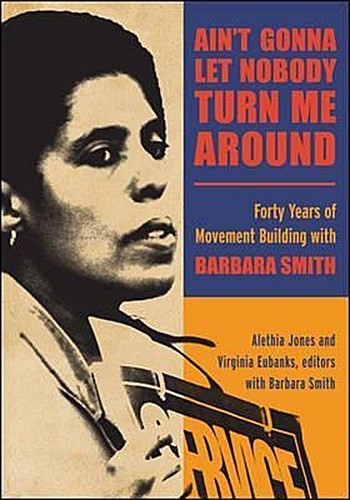
The recent tragedy in Orlando should remind us, among many other things, that building solidarity and compassion across multiple identities is both difficult and necessary. It is difficult because too few people are willing or able to understand how intersecting forms of oppression can leave their mark on one’s identity. It is necessary because those forms of oppression are at their most powerful when they divide people as they hold them down. Building a politics that recognizes the unique challenges of intersecting identities while not stopping at advocating for the freedom of only that identity is the sort of critique that reminds us that organizations like The Human Rights Campaign are both a force for progressive change but ultimately an extremely limited one. I like to think of concepts like identity politics and intersectionality as inventions or technologies because it underscores how analytical concepts do work in the world. You can look at writing by radical collectives before and after these concepts were invented and see very different kinds of points being made and new approaches to activist work being tested. Thinking this way also helps us think about how and to what degree people use these concepts correctly or productively.
The Combahee River Collective started out as a chapter of the National Black Feminist Organization but eventually became a black feminist lesbian organization of its own operating out of Boston in the second half of the 1970s. The term “identity politics” was first coined in their collective statement released in 1977 which was consciously part of building a movement around intersecting forms of oppression. In the interview below, between author and black feminist Kimberly Springer and Combahee River Collective member Barbara Smith, we can see how identity politics and intersectionality were “invented” for a very particular purpose but then appropriated by the right wing to do the exact opposite kind of rhetorical work. After so much abuse, these terms get “watered down” even when they’re used by well-intentioned leftists. more...

In the 60s there was a movement in engineering and the physical sciences towards building what the British economist E.F. Schumacher called “appropriate technology.” Appropriate technology is sort of what it sounds like: build things that are appropriate to the context in which they are meant to be deployed. If that sounds like common sense to you, then you are benefitting from a minor scientific revolution that occurred in the midst of incredible professional hubris. For quite a while (and still today, as I can personally attest to during my time at a polytechnic institute) scientists and engineers thought that what works in an American lab will work anywhere in the world. Physics is physics no matter where you are and so the underlying mechanical properties of any given technology should work wherever it is situated. Appropriate technology pushed back against that concept, encouraging practitioners to think long and hard about social, economic, political, environmental, and any other context an artifact might find itself in. more...
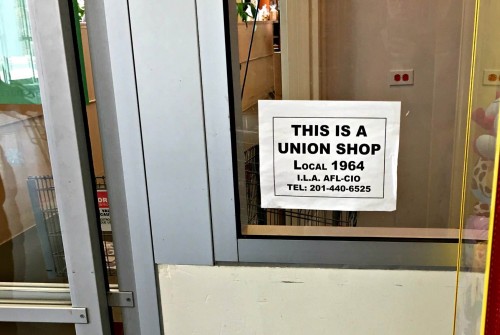
As I walk in, I glance at the sign that says “Local 1964 AFL-CIO” and smile at the greeter who stands by the front door. Walking down the aisle I peruse the household cleaners. All natural, $4; organic, $9; wood-safe, $3.Taken slightly aback by the cost, I pull out my phone and bring up the same products in the Amazon app: $1.50 difference. I pause to think about that $1.50 and spiral into an internal dialogue about capitalism and my place within it. Not only do these chemicals eventually go down my drain back into a water source that I share with my neighbors, but the money I spent represents my values. $1.50 is less than the price of a small ice cream, and also, apparently, the margin necessary to pay the local grocery workers a living wage. I pick up the product off the shelf— the $4 natural multi-surface cleaner—and continue down my list.
The presence and use of Amazon’s apps on my phone are part of a larger socioeconomic process. As gentrification runs rampant in my small city, the local use of Amazon and other delivery apps increases and local union grocery stores have closed one after another, resulting in many unemployed people. One of the many insidious aspects of late capitalism is its ability to force a competition between time-saving and wage-saving. The convenience of technology necessitates further trust in and reliance on the rest of society. Or, as PJ Rey puts it: “There is no such thing as a lone cyborg.” What we often ignore, however, is how our choice of convenience simultaneously necessitates that our local community also become more reliant on large infrastructures and less self-sustaining. As Christian Fuchs explains in Labor in Informational Capitalism and on the Internet, the unemployed class is an inevitable byproduct of technological progress in a capitalist society that must be continuously deprived of wage labor and capital. more...

“The founding practice of conspiratorial thinking” writes Kathleen Stewart, “is the search for the missing plot.” When some piece of information is missing in our lives, whether it is the conversion ratio of cups to ounces or who shot JFK, there’s a good chance we’ll open up a browser window. And while most of us agree that there are eight ounces to every cup, far fewer (like, only 39 percent) think Lee Harvey Oswald acted alone. Many who study the subject point to the mediation of the killing –The Zapruder film, the televised interviews and discussions about the assassination afterward—as one of the key elements of the conspiracy theory’s success. One might conclude that mediation and documentation cannot help but provide a fertile ground for conspiracy theory building.
Stewart goes so far as to say “The internet was made for conspiracy theory: it is a conspiracy theory: one thing leads to another, always another link leading you deeper into no thing, no place…” Just like a conspiracy theory you never get to the end of the Internet. Both are constantly unfolding with new information or a new arrangement of old facts. It is no surprise then, that with the ever-increasing saturation of our lives with digital networks that we are also awash in grotesque amalgamations of half-facts about vaccines, terrorist attacks, the birth and death of presidents, and the health of the planet. And, as the recently leaked documents about Facebook’s news operations demonstrate, it takes regular intervention to keep a network focused on professional reporting. Attention and truth-seeking are two very different animals.
The Internet might be a conspiracy theory but given the kind, size, and diversity of today’s conspiracy theories it is also worth asking a follow-up question: what is the Internet a conspiracy about? Is it a theory about the sinister inclinations of a powerful cabal? Or is it a derogatory tale about a scapegoated minority? Can it be both or neither? Stewart was writing in 1999, before the web got Social so she could not have known about the way 9/11 conspiracies flourished on the web and she may not have suspected our presidential candidates would make frequent use of conspiratorial content to drum up popular support. Someone else writing in 1999 got it right though. That someone was Joe Menosky and he wrote one of the best episodes of Star Trek: Voyager. Season 6, Episode 9 titled The Voyager Conspiracy. more...

A favorite pastime of mine is listening to podcasts or stories while playing mindless mobile games. For me, it’s the perfect blend of engagement and passivity—just enough informational input to be stimulating while still being relaxing, and put-downable enough that I can pause to do other things like prepare a meal or… get back to work. The combination of aural and visual stimulus hits just the right balance. I’m always looking for other good combinations of aural and visual input for various tasks: a TV show I can watch while organizing my PDFs, the right music for reading, another for writing, and so on. Proliferation of media texts, and the increasing availability of them, has made much of my life a mixing and matching of sensory inputs. more...
 Contemporary political campaigns are highly data-driven. Large datasets let campaign staffers learn about, access, and ultimately persuade potential voters through hyper-local messaging or micro-targeting. The digitization of society means that people leave traces of themselves in the course of everyday life—how they consume, who they love, when their next menstrual cycle is likely to begin and most relevant here, how they have engaged politically. These traces and advanced analysis of them, have been instrumental in political campaign strategies, guiding staffers in numbers-based decisions about how to best reach and acquire, voters. Many partially attribute Obama’s 2008 and 2012 successful Whitehouse bids to his team’s skillful use of voter data and micro-targeting, and an uproar ensued with Bernie Sanders temporarily lost access to a DNC voter database.
In contemporary politics, big data is a big deal. So of course, Donald Trump is not down with big data. The Associated Press is circulating a story about the discrepancy between Trump and Clinton with regard to data usage. Clinton’s campaign has embraced voter-data as a central tool of success, while in contrast, Trump has dismissed big data as “overrated” and expressed his intention to use big data in a “limited” capacity (although in the story linked above, a Trump advisor assures that the campaign will be “state of the art,” presumably including some degree of data analytics). more...
Before the first word was written, Orange is the New Black was already fucked.
In an essay we posted earlier this week, guest author Apryl Williams refers to the 4th season of Orange is the New Black as a spectacle, comparable to the lynch mobs that used the destruction of black bodies as a form of entertainment. In her excellent post, Williams especially laments the lack of a trigger warning accompanying the graphic death of a key black character, one which unapologetically mirrored the 2014 suffocation of Eric Garner. Had there been black writers, Williams contends, things would have been different—she would have been warned instead of just “entertained.”
Williams and others critique the writing decisions that played out in Season 4 and attribute the season’s missteps to a very white writing crew. Indeed, by Isha Aran’s careful calculation, exactly zero black people have been involved in writing Orange is the New Black across its 4 seasons.
Undoubtedly, Williams is right that the series, and the 4th season in particular, would have been generally better, and also more carefully written and produced, with a racially diverse staff. The issue of racial representation in the writing room is one that pervades the popular media industry, and Orange, a show about prisons that tells stories about race, is a cautionary tale. Rather than reimagine how much better the season could have been with the inclusion of writers of color, however, I think the critique of a whitewashed profession and industry stands strongest when we table the quality of the writing altogether. Because even if Orange is the New Black Season 4 had been the greatest story of our time, it would remain, unacceptably, told by the wrong people. more...

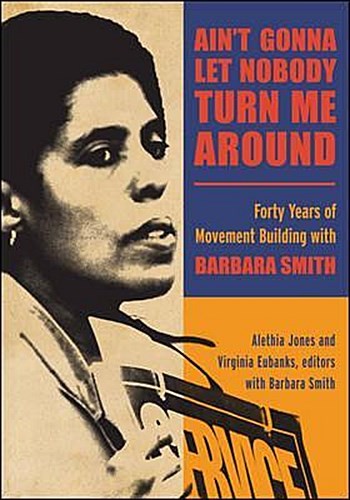
The recent tragedy in Orlando should remind us, among many other things, that building solidarity and compassion across multiple identities is both difficult and necessary. It is difficult because too few people are willing or able to understand how intersecting forms of oppression can leave their mark on one’s identity. It is necessary because those forms of oppression are at their most powerful when they divide people as they hold them down. Building a politics that recognizes the unique challenges of intersecting identities while not stopping at advocating for the freedom of only that identity is the sort of critique that reminds us that organizations like The Human Rights Campaign are both a force for progressive change but ultimately an extremely limited one. I like to think of concepts like identity politics and intersectionality as inventions or technologies because it underscores how analytical concepts do work in the world. You can look at writing by radical collectives before and after these concepts were invented and see very different kinds of points being made and new approaches to activist work being tested. Thinking this way also helps us think about how and to what degree people use these concepts correctly or productively.
The Combahee River Collective started out as a chapter of the National Black Feminist Organization but eventually became a black feminist lesbian organization of its own operating out of Boston in the second half of the 1970s. The term “identity politics” was first coined in their collective statement released in 1977 which was consciously part of building a movement around intersecting forms of oppression. In the interview below, between author and black feminist Kimberly Springer and Combahee River Collective member Barbara Smith, we can see how identity politics and intersectionality were “invented” for a very particular purpose but then appropriated by the right wing to do the exact opposite kind of rhetorical work. After so much abuse, these terms get “watered down” even when they’re used by well-intentioned leftists. more...


In the 60s there was a movement in engineering and the physical sciences towards building what the British economist E.F. Schumacher called “appropriate technology.” Appropriate technology is sort of what it sounds like: build things that are appropriate to the context in which they are meant to be deployed. If that sounds like common sense to you, then you are benefitting from a minor scientific revolution that occurred in the midst of incredible professional hubris. For quite a while (and still today, as I can personally attest to during my time at a polytechnic institute) scientists and engineers thought that what works in an American lab will work anywhere in the world. Physics is physics no matter where you are and so the underlying mechanical properties of any given technology should work wherever it is situated. Appropriate technology pushed back against that concept, encouraging practitioners to think long and hard about social, economic, political, environmental, and any other context an artifact might find itself in. more...

As I walk in, I glance at the sign that says “Local 1964 AFL-CIO” and smile at the greeter who stands by the front door. Walking down the aisle I peruse the household cleaners. All natural, $4; organic, $9; wood-safe, $3.Taken slightly aback by the cost, I pull out my phone and bring up the same products in the Amazon app: $1.50 difference. I pause to think about that $1.50 and spiral into an internal dialogue about capitalism and my place within it. Not only do these chemicals eventually go down my drain back into a water source that I share with my neighbors, but the money I spent represents my values. $1.50 is less than the price of a small ice cream, and also, apparently, the margin necessary to pay the local grocery workers a living wage. I pick up the product off the shelf— the $4 natural multi-surface cleaner—and continue down my list.
The presence and use of Amazon’s apps on my phone are part of a larger socioeconomic process. As gentrification runs rampant in my small city, the local use of Amazon and other delivery apps increases and local union grocery stores have closed one after another, resulting in many unemployed people. One of the many insidious aspects of late capitalism is its ability to force a competition between time-saving and wage-saving. The convenience of technology necessitates further trust in and reliance on the rest of society. Or, as PJ Rey puts it: “There is no such thing as a lone cyborg.” What we often ignore, however, is how our choice of convenience simultaneously necessitates that our local community also become more reliant on large infrastructures and less self-sustaining. As Christian Fuchs explains in Labor in Informational Capitalism and on the Internet, the unemployed class is an inevitable byproduct of technological progress in a capitalist society that must be continuously deprived of wage labor and capital. more...

“The founding practice of conspiratorial thinking” writes Kathleen Stewart, “is the search for the missing plot.” When some piece of information is missing in our lives, whether it is the conversion ratio of cups to ounces or who shot JFK, there’s a good chance we’ll open up a browser window. And while most of us agree that there are eight ounces to every cup, far fewer (like, only 39 percent) think Lee Harvey Oswald acted alone. Many who study the subject point to the mediation of the killing –The Zapruder film, the televised interviews and discussions about the assassination afterward—as one of the key elements of the conspiracy theory’s success. One might conclude that mediation and documentation cannot help but provide a fertile ground for conspiracy theory building.
Stewart goes so far as to say “The internet was made for conspiracy theory: it is a conspiracy theory: one thing leads to another, always another link leading you deeper into no thing, no place…” Just like a conspiracy theory you never get to the end of the Internet. Both are constantly unfolding with new information or a new arrangement of old facts. It is no surprise then, that with the ever-increasing saturation of our lives with digital networks that we are also awash in grotesque amalgamations of half-facts about vaccines, terrorist attacks, the birth and death of presidents, and the health of the planet. And, as the recently leaked documents about Facebook’s news operations demonstrate, it takes regular intervention to keep a network focused on professional reporting. Attention and truth-seeking are two very different animals.
The Internet might be a conspiracy theory but given the kind, size, and diversity of today’s conspiracy theories it is also worth asking a follow-up question: what is the Internet a conspiracy about? Is it a theory about the sinister inclinations of a powerful cabal? Or is it a derogatory tale about a scapegoated minority? Can it be both or neither? Stewart was writing in 1999, before the web got Social so she could not have known about the way 9/11 conspiracies flourished on the web and she may not have suspected our presidential candidates would make frequent use of conspiratorial content to drum up popular support. Someone else writing in 1999 got it right though. That someone was Joe Menosky and he wrote one of the best episodes of Star Trek: Voyager. Season 6, Episode 9 titled The Voyager Conspiracy. more...

A favorite pastime of mine is listening to podcasts or stories while playing mindless mobile games. For me, it’s the perfect blend of engagement and passivity—just enough informational input to be stimulating while still being relaxing, and put-downable enough that I can pause to do other things like prepare a meal or… get back to work. The combination of aural and visual stimulus hits just the right balance. I’m always looking for other good combinations of aural and visual input for various tasks: a TV show I can watch while organizing my PDFs, the right music for reading, another for writing, and so on. Proliferation of media texts, and the increasing availability of them, has made much of my life a mixing and matching of sensory inputs. more...
Contemporary political campaigns are highly data-driven. Large datasets let campaign staffers learn about, access, and ultimately persuade potential voters through hyper-local messaging or micro-targeting. The digitization of society means that people leave traces of themselves in the course of everyday life—how they consume, who they love, when their next menstrual cycle is likely to begin and most relevant here, how they have engaged politically. These traces and advanced analysis of them, have been instrumental in political campaign strategies, guiding staffers in numbers-based decisions about how to best reach and acquire, voters. Many partially attribute Obama’s 2008 and 2012 successful Whitehouse bids to his team’s skillful use of voter data and micro-targeting, and an uproar ensued with Bernie Sanders temporarily lost access to a DNC voter database.
In contemporary politics, big data is a big deal. So of course, Donald Trump is not down with big data. The Associated Press is circulating a story about the discrepancy between Trump and Clinton with regard to data usage. Clinton’s campaign has embraced voter-data as a central tool of success, while in contrast, Trump has dismissed big data as “overrated” and expressed his intention to use big data in a “limited” capacity (although in the story linked above, a Trump advisor assures that the campaign will be “state of the art,” presumably including some degree of data analytics). more...