Archive: 2016

turkey3

A couple of years ago I wrote about Friendsgiving, that very special holiday where cash-strapped millennials gather around a dietary-restriction-labeled potluck table and make social space for their politics and life experiences under late capitalism. All still very relevant, though I suspect this is the year where we should come up with a name for whatever happens after late capitalism. Some of you, of course, will be sharing a table with people not of your own choosing and so you might be forced into reckoning with people who make excuses for Nazis and disagree that trans people exist.

What follows are a couple of useful tactics that will help you hold your own and get through arguments that we shouldn’t have to keep having but here we are. These probably will not help you in a completely hostile room. These are better if you’re in a mixed crowd and you want to make sure that at the end of the political argument people don’t leave saying nothing more than “politics is so divisive!” People only criticize divisiveness when they aren’t sufficiently convinced by one side. more...
image

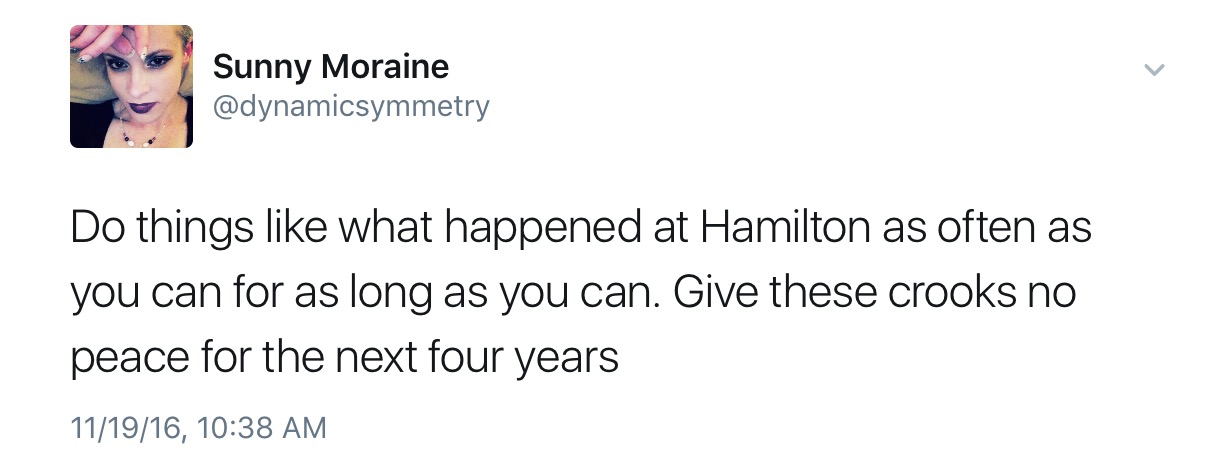
On Friday night, VP-elect Mike Pence went to see Hamilton. He was loudly booed. The cast delivered a respectful message asking him to “work on behalf of all of us”. President-elect and noted internet troll Donald Trump accused the cast of harassment, because the truth is whatever he says it is. By Saturday morning, it was – going by my feed – most of what Twitter was talking about.

more...

Response to harassment report issued by EA's COO Peter Moore in Dec. 2014
Response to harassment report issued by EA’s COO Peter Moore in Dec. 2014

It’s probably appropriate that amidst a torrent of harassment and abuse directed at marginalized people following the election of noted internet troll Donald Trump, Twitter would roll out a new feature that purports to allow users to protect themselves against harassment and abuse and general unwanted interaction and content. Essentially it functions as an extension of the “mute” feature, with broader and more powerful applications. It allows users to block specific keywords from appearing in their notifications, as well as muting conversation threads they’re @ed in, effectively removing themselves.

more...

15036236_10101391638542713_6639250440135461709_n

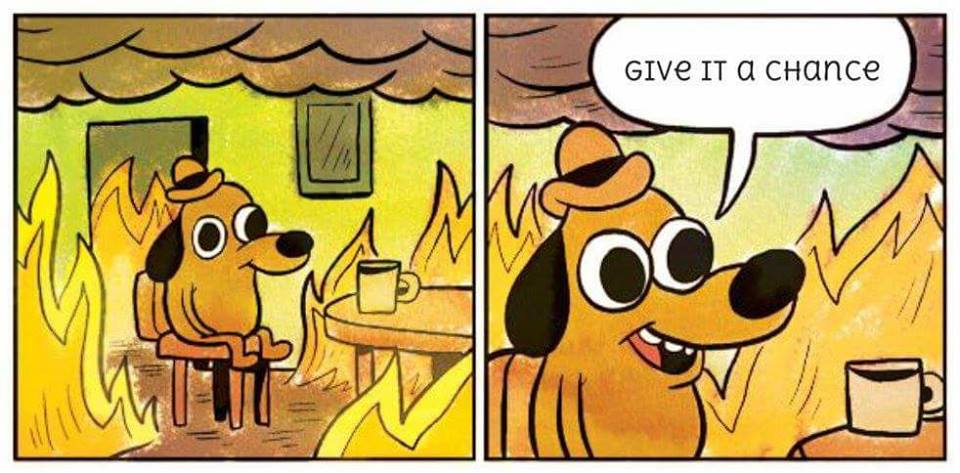
“It’s time for unity.” “We need to listen to each other more.” “Now that it’s over, things can get back to normal.” “Who knows, maybe he won’t do all that stuff.” “Let’s give him a chance.”

This is what it often looks like when liberals and moderates who didn’t support Trump try to come to terms with his election. To quell their own fears. To quell the fears of others. To tamp down the vitriol and partisanship of a long, ugly campaign. To make amends with the relatives on Facebook whom they all-caps yelled at, to signal to their Twitter followers that they are folding themselves into the new normal, and to atone for being blindsided by an election result that many had already predicted—primarily those most effected by a Trump presidency: immigrants and people of color.

Calls for unity and prayers that his campaign was mere showmanship are not only a coping mechanism, but a performance as well. It’s trite to say that any post on social media is a performance, though that does not make it less true. And politics itself is a performance. But I believe the performance of reasonability in this particular climate has important, perhaps dire, repercussions for all of us, and more so for the most vulnerable and disenfranchised among us.

more...

0e154ea83f86b84908edf5cfac9afc6b5cf5ae10
Spoiler alert: No, no he does not.

My writing this was inspired prior to last week’s result by an article from May of this year, which proclaimed 2016 as the first “internet election.” The author, Andrew Keen, was less concerned with rigorously defining what an “internet election” might entail, and more interested in throwing a variety of questions at 2016 in order to rip it away from the course of standard electoral discourse. The barely-implicit question, of course, was to explain away what seemed––at the time and until last week––the outlier that was Donald J. Trump.

more...

01

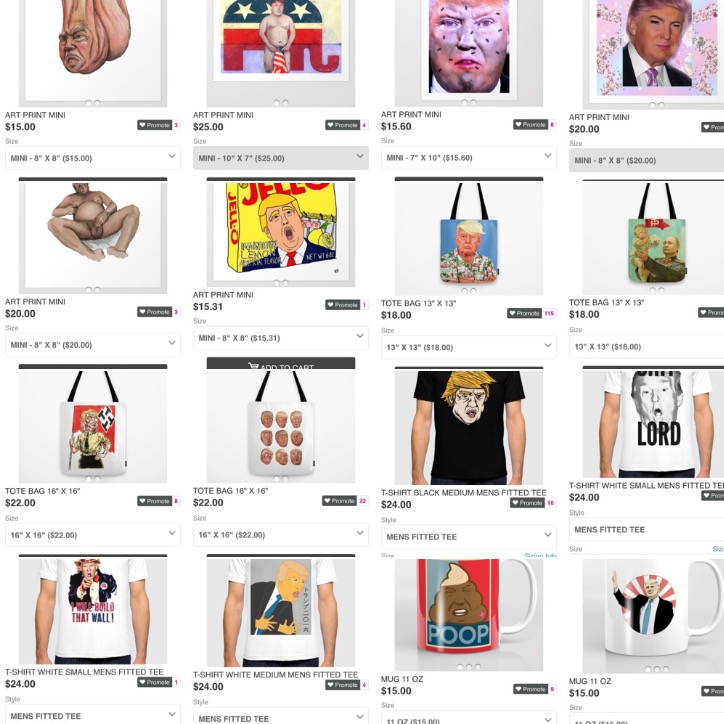
The internet has been saturated with Trump memes. Some times they are hilarious, some times they are hurtful. Some times they bring relief, some times they are agonizing. This post is a product of my observations and archive of Trump memes and their evolving power from “subversive frivolity” to “normativity”. I demonstrate how Trump memes have transited along a continuum as: attention fodder, subversive frivolity, the new normal, and popular culture.

Screengrabs with the black header were archived from the mobile app version of 9gag on 8 November 2016, around 0001hrs, GMT+8 time. They include all the posts tagged “Trump”, with the earliest backdating to 14 weeks. There were 141 original memes in total but a handful have been omitted from this post. Screengrabs without the black header were archived from various news sites and social media throughout the Election season.

more...

affinity

Editor’s Note: This essay originally ran on November 9, 2016 and included a call to politics of affinity. On November 10th, I added to the essay by applying the framework to ongoing protests. 

As the reality of the 2016 election results sunk in, my echo-chamber of a leftist newsfeed was full of two key things: heartbreak and I told you so’s. The heartbroken expressed disbelief that the U.S. would elect a person with an impressive record of bigotry coupled with an appalling record of incompetence. The I told you so’s said they already knew. Not knowing was a sign of privilege, naivety, foolish trust in big data. We should have nominated Bernie, they said. You should have voted, but not for Jill Stein.

Donna Haraway, so keen on blurring boundaries, promotes what she calls affinity politics, vis-à-vis identity politics. more...

After my last post on Neil Degrasse Tyson and the (seemingly fictional?) War on Science, I received feedback from a few people suggesting that there was more to be written. In fact, more has been written; for well over a century, the field of science studies has been developing and shifting, comprised of scholars studying the history, philosophy, and sociology of “science” and many of its cousins (technology, asceticism, “innovation”, et al.). I am an artist who is starting to immerse myself in the field in order to strengthen my critique of technological mediation in culture. So while I don’t plan on using science studies frames in every one of my posts, I do expect there to be shades of its tenets throughout.

That said, where should one start to understand the history and development of science studies? more...

original
(courtesy of The Atlantic)

It’s been a real struggle for me to talk about Donald Trump.

No, not because he’s an extremely unpleasant subject. I mean, that, sure. Though to be honest I’ve been talking about him a lot in various places. I wish I could ignore him – and the whole damn election – entirely, but this is not how I cope. Or my coping mechanism of choice isn’t altogether a healthy one, and it is to become totally and utterly obsessed.

Don’t ask me what my curated news feed largely consists of. Don’t ask me how many political podcasts I currently follow. Don’t ask me how frequently I check FiveThirtyEight, and how much emotional weight I attach to numbers which are, after all, not objective but instead mediated through and interpreted by human beings. The point is that I’m obsessed, which means that I’m immersed in the way you and I and we all talk about Donald J. Trump.

‘scuse me a sec.

*MUFFLED SCREAMING*

more...

A substantial part of my graduate research work focused on the vernacular creativity of Chinese digital media users. In practical terms, this meant participating in various local social media platforms and collecting content that my contacts shared through chat applications and posted on their personal social media feeds. Given that most of my friends and acquaintances knew I was doing research about 网络文化 wangluo wenhua [Internet culture], it wasn’t uncommon to receive proactive updates about newly-minted slang terms or hot-button funny images of the week, often accompanied by detailed explanations and personal interpretations of the content in question. Sometime in 2014, right at the beginning of my actual fieldwork, a friend from Shanghai sent me a stylized image of a frog with teary eyes and pouty lips on the popular chat application QQ. “What is this?” I asked. “It’s 伤心青蛙 shangxin qingwa [sad frog],” he replied. “I see… but do you know where it comes from?” I continued. “Hahaha, no, I don’t… it’s just funny, it’s really popular now on the Baidu Tieba forums, I got it there. There’s many versions of it.”

“I’m so sad I mutated”, one of the Pepe images I collected on Chinese social media platforms.

In fact, I knew that the vaguely humanoid frog was Pepe, a character originally appearing in Matt Furie’s Boy’s Club comic series that had by that time already become an archetypal figure of American digital folklore, circulating from relatively unknown bodybuilding forums to massive discussion boards like 4chan and Reddit, and mutating from his trademark “feels good man” comic panel into an endless series of self-referential variations and meta-ironic phenomena such as rare pepes. The fortuitous and unpredictable popularity of Pepe, rising from one among many characters of an independent comic to paragon “Internet meme”, has been amply chronicled as one of the most evident examples of how the creative practices of digital media users can near-instantly put anyone or anything under the spotlight of “Internet fame”. Matt Furie himself, reflecting on the unexpected rise to fame of one of his artistic creations, describes the cultural dynamics evidenced by the circulation of Pepe in terms of “post-capitalist” vernacular creativity: “It’s like a decentralized folk art, with people taking it, doing their own thing with it, and then capitalizing on it using bumper stickers or t-shirts.” more...