
socioeconomic status

Photo of two houses in flooded area. Photo by Mary, Flickr CC

The National Weather Service estimates that Hurricane Florence dropped over 8 trillion gallons of rain across North Carolina, and the Federal Emergency Management Agency (FEMA) has just started evaluating how much damage was done. While Hurricane Florence and other natural disasters impact thousands of lives every year, not all groups recover equally. Recent research reported by Mic reveals that non-white households tend to lose wealth after a natural disaster, while white households often profit.

Tracking families from 1999 to 2013, sociologists Junia Howell and Jim Elliot found that white families in the most disaster-hit counties gained $126,000 in wealth on average over the 14 years of the study. By contrast, Back, Latinx, and Asian families in the same counties lost $27,000, $29,000 and $10,000 respectively. “Put another way, whites accumulate more wealth after natural disasters while residents of color accumulate less,” Elliot explained.

After a natural disaster, FEMA provides grants and low-interest loans to offset the cost of property damage. While it would make sense that federal disaster relief would mitigate racial disparity, Howell and Elliot’s research shows that it actually makes it worse. Counties receiving the most FEMA aid experienced the starkest widening of the racial wealth gap. Black families in counties that received the least FEMA aid accumulated $82,000 more wealth on average than Black families in counties that received the most aid. The researchers tried to explain this puzzling finding:

“Based on previous work on disasters such as hurricanes Katrina and Harvey, we know FEMA aid is not equitably distributed across communities … When certain areas receive more redevelopment aid and those neighborhoods also are primarily white, racial inequality is going to be amplified.”

In other words, one potential explanation for this trend is that white communities within counties receiving federal aid tend to receive more investment for rebuilding after a disaster than non-white communities in the same county. And with climate change increasing the frequency and intensity of natural disasters, this discovery implies worsening racial wealth gaps in the future. However, Howell and Elliot see reason to be hopeful,

“The good news is that if we develop more equitable approaches to disaster recover, we can not only better tackle that problem but also help build a more just and resilient society.”
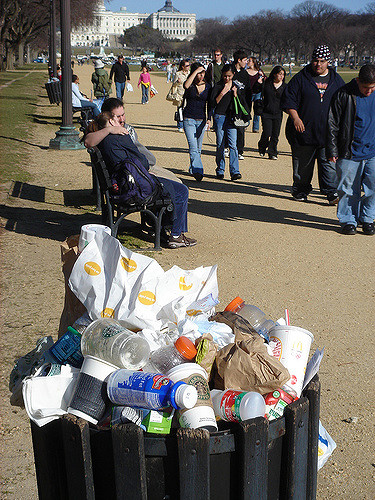

Photo of a Trash Bin in Washington D.C. by David Lisbona, Flickr CC

Today, the term “white trash” is used colloquially to identify white people who do not conform to the established ideas about what it means to be “white,” usually indicating they are poor, uneducated, unemployed, or backwards. This term emerged as a racial slur for white indentured servants — poor whites from England and other European countries that came to the United States in search of citizenship in exchange for labor. In a recent segment on NPR’s podcast Code Switch, sociologist Matt Wray discusses why “white trash” remains a powerful insult against poor whites and people of color alike.

Wray argues that although the term is meant to disparage poor whites, it simultaneously demeans other races by maintaining that there is something about being white that is superior to other racial groups. This is why the modifier “trash” is used. Code Switch news assistant Leah Donnella sums up Wray’s argument well:

“. . . ‘white’ is the only racial group that needs a modifier for it to become a slur. There’s no ‘black trash’ or ‘Hispanic trash’ or ‘Native American trash,’  presumably, because for most of American history, those people were assumed by those in power to be poor, uneducated and criminal.”

Wray also suggests that the term is used to reinforce the long-standing idea that poor whites are more racist than middle class or white elites. This allows affluent whites to escape criticism as racists, while stereotyping poor whites as representative  of “real” racism. Accordingly, Wray states:

“Whites who use the term are saying, ‘Look, I’m not racist. The person down the road is racist. The one who drops the N-word, or has the Confederate flag flapping off the back of their truck. That’s real racism.’ “

In short, Wray’s research shows how the term “white trash” reinforces ideas of white superiority, today and throughout history.  Since it first emerged in the colonial era, the term symbolized how important the intersection of race and class was — and still is — for personal belonging and worth in the United States.

Photo by Brandon Atkinson, Flickr CC

The procedure for the Marshmallow Test is simple: give a child one marshmallow, and promise them one more if they can resist the first. This test, originally conducted by psychologist Walter Mischel, is intended to measure self-discipline and future success, and is arguably one of the most well-known studies in social science research. But in a recent article in The Atlantic, sociologist Jessica Calarco argues that success never stemmed from the ability to “delay gratification” — in this case, by not eating the marshmallow — but from one’s social and economic background.

A new study replicating the marshmallow test, which also accounts for mother’s education level and household income, finds a child’s capacity for self control does not influence their achievement later on. What does matter is socioeconomic standing and the opportunities that come with it. Children of lower socioeconomic standings have fewer opportunities for success and are less motivated to wait due to the conditions of their daily lives. Calarco explains,      

“For them, daily life holds fewer guarantees: There might be food in the pantry today, but there might not be tomorrow, so there is a risk that comes with waiting. And even if their parents promise to buy more of a certain food, sometimes that promise gets broken out of financial necessity.”

Amidst today’s “replication crisis,” the Marshmallow Test is just one of many classic social science studies to falter. In this case, social environment proves to reveal much more about a person and their future than impulsivity. Calarco concludes,

“The failure to confirm old assumptions pointed to an important truth: that circumstances matter more in shaping children’s lives than Mischel and his colleagues seemed to appreciate.”

Photo by John Beagle, Flickr CC

Throughout the United States, school years are wrapping up and families are making their summer plans. While at one time students could rely on their school-friends to be playmates for the summer, the prevalence of school choice policies — which allow students to attend schools outside of their neighborhoods — means that this is no longer the case. This spring, CityLab highlighted social science research on the relationship between school choice policies and gentrification. Specifically, two recent studies found that school choice policies may create inequalities in housing even as they seek to alleviate them in education.

Carla Shedd, a sociologist who has written about challenges in urban education, notes,

“What is remarkable in this moment is that schooling and housing are decoupled in a way that hasn’t been the case before.”

In other words, schools and neighborhoods no longer share the same fate. The emergence of school choice policies, such as charter schools and waivers from No Child Left Behind, allow well-off families to buy houses in lower-priced areas while still avoiding schools they perceive as undesirable. Francis Pearman, who published his recent findings with Walker Swain in Sociology of Education, told CityLab,

“As school choice expands, the likelihood that low-income communities of color experience gentrification increases.”

 Research by Stephen Billings, Eric Brunner and Stephen L. Ross also supports this finding. Lottery policies from No Child Left Behind meant that families could move into areas with lower housing prices but send their child to school elsewhere. Since the law gave students in failing schools priority in the lottery, new residents in Charlotte exploited the law by moving into districts with schools deemed to be failing. In both instances, the ability to send a child to a school other than the neighborhood option meant that housing in low-income communities of color were more attractive to well-off White families, spurring gentrification but without improvement to the local schools in the area.

Photo by Travis Johnson, Flickr CC

Parents of all backgrounds want their children to receive the best education possible, but what sets wealthy “helicopter parents” apart is that they have the resources to ensure it happens. A recent article in The Washington Post describes the role of “college concierges” — affluent parents that meticulously map out important college opportunities for their child — in widening the gap between their own children and children from working-class families, whose parents may not know how to guide their child through the college process.

The article draws from a study by social scientists Laura HamiltonJosipa Roksa, and Kelly Nielsen about the role parents play in college students’ lives. The authors find that female students from wealthy families graduate at a rate of 75 percent, while their counterparts from low-income families only graduate at a rate of 40 percent. To explain this discrepancy, the authors give an example of two students interested in dentistry — one from a wealthy family accepted into her top-choice dental school, and the other from a poorer family who was not admitted. 

“[The] one from an affluent family…had reviewed applications years earlier and knew what she needed to do to get in…. [The other student’s] parents didn’t know what was required — such as job shadowing — nor did they realize her slipping grades would disqualify her from getting admitted. She ended up as a dental assistant making $11 an hour, a job that didn’t even require a bachelor’s degree.”

Instead of criticizing affluent parents’ behavior, the article’s author suggests we should direct our energy towards providing guidance to students without it, in order to close success gaps like the one illustrated in this study. 

 “Simply providing more aid or more help in getting admitted isn’t enough…. Schools also need to put in place programs — and pay for them — that help middle- and lower-income students find the right mentors, get spots in study-abroad programs and internships, and navigate the often confusing and tricky journey to graduation.”

Tinder's promise.
Tinder’s promise.

In Vanity Fair, a piece by Nancy Jo Sales discusses “hook up culture” and its potential causes, including the infamous app Tinder. Sales’ accounts of dating in New portray a “dating apocalypse,” wherein some of her interviewees see men, in particular, moving away from “relationships” altogether. To them, Tinder has forever changed how people date and how they perceive dating. As explained by John Birger in The Washington Post, however, Tinder and its ilk may be better understood of symptoms of “hookup culture” rather than causes. The real problem, Birger asserts, is plain old math.

Birger describes how today’s college-educated demographics mean three men for every four available women. For him, the surplus of women is shaping the narrative of non-committal “hook up culture” detailed in Vanity Fair. And it wouldn’t matter so much if people were more likely to date across socioeconomic or educational lines. Birger uses research from UCLA sociologists Christine Swartz and Robert Mare to show that marriage between individuals of unequal education at its lowest point in fifty years. Since college-educated women outnumber college-educated men, the former inevitably exclude a greater population of potential partners if they overlook men with different educational trajectories—and they replicate the idea that relationships are harder to come by for female college grads. Those interviewed in Sales’ article provide testimonials of the ways Tinder can affect interpersonal communication and relationships, but as Birger shows, demographics and mathematics paint a more accurate picture of how “hook up culture” lasts beyond college.

For more on marriage across class and education lines, see Jessi Strieb’s “Marrying Across Class Lines.” For more on “hook up culture,” see Elizabeth Armstrong, Laura Hamilton, and Paula England’s “Is Hooking Up Bad for Young Women?”

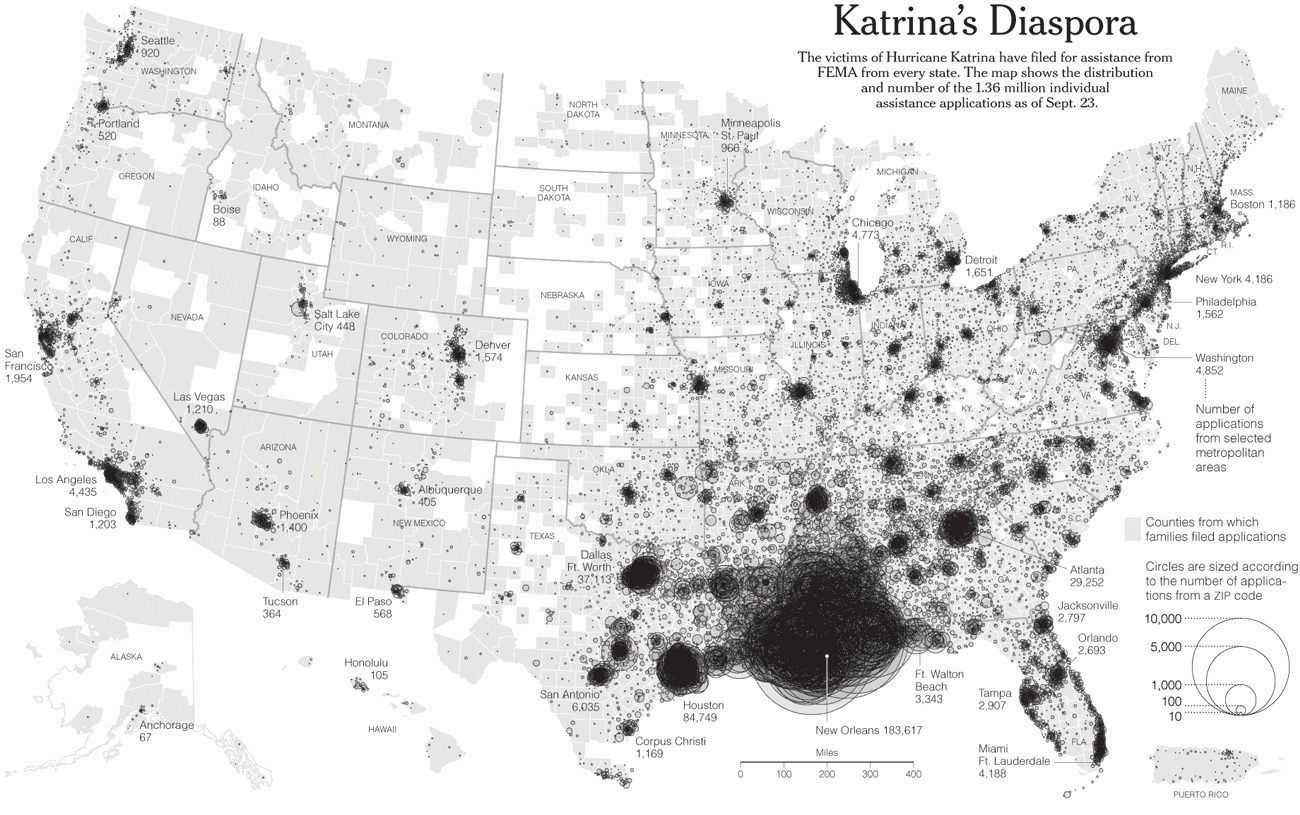
The New York Times, Katrina displacement as of 9/23/2005.
The New York Times, Katrina displacement as of 9/23/2005. Click for original.

The New Yorker recently featured several sociologists in a piece about what has happened to residents of New Orleans’s Lower Ninth Ward in the aftermath of Hurricane Katrina:

  • David Kirk, who studies neighborhood effects, focused on recidivism, or likelihood of ending up in prison again after release, based on whether individuals stayed in the same neighborhood or moved elsewhere. He found that those who returned to their former neighborhoods in New Orleans had a 60% recidivism rate compared to those who. While, historically African Americans have been more likely to move, often for economic mobility, since 1970 the pattern has flipped, and more African Americans tend to stay put.
  • Patrick Sharkey says that in recent decades white Americans more frequently engage in “contextual mobility,” or moves significant enough to change opportunities and circumstances. Instead of major moves, African-American families in urban areas tend to make more frequent, minor moves to places similar to their previous living arrangement.
  • According to Stefanie DeLuca, these moves are not voluntary. Rising rent, eviction, breakups, or changing in housing subsidies spark moves within the same areas—not the better schools or job opportunities that middle-class Americans cite as reasons to relocate.

Following the severe damage from Hurricane Katrina in 2005, going “home” wasn’t possible for many poor black families. As it turns out, those who had to leave found their new homes offered more opportunity:

  • Houston, Texas, has become a hot spot of upward mobility for those displaced by Katrina, Corina Graif found: “The fact that they were all of a sudden thrown out of that whirlpool gives them a chance to rethink what they do. It gives them a new option—a new metro area has more neighborhoods in better shape,” she says of the 700 mostly black women she tracked.

Sharkey cautions optimistic readers that relocation could become a game of cat and mouse. If too many poor people move into middle-class areas, the middle-class may move, taking some of the neighborhood’s higher resources and leaving new families in circumstances that mimic a minor move.

Looks like a practical type. Photo by Nic McPhee, Flickr Creative Commons.

“What’s your major?”

Often the reasons for choosing engineering or English extend beyond the student’s enthusiasm for the subject. Sociologist Kim Weeden explains to The Atlantic that parental income can play a part: students from wealthy families are more likely to study humanities and fine arts, while their lower-income peers tend to choose more “practical” majors like physics, engineering, or computer science. Weeden says:

It’s … consistent with the claim that kids from higher-earning families can afford to choose less vocational or instrumental majors, because they have more of a buffer against the risk of un- or under-employment.

In other words, if wealthy students cannot get lucrative jobs with a ceramics or history degree, they have a monetary safety net. NYU’s Dalton Conley elaborates:

It might seem like there’s a lot of social mobility that the offspring of doctors are artists, or what have you, but maybe they traded off occupational autonomy and freedom … They still have a high education level and they still have wealth.

Future employment is not the only explanation for why students from different income brackets choose their courses of study. Often, students from higher-income families have more prior exposure to arts, music, and literature, sparking an interest in these areas before college. Furthermore, according to Conley, the prestige of a major and its associated careers may matter more than the size of the actual paycheck:

There’s a notion that what people are maximizing is not income, per se, or wealth, per se, or prestige, per se, but just there’s a general sense of social class, and people in each generation make trade-offs.

A fine arts degree may have fewer career opportunities, but it also has an association with high socioeconomic status that a law enforcement degree does not.

Image by Ginny Washburne via FLickr CC


Most people think of sociology as marriage-neutral, or even anti-marriage because the institution has been linked to patriarchy, heteronormativity, domestic abuse, and a general suppression of women’s rights; however, the field has seen a shift toward a pro-marriage point of view (see, for instance, scholars like Andrew Cherlin). In the Boston Globe, Philip Cohen from University of Maryland College Park says, “Criticism of marriage as a social institution comes from the universal and basically compulsory system of marriage in the 1950s.” Since ‘50s-style marriage is no longer necessarily true, it makes sense to see an evolving scholarly outlook on the issue.

Those who say matrimony matters point to its advantages for low-income children. According to Sarah McLanahan, children with unmarried parents spend less time with their fathers and receive less financial support. Cherlin, for his part, says marriage, more so than cohabitation, contributes to family stability that leads to better child outcomes.

The evidence doesn’t necessarily mean that marriage causes the “good things” attributed to it, either. Yes, unmarried mothers tend to make less money than their married counterparts, but marriage thrives among the more educated. Those with college degrees wait longer to marry and have more resources to give their children. This means the specific people who marry make it look like married people have better outcomes, when usually they were privileged before exchanging vows. Putting a ring on it will not automatically make people healthier, wealthier, or wiser.

This disparity in findings and even recommendations about marriage points to an issue bigger than family values: “This class divide in marriage and family life is both cause and consequence of the growing inequality in American life,” said W. Bradford Wilcox, a sociologist at the University of Virginia and director of the National Marriage Project. Kristi Williams elaborates that economic circumstances can influence marriage, so trying to change marriage without fixing economic disparities is wrong-headed. Philip Cohen agrees, saying, “The idea that the culture is going downhill and we need a cultural revival happens to be very closely related to the idea that we should not address poor peoples’ problems by raising taxes and giving poor people money,” he said. “So there’s a political element” in marriage promotion efforts.

Photo by JD via Flickr. Click for original.


Parents often equate good parenting with spending as much time with their children as possible. The idea is that, in those hours, parents will cultivate particular characteristics in their children that will contribute to bright futures. But is helicopter parenting really worth it? Sociologists Melissa Milkie and Kei Nomaguchi share the findings of their recent study with the Washington Post: “I could literally show you 20 charts, and 19 of them would show no relationship between the amount of parents’ time and children’s outcomes. . . . Nada. Zippo,” says Milkie.

It’s not the number of hours, but quality of time spent together that matters. Interactive activities like reading to a child, sharing a meal, and talking one-on-one benefit kids, while just watching TV together may be detrimental, as Amy Hsin found. Still, Milkie and Nomaguchi’s study did find that teenagers who engaged with a parent for six hours per showed lower levels of delinquent behavior and drug use than peers who spent less time with their parents.

The authors dug deeper, finding that when a parent was overly-tired, stressed, cranky, or feeling guilty, spending time with their children could lead to more behavioral problems and lower math scores. Nomaguchi says, “Mothers’ stress, especially when mothers are stressed because of the juggling with work and trying to find time with kids, that may actually be affecting their kids poorly.” This particularly impacts parents from low-income households who often lack access to social resources for improving mental health, but still feel the pressure to be “good” parents by spending time with their children. In fact, Milkie and Nomaguchi found that the biggest indicators of child success were mothers’ income and education levels:

“If we’re really wanting to think about the bigger picture and ask, how would we support kids, our study suggests through social resources that help the parents in terms of supporting their mental health and socio-economic status. The sheer amount of time that we’ve been so focused on them doesn’t do much,” says Milkie.