
parenting

The Census Bureau recently released new data, “A Child’s Day: Living Arrangements, Nativity, and Family Transitions: 2011 (Selected Indicators of Child Well-Being),” that explores how widespread are selected parental practices that affect child well-being and how such practices vary by family types. Sandra Hofferth of the University of Maryland offers a summary of the main findings and commentary on their implications.

Parenting practices matter. Children’s long-term emotional and cognitive health is greatly affected by the daily rituals and rules of family life. Especially beneficial are the following parenting practices: reading to children; eating breakfast or dinner together as a family at least 5 out of 7 days in a week; having clear rules regarding television viewing; and facilitating children’s participation in extracurricular activities. A recent census report studies the prevalence of such parental involvement across different family types, comparing children under 18 living with two parents, a single parent, or a guardian.

Although most children – 63 percent – live with two married parents, 37 percent do not. Five percent live with two unmarried parents, 27.5 percent with a single parent, and 4.5 percent live with a guardian, according to this report. It is worth noting, moreover, that despite the preponderance of children living with two married parents at any one time, more than half of American children will spend some part of their childhood living in a household that does not include two biological parents who are married to each other. [i]

American parents are doing well on most of the parenting indicators covered in this report. Overall, fewer than 10 percent of children under age 6 were never read to last week. About half of 6-17 year olds ate breakfast with their family at least 5 days per week. Nine out of 10 parents of children under 12 had rules about television viewing. And one-fifth to two-fifths of all children participated in sports as an extracurricular activity.

Reading to (and talking with) children is an important way to make sure that children’s verbal skills develop appropriately and that they are ready for school. Focusing on the years immediately prior to school entry, the report shows that 54 percent of 3-5 year-old children living with married parents and a full half of 3-5 year-old children living with two unmarried parents were read to 7 days per week. Among children living with a single parent, that figure fell to 41 percent. But single parents reported reading to children aged 3-5 an average of 6 times a week, not dramatically less than the 6.8 times reported by married parents. (Another study has found that single mothers spend nearly an hour more time per day on solo child care than married mothers, despite working more hours outside the home. But that typically still does not produce enough total time to make up for the absence of a second care-giver or story-reader.[ii])

Pediatricians consistently recommend that parents monitor their children’s television viewing, including types of programs, hours watched, and total viewing time. Of children aged 6-11 living with two married parents, 93 percent have at least one such rule and 76 percent have all three types of rules, compared with 90 percent and 70 percent respectively of children living with a single parent.

Being placed in an advanced class in elementary school can enhance a child’s success in high school. Almost 13 percent of 6-11 year old children of married parents were enrolled in gifted classes, compared with 10.5 percent of children living with a single parent. Again the differences, though significant, are small.

Eating meals together allows kids and parents to talk about big issues and mundane things, like what the kids are working on in school. Phtoo by Katia Strieck via Flickr CC.
Eating meals together has nutritional benefits and gives kids space to share the events of their days with caring adults. Phtoo by Katia Strieck via Flickr CC.

Being held back in school can be a big disadvantage. Almost twice as many children living with one parent had ever repeated a grade as children living with two married parents. But the overall risk of this was low, with just 5.3 percent of 6-11 year-old children in a single-parent family ever repeating a grade, compared with 2.7 percent of children living with married parents.

Having routine mealtimes with the family has nutritional benefits and provides children an opportunity to share the events of the day with caring adults. Here we see little difference by family type, but a small advantage for children of single parents. Eating breakfast together with children aged 6-17 was a widespread practice that varied little by family structure. Eating dinner together was common at an early age but became less common among older children. A slightly higher proportion (35 percent) of 12-17 year old children living with a single parent reported eating dinner with a parent at least 5 days a week than children living with two married parents (32 percent).

This seeming advantage for children of single parent families may be a result of lower participation in the extracurricular activities that have been shown to contribute to better grades in high school and increased college enrollment. There is a trade-off between family dinner times and children’s extracurricular activities, which often extend into the family dinner hour, leading families to eat dinner in shifts. Teenage children of married parents are more likely than children of single parents to participate in extracurricular activities such as sports, lessons and clubs. For example, 44 percent of teenage children of married parents vs. 34 percent of teenage children of single parents participate in sports.

Children of cohabiting parents are more likely to be disadvantaged in both extracurricular activities and family dinners. Children living in two unmarried parent families had lower levels of participation in extracurricular activities (only 32 percent participated in sports, for example) and the lowest percentage of all groups who ate dinner with a parent. Just a quarter of these children (26 percent) ate family dinners 5 times a week or more. This is likely linked to the characteristics of unmarried cohabiting parents, who tend to be younger and less educated than single mothers.[iii] As a result, they are likely to be in occupations with less control over their work schedules.[iv]

The proportions of children eligible for free and reduced cost school lunch are one indicator of children living in poverty. Photo by DC Central Kitchen via Flickr CC.

Poverty is our most striking problem. What is most striking about this report is the high proportion of American children who are financially disadvantaged. Overall, more than one-fifth (22 percent) of children of all ages, and more than a quarter (26 percent) of children under age six, lived in families with incomes below the poverty line. Not surprisingly, children living with single parents are the most likely to be living in poverty. Almost 41 percent of such children are poor. Yet two parents do not guarantee economic security: An astounding 37.3 percent of children of two parents who live together but are not married to each other are in poverty, and almost 30 percent of children living with a guardian are poor. The poverty rate of children in married-couple families is much lower – 14 percent – but in terms of absolute numbers there are more married than unmarried parents living below the poverty line.

It should be noted that the poverty rate for children in the U.S. is the highest in the developed nations. In 2000, child poverty rates in Denmark, Finland, Norway and Sweden averaged 3 to 4 percent, Western European nations averaged 9 percent, and the UK averaged 15 percent. The U.S. had the highest child poverty rates, with 22 percent of children living in poverty.[v] This is not because of a higher proportion of children living with single parents in the U.S. but because the combination of tax and transfer policies do not lift low income earners and their families out of poverty as much as do other countries.

It is also important not to assume that getting single parents to marry would make these high poverty rates disappear. In many cases, parents do not marry because they are poor, rather than becoming poor because they are not married.[vi]

Given such large financial differences, it does not seem fair to compare the fraction of these different family types who engage in positive activities with children without adjusting for differences in their financial well-being. In earlier work, I have shown that many differences in outcomes between children in different family types disappear when the economic and demographic characteristics of the fathers and mothers (such as young age or low income) are taken into account.[vii]

Low-income kids are less likely to participate in extracurricular activities. Photo by Edward N. Johnson/U.S. Army.

The census report makes a major contribution by documenting differences in children’s involvement in extracurricular activities by the income of the household. Within each specified activity and across all family types, children whose family poverty sta­tus was 200 percent of poverty or higher had greater activity partici­pation levels than children living below poverty or those whose pov­erty status was 100 to 199 percent of poverty. For example, the extracurricular participation in sports of children in families at 200 percent or more of the poverty level is 42.5 percent, while the participation of those in poverty is 22.5 percent, a difference of 20 percentage points. The difference between children of two married parents and children with a single parent was only 10 percentage points (44 percent vs. 34 percent). Although having another parent in the household is important, having the resources to participate may be even more important.

In spite of living in what are difficult economic circumstances, the differences in these parenting behaviors between single parents, cohabiting unmarried parents, and married parents are comparatively small. If anything, the report documents the serious attention to parenting made by parents who are caring for children in difficult circumstances and highlights the importance of continuing to focus on improving economic and employment opportunities for parents and for guardians of young children. This is an especially urgent challenge for policy-makers today, because a report issued just this month shows that for the first time, a majority of public school children come from low-income families.[viii]

[i] https://www.americanprogress.org/issues/poverty/report/2015/01/12/104149/valuing-all-our-families/;

Laura Tach & Kathryn Edin (2013). The Compositional and Institutional Sources of Union Dissolution for Married

and Unmarried Parents in the United States, Demography 50, 1789-1818..

[ii] Ariel Kalil, Rebecca Ryan, and Eise Chor (2014). “Time Investments in Children Across Family Structures,” The ANNALS of the American Academy of Political and Social Science 654 (1) (2014): 150–168.

[iii] Hofferth, Sandra L. (2006). Residential father family type and child well-being: Investment versus selection. Demography 43(1), 53-77

[iv] Toby Parcel & Charles Mueller (1983). Occupational differentiation, prestige, and socioeconomic status. Work and Occupations 1:49-80.

[v] Smeeding, Timothy (2008). Poorer by Comparison: Poverty, work and public policy in comparative perspective. https://web.stanford.edu/group/scspi/_media/pdf/pathways/winter_2008/Smeeding.pdf.

[vi] understanding low- income unmarried couples with children

https://contemporaryfamilies.org/…/2008_Briefing_England_Unmarried- couples-with-children.pdf

[vii] Hofferth, Sandra L. (2006). Residential father family type and child well-being: Investment versus selection. Demography 43(1), 53-77.

[viii] http://www.southerneducation.org/Our-Strategies/Research-and-Publications/New-Majority-Diverse-Majority-Report-Series/A-New-Majority-2015-Update-Low-Income-Students-Now.
Sandra Hofferth is a professor of family science and director of the maternal and child health program at the University of Maryland.

This paper is part of the Council on Contemporary Families’ Online Symposium “New Inequalities.”.

Contrary to popular opinion, growing instability in American families, reflected not just in divorce rates but falling rates of marriage and high rates of unwed motherhood, is not caused by people abandoning traditional concerns for children’s well-being. It is a class issue caused by the growing gap between the job options, resources, economic stability, and personal safety nets available to college-educated Americans and less-educated workers. The authors explain.
–Stephanie Coontz

For the past two decades, countless media reports have claimed that we face a crisis in Americans’ commitment to their children, as falling rates of marriage, high divorce rates, and soaring numbers of non-marital births have affected millions of children. Contrary to popular opinion, this crisis is not caused by people abandoning traditional concerns for children’s well-being. It is a class crisis caused by the growing gap between the job options, resources, economic stability, and personal safety nets available to college-educated Americans and less-educated workers. more...

People often think of social change in the lives of American children since the 1950s as a movement in one direction – from children being raised in married, male-breadwinner families to a new norm of children being raised by working mothers, many of them unmarried. Instead, we can better understand this transformation as an explosion of diversity, a fanning out from a compact center along many different pathways.

The dramatic rearrangement of children’s living situations since the 1950s

At the end of the 1950s, if you chose 100 children under age 15 to represent all children, 65 would have been living in a family with married parents, with the father employed and the mother out of the labor force. Only 18 would have had married parents who were both employed. As for other types of family arrangements, you would find only one child in every 350 living with a never-married mother!

Today, among 100 representative children, just 22 live in a married male-breadwinner family, compared to 23 living with a single mother (only half of whom have ever been married). Seven out of every 100 live with a parent who cohabits with an unmarried partner (a category too rare for the Census Bureau to consider counting in 1960) and six with either a single father (3) or with grandparents but no parents (3).The single largest group of children – 34 – live with dual-earner married parents, but that largest group is only a third of the total, so that it is really impossible to point to a “typical” family.

With two-thirds of children being raised in male-breadwinner, married-couple families, it is understandable that people from the early 1960s considered such families to be the norm.* Today, by contrast, there is no single family arrangement that encompasses the majority of children. more...

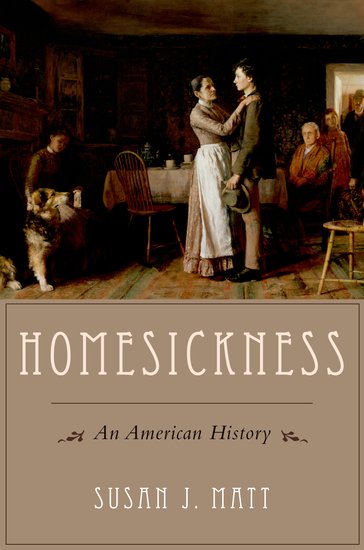
Susan J. Matt is author of Homesickness: An American History (Oxford University Press, 2011). She is Presidential Distinguished Professor and Chair of the History Department at Weber State University, in Ogden, Utah. She tweets at @alongingforhome.

Not long ago, The Onion ran an article with the headline “Unambitious Loser with Happy, Fulfilling Life Still Lives in Hometown.” The piece quoted a friend of the “loser,” who said, “I’ve known Mike my whole life and he’s a good guy, but it’s pretty pathetic that he’s still living on the same street he grew up on and experiencing a deep sense of personal satisfaction . . . .[H]e’s nearly 30 years old, living in the exact same town he was born in, working at the same small-time job, and is extremely contented in all aspects of his home and professional lives. It’s really sad.”

While the article was fiction, the attitudes it encapsulated were not. Americans disparage those overly attached to home. The homesick, boomerang kids, and tightly bonded families seem antithetical to American individualism. We are supposed to be a nation of restless movers who break ties to home with ease. When individuals stay in place, it contradicts our mythology. What is wrong with these people?homesickness

That’s a question being asked with increasing frequency about the rising generation, for nearly 22 percent of all adults in their 20s and 30s are living with their parents, the highest rate since the 1950s. And the media have not been kind to them: CBS News observed “… for many boomerang kids, living in a parent’s home becomes a crutch, enabling them to put off making grown-up decisions . . . .” Others have termed them the “Go-Nowhere Generation.”

The message is that staying home shows immaturity and a fatal lack of ambition. It is a sign of emotional neediness and dependence, traits widely stigmatized in American society. However, the expectation that individuals should leave home in their early 20s, and do so easily, is of recent vintage. Only in the last century did Americans come to see young adults who were emotionally close to kin and geographically rooted as psychologically immature and destined for economic failure.

In the nineteenth century, Americans believed that love for home was an ennobling emotion, evidence of a tender heart and a strong family life. Writers and preachers lavished praise on those who loved home, while physicians suggested that wandering too far from it could be fatal, for they believed people could die of acute homesickness.

In contrast, during the 20th century, as corporations and the military began to deploy people across the nation and the globe, strong attachments to family and place became a problem, obstacles to the smooth flow of capital and personnel. The love of home became an archaic emotion in a modern society dependent on a fungible, mobile workforce.

By mid-century, experts were arguing that tightly bonded families were out of place in America. Sociologist W. Lloyd Warner explained that because the economy required individuals to move frequently, “families cannot be too closely attached to their kindred. . . or they will be held to one location, socially and economically maladapted.” Those who tried to maintain strong kin ties were criticized. In 1951, psychiatrist Edward Strecker, preoccupied with the Cold War and the need for a mobile fighting force, accused American mothers of keeping their “children enwombed psychologically,” failing to “untie the emotional apron string . . . which binds her children to her.” He dubbed these women the nation’s “gravest menace.”

Today, we continue to believe young adults should leave home. When they don’t, their living choices are chalked up to poor employment prospects. While economic realities surely play a part in their residential choices, the media give short shrift to other motives. The idea that families might be drawn together by feelings of affection is left out of the equation, as is the possibility that this generation wants to become something other than mobile individualists. Yet there’s considerable evidence that millennials hold values that center more on family and less on high powered careers. A recent poll found them far less concerned with financial success than the population at large. They also are closer to their parents, whom they fight with less, and talk with more than earlier generations.

For decades we’ve assumed that leaving home in one’s early twenties is natural, a sign of healthy psychological adjustment; but we should remember such expectations are historically contingent. Today’s millennials remind us there are other ways of organizing family life than the model we’ve grown accustomed to, and prompt us to recognize that values other than individualistic, market-driven ones frequently motivate human behavior. We can learn from them that staying close to home does not make one an “unambitious loser.”


As colleges across the country begin the new school year, we hear a chorus of warnings about a generation of young adults unable or unwilling to “leave the nest.” Phrases are bandied about: “Failure to launch”; “the Peter Pan syndrome”; “boomerang kids” who can’t seem to leave home and establish an independent life. Undergirding these warnings is a fear that the younger generation is growing soft, losing the pioneer independence and rugged individualism that once built this nation.

But a glance at the past suggests it may not be the behavior of youths that has changed so much as the response by adults. Only over the past 90 years did American culture come to define young adults’ continued reliance on parental guidance and their longing to return home as a sign of psychological maladjustment. more...

My world of parenting involves sifting through countless listicles of advice, online images of children in trauma who are forced to grow up too fast, apps to manage kids’ crazy schedules, Vine videos of tiny tots singing “Let it Go” off key in the back of a minivan, and clever kidroom decorating tips on Pinterest. This is overwhelming, even for parents like me who have plenty of resources and time and education and other things that likely will enhance the life chances of my son. Parenting is hard for everyone, especially those who struggle to find work, make meals, or know where to look if they have questions about kids. Navigating the words and images and sheer volume of information on parenting out there makes it hard even for the people who have work, food, and people to turn to for help.

From Pixabay.
From Pixabay.

Many of us American parents who have the luxury of a laptop or a bookshelf may have catchy titles such as the following in our libraries and social media feeds:

More or Less: How to Raise Overscheduled Kids and Then Feel Guilty About It and Then Schedule Them in Fewer Activities but Then Add to Their Schedule to Keep Up with Other Parents Whose Kids Will Get Into a Good College

Quality Assurance: How to Use Your Professional Career Skills in Parenting, but Never Show Too Much of Your Family Self at Work for Fear of Being Labeled “Not a Committed Team Player”

Independence Days: How Not to Get Arrested for Letting Kids Do Things by Themselves That You Did When You Were a Kid

Americans are the Worst: How to Raise Your Kids Like French/Italian/Chinese/Swedish Parents Do, and Also How to Eat Like Them with Your Kids in Restaurants and Not Gain Weight

Sometimes I think parents, despite our valiant efforts to be the grown-ups in situations with our children, are more like toddlers with flailing appendages trying to learn what we should and should not fear. Trying to control a world that seems filled with tall and vocal experts and parenting peers whom we’re not sure we should trust. And tripping and hitting our heads on coffee tables every so often. While parents since the dawn of time have probably felt insecure about their abilities, we now swim in an especially large and public typhoon of confusing messages.

Does this typhoon of information make us better parents? Does it make is more assured that we are, in fact, the parents, and our children are, in fact, in need of parenting? More is not better, after all, and not just with regard to chocolate cake. Does the overload actually make us less sure of ourselves, more in need of comforting, less mature, and therefore more similar to the little creatures we are trying our hardest to raise? While our tendency to read a list of the latest habits of highly effective parents would place us squarely in the demographic category of “parent” (because who else would read that stuff?), could it also be that reading all of this actually makes us feel less parental?

Many smart people, from folks at the CDC to a long list of wonderful experts, have talked about this topic already in a myriad of other online and paper-type sources, and have even said that there are too many pieces of advice out there so we should be careful not to get overwhelmed (whoa, that’s very meta), but sometimes when it hits home it bears pondering again. My husband and I, when our son was a baby a decade ago, found ourselves amidst a circle of people who had the time and resources to read and recommend all sorts of books on babies. We, being people with time and resources and commitment to the use of big words whenever possible, read excerpts from the fluffy baby whisperer book and from the technical medical book, threw both out the window and improvised, and then returned to them three months later to realize we had done it pretty much the way the fluffy and medical experts had told us to do it in a perfect combination of both. Sometimes I think experts are just good at telling us what our guts would tell us to do anyway, but far more eloquently and for $12.95. Evidently my husband and I would rather buy advice than trust ourselves not to hit our heads on coffee tables.

I recently asked my mom, now in her 70s and an expert on parenting who has read every book out there since Dr. Spock, whether she thought the difference between the parent and child roles seemed wider between her and me than they are between me and my son. I asked her because she always seemed far more grown-up to me than I am currently acting with my kid. She never laughed when I farted at the dinner table, for example.

In this discussion, Mom and I figured that the answer to that question lies not in my penchant for scatological humor, nor in the amount of information available for parents today, but squarely in the fact that kids are often better than their parents at navigating the latest technology. Kids have long figured they knew more than their parents, and parents have long figured they need to ask for advice on what to do with these tiny creatures who appear in our lives, but now we parents have a hard time knowing which screen corners to swipe and in-app purchases to avoid to retrieve the good information. Ten years after my husband and I threw actual books out an actual window, the typhoon of advice can be read in every social media feed, app, and link on Buzzfeed. Not to mention in the 2nd editions of the fluffy and medical books, now available electronically if you can remember your Kindle password.

Kids are teaching us more than ever, at least about the means to get to the messages. I never taught my mom the steps on how to open a calendar without ripping the pages to mark down when I had piano lessons. She never needed to rely on my brothers to find out how to unfold the medical brochure on tetanus shots. There was no swiping involved in parenting then, at least not on a screen. She was the grown-up. I was the kid. But when our tiny tech expert offspring know more than we do about technology, we feel like the kids.

But despite our agreement that today’s generation gap seems narrower because of our technology-induced role reversals, I felt that my mom gave me more independence than I am giving my son. And isn’t independence part of being a grown-up? Wouldn’t that criterion be evidence of a narrower generation gap then versus now? What does it mean that my son has more skills on a smartphone than I do, but I could ride farther away on my purple banana-seat bike when I was his age? Who is more grown-up – the one who can navigate Map My Ride without accidentally buying porn or the one who can ride her bike alone to the swimming pool two miles away?

As for myself, I am considering two options for my next step as a parent. I could read all of the titles I mentioned earlier, once I find them online with my son’s help. Maybe the most apropos book we could find would be titled

Parenting in an Age of Irony: How My Kid Helped Me Responsibly Purchase Online Resources about How I Should Protect His Innocent and Developing Brain.

Or, rather than actually reading the myriad parenting columns, books, and online diatribes, I will ask my son to digitally catalog them in order from “Most Useful for How to Raise Me” to “Meh, You Can Delete This from Your Cache,” and then make the catalog into a smartphone app that will not accidentally make me buy porn.

Surely his technological prowess will prepare him well for deciphering what is and is not useful information.

But only if he does his deciphering within a one-block radius of our house, so I can keep an eye on him.

Ever since winning third place in a rural Minnesota district high school speech contest with her rendering of an excerpt from Scandinavian Humor and Other Myths, Michelle Janning has attempted to add humor to all academic pursuits, including the sociological discovery of everyday life patterns. She is a sociology professor at Whitman College, and a Senior Scholar with the Council on Contemporary Families. Her website and blog, with a humorous focus on the “between-ness” of social life, is at michellejanning.com.

National surveys and other studies continuously tell us that work is a major source of stress for Americans. A 2005 Work and Families Institute study found that almost 90 percent of workers felt they either never had enough time in the day to do their job or that their job required them to work very hard. A Pew Report from 2013 found that more than half of all working moms and working dads experience work-family conflict. One-third of working moms and dads feel rushed on work-days, and almost 50 percent of working dads (and 25 percent of working moms) say they don’t have enough time with their children. And in a recently completed research project I helped conduct, we found that people report feeling less stressed out on non-work days than on work-days. Home, most of us believe, is where we recover from the stress of the work day. more...

Photo by AlisaRyan via Flickr CC.

Everybody loves to talk about stress—including work/family aka work/life balance stress. But it is a tricky topic that can bring casual listeners to the conclusion that something like stress—that is experienced as personally as enhanced heart rates or elevated cortisol levels—must require personal solutions. Sociology points in another direction.

To wit, recently the Council on Contemporary Families shared a briefing report from Penn State sociologist Sarah Damaske about research she and colleagues conducted that showed that working people have higher cortisol levels at home than at work. Though stress is experienced in the body, it is ultimately about context, about policy, not about individual character or family-values sentimentality. more...