
parenting

This recent coverage of family friendly policies and men in academia made us want to look again at Erin Anderson’s post from earlier this year.

Something at work can make choices related to this hard. Image from Pixabay.

U.S. fathers are eager to be more involved in the care of their infants and young children—per much research and many people’s personal accounts. The New York Times recently reported on men who have pursued legal action against their employers as a challenge to discriminatory policies and practices that prevent or limit the time they have available to utilize parental leave. Additionally, a recent survey of American fathers found an overwhelming majority, 89 percent, rated paid parental leave provided by an employer as an important workplace benefit. But consider this: there is also significant evidence that men are not likely to use parental leave, even when it is paid.

Because the leave mandated by the 1993 Family and Medical Leave Act is unpaid (and simply unavailable to many Americans), many fathers can’t use it due to financial constraints. If paternity leave was paid, and resulted in no lost income, would men be more likely to take it? In our current economic climate, the answer is not so clear. My recent research on men in academia reveals that many fathers are uninterested, hesitant, or fearful that if they step away from their workplaces for most or all of the 15 weeks their employer offers in parental leave, their careers will suffer.

Some people think that academic institutions are paragons of research, discovery, and innovation that would, of course, be on the leading edge of progressive policies that would allow employees to balance the needs of work and family. This, however, is not the case. Few colleges and universities offer paid leave for mothers that doesn’t require the use of sick or vacation time to cover lost wages, and many schools actually violate federal law with their parental leave policies. Fewer still extend parental leave benefits to fathers. Furthermore, the tenure process puts pressure on young faculty, those who might be looking simultaneously at the tenure clock and their biological clocks. And the vulnerability of some staff positions or the demands on administrators means they are also not likely to take any extended leaves for the birth or adoption of a child.

Originally impressed by the decade long policy of gender neutral parental leave at the institution I recently studied, I ultimately found that policy and practices were seldom in alignment. Through interviews with men, both faculty and staff, employed in higher education within an institution with a generous parental leave policy, I learned that the opinions of colleagues and the needs of co-workers often took precedence over the wishes of a spouse and the needs of a new baby. In general, the men I interviewed still defined a significant part of their family role as that of provider, regardless of their partner’s employment status. Even though a policy of parental leave existed, and even though many of the women with whom they worked had utilized the leave, many fathers worried about the future consequences for their careers if they took any significant time out for parenting. Would co-workers resent them for taking the time off and possibly burdening colleagues with additional responsibilities? Would supervisors question their commitment to their careers or the institution? Would they lose future opportunities or rewards in their workplace if they took parental leave?

Without a doubt, we need more realistic and generous policies that allow workers, men and women, to meet the needs of their families and their workplaces. But people also need to use the policies that are available. The fact that this workplace offered a policy, but few men felt they could use it without suffering consequences, demonstrates the power of the workplace culture and the resistance many employees feel to rocking the boat, especially following a period of economic tumult. Moreover, when it is largely women who utilize parental leave, we reinforce gendered patterns of care work and continue to disadvantage women in the workplace.

These and other issues related to the individual and institutional factors that influence combining paid work and care work in academia are examined more closely in a collection I recently co-edited with Catherine Richards Solomon, Family Friendly Policies and Practices in Academe.

Erin K. Anderson is Assistant Professor of Sociology at Washington College. Her research focuses on the experiences of gender at individual, interactional, and institutional levels. Her most recent work appears in Family Friendly Policies and Practices in Academe.
finding time book coverFamilies at all levels of income are struggling in our economy simply because it does not allow congenial coexistence of work and family life. Lives have become busier and busier and policies have not changed to reflect that. In her book, Finding Time: The Economics of Work-Life Conflict (Harvard University Press), Heather Boushey thoughtfully and comprehensively explains the problems with work-life conflict for women. Her book presents a set of solutions, too, that could make work-life conflict a thing of the past. While the story leads with the tale of what happens to women, Boushey takes the very issues that working women with families face and shows how these dilemmas are not about being a woman, they are about economics, and are shackling our entire economy. A valuable contribution is her portrait of contrasting work-life conflicts across income groups and family composition. She uses data as a skilled economist—which is her discipline—yet builds sensitively from history and social theory in a compelling book. Ultimately, her grounded arguments deliver detailed explanations as to why family policy needs to change and change quickly. Boushey, who is Executive Director and Chief Economist at the Washington Center for Equitable Growth, has decades of work bringing careful research to bear on key policy issues—and is successful at making the research and policy issues understandable to people who are really affected by the policies.
DUAL EARNING FAMILY DEPENDENCE

Boushey sets the table with locating economics in social context. The deal with capitalism is that by design the economy is ever-changing. Since the 1970s it has become heavily dependent upon women’s earnings. Families can no longer get by on the earnings of just one parent as they could before around 1979. So if our economy is so dependent upon a dual income family, then why aren’t there policies that support families’ need to manage work and family care? In Boushey’s words: “The hodgepodge of work and family policies that has evolved over the years does not address how people can have the time to deal with conflicts between work and home life” (p. 250). Finding Time explains the factors that determine what needs to change and how that change can happen.

COMPOSITION OF THE FAMILY IS CHANGING

The composition of families, Boushey reminds readers, are a lot different now than they used to be. While in the past families typically consisted of a mother, a father, and children, families now are more complex and could be classified in a burgeoning array. Single parent families make up about 27 percent of families today, for example. While in the past families could survive off of one parent being the breadwinner, that is nearly impossible now, especially for single parent families. She explains that single parent families are more likely to be low-income than families that have two (married) parents. Where are U.S. policies that make single-parent families able to thrive? Yes, they are already at a disadvantage with only one income, but policies that work will empower single parents to earn money and do the carework, which are two key things parents need to do.

WHO WILL BE THE “SILENT PARTNER” NOW?

Boushey makes a great point when she explains that women have always been the “silent partner” to businesses. Starting with the 19th century “family wage” and ending somewhere after the 1950s boom, men could go to work and not have to worry about their family because they knew their wives would be taking care of it. Businesses never had to take family into account because men never had to worry about theirs. In Boushey’s phrase, women were the “silent partners” to business. However, now that women’s incomes are key to family survival, the country is still not doing anything to lessen the burden of the work-family conflicts. Meanwhile, businesses reap benefits from having more capable workers in a larger labor pool, for whom wages are stagnant.

HOW CAN WE BE HERE, THERE, PROVIDE CARE, AND MAKE SURE ITS FAIR?

Women do not have a “silent partner.” But Boushey has a recommendation to fix this. She found that there is not one sure-fire way to fix the work-life conflict that families are facing. She argues that we need solutions in four areas that she calls Here, There, Care, and Fair.

Here: Policies for when women need to be Here (in the home). These policies include paid sick leave for medical needs and other time that would need to be spent with children.

There: Policies to make sure that the amount of hours that women are working leaves room for managing their family so that they do not always need to be There (at work).

Care: Policies regarding high-quality Care for children and aging family members.

Fair: Overall, policies need to be fair for everyone. This means that no matter what your income or familial composition is, you are still afforded the same work-family policies and no added responsibilities should hinder that.

Not only would adding this support make it less stressful for families to balance work and life, but such supports decrease costly turnover rates and increase productivity.

FINAL THOUGHTS

Women (and men!) need family policy as our silent partner to help us provide for our families. The “family policy” men had in the past was a housewife—and this policy is out of date. The economy has grown with the growth of women’s participation in the work force. It is time, Boushey demonstrates, that this growth should extend to benefits for women and their familial responsibilities.

This book was a great read. Along with clear explanations of economic concepts, Boushey uses her personal experience growing up in a working-class, union family in Washington State along with her knowledge of economics and history to show that to grow our economy and bring us out of the doldrums, working women need family-friendly policies. As a young woman looking ahead to a life of work-life conflict, I gained clarity and direction for my own work. Work-life conflict is a topic that needs recognition and Boushey is helping to spread knowledge and awareness. Boushey’s book still left me wondering how race may factor into this work-life conflict, maybe in a future addition we will be given some insight!

Molly McNulty is a CCF public affairs intern at Framingham State University. She is a senior Sociology and Education major.

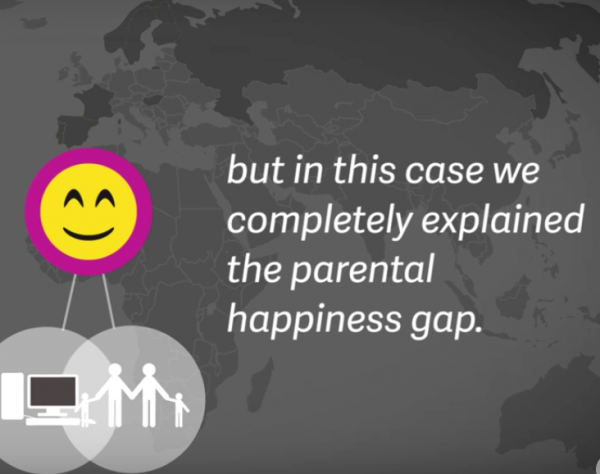
Happiness Gap Findings Screenshot

A briefing paper prepared for the Council on Contemporary Families by Jennifer Glass, University of Texas; Robin Simon, Wake Forest University; and Matthew Andersson, Baylor University

June 16, 2016

Many people now know that parents in the United States report being less happy than nonparents, but there is considerable disagreement about why parents pay a “happiness penalty,” along with conflicting reports about whether this is true in most contemporary cultures. To explore these questions, our team, with support from the National Science Foundation, examined comparative data from 22 European and English-speaking countries. We utilized two well-respected surveys (the International Social Surveys of 2007 and 2008 and the European Social Surveys of 2006 and 2008), confining ourselves to data prior to the global recession in order to avoid confusing reports of happiness in a period of relative prosperity with reports taken in a period of economic stress.

The good news is that parents are not doomed to be unhappier than non-parents. Our results indicate that the parental “happiness penalty” varies substantially from country to country, and is not an inevitable accompaniment of contemporary family life. In fact, in some countries, such as Norway and Hungary, parents are actually happier than non-parents!

The bad news is that of the 22 countries we studied, the U.S. has the largest happiness shortfall among parents compared to nonparents, significantly larger than the gap found in Great Britain and Australia.

But why are parents so much less happy than the childfree in the U.S., when other countries show different patterns? This is a somewhat complicated question to answer because of cultural differences in people’s definitions, standards, and self-reports of happiness. People in the U.S. tend to say they are pretty happy overall: On a scale from 1-10, Americans hover in the 8-10 range. People in France tend to rate their levels significantly lower – in the middle of the scale from 5-7. We aren’t sure if this means the French are truly less happy than Americans, or just don’t think it is appropriate to use the extremes of any scale.

Accordingly, we focused on the differences between parents and nonparents in the same country, or the relative effects of parenting. What factors are associated with parents being less happy than nonparents, given their country’s overall average level of happiness? Is it levels of unplanned parenthood or perhaps larger overall family sizes that depress parental happiness? Perhaps countries with more unexpected births and larger families end up with more parents who are unhappy and stressed-out. We checked out this hypothesis, but our data revealed that these factors were relatively unimportant in understanding why parents are less happy than childfree individuals in many countries.

So maybe parental happiness gaps are related to the differing costs — in time, money, and energy — of raising children in the countries we studied. We looked at several specific government policies that we thought would make a difference in the lives of employed parents – the duration and generosity of paid parenting leave, the number of annual paid sick and vacation days guaranteed by law, the cost of child care for the average two-year old as a percent of median wages, and the extent of work schedule flexibility offered to parents of dependent children. We also constructed a summary policy measure, combining all these, to differentiate countries with good parental policy “packages” from countries with weak parental policy “packages.” We gathered this policy information for all 22 of our countries, along with their Gross Domestic Product and their fertility rate, to make sure that our findings were not simply reflecting the effects of living in a richer country versus a poorer one.

What we found was astonishing. The negative effects of parenthood on happiness were entirely explained by the presence or absence of social policies allowing parents to better combine paid work with family obligations. And this was true for both mothers and fathers. Countries with better family policy “packages” had no happiness gap between parents and nonparents.

Furthermore, the positive effects of good family support policies for parents were not achieved at the expense of nonparents, as some commentators have claimed might be the case. The policies that helped parents the most were policies that also improved the happiness of everyone in that country, whether they had children or not. Policies such as guaranteed minimum paid sick and vacation days make everyone happier, but they had an extra happiness bonus for parents of minor children.

The same pattern held even for policies such as subsidized child care, which one might assume would only benefit parents. Countries with cheaper out-of-pocket costs for child care had happier nonparents as well as parents.

Another striking finding was that giving money to parents in the form of child allowances or monthly payments had less effect on parental happiness than giving them the tools to combine employment with parenting. Many European countries have child allowances in varying amounts, but few of these policies had a significant impact on the relative happiness of mothers or fathers compared to nonparents.

There were a few differences in what increased the happiness of fathers compared to mothers. Fathers’ happiness was slightly more sensitive to money policies (child care costs, specifically), and mothers’ happiness was slightly more sensitive to time policies (especially paid sick and vacation days). But these differences were minor. The most important predictor of higher relative levels of happiness for parents was the presence of family policies making it less stressful and less costly combine childrearing with paid work. And such policies seemed to increase the happiness level of childless individuals as well.

Jennifer Glass is the executive director of the Council on Contemporary Families. She is in the department of sociology and the Population Research Center at the University of Texas, Austin. Robin Simon is in the sociology department at Wake Forest University, and Matthew Anderson is in the sociology department at Baylor University. For comment, please contact Dr. Glass at 319-621-6304.

Before you tell your intimate partners, “It’s not you, it’s me,” take a look at the media reactions to two new reports from the Council on Contemporary Families released this month, one on parenting the other on sex, and both relating to policy.

Journalists at several outlets including New York Times, Chicago Tribune, and AlterNet reported that there was a reason—that didn’t justify blaming parents—to explain the “happiness gap,” or the fact that parents in the United States, particularly when compared to parents in other countries, were less happy than non-parents. According to CCF expert Jennifer Glass, “The negative effects of parenthood on happiness were entirely explained by the presence or absence of social policies allowing parents to better combine paid work with family obligations. And this was true for both mothers and fathers. Countries with better family policy ‘packages’ had no happiness gap between parents and non-parents.” Boston Globe writer Duggan Arnette identified “paid sick and vacation leave, child care costs, and work schedule flexibility,” or lack thereof, as specific factors that were shown to influence the “happiness gap.”

Yet the happiness gap is not a universal problem, and some countries have addressed it. Quartz journalists Solana Pyne and Michael Tabb created a video that compares the United States to 22 other countries in terms of parent and non-parent happiness, as well as the availability of various kinds of social supports. The narrator says that “if you’re a working parent,” the reason for the happiness gap “is basically what you’d think.” The happiness gap will seem less inevitable, and its solutions more achievable, however, after seeing visuals comparing the presence of specific policies in countries in which parents are just as happy, if not happier than non-parents, with the absence of those policies in the United States, where the happiness gap is the largest.

What about romantic relationships? Emma Lousie-Pritchard of Cosmopolitan UK reported that, “To have more sex, couples have to agree to this one, brilliant rule.” That rule is dividing household work equally between men and women. CCF expert Sharon Sassler reported that couples in which men did between one-third and 65% of the housework tended to have more frequent sex. As personal as this sounds, though, there are still policy implications in that progressive work-family policies are a twofer: they are both family-friendly and promote equality in couples.

The notion of the policy twofer was made by Fusion’s Jennifer Gerson Uffalussy. She cited a Department of Labor report to connect Glass and colleagues’ findings on parental happiness with couples’ relationship satisfaction: “families with fathers who take more leave also share chores and childcare more equally between mothers and fathers. So paid leave and equitable paternity leave policies not only give dads the time to be parents, but cause a trickle-down effect of creating greater gender equity.”

Taking turns and “get[ting] out the toilet bleach and your sexiest pair of rubber gloves” might be good relationship advice, but improved work-family policies will make it easier for couples to do so equitably, and still have the time and money to spend with their children.

Read the full reports here:

“Parenting and Happiness in 22 Countries,” by Jennifer Glass, Robin Simon, and Matthew Andersson.

“A Reversal in Predictors of Sexual Frequency and Satisfaction in Marriage,” Sharon Sassler.

Braxton Jones is a graduate student in sociology at the University of New Hampshire, and serves as a CCF’s Graduate Research and Public Affairs Scholar.

via pixabay / Gerd Altman aka geralt

Media have tended to depict childfree people negatively, likening the decision not to have children to the decision “whether to have pizza or Indian for dinner.” Misperceptions about those who do not have children have serious weight, given that 15 percent of women, and 24 percent of men had not had children by age 40 between 2006 and 2010, and that nearly half of women aged 40-44 in 2002 were what Amy Blackstone and Mahala Dyer Stewart refer to as childfree, or purposefully not intending to have children. Their forthcoming July 2016 article in The Family Journal, “There’s More Thinking to Decide”: How the Childfree Decide Not to Parent, engages the topic of childfree that extends much scholarly and public work Blackstone has done, including at her shared blog, We’re Not Having a Baby.

When researchers explore why people do not have children, they find that these reasons are strikingly similar to reasons why people do have children. For example, “motivation to develop or maintain meaningful relationships” is a reason that some people have children–and a reason that others do not. Scholars are less certain on how people come to the decision to to be childfree. In their new article, Blackstone and Stewart find that, as is often the case with media portrayals of contemporary families, descriptions of how people come to the decision to be childfree have been oversimplified. People who are childfree put a significant amount of thought into the formation of their families, as they report.

Blackstone and Stewart conducted semi-structured interviews with 21 women and 10 men, with an average age of 34, who are intentionally childfree. After several coding sessions, Blackstone and Stewart identified 18 distinct themes that described some aspect of decision-making with regard to living childfree. Ultimately, the authors concluded that being childfree was a conscious decision that arose through a process. These patterns were reported by both men and women respondents, but in slightly different ways.

Childfree as a conscious decision

All but two of the participants emphasized that their decision to be childfree was made consciously. One respondent captured the overarching message:

People who have decided not to have kids arguably have been more thoughtful than those who decided to have kids. It’s deliberate, it’s respectful, ethical, and it’s a real honest, good, fair, and, for many people, right decision.

There were gender differences in the motives for these decisions. Women were more likely to make the decision based on concern for others: some thought that the world was a tough place for children today, and some did not want to contribute to overpopulation and environmental degradation. In contrast, men more often made the decision to live childfree “after giving careful and deliberate thought to the potential consequences of parenting for their own, everyday lives, habits, and activities and what they would be giving up were they to become parents.”

Childfree as a process

Contrary to misconceptions that the decision to be childfree is a “snap” decision, Blackstone and Stewart note that respondents conceptualized their childfree lifestyle as “a working decision” that developed over time. Many respondents had desired to live childfree since they were young; others began the process of deciding to be childfree when they witnessed their siblings and peers raising children. Despite some concrete milestones in the process of deciding to be childfree, respondents emphasized that it was not one experience alone that sustained the decision. One respondent said, “I did sort of take my temperature every five, six, years to make sure I didn’t want them.” Though both women and men described their childfree lifestyle as a “working decision,” women were more likely to include their partners in that decision-making process by talking about the decision, while men were more likely to make the decision independently.

Blackstone and Stewart conclude by asking, “What might childfree families teach us about alternative approaches to ‘doing’ marriage and family?” The present research suggests that childfree people challenge what is often an unquestioned life sequence by consistently considering the impact that children would have on their own lives as well as the lives of their family, friends, and communities. One respondent reflected positively on childfree people’s thought process: ‘‘I wish more people thought about thinking about it… I mean I wish it were normal to decide whether or not you were going to have children.’’

Braxton Jones is a graduate student in sociology at the University of New Hampshire, and serves as a CCF Graduate Research and Public Affairs Scholar.

Graffiti/Paris/July 2012. Credit: John Schmitt

I work with one of the most heartbroken groups of people in the world: fathers whose adult children want nothing to do with them. While every day has its challenges, Father’s Day—with its parade of families and feel-good ads—makes it especially difficult for these Dads to avoid the feelings of shame, guilt and regret always lurking just beyond the reach of that well-practiced compartmentalization. Like birthdays, and other holidays, Father’s Day creates the wish, hope, or prayer that maybe today, please today, let me hear something, anything from my kid.

Many of these men are not only fathers but grandfathers who were once an intimate part of their grandchildren’s lives. Or, more tragically, they discovered they were grandfathers through a Facebook page, if they hadn’t yet been blocked. Or, they learn from an unwitting relative bearing excited congratulations, now surprised by the look of grief and shock that greets the newly announced grandfather. Hmm, what did I do with those cigars I put aside for this occasion?

And it’s not just being involved as a grandfather that gets denied. The estrangement may foreclose the opportunity to celebrate other developmental milestones he always assumed he’d attend, such as college graduations, engagement parties, or weddings. Maybe he was invited to the wedding but told he wouldn’t get to walk his daughter down the aisle because that privilege was being reserved for her father-in-law whom she’s decided is a much better father than he ever was.

Most people assume that a Dad would have to do something pretty terrible to make an adult child not want to have contact. My clinical experience working with estranged parents doesn’t bear this out. While those cases clearly exist, many parents get cut out as a result of the child needing to feel more independent and less enmeshed with the parent or parents. A not insignificant number of estrangements are influenced by a troubled or compelling son-in-law or daughter-in-law. Sometimes a parent’s divorce creates the opportunity for one parent to negatively influence the child against the other parent, or introduce people who compete for the parent’s love, attention or resources. In a highly individualistic culture such as ours, divorce may cause the child to view a parent more as an individual with relative strengths and weaknesses rather than a family unit of which they’re a part.

Little binds adult children to their parents today beyond whether or not the adult child wants that relationship. And a not insignificant number decide that they don’t.

While my clinical work hasn’t shown fathers to be more vulnerable to estrangement than mothers, they do seem to be more at risk of a lower level of investment from their adult children. A recent Pew survey found that women more commonly say their grown children turn to them for emotional support while men more commonly say this “hardly ever” or “never” occurs. This same study reported that half of adults say they are closer with their mothers, while only 15 percent say they are closer with their fathers.

So, yes, let’s take a moment to celebrate fathers everywhere. And another to feel empathy for those Dads who won’t have any contact with their child on Father’s Day.

Or any other day.

Josh Coleman is former Co-Chair, Council on Contemporary Families, and author most recently of When Parents Hurt.

A new study of Quebec’s recent non-transferable parental leave for fathers demonstrates just how effective this generous benefit is in getting fathers more involved at home. With new benefits, fathers increased their participation in parental leave by 250 percent. In households where men were given the opportunity to use this benefit, fathers’ daily time in household work was 23 percent higher, long after the leave period ended. Background and details of economist Ankita Patnaik’s innovative study are provided in this briefing report, prepared for CCF.

This briefing is based on a study by Dr. Ankita Patnaik. The original paper is available here and is forthcoming in the Journal of Labor Economics. This research was funded by Cornell University.

more...

Photo via VelvetTangerine, Flickr CC.

One of the consistent findings of sociological research in recent decades has been that couples who had a child before getting married had substantially higher odds of divorcing than couples who married first. This held true even when researchers controlled for other factors that tend to distinguish such couples from those who marry directly—education, family background, race and ethnicity. But considering the tremendous increase in premarital cohabitation and childbearing over the past quarter century, and in light of new evidence that many other longstanding “laws” of marriage and divorce have been overturned (e.g., see “It’s Not Just Attitudes: Marriage Is Also Becoming More Egalitarian”; Are Individuals Who Marry at an Older Age Too Set in Their Ways to Make Their Marriages Work?), we set out to investigate whether this particular sociological “rule” still applies. more...

the way we never wereAnother Quarter Century of Family Change and Diversity

Editor’s note: In 1992—the year the U.S. presidential campaign erupted into a culture war over family values—Stephanie Coontz published The Way We Never Were: American Families and the Nostalgia Trap. The title itself offered the pithy concept, and the book demonstrated that diversity and change have always been hallmarks of American family life: “Leave It to Beaver” was not a documentary. This week (March 29, 2016) Coontz released a substantially revised and updated edition of The Way We Never Were. Below, she provides a brief review of ten things that have changed for the better in the past quarter century, three that have stayed the same, and two that have gotten worse.

In 1992, political leaders and pundits were predicting that changes in family forms and gender roles were leading America into disaster. Were they right? 

  1. Whatever happened to the Super Predators? In the early 1990s criminologists were predicting “a blood bath of violence” unleashed by “tens of thousands of severely morally impoverished juvenile super-predators” – all supposedly a result of rising rates of unwed births. But between 1993 and 2010, sexual assaults and intimate partner violence reported dropped by more than 60 percent. According to the FBI’s Uniform Crime Reporting Statistics, the murder rate in 2013 was lower than at any time since the records began in 1960. Since 1994, juvenile crime rates have plummeted by more than 60 percent, even though the proportion of children born out of wedlock has risen to 40 percent.
  1. How about crack babies? In the 1980s and 1990s, newspapers headlined an epidemic of “crack babies” in the inner city, with kids permanently damaged by their mothers’ use of crack cocaine during pregnancy. This led to a wave of punitive legal actions against such women. But follow-up studies have since revealed that children from the same high-poverty areas who had not been exposed to cocaine in utero were equally likely to have developmental and intellectual delays as babies born with cocaine in their systems. As I documented in The Way We Never Were, the big risk to these children was the pollution, violence, and chronic stress of deeply impoverished and neglected communities – including lead poisoning damage that was going on for years before it hit the headlines in 2016 because of the disaster in Flint.
  1. Did career women start “out-sourcing” their children’s developmental care? As women gained more high prestige jobs in the late 1990s, that’s what many experts feared. In fact, however, even as mothers’ work hours increased, their child-care hours increased too, while fathers’ child-care time tripled. Today, both single and working moms spend more time with their children than married homemaker mothers did back in 1965.

more...

Via Pixabay CC.
Via Pixabay CC.

A January Huffington Post article reported on a recent study that showed that 43.5 percent of single mothers get fewer than seven hours of sleep, and 52 percent wake up feeling unrested. Kristi Williams, sociologist and senior scholar for the Council on Contemporary Families raised some good questions for HuffPo readers. In the reporter’s words, Williams noted that “the study doesn’t actually show whether single parenthood causes sleep problems. Because single parenthood is also concentrated among poor and racial minority groups, it’s hard to tell whether being a single parent, being poor or being part of a certain minority group is a stronger factor in poor sleep and poor health.” Williams put it succinctly: “Family policy is health policy.” more...