parenting

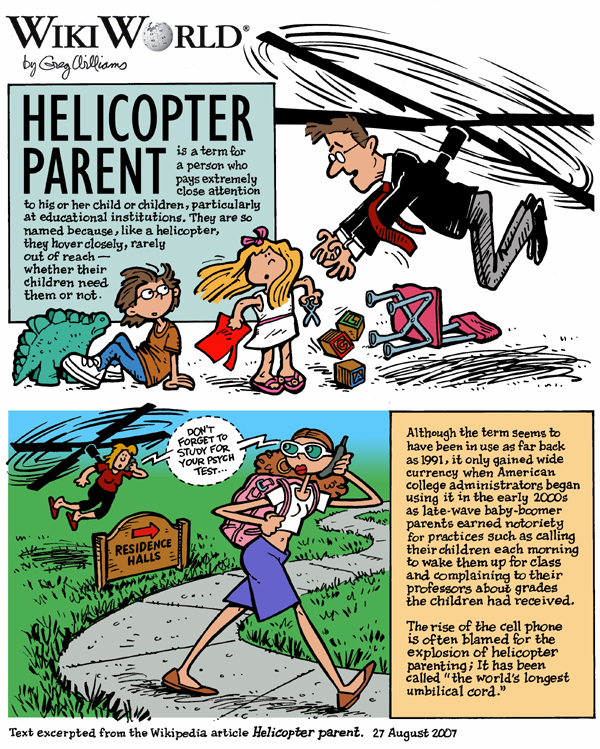
A cartoon by Greg Williams, Flickr CC. Click to expand. Original: https://flic.kr/p/2Tipvn.

Looking for some perspectives on parenting? Here are a few articles to revisit.

In January, Sandra Hofferth presented to CCF a briefing report on Child-Rearing Norms and Practices in Contemporary American Families. Hofferth, Professor, Family Science, at University of Maryland’s School of Public Health, notes that although a recent Census Report had found some differences by family type, most American parents—married, divorced, or single—read to their children, monitor their children’s media youth, and engage their children in extra-curricular activities. Revisit Hofferth’s report here for how parents are doing, by the numbers.

In August, Michelle Janning, a sociologist at Whitman College and CCF Co-Chair, shared a three-part series on parenting: her interest was in overparenting and cross cultural metaphors.

Overprotective Parenting, Back-to-School Edition

American Helicopters, Danish Curling Brooms, and British Lawnmowers

Anxiety, Social Class, and a Gallery of Parenting Advice

Virginia Rutter is a sociologist at Framingham State University, a board member of the Council on Contemporary Families, and a regular contributor to both Girl w/ Pen! and Families As They Really Are.

Photo by Chris Hunkeler, Flickr CC.

August 26 was Women’s Equality Day. Established in 1971, the day commemorates passage of the 19th Amendment, which gave women the right to vote. But political equality did not begin to extend to economic equality or marital equality until the 1970s, despite passage of the Civil Rights and Equal Pay Acts in the mid-1960s. As late as 1975, women earned only 60 cents for every dollar a man earned, and no state had yet repealed the laws that gave a man immunity from raping his wife.

Since then, women’s progress in upward occupational mobility and earnings has been dramatic. Dual-earner marriages are now the norm, women now outpace men in educational achievement, and growing numbers of wives out-earn their husbands.

For many years, however, women’s gains seemed to destabilize marriages and threaten family formation. As women entered the workforce, marriage rates fell and divorce rates soared. Fertility plummeted, and policy-makers worried that career-oriented women were turning their backs on motherhood entirely. Some early studies suggested that when wives got their husbands to do housework, they were more likely to get beaten up (Fuchs 1988), or at the very least, to have less happy sex lives.

Many of these developments, however, were products of a transitional period of adjustment, especially marked in the 1970s and 1980s, when women embraced gender equality more quickly than did men and experienced widespread discontent with the persistence of traditional marriage and family arrangements.

The gender revolution is nowhere complete, but there is now evidence that the further progress of the gender revolution is in many cases resulting in a certain restabilization of family life.

  • In the US and many other countries, divorce rates have fallen among couples who express the greatest support for gender equality. Women’s higher education and earnings now seem to help rather than hurt their marriage chances.
  • In Sweden, women with a high career orientation are now more likely to enter a union than other women (Thomson and Bernhardt 2010). And in other countries with strong work-family support systems (Finland and Norway as well as Sweden), dual-earner marriages are now less likely to divorce than male breadwinner ones (Cooke et al 2013).
  • In US marriages formed in the early 1990s and since, couples who share housework report higher marital quality and better sexual relationships than those with a more traditional division of labor. And even among older men (ages 51-92) those with egalitarian gender role attitudes report much higher levels of marital happiness than otherwise comparable men with traditional attitudes (Kaufman 2006).
Photo by Anne Worner, Flickr CC.

Men’s increasing involvement in child care and housework (Sullivan, et al. 2014) seems to be critical here.

  • An analysis of 13 industrialized countries (Sevilla-Sanz 2010) found that men with more egalitarian attitudes were more likely to form a romantic union and particularly to cohabit than men with less egalitarian attitudes.
  • Among cohabitors, men who were involved in the care of their children (providing care when the mother was absent, taking children to daycare and medical appointments) were more likely to make the transition to marriage than those less involved (Kotila 2014).

In fact, such men’s involvement seems to make women more willing to have children.

  • Studies show that when men are more involved with their children after the birth of a first child, a couple is more likely to have a second child. This is the case both in Sweden (Goldscheider, Bernhardt and Brandén 2013) and the US. In the US, the big difference was between the most sharing couples and those who shared inconsistently (81 percent of the former had a 2nd child compared with only 55 percent of the latter [Torr and Short 2006]).
  • This may be why fertility patterns in Europe are changing: In the 1970s, the countries in Europe with the lowest levels of women’s employment (primarily in southern Europe) had the highest fertility; by the 1990s this relationship had reversed, with the countries of northern Europe, which have the highest levels of women’s employment, also having the highest fertility.

References:

Fuchs, Victor R. 1988. Women’s Quest for Economic Equality, Cambridge MA: Harvard University Press.

Kotila, Letitia. 2014. “The role of father involvement in the union transitions of cohabiting parents.” Paper presented at the annual meetings of the Population Association of America, Boston, MA.

Kaufman, Gayle. 2006. “Gender and marital happiness in later life,” Journal of Family Issues 27(6):735-757.

Torr, Berna Miller and Susan E. Short. 2004. “Second births and the second shift: A research note on gender equity and fertility,” Population and Development Review 30:109-130.

Goldscheider, Frances, Eva Bernhardt, and Maria Brandén. 2013. “Domestic gender equality and childbearing in Sweden,” Demographic Research 29 (40):1097-1126.

Cooke, Lynn, et al. 2013. “Labor and love: Wives’ employment and divorce risk in its socio-political context,” Social Politics 20(4):482-509.

Sullivan, Oriel, Francesco Billari, and Evrim Altintas. 2014. “Father’s changing contributions to child care and domestic work in very low fertility countries: The effect of education,” Journal of Family Issues 35(8):1048-1065.

Sevilla-Sanz, Almudena. 2010. “Household division of labor and cross-country differences in household formation rates,” Journal of Population Economics 23: 225-249.

Released originally on August 25, 2015.

Frances Goldscheider is the College Park Professor of Family Science at the University of Maryland.

Photo credit: Niels Linneberg / Creativecommons.org/

Part 3 of the Overparenting Series

My previous posts offered an introduction to metaphors used in three different national contexts in order to lay a foundation for my claim that both the concept of overparenting and the words used to describe it are culturally constructed. I also introduced the historical and disciplinary origins of the metaphors. The next paragraphs identify important sociological threads that tie together the obsession with American helicopter parents, Danish curling parents, and British lawnmower parents.

Anxiety, Social Class, and Overprotection. Despite the differences between the metaphors, all of them are about parents who have the means to enact them. In most of the sources referenced here, authors are quick to point out that it is primarily affluent parents who are transforming into helicopters, sweepers, and lawnmowers. The effort put forth for the sake of protecting children and preparing them for the world is recognizable as a form of cultural capital that only the select few have the resources to enact (and the resources to read and talk about), something that sociologist Annette Lareau has discussed in her work on middle class parents’ efforts to intentionally cultivate skills in their children. But even as affluent parents make the efforts to protect their children, the ideals associated with being a “good parent” spread to all parents regardless of class.

In addition to the class-based popularity of overprotective parenting, the metaphors connote anxiety in a sea of saturation of bad, good, and in-between information. As sociologist Margaret Nelson has written in her book Parenting Out of Control: Anxious Parents in Uncertain Times, today’s parents, especially ones with means, are overwhelmed with metaphors, messages, and scary clip art about effective parenting. The metaphors lead to a damned-if-you-do, damned-if-you-don’t world. Parents feel inadequate in their seemingly excessive (class-based) efforts to try to curtail the perceived dangers that lurk around the corner for their children. And feel anxious about whether their impulse to protect is messed up, too.

If we think about the metaphors used, they are meant to convey protection, but they can create unforeseen problems. Indeed, these layers of action that the images suggest is why metaphors are particularly compelling, and why the types of parents they represent can be deemed as both good and bad. The helicopter can rescue, but it can also blow away the prized scarf. The sweeper can smooth a path, but also carve too shallow a spot in the ice that leads the stone to the edge. The lawnmower can clear the blades, but also propel itself into the flowerbed where the spiders live. The metaphors evoke the infinity of “what if” moments that could make anyone have butterflies in the stomach, in terms of both success and failure of the image. Maybe that scarf is ugly. Maybe the stone needs to find the edge before it gets back on track. Maybe spiders are interesting creatures to spend time getting to know. In other words, the collateral damage may be harmless, or it may even simply be not harmful at all to begin with.

Admittedly, creating the best designed fuselage, studying the science of ice brushing, and inventing a stop button on a self-propelled lawnmower are reasonable pursuits to enhance actual helicopter flying, curling, and lawnmowing. But these pursuits done in the name of preventing imaginary things or things inaccurately defined as negative, or done so that parents can have yet more scary imagery in their anxiety arsenal, doesn’t seem to be a good use of time and resources.

MY VIEW: We spend time thinking about the quality of other people’s parenting because other people’s children may affect our child; because thinking about others’ parenting affects how we assess our own parenting; and because it matters beyond our families to locations as large as the nation-state. After all, it’s not hard to find opinion pieces on how a particular country is faring, given the characteristics of the youngest generation. Or on how some parents who are trying to instill the asset of autonomy in their children are reported as UNDERdoing it, thus offering commentary on the role of the state, the neighborhood, and the voyeuristic role of other parents. In other words, the act of assessing the quality of other people’s parenting is contextualized by important sociological factors. What I hope to add is that the words used to describe all of this also need context, too.

Art Gallery of Advice. At the risk of subjecting myself to my own critique about both parenting advice and social class inequality, I offer here another metaphor. But this time, the parent and the child are not metaphors. The parenting advice is. What if each parenting advice column and conversation was an art piece hanging on a wall? What if the world in which parents try to operate is the art gallery? There’s a reason art galleries allow a lot of space between pieces. The space allows the viewer to absorb the art with little distraction and enough time, so that she can uncover the art piece’s story and context, and can decide whether it’s worth looking at longer, ignoring, or obsessing over until she buys a copy for her own home.

Why not take a step back and look into the entire gallery, in order to recognize that we often find ourselves in front of a cluttered wall of parenting advice? Wall clutter that contains different artists competing for the most clever use of metaphorical imagery or best use of genre or media, and different nations competing over who has submitted the best art. Why not take a step back and look at the gallery-goers, recognizing that their artistic preferences are all influenced heavily by their cultural context? Heck, why not recognize that art galleries are classed, and not everyone has time to visit one or care whether it exists?

Imagine a gallery where there was no white space, and the space between crowded pieces was filled with mirrors etched with superimposed scary images. Like viewers in an art gallery who are well-served with calm space between art pieces, parents can benefit from less, not more. Let’s stop making so much clutter, or at least help viewers realize that they can ignore it and just focus on the art that brings them joy and just the right amount of challenge. I encourage people to remember that actual children and parents are not metaphors. What I would like us to realize is that our preoccupation with turning them into metaphors is very real, and could use a careful calm stroll through the gallery of information so that we can best choose what art makes us feel the best about our amazing (and yet, totally mundane) role as parents.

Michelle Janning is Professor of Sociology at Whitman College in Walla Walla, Washington, and serves as Co-Chair of the Council on Contemporary Families. She has taught and served as a pedagogical consultant for the Sociology and Child Development and Diversity programs at the Danish Institute for Study Abroad. She also let her son ride public transportation in Copenhagen by himself when he was eight years old. More about her can be found at www.michellejanning.com.

Part 2 of the Overparenting Series.

Helicopters, curlers, and lawnmowers defined and differentiated. Previously, I discussed the proliferation of metaphors that refer to Parentus Overprotectus – when parents overparent, overindulge, overprotect, and that these are concepts that are not exclusive to the U.S. In this installment, I consider the helicopter parent (in the U.S.), the curling parent (in Denmark), and the lawnmower parent (in England). These metaphors have different origins, disciplinary expertise of the originators, and meanings. They are inseparable from the cultural context in which they originated.

Credit: DVIDSHUB on Flickr, under Creative Commons (CC BY 2.0).
“I hear helicopters hovering.” Credit: DVIDSHUB on Flickr, under Creative Commons (CC BY 2.0).

A chronology of overprotective parenting metaphors reveals a picture that starts with Israeli psychologist Haim Ginott in his 1969 book Between Parent and Teenager. The oft-cited quote, “Mother hovers over me like a helicopter and I’m fed up with her noise and hot air.… I’m entitled to sneeze without explanation” shows the use of helicopter as simile, not metaphor, for a certain type of parenting.

Jump forward to the early 1990s, when education consultant Jim Fay and medical doctor Foster Cline introduced Parenting with Love and Logic to a largely American audience. In their parent typologies, the term “helicopter parent” is presented as one of two negative types of parents, in which parents hover over their offspring and, as is often left out of the definition, rescue them when things go badly. This metaphor has been present in their writing, workshops, and popular media ever since, and has spread internationally to the point where scholars from countries outside of the U.S. reference the term as they construct new ones.

Team USA! Curling at the Vancouver Olympics. Credit: Jon Oropeza/jon oropeza on Flickr, under Creative Commons (CC BY-SA 2.0).

Denmark is often cited as a place where hovering parents are less likely to be seen and heard. But this place is not exempt from a Parentus Overprotectus metaphor. In 2004, Danish psychologist Bent Hougaard coined the metaphor “curling parent” in his book Curling-Forældre og Service-Børn (Curling-Parents and Service-Children, translated into Norwegian and Swedish, but not English), referring to the winter sport where a “sweeper” uses a broom to smooth the ice in such a way that the polished granite stones move across the ice to a desired end. In the same way, parents smooth the icy path for their little stone children to prevent them from struggle. And the children end up feeling entitled to whatever they want to make their lives easier as they grow. Parents are, as the title suggests, at the service of their little stone children. I’m fairly certain there’s a Hans Christian Andersen fairy tale that could illustrate this.

Lawnmower parents have a British origin. A British pair of “behavioural research strategist” authors Kieran Flanagan and Dan Gregory coined the term in a 2014 book about business entitled Selfish, Scared, & Stupid. This is a text marketed to business people seeking advice on how to effect change, have strong leaders, make more money, and get a grip on how real people work. The authors argue that, in reality, people are selfish, fearful, and stupid, traits that have been glossed over as children are raised with parents who clear the way and tell them that they are perfect. Lawnmower parents, then, are partly to blame for (especially millennial generation) business people’s unreal expectations for themselves and others because too many paths have been cleared for children who grow up incapable of handling failure. Similar arguments are made by U.S. authors who discuss problematic characteristics of the millennial generation that stem from parenting practices, using the helicopter metaphor.

"Backyard Haircut." Credit: Sean Hobson/seantoyer on Flickr, under Creative Commons (CC BY 2.0).
“Backyard Haircut.” Credit: Sean Hobson/seantoyer on Flickr, under Creative Commons (CC BY 2.0).

Helicopter, curler and lawnmower parents have been compared to one another in popular and academic venues inconsistently. Sometimes they are presented as the same, sometimes as versions of the same thing, and sometimes they are presented as part of an evolving sequence. Specifically, one scholar has said that curling and helicopter parents are “equivalent metaphor(s).” Another articulates that curling is “much like lawnmower parenting,” or that these latter two “correspond to” each other. And finally, in a twist that suggests etymological evolution, one writer offers that helicopter parenting has evolved into lawnmower parenting, as if the latter is a more aggressive and potent version of the former. I can’t help it: do they mean that this could be a hard-to-kill immune-from-gunfire new kind of genetically modified dinosaur killing machine type of parent? You laugh, but I assure you I am taking these metaphors seriously. I mean, just for the fun of it.

Cultural context. What I like most about sociology is the ability to examine cultural context. To see the forest amidst the trees. Overprotective parenting metaphors come not just from different places, but also from different disciplines – from psychology, education, medicine, and business. These are disciplinary contexts that, like nations, have their own cultures. Parentus Overprotectus, then, becomes about individual well-being, learning abilities, bodies, and the bottom line. What all of this does is construct parenting and childhoods as individualized projects that require measurable outcomes and a dose of imagery-induced anxiety at a cultural level.

Hovering helicopters, curlers brushing away obstacles on the ice, and lawnmowers clearing a path in the grass have important differences as they represent overprotective parenting, yet it is easy to conflate their definitions. The choice of imagery matters in the cultural context. Lumping them into one category of overprotective parents (most often as “helicopter parents”) may misrepresent important yet subtle qualities that the image seeks to convey. What this review reveals is that each of the terms has stemmed from a different country, a different disciplinary lens, and a different time period. Helicopter parenting is about hovering and rescuing, curling parenting is about carefully smoothing ice for an idealized version of childhood, and lawnmower parenting is about mowing over all obstacles so that children have a visibly clear and easy path, with no harmful sticks or tall grass blades standing in their way. The latter two are about prevention, the first one about fixing things after the fact.

For fun, I like to think about the use of a large metal machine used in military exercises as particularly American, the image of a parent who already knows the rules of most winter sports on account of the fact that it’s cold in Scandinavia as particularly Danish, and the clearing of a smooth row of mowed green like Wimbledon and paths in the symmetrical gardens at the Queen’s residence as particularly British. Or maybe that’s a stretch. Over the next couple days, you can do the same for Parentus Overprotectus metaphors beyond these three countries, in preparation for my next installment.

In the next post, I discuss how these metaphors, despite their varying cultural context, disciplinary history, and etymology, have a very important common theme: social class matters. And I offer a metaphor of my own to add to the mix.

Michelle Janning is Professor of Sociology at Whitman College in Walla Walla, Washington, and serves as Co-Chair of the Council on Contemporary Families. She has taught and served as a pedagogical consultant for the Sociology and Child Development and Diversity programs at the Danish Institute for Study Abroad. She also let her son ride public transportation in Copenhagen by himself when he was eight years old. More about her can be found at www.michellejanning.com.

This is part one of a three-part series.

via Pixabay
via Pixabay. Parent = Helicopter?

As parents of school-age children transition out of summer and into fall, we add to our daily list of things to think about. Making friends. Having the right outfit. Knowing the latest terminology for inappropriate recess conversations. I don’t know about you, but I think this list of concerns goes for my kid, too.


via Pixabay
via Pixabay. Parent = Lawnmower?

But is there such a thing as too much when it comes to parenting, especially as we ponder our kids heading back to school? More importantly, why do we spend time assessing parenting as if it were a lesson in prepositions? As in, OVERparenting. OVERprotective. OVERdoing it. It’s easy to find pieces written that contain judgment towards parents who hover, micromanage, or insert themselves loudly and proudly into children’s spaces. There are also entire organizations and websites devoted to asking parents to self-assess and read articles by experts. We live in a world where we scrutinize our decisions as parents, and we have no trouble finding resources that can help us with what I like to call The Parenting Scrutiny Project. This goes for parents who are judged to do too little, and those who are judged to do too much.

via Pixabay
via Pixabay. Parent = Curler? (See Scandinavian sports for meaning.)

I must admit that there is good that can come from this. After all, I descend from a certified parent educator whose ideas are brilliant and whose love for all children and their parents is immeasurable, and I would never advocate neglecting children and their needs. To avoid self-awareness and love as a parent doesn’t feel right. I’m probably a better parent if I think about whether listening to my son is a better choice than ignoring him when he comes home from a science class that made him squeamish because they showed a real sheep brain. But as a sociologist, I would assert that even labeling ignoring a child as bad, as well as the best way to demonstrate self-awareness and love, are themselves socially constructed.

This scrutiny would occur in our own heads naturally, I suppose, but the proliferation of news stories, typologies, and listicles about parenting sure does make this more likely. The scrutiny occurs both inwardly and outwardly, perpetuating a simultaneously individualistic and other-centered ethos. This can be deemed good (let’s help each other build a sharing community of parents and incorporate those ideals into our own families), or bad (the world revolves around me and my stressful neoliberal parenting project, and others are terrible at it). I recognize that it’s a risky road to traverse by offering yet another writing about parenting. But the twist here is that I am offering some words about why we keep seeing so much about parenting, what metaphors we use to describe it, and why our national context may matter for both.

Overprotective Parenting Metaphors: Helicopters, Curlers, and Lawnmowers

There is no shortage of metaphors in international academic and popular venues for overprotective parenting, which I like to refer to as Parentus Overprotectus. Images of tigers, snow plows, blackhawk helicopters, curling brooms, and lawnmowers are introduced, debated, compared, and replaced, seemingly continuously. Objects and animals and inclement weather are anthropomorphized into anxious caretakers of little ones with varying scary traits, as if naming a style of parenting just right might help to prevent the next generation from hitting their heads or using their heads without any help from a grown-up.

But the proliferation of overprotective parenting metaphors itself may fuel the parental anxiety that persists.

Search online and you will easily encounter columns about the pitfalls of overprotective parenting, occasionally with a new term introduced to give parents a broader vocabulary to refer to their own anxiety. Just as easy to come across are stories about how parents from other countries are happier because they do not overparent or overprotect; rather, they value children’s independence and exposure to adult themes and emotions so that their children will be better off. We see reports about the lessened physical activity of children because their parents are afraid to let them play outside, which ultimately leads to a “protection paradox” – where the protection of kids from harm diminishes children’s skills to combat future harm. We also see news stories about parents who are criticized for not hovering enough because they allow their children to play alone on playgrounds. I’m fascinated by the endless stream of research and commentary on this phenomenon and the metaphors that are introduced within it.

Protection of children by adults is culturally constructed. When I return to the U.S. from research trips to Scandinavia I tell stories of babies sleeping in baby carriages outside in the cold winter air to colleagues whose jaws drop just as they remember that they should probably not drop their jaws in polite conversation. “How can that be safe? They are not protected from the elements! Let alone strangers walking by!” they argue. To this, I respond with my usual discussion of how the Scandinavian good childhood is defined by early childhood education scholar Judith Wagner as one where children can be independent, where there is a lot of social trust, where democracy is ensured when children are allowed to be on their own, and where brisk air on cheeks is seen as good for the skin and the soul, starting at birth. The variations in how parents parent across cultures, and in what is defined as good and bad, and over and under, is what I mean by cultural construction. But even scholars and friends who already accept this variation sometimes find themselves with dropped jaws.

Overprotective parenting metaphors exist in different forms in different geographic locations. And the metaphors seem to be multiplying. In one U.S. source that has a chapter discussing “Hyper-Parenting,” I counted no fewer than twelve (twelve!) types of parents who are overprotective, overinvolved, excessive. This leads me to two questions, which are the subject of the next two posts: first, does the process of constructing a metaphor for overprotective parenting tell us about the culture, time period, and discipline in which it was created? And second, why are we seeing a proliferation of metaphors used to describe overprotective parenting across cultures?

Stay tuned to the next installment, where I consider the overprotective parenting metaphors from three places where I have spent lots of time living, researching, teaching, and parenting: helicopter parent (in the U.S.), curling parent (in Denmark), and lawnmower parent (in England).

Michelle Janning is Professor of Sociology at Whitman College in Walla Walla, Washington, and serves as Co-Chair of the Council on Contemporary Families. She has taught and served as a pedagogical consultant for the Sociology and Child Development and Diversity programs at the Danish Institute for Study Abroad. She also let her son ride public transportation in Copenhagen by himself when he was eight years old. More about her can be found at www.michellejanning.com.


Despite substantial increases in married mothers’ employment and the expressed desire of the majority of women and men to share employment and caregiving responsibilities, gender remains the most influential determinant of who does the housework and child care today. Many observers have attributed the seeming unwillingness of men to increase their time in housework and child care as the linchpin of gender inequality, a manifestation of men’s patriarchal power to prioritize activities that provide economic rewards, such as paid work, or enjoyment, such as leisure (Goode 1992; Jackman 1994).

One strain of feminist and academic scholarship holds that men feel no need to do more child care or housework because they reap the benefits of marriage and fatherhood (e.g. marriage and fatherhood wage premiums, living in a clean, well-run household, and children’s performance of filial duties) without having to spend time producing them — cooking, cleaning, or taking on the everyday, physical care of children. Rather, they can expect wives and mothers to shoulder the burden of feeding and caring for children and families, regardless of women’s other time demands. Such an analysis builds on the work of Jessie Bernard, an influential feminist sociologist, who argued that marriage is a gendered institution that privileges men and disadvantages women.

One key assumption of this argument has been that men do not want to become involved with children except when they can have fun with them. But this argument does not hold up when we analyze both the quantitative time diary data on mothers’ and fathers’ child care time and the qualitative literature on what fathers want. Instead, careful examination reveals a more complex story about the interplay between gender, marriage, parenthood, and class-differentiated patterns of childrearing that are more about ensuring upward mobility among children than about gender oppression. more...

Tiring? Never! Photo by Harsha K R via Flickr CC.

In a dramatic shift in attitudes from just 40 years ago, most modern couples want to share the duties and rewards of work and family equally. However, this is particularly difficult for new parents in the U.S. in light of limited governmental support and persistent traditional gender norms. The U.S. offers inadequate paid parental leave and few options for cutting hours at work, while the cost of quality infant child care is exceptionally high. Thus parenthood is especially challenging for U.S. couples—the majority of whom are dual-earners who strive to achieve a work/family balance.

We studied 182 different-sex couples who were expecting their first child. Most were professionals who were well-positioned to equally share housework, parenting, and paid work responsibilities due to their high levels of education and the fact that both partners were working full-time. During the last trimester of the woman’s pregnancy and at 9-months postpartum, we had these men and women keep time diaries, recording every activity they engaged in during a 24-hour workday and non-workday. We also surveyed them about their own attitudes and perceptions of their division of labor at the beginning of our study and again when their child was nine months old.

more...

Dads. Credit Kordale Lewis and Kaleb Anthony (Instagram)

At the end of this month, the Supreme Court will hear arguments as to whether the Constitution requires states to allow same-sex marriages and to recognize same-sex marriages allowed in other states. In the

arguments heard in the lower courts and the record-setting number of amici filed for this case, debate has often veered from whether same-sex couples should be able to marry and waded into the question of how they parent children. Social science research has been front and center in this debate, with a variety of studies examining whether families with two parents of a different sex provide better environments for raising children than two parents of the same sex.

No differences? In general, these studies have examined differences in children’s developmental outcomes to make inferences about differences in what is happening in the home, conflating how children do with the ways that people parent in same-sex and different-sex couples. The “no differences” conclusion refers to the fact that few studies have revealed significant differences in these outcomes between children raised by different-sex parents and same-sex parents. This conclusion about parenting based on data on children, however, may be biased in both directions. For example, same-sex couples are more likely to adopt “hard-to-place” children from the foster care system. They are also more likely to have children who have experienced family instability because they transitioned into new family settings after being in families headed by ‘straight’ couples. Both of these factors are known to affect children’s wellbeing, but they are not as strongly tied to parenting.

New study clarifies. In our new study in the June issue of Demography, we directly address the arguments being made about differences in parenting in two-parent families by examining parents’ actual behaviors. Using the nationally representative American Time Use Survey, we examine how much time parents in same-sex and different-sex couples spend in child-focused activities during a 24-hour period, controlling for a wide range of factors that are also associated with parenting, such as income, education, time spent at work, and the number and age of children in the family. By ‘child-focused’ time, we mean time spent engaged with children in activities that support their physical and cognitive development, like reading to them, playing with them, or helping them with their homework.

Supporting a no differences conclusion, our study finds that women and men in same-sex relationships and women in different-sex relationships do not differ in the amount of time they spend in child-focused activities (about 100 minutes a day). We did find one difference, however, as men in different-sex relationships spend only half as much child-focused time as the other three types of parents. Averaging across mothers and fathers, we determined that children with same-sex parents received an hour more of child-focused parent time a day (3.5 hours) than children in different-sex families (2.5 hours).

A key implication of our study is that the focus on whether same-sex parents provide depreciably different family contexts for healthy child development is misplaced. If anything, the results show that same-sex couples are more likely to invest time in the types of parenting behaviors that support child development. In line with a recent study that has continued to highlight that poverty—more so than family structure—is the greatest detriment to parenting practices, it’s hard not to see how delegitimizing same-sex families in ways that create both social and economic costs for them, pose a greater source of disadvantage for children.

Kate Prickett is a PhD candidate in the Department of Sociology and the Population Research Center at the University of Texas at Austin; Alexa Martin-Storey is a developmental psychologist and Assistant Professor at the Université de Sherbrooke, in Sherbrooke, Quebec. Their new study in Demography (with Robert Crosnoe), A Research Note on Time with Children in Different- and Same-Sex Two-Parent Families, was released today.

It is time to quit viewing motherhood as incompatible with employment.

In 2013, hedge fund billionaire Paul Tudor Jones set off a controversy when he remarked that “you will never see as many great women investors or traders as men.” In his experience, Jones claimed, a woman did fine until she had a child. But “as soon as that baby’s lips touched that girl’s (sic) bosom, forget it….”

By virtually every measure, we are closer to gender equality today than we were fifty years ago—with one very big exception. As Joya Misra notes, the majority of the gender gap in wages is now the result of the lower earnings of mothers. This once led Denise Venable of the National Center for Policy Analysis to claim: “When women behave as men do [by not having children], the wage gap between them is small.” But mothers not only earn less than childless women. They earn less than fathers. When women “behave as men do” and have children, the wage gap between fathers and mothers remains large. more...

from Wikimedia Commons

A briefing paper released by the Council on Contemporary Families today analyzes recent data on parenting practices compiled by the U.S. Census Bureau. Sandra Hofferth, Professor, Family Science, at University of Maryland’s School of Public Health, notes that although the Census Report found some differences by family type, most American parents — married, divorced, or single — read to their children, monitor their children’s media youth, and engage their children in extra-curricular activities.

Overall, reports Hofferth, more than 90 percent of American children were read to during the week. Married parents reported reading to children aged 3-5 an average of 6.8 times a week, compared to 6 times a week for single parents of children the same age. “About half of all 6-17 year olds ate breakfast with their family at least 5 days per week. Nine out of 10 parents of children under 12 had rules about television viewing. And one-fifth to two-fifths of all children participated in sports as an extracurricular activity.”

In general, differences between family types were significant but small. Almost 13 percent of 6-11 year-old children of married parents were enrolled in gifted classes, compared with almost 11 percent of children living with a single parent. Slightly more teenaged children living with a single parent ate dinner with a parent at least 5 days a week than did children living with two married parents. However, only 34 percent of teenagers in single-parent homes, vs. 44 percent of teens from married couple families, participated in sports activities. Children of cohabiting couples had the lowest rates of shared family dinners and extracurricular activities.

Hofferth explains that many of these differences are more closely related to income than to family structure. 42.5 percent of teenagers in families with incomes 200 percent or more of the poverty level participated in sports, compared to only 22.5 percent of teens in poor families. This is a difference of 20 percentage points, compared to only a 10-point difference by family structure.

Such income differences are especially worrisome, Hofferth writes, because more than one-fifth of children of all ages, and more than a quarter of children under age six, live in families with incomes below the poverty line. Another recent report finds that more than half of students in U.S. public schools now come from low-income families.

The negative impact of poverty on parents’ involvement in extracurricular activities may be especially strong in the United States, which has higher levels of extreme poverty than other developed nations, suggests Virginia Rutter, a sociologist at Framingham State University and a Senior Scholar with the Council on Contemporary Families. A recent study of the United Kingdom found that poor parents were equally engaged with their children as middle class parents, despite fewer material resources. The lower level of support systems for low-income families with children in the U.S. may help account for such differences, notes Rutter.

Read Hofferth’s complete commentary here at CCF@ The Society Pages.