
housework

Photo by cvrcak1 via Flickr

Fifteen years ago, the going wisdom on cohabitation was that marriages preceded by living together were more likely to fall apart—that news is out of date. Several pieces from CCF share more current work on cohabitation, including the key observation that cohabitation itself is no longer associated with more or less risk of divorce in any subsequent marriage. Other recent pieces cover cohabitation and housework, childrearing, and remarriage.


Despite substantial increases in married mothers’ employment and the expressed desire of the majority of women and men to share employment and caregiving responsibilities, gender remains the most influential determinant of who does the housework and child care today. Many observers have attributed the seeming unwillingness of men to increase their time in housework and child care as the linchpin of gender inequality, a manifestation of men’s patriarchal power to prioritize activities that provide economic rewards, such as paid work, or enjoyment, such as leisure (Goode 1992; Jackman 1994).

One strain of feminist and academic scholarship holds that men feel no need to do more child care or housework because they reap the benefits of marriage and fatherhood (e.g. marriage and fatherhood wage premiums, living in a clean, well-run household, and children’s performance of filial duties) without having to spend time producing them — cooking, cleaning, or taking on the everyday, physical care of children. Rather, they can expect wives and mothers to shoulder the burden of feeding and caring for children and families, regardless of women’s other time demands. Such an analysis builds on the work of Jessie Bernard, an influential feminist sociologist, who argued that marriage is a gendered institution that privileges men and disadvantages women.

One key assumption of this argument has been that men do not want to become involved with children except when they can have fun with them. But this argument does not hold up when we analyze both the quantitative time diary data on mothers’ and fathers’ child care time and the qualitative literature on what fathers want. Instead, careful examination reveals a more complex story about the interplay between gender, marriage, parenthood, and class-differentiated patterns of childrearing that are more about ensuring upward mobility among children than about gender oppression. more...

Horia Varlan, Flickr CC.

Does marriage lead women to take on a larger share of housework? In the 1950s and 1960s, marriage was clearly unfair to women. The social and legal definition of marriage made it a woman’s duty, but not a man’s, to provide services in and around the home. Husbands had the final say over many family matters, such as where a couple would live and how the finances were managed. Married women were expected to take care of the meals and housework without any assistance from their husbands, whether they worked outside the home or not.

Values have changed since then, but some scholars argue that marriage still carries powerful role expectations that differ by gender and that lead women to start doing more housework and men to start doing less. Since the 1990s, several studies have compared the behavior of couples who are married and couples who live together. They find that unmarried cohabiting couples split the housework and paid work more equally than married couples, where wives tend to do a larger share of unpaid housework and husbands to do more paid work. Some have concluded from this comparison that there is something about marriage roles, and the expectations surrounding those, that causes couples to become more traditional after marriage.

But these studies were not comparing the same types of couples before and after marriage. They were comparing all cohabitors, even ones that didn’t intend to ever get married, with all married couples, even those that did not cohabit before marriage. more...

Tiring? Never! Photo by Harsha K R via Flickr CC.

In a dramatic shift in attitudes from just 40 years ago, most modern couples want to share the duties and rewards of work and family equally. However, this is particularly difficult for new parents in the U.S. in light of limited governmental support and persistent traditional gender norms. The U.S. offers inadequate paid parental leave and few options for cutting hours at work, while the cost of quality infant child care is exceptionally high. Thus parenthood is especially challenging for U.S. couples—the majority of whom are dual-earners who strive to achieve a work/family balance.

We studied 182 different-sex couples who were expecting their first child. Most were professionals who were well-positioned to equally share housework, parenting, and paid work responsibilities due to their high levels of education and the fact that both partners were working full-time. During the last trimester of the woman’s pregnancy and at 9-months postpartum, we had these men and women keep time diaries, recording every activity they engaged in during a 24-hour workday and non-workday. We also surveyed them about their own attitudes and perceptions of their division of labor at the beginning of our study and again when their child was nine months old.

more...

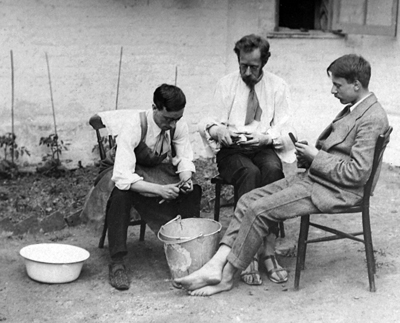
"Peelers" via judygreenway.org
“Peelers” via judygreenway.org

There are memes all over the internet proclaiming that men who do housework “get laid” more often. Google “men who do housework,” and you’ll find, “Porn for Women:” a calendar featuring shirtless men doing household chores. What’s so sexy about men doing housework? The underlying message winks at the fact that, in the US, women continue to do the bulk of household labor even though almost as many of them work for pay outside the home as do men. Even after more than a century of feminist movement, most heterosexual households are still organized along gender lines. Heterogendered tradition still valorizes (and separates) male breadwinners and female caregivers. In this context, men who relieve women of housework are seen as rare, exotic, and even “sexy.”

Of course, real housework isn’t sexy at all. Preparing meals, doing laundry, washing dishes, cleaning – these are tasks that never end. Another common internet meme asks, “Don’t you just love those 12 seconds when all the laundry is done?” We noticed that you could create a lively, acerbic Pinterest page just on gender and housework!

So what does it look like when “real men”—men who consider themselves breadwinners and heads of the household—do housework? Why would these men do housework in the first place? They might do it if they became unemployed. We interviewed 40 men who lost their jobs during the recent recession. Most (85%) of these men expressed traditional viewpoints about gender in the home, saying that men should provide for women and children. And yet, after losing work, most (85%) of these men became financially dependent on their wives or girlfriends. This caused an ideological as well as financial quandary for them. Because their beliefs about masculinity were tangled up with employment, they had to redefine manhood while they were unemployed.

So how did these men prove their manhood? They tackled housework, and they crushed it “like men.” Ben, who called himself, “Mr. Housework,” explained that he mopped, vacuumed, and steam cleaned the floors multiple times a week. Richard said, “I won’t even use a mop on a floor, just on my knees and stuff. I find it somewhat cathartic, believe it or not, but I roll the rugs up, the ones in the kitchen, shaking them outside, leaving them [to air] out.” Our subjects embraced housework to do their part in the family, and they redefined women’s work as hard work—work befitting men. As Brian said, “I would prefer to be working but I just have to step up and be a man in a different kind of manner.”

So it apparently takes a recession to blur the division of labor in traditional household. Will this blurriness last as the economy recovers and men go back to work? Maybe. If “heads of households” and “men’s men” see household labor as real work, this could elevate its worth in larger society, making it less surprising and funny when men and women cross gendered boundaries in their homes.

Kristen Myers is Professor of Sociology and Director of Center for the Study of Women, Gender, & Sexuality at Northern Illinois University. Ilana Demantas is a doctoral candidate in Sociology at University of Kansas. They write about their research in detail in “Being ‘The Man’ Without Having a Job And/Or: Providing Care Instead of ‘Bread’”—a chapter in Families as They Really Are.

Evidence from Long-term Time-use Trends

In a period of “long-term stuttering social change,” the authors argue that men are making progress toward reducing structures of gender inequality.

As women entered the paid labor force in the 1970s and 1980s, time use studies found that wives began spending less time in housework, while husbands began increasing their time (Robinson 1979). But these changes certainly did not lead to parity, and in the late 1990s and early 2000s, progress in gender equality at home and in the public sphere appeared to slow – or even stall.

We argue, however, that like most momentous historical trends, we shouldn’t expect progress towards gender equality to happen in an uninterrupted way. Just as we still see cold snaps within a process of longer-term climatic warming, the progress of gender equality should be seen as a long-term, uneven process, rather than as a single, all-at-once revolution.

When we take a broader and longer view of key trends in the gender division of labor, it is clear that despite periodic setbacks or slow-downs, there has been continuing convergence in the roles and attitudes of men and women. For this paper we studied such trends in 14 developed countries over a 50 year period, using a multinational archive of time-use diary data.

Long term changes in housework and care.

Researchers often look at the division of core housework as a measure of gender power in households. Across the 14 countries surveyed the time women spent in cleaning, cooking and laundry showed a striking downward trend over this extended period, with a less impressive, but nonetheless largely consistent, increase for men (shown in Figures 1a and 1b respectively). These graphs show that women’s hours of core housework stood at well over four hours a day (260 minutes and more) in most of those countries for which we have records from the 1960s – the USA being the exception at just under four hours (228 minutes). A rapid decline is then evident over subsequent decades to a level of below 2 ½ hours a day (150 minutes) in most countries by the first decade of the 21st Century. The exceptions for the later period are the southern and central European countries of Italy, Spain, Austria, Slovenia and Germany, where women’s core housework hours remained at levels of at least 175 minutes a day or more. more...

The following is a repost in honor of the 51st anniversary of the Equal Pay Act. You can download this essay as part of CCF’s Equal Pay Symposium(.pdf).

Gender inequality within families is reciprocally related to gender inequality in the paid workplace. That is why one of the legacies of the Equal Pay Act, which brought scrutiny and sanctions to bear on gender discrimination at work, has been growing egalitarianism within families as well. Research consistently shows the effect of workplace progress on equality within couples. Most recently, analysis of the American Time-Use Survey confirms that women’s own earnings are associated with the amount of housework they perform. Each thousand dollars of earnings is associated with a 14-minute reduction in daily housework.

Photo by Kate Ter Haar via Flickr CC.

In 1962 fewer than one-in-seven nonfarm managers were women, according to Bureau of Labor Statistics data. Women earned less than 10 percent of degrees in law and medicine, and full-time employed women earned just 59 percent of what men made. Not surprisingly, at that time just 7 percent of wives ages 25-54 earned more than their husbands – and wives did almost six-times as much housework as husbands. Their constrained workplace opportunity weakened their relative standing at home. more...