housework

In Time to Join #MeToo, Research Highlights Men’s Growing Support for Gender Equality

Two recent studies, presented to the Council on Contemporary Families, reveal that despite the serious obstacles still standing in the way of achieving full gender equality, progress continues. Married men are expanding their contributions on the home front, and data from the General Social Survey show men at their highest levels yet of support for gender equality.

Dan Carlson of the University of Utah reports on a new study with co-authors Amanda Miller and Sharon Sassler that expands on their earlier research: It had shown that sharing housework now increases happiness for heterosexual couples. The new work finds sharing housework is good news for the bedroom, though how good depends on what you’re sharing.

Carlson’s report on housework underscores what David Cotter (Union College, New York) indicates about trends in attitudes: When looking at men’s and women’s roles at home and at work, a stall in support for gender equality in the 1990s was followed by advances in the 2000s, and mixed results in the 2010s. But in 2016, support for all aspects of gender equality reached new highs. While men have consistently been less egalitarian than women since the 1970s, the gap between their attitudes has narrowed in recent years. “History seldom proceeds in a straight line,” notes Stephanie Coontz, CCF’s director of research and education, “but when you even out the ups and downs, the increase in approval of gender equality, at home and at work, over the past 40 years has been truly dramatic.”

Highlights

In Not All Housework is Created Equal: Particular Housework Tasks and Couples’ Relationship Quality, Carlson shares a couple of intriguing findings:

  • By 2006, the proportion of lower and moderate income parents sharing house cleaning had nearly doubled, to 22 percent, and the proportion sharing the laundry had risen to 21 percent, an increase of 129 percent.
  • In 1992 the division of tasks mattered little for couples’ well-being. But, by 2006, couples who equally shared tasks demonstrated clear advantages in relationship quality over couples where one partner shouldered the load.
  • Which tasks partners shared made a difference. Men who shared the shopping for their household reported greater sexual and relationship satisfaction than men who did either less or more shopping than their partner.
  • And for women? Sharing responsibility for dishwashing was the single biggest source of satisfaction for women. Lack of sharing in this task was the single biggest source of discontent with their marital relationship.

In Patterns of Progress? Changes in Gender Ideology 1977-2016, Cotter provides four graphics that chart change.

  • Overall, people have become more egalitarian about such issues as support for working mothers, whether men should be in charge at home, and whether men are superior to women in politics. The upward lines in Figures 1 and 2 tell it all.
  • The change has more to do with generational replacement than anything else, as you’ll see in Figure 4. The younger generations—groups referred to as Baby Boomers, Gen-Xers, and Millennials–all trend together towards high levels of egalitarianism.
  • The biggest news is that men are catching up to women, as seen in Figure 3. Men are still less egalitarian than women, but the gap between men and women has declined significantly in the past four years.

Where do we stand today?

Discussions about gender equality tend to invite that “glass half full / glass half empty” response, notes Stephanie Coontz, who reviewed these reports. “As we know from #MeToo, we have a long way to go. But to reach gender equity, we started with a very tall glass that had sat empty for thousands of years. The fact that we’ve filled it this far in just forty years should give us confidence to keep pouring.”


Reposted from Psychology Today. 

The majority of Americans today believe in equality. Nearly three-quarters of American adults (73%) say the trend toward more women in the workforce has been a change for the better. And 62% of adults believe that a marriage in which the husband and wife both have jobs and both take care of the house and children provides a more satisfying life than one in which the husband provides for the family and the wife takes care of the home. But despite real progress in men’s participation in family life, Moms usually remain the default parent while Dads help out but do not take charge. Women’s income, not men’s, is often seen as what pays for the childcare. Another recent study of American families shows that mothers multi-task more than fathers, do it more often at the office, and feel more burdened than men by having to always be doing two things at once time.

So what is going on here? Is there an international plot to maintain patriarchy, as conspiracy theorists might argue? Or are women naturally suited to housecleaning and men are just not up to the task, as so many anti-feminists claim? Are today’s husbands really Neanderthals that come home from a long day’s work, drink beer, and expect their wives to wait on them?

Perhaps my own experience loading the dishwasher a few months ago can provide some clues. I don’t do housework very often. As a university professor, researcher, and author who always has writing deadlines looming while I travel to conferences and lectures, both in the US and overseas, I’m ridiculously over-scheduled. My husband is semi-retired, works from home and so with his flexible schedule, spends a lot of his time following me around the world. He doesn’t pick up the slack in our home; he runs our household. One Saturday morning after being served fabulous French toast, I insisted on cleaning up for a change. Within minutes, I was lecturing him on how the dishes already in the dishwasher weren’t rinsed well enough, or stacked neatly. He smiled at me and said, “So when was the last time you ate on a dirty dish?”

If I can find myself, without thinking twice about it, lecturing my husband on how to load a dishwasher, when I haven’t touched a dirty dish in months. How hard must it be for women who’ve been doing the dishes and the meals and taking care of the kids to accept their husbands as competent partners? Or even as partners who might become competent once they were responsible for the tasks?

I have no doubt there are men out there who are simply sexist self-serving narcissists who want wives to do the second shift so they drink beer, play golf, and watch TV. But are there not also some women who just cannot stop themselves from lecturing our partners on how to launder clothes, stack the dishes, put away the groceries and dress the children. Many moms I have talked with even leave lists of what to put into the lunch box when they travel for business–as if their husband isn’t smart enough to figure out what to put between two slices of bread. Why would these successful women have married men they can’t trust to make a sandwich or pick out a toddler’s outfit? The assumption of male incompetence at home has the same result as expecting women to be incompetence at work. It makes the recipients less likely to take on responsibility, to do the job well, or to show initiative.

Perhaps part of why men aren’t stepping up to the plate as equal partners is because women don’t let them. It’s not that women don’t want their husbands to share the job and the joys of parentingResearch shows clearly that they do, and that there are even benefits in the bedroom when people feel their marriage is fair. But we women have set the rules for how housework is done for so long, and often take so much pride in our mothering identities, that we don’t leave enough room for fathers to be equal players. Perhaps mothers are worried about what the neighbors will think if their son’s outfits are not matching, or their daughter’s shirts have stains? Is such shame worth undercutting men’s responsibility for domestic labor? Surely, if a man was worth marrying, he’s talented enough to wash dishes, make play dates, and clean the toilet.

So for Father’s Day, let’s show dad’s some respect. The best gift might just be to respect your partner enough to let him load the dishwasher without comment, and take care of the kids without fearing his your evaluation. Here ’s a gift idea for wives on this Father’s Day: stop giving directions, stop running the show and then resenting that you carry the load of the family work. Give Dads a break this year for Father’s Day. Trust them enough to lean out at home. And if you have to occasionally eat from a dirty plate, as I do, it’s worth it. Let your guy lean in for a change.

Barbara J. Risman is a Distinguished Professor of Sociology in the College of Liberal Arts & Sciences at the University of Illinois at Chicago.  She is also a Senior Scholar at the Council on Contemporary Families.

The Council on Contemporary Families Gender and Millennials Online Symposium presents research on how Millennial men and women are changing—and how they are not changing. Countering the recent trend of ignoring inconvenient facts, this symposium makes it clear that attitudes about gender equality are more complex than either supporters or opponents of feminism often admit. Here’s a quick review of the brief reports.

The Council on Contemporary Families released a Gender and Millennials Online Symposium revealing that young adults have become less supportive of gender equality at home over the past two decades—though not in Europe, where work/family policies are more generous. Yet the benefits of egalitarian marriages, for both partners, have increased during the same time frame.

In this eight-part series, there’s the old news: women and men are more likely to endorse gender equality than ever—and they live lives that express that. Then there’s the not-so-old news: progress toward gender equality has slowed since the 1990s. Some call it a stall. And there’s new news: youthful gender attitudes are more variable than we thought, and at least among younger Millennials, a continued endorsement of equality at work has been accompanied by a dip in support for equality at home. And therein lies the complex set of reports that comprise the Council on Contemporary Families Gender and Millennials Online Symposium, released March 31.

The keynote essay, “Trending Towards Traditionalism? Changes in Youths’ Gender Ideology,” by sociologists Joanna Pepin (University of Maryland) and David Cotter (Union College), reports that when it comes to work and politics, young adults are increasingly egalitarian. But when it comes to home life, the 40-year-long move toward gender equality has stopped or reversed in recent years.

The trends: Specifically, Pepin and Cotter report:

  • In 1994, 42 percent of high-school seniors felt that the best family was one where the man was the outside achiever and the woman took care of the home. In 2014 this had gone up to 58 percent.
  • In 1994, 48 percent of high school seniors said a mother who works cannot establish as warm and secure a relationship with her children as a mother who does not work. In 2014, the share disagreeing went up to about 60 percent.

While young people endorse at rates of 90 percent or higher the idea that men and women should be equal at work, Pepin and Cotter see a trend in greater traditionalism at home. They call this “egalitarian essentialism”—a concept that seems to go a long way in describing the complex trends in gender attitudes presented today. In her overview essay “CCF Gender and Millennials Online Symposium: Overview,” historian Stephanie Coontz defines egalitarian essentialism as combining “a commitment to equality of opportunity with the belief that men and women typically choose different opportunities because men are ‘inherently’ better suited to some roles and women to others.” Coontz explains, “Egalitarian essentialism assumes that as long as women are not prevented from choosing high-powered careers, or forced out of them upon parenthood, their individual choices are freely made and are probably for the best.”

Nika Fate-Dixon identifies similar trends among young people in the 18-25 age group, using data collected since 1977. In “Millennials Rethinking the Gender Revolution? Long-Range Trends in Views of Non-Traditional Roles for Women,” she found that by 1994, 84 percent disagreed with the claim that a woman’s place was in the home. In 2014, however, the percent disagreeing had dropped to three-quarters. While Pepin and Cotter found that the backtracking on gender equality occurred among both men and women high-school seniors, Fate-Dixon found a sharp and growing gender gap among people in their early 20s. As noted below, this was a clear trend through 2014, but the 2016 GSS data no longer follow this pattern. Researchers await more results and analyses.

Politics: Young people—ages 18-30—were by far the strongest supporters of Clinton over Trump in the 2016 Presidential Election. However, according to Kei Kawashima-Ginsberg’s “How Gender Mattered to Millennials in the 2016 Election and Beyond,” only 25 percent of the women Millennial voters and 15 percent of the Millennial men identified as feminists. Furthermore, Kawashima-Ginsberg, Director of Tuft University’s Center for Information and Research on Civic Learning & Engagement (CIRCLE), Millennials’ support for Clinton in 2016 was ten percentage points lower than their vote for Obama in 2008, further evidence for a dip in enthusiasm for gender equality.

Other political research presented by political scientist Dan Cassino (Fairleigh Dickinson University) in “Some men feel the need to compensate for relative loss of income to women. How they do so varies” suggests that some men have reacted negatively to women’s economic gains. During the primaries, male voters who were reminded of women’s growing economic clout became markedly less likely to express a preference for Hillary Clinton. When Cassino studied men who had actually lost income relative to their wives, however, Republicans and Democrats reacted in different ways. Men who were Democrats became more liberal as their share of household earnings fell, while Republican men became more conservative.

Married life: In “A View From Above: How Structural Barriers to Sharing Unpaid Work at Home May Lead to “Egalitarian Essentialism” in Youth,” Dan Carlson, assistant professor of family and consumer studies at the University of Utah, suspects that this backsliding on gender equality is less a product of gender threat than it is due to the absence of work/family policies that make domestic equality possible. Since the 1990s, the historically higher risk of divorce for couples where the wife earns more than her husband has disappeared. And these days, in contrast to the past, couples in which husband and wife equally divide family chores and child-rearing now report higher marital and sexual satisfaction than more traditional couples. Carlson suggests that support for domestic equality continues to strengthen among children of dual-earners when they have access to family-friendly work policies, but that youth who have seen their parents overwhelmed by economic and time pressures may have gotten discouraged.

Research on European countries—where social supports for families are stronger—backs Carlson up. Using European public opinion surveys, Professor Jan Van Bavel (University of Leuven) found no dips in egalitarianism related to home life or work life in “The Reversal of the Gender Gap in Education and the Continued Push towards Gender Equality.” He writes, “In the more recent round of the European Social Survey, in 2010, the responses tended to be less conservative and more gender egalitarian than six years earlier, in 2004.”

Well, maybe “Millennials” isn’t such a great category. In “The Use and Abuse of Millennials as an Analytic Category,” sociologist Frank Furstenberg (University of Pennsylvania) warns against over-generalizations about such a diverse group as the Millennials. He argues that the 18-to-25-year-olds interviewed in 2014 are not really comparable to those interviewed in 1994: They are far less likely to be married or employed in permanent jobs than this age group 20 or 40 years earlier. In her overview essay, historian Coontz notes that CCF Board President Barbara Risman’s research supports this warning against stereotyping a generation. In Risman’s interviews with Millennials for a forthcoming book, she was struck by the contradictory expectations about gender and family life expressed even within a single conversation. Furstenberg and Van Bavel suggest that as youths enter married life, and especially if they gain access to family-friendly work policies, they may well change their views. But Pepin and Cotter warn that this is by no means inevitable.

Update: After this symposium was released last Friday, 2016 data from the General Social Survey became available. The latest numbers show a sharp rebound in young men’s disagreement with the claim that male-breadwinner families are superior. GSS two-year trends are exceptionally volatile, due to the small size of the sample, and the overall decade averages still confirm a rise in traditionalism among 18-to-25-year-olds since the 1990s. But the new data shows that this rise is no longer driven mainly by young men, as it appeared to be in the General Social Survey results from 1994 through 2014. Other evidence for a Millennial gender gap still stands, so stay tuned for more updates on this moving target.

Originally prepared for the Council on Contemporary Families Online Symposium on Gender and Millennials March 31, 2017. Previously posted at Famillies as They Really Are on April 5, 2017. 

This column was prepared for CCF by Virginia Rutter, Professor of Sociology, Framingham State University, and Megan Peterson, CCF Public Affairs and Social Media Intern, Framingham State University.

photo by miapowter via pixabay

A briefing paper prepared for the Council on Contemporary Families Online Symposium on Gender and Millennials, originally released March 31, 2017.

Pepin and Cotter make a major contribution to family research by challenging the current practice of treating people’s attitudes about gender as a unitary construct called a “gender ideology.” Instead, they show us that people’s attitudes about gender are multidimensional, complicated, and at times contradictory. Most of us hold multiple gender ideologies or views simultaneously, depending on what aspects of life we are thinking about.

In the process of disentangling people’s attitudes about different gender issues or distinct aspects of changing gender relationships, Pepin and Cotter show us that at least some of the gains made toward gender equality since the 1970s may be under serious threat. On the one hand, support for giving women the same job opportunities as men remains high, and attitudes about the impact of mothers’ labor force participation on their children have continued to liberalize since the 1970s. But among high school seniors — the next generation of parents — support for egalitarian sharing of unpaid household work and decision-making has actually slipped since reaching a high point in 1994.

Pepin and Cotter contend that a new ideology of “egalitarian essentialism” lies behind the revival of support for differentiated gender roles at home, and that these beliefs explain the stalled revolution in gender equality as defined by the lack of gender parity in labor force participation, the persistent gender wage gap, and women’s continued responsibility for childcare and housework in families. They also suggest that such beliefs about gendered family roles at home may be leading many women to internalize the notion that doing the bulk of unpaid work is just and fair, making them unlikely to ask for change. This modernized notion of separate but equal spheres for men and women thus legitimizes and perpetuates an unequal labor burden on women in families, which in turn limits their progress outside the home. Although Pepin and Cotter point to a causal role of attitudes in shaping the social behaviors and structures associated with the stall in the gender revolution, they have trouble explaining why these attitudes have changed.

Cause and consequence. My own work and that of others would suggest that the retreat from egalitarian behaviors and values in many families likely reflects the obstacles couples face in pursuing an egalitarian division of financial and family responsibilities – an arrangement that the majority of U.S. couples state is very important to a successful marriage (Pew 2016) and that researchers find to have increasingly positive consequences for couples’ well-being.

Previous research on adult subjects has shown that people’s attitudes are shaped by their experiences and options. Gender ideologies and choices about gender arrangements in the home are just as much the product of larger structural conditions related to gender inequality as they are the source of those conditions. My work with Jamie Lynch (2013) has demonstrated as much, showing that gender ideologies are both the cause and consequence of the division of housework in marriage. Sharing housework leads to more egalitarian attitudes and vice versa. Additionally, Pedulla and Thébaud (2015) have recently shown just how malleable gender attitudes can be to variations in paid work arrangements and workplace policies. When provided the option of supportive work-family policies, they find that individuals overwhelmingly prefer egalitarian arrangements. But when supportive policies are absent, preferences for egalitarianism decline for most men and women.

Pepin and Cotter acknowledge that adults’ attitudes are shaped over time through their experiences, but they suggest that the attitudes of high school seniors constitute a “unique view from below” — as if these attitudes represent an unadulterated set of beliefs unsullied by the onerous decisions about family leave, childcare, housework, and career investment forced upon adults. Yet, the gender ideologies of youths are forged in interaction with the structural and cultural milieus surrounding them. Children’s gender ideologies are derived from their parents, not just from the messages they are explicitly given but from their own observations of their parents’ experiences (Carlson and Knoester 2011). Pepin and Cotter acknowledge this by pointing out that youths with educated working mothers are more likely to embrace equal family roles at home. They contend that this makes the shift toward conventional attitudes all the more perplexing since demographic shifts toward greater employment, education, and single parenting among mothers’ in the population would suggest more egalitarian beliefs.

It’s the policies. How, then, do we understand the retreat from egalitarian values about domestic roles among youths? Although Pepin and Cotter ask the right questions, they look in the wrong place for the answer. I would argue that two structural factors must be taken into account. First, rising valuation of, and attempts to achieve, egalitarianism from the 1970s to the 1990s were not met with sufficient changes in the workplace or in public policy to accommodate couples’ desires to share family responsibilities. In the face of unresponsive workplaces and role conflict, many adults have likely reverted to conventional gender arrangements and traditional beliefs, transmitting their attitudes to their teenage children. Alternatively, some youths who saw their parents experiencing disagreements and stresses as they tried to integrate work and family without supportive policies may have concluded that a male-breadwinner arrangement would have made family life easier. This could explain Pepin and Cotter’s findings about the more positive views of children of educated working mothers, who generally have better jobs and support systems for family life. But, even so, educated couples often privilege men’s careers, leaving women with incredibly difficult decisions about pursuing careers and raising children (Stone 2007).

A second possible reason for a reversion toward traditional beliefs about family roles and decision-making may lie in the recent increases in counter-conventional family arrangements – arrangements that actually reverse rather than more equally divide traditional household arrangements, with women taking the larger share of breadwinning and men taking on the larger share of homemaking. Indeed, the number of women who earn as much or more than their male partners has increased substantially over the past 30 years (Schwartz and Gonalons-Pons 2016) while the number of stay-at-home fathers has doubled since 1990 (Pew Research 2014).

Some of these role reversals reflect many men’s increasing desire to be more involved at home, but they also reflect real economic stressors for poor and working-class families, resulting from men’s increasingly precarious position in the post-industrial service economy (Pew Research 2014). My research (Carlson, Miller, Sassler, and Hanson 2016) demonstrates that although most couples who adopt a non-traditional egalitarian division of housework find that it enhances marital and sexual satisfaction, most couples who reverse the traditional division of housework find it quite unsatisfactory. When men are primarily responsible for housework, both men and women report the highest feelings of inequity and the greatest dissatisfaction with their housework arrangements. This translates into less sexual intimacy and lower relationship quality. It seems plausible that teens who see their parents or neighbors react negatively to such counter-conventional gendered arrangements may conclude that traditional arrangements with a man as head of the household are “better for everyone involved.”

Looking ahead. Most couples do not appear ready for role reversals, and many have difficulty meeting the increased flexibility demanded of them over the past decade. To the extent that these couples have experienced tension and conflict over these changes, no wonder some children have become less optimistic about the consequences of upending gender conventions than their predecessors in the 1990s.

But this does not mean that the gender revolution has failed or will continue to lose ground. Despite the stall in the gender wage gap and the desegregation of occupations, we have seen a notable leap forward in the ways that egalitarianism benefits people’s personal lives. Indeed, one could argue that the greatest emissary for gender equality is the improvement it leads to in the lives of couples. Unlike the past, today’s egalitarian couples look better on a wide range of indicators than other couples. For example, equally-educated partners now have the lowest odds of divorce, and when a wife has more education than her husband this no longer raises the risk of divorce (Schwartz and Han 2014). Equal-breadwinning couples used to have the highest rates of divorce, but women’s earnings are no longer related to divorce risk (Schwartz and Gonalons-Pons 2016).

Perhaps most important for what more and more children will observe as they grow up, an equal sharing of unpaid labor – both housework and childcare — is increasingly associated with positive advantages for couples’ relationships. In our analysis comparing the association of housework arrangements with mid- to low-income parents’ sense of equity, sexual intimacy, and relationship quality, we found that since the mid-1990s traditional arrangements have increasingly been seen as less fair and egalitarian arrangements increasingly as more fair. Unequal sharing of housework, though initially unrelated to relationship quality, has steadily come to undermine it, while the advantages of conventional arrangements for sexual intimacy have disappeared. In fact, over the time span we observed, sexual frequency declined for all couples except those who shared housework. In addition to the rising benefits of sharing housework, we find also that having partners equally share childcare responsibilities is associated with greater sexual and relationship satisfaction compared to having mothers shoulder the majority of care.

Taken together, it is difficult to reconcile a narrative of a stalled revolution due to a retreat from egalitarian beliefs with our findings that egalitarianism increasingly benefits couples and is seen as the most satisfying and fair arrangement. I suggest that we have seen a polarization in family life that is likely a counterpoint to the polarization in access to good jobs and stable benefits. Relationship stability and quality has been enhanced for the fortunate minority who manage to achieve egalitarian relationships without sacrificing their work or family obligations. But for those who cannot – for the too many who are forced into conventional and counter-conventional arrangements because of financial and time constraints – egalitarian beliefs have been abandoned to defend against cognitive dissonance and the risk of psychological distress. These struggles and reconciled beliefs are then likely transmitted to their kids.

Pepin and Cotter’s important findings call to mind the image of a canary in a coal mine, warning us that if things do not change, the promise of gender equality may suffocate and die. Yet it’s important to remember that there may be light and fresh air at the end of the tunnel. Because youths have increasingly delayed their movement into marriage and parenthood since the 1970s, the attitudes of today’s high school seniors are measured an average of eight to ten years before most will begin family formation (Mathews and Hamilton 2009; Payne 2012). For these youths, several years remain before they will make decisions about how to arrange the paid and unpaid labor in their marital or cohabiting partnerships. Much will likely change, both personally and socially, in the interim.

Still, Pepin and Cotter’s study shows that our current lack of supportive institutions and policies to help families integrate work and family life has begun to take its toll. If something is not done soon to structurally support the egalitarian arrangements that research now shows to be best for most relationships, people may no longer want them to begin with.

Daniel L. Carlson is an Assistant Professor of Family, Health, and Policy at the University of Utah.


Keynote brief prepared for the Council on Contemporary Families Online Symposium on Gender and Millennials March 31, 2017.

Overview. We often think that each generation becomes more modern, egalitarian, and tolerant than the last. And frequently this is correct—as it generally has been with changing attitudes about gender, work and family. Recently, though, our research has shown a surprising twist to that pattern. Looking at a survey that for nearly 40 years has asked high school seniors a series of questions about how men and women should be treated at work, what responsibilities at home should look like, and whether mothers’ employment harms their children, we see that on some of those questions the answers have indeed continued to become more egalitarian. But on others, what had been a trend toward equality stopped or even reversed in the mid-1990s.

We focused on youth because their values are important for predicting future trends. Youths’ attitudes capture changing cultural ideals that are less likely to have been reconciled with adulthood realities, such as unpaid maternity leave and the expenses of childcare, making their opinions of gender unique views from below. Although these adolescents have not yet entered the labor force full-time, the youth in our analyses had diverse experiences with their families, including witnessing their mothers’ work pathways and, for many, the dynamics of their parents at home.

The data in three charts. When we looked at the changing patterns of responses among high school seniors from the mid-1970s to today, we found that trends in attitudes about gender equality in the public realm increasingly diverged from those regarding gender relations within families (see Figure 1). In reference to the public sphere—employment opportunities and leadership abilities—youth have indeed become more egalitarian, increasing their support for the idea that men and women have equal abilities and should be afforded equal opportunities. In 1976, 82 percent of high school seniors already agreed or strongly agreed that “women should be considered as seriously as men for jobs as executives or politicians.” By 1994, that had risen to 91 percent, a high that was sustained for the next two decades. Similarly, in 1976, 76 percent agreed that “A woman should have exactly the same job opportunities as a man.” This rose to 89 percent in 1994 and has remained stable through 2014. Essentially, starting in the mid-1970s, youth’s attitudes became more egalitarian and plateaued at a high level of egalitarianism since the mid-1990s.

Young people’s attitudes with regard to employed mothers’ relationship with their children show greater variability over the period (see Figure 2). We observed high school seniors becoming more supportive of employed mothers from 1977 through 1994, with their support slowing for a period thereafter, and then becoming more supportive again in the mid-2000s. When asked whether “a working mother can establish just as warm and secure a relationship with her children as a mother who does not work,” only about half (49 percent) of high school seniors agreed in 1976, but this had risen to more than two-thirds (68 percent) by 1994 and three-quarters (76 percent) by 2014. In 1976, about three-quarters of high school seniors agreed that “a preschool child is likely to suffer if the mother works.” By 1994, however, nearly half (48 percent) disagreed, and by 2014 about 60 percent disagreed. This dramatic change suggests that the “mommy wars” and similar controversies seem to have abated. There appears to be broad and growing acceptance of mothers’ employment.

But a very different and surprising trend is evident in attitudes about gender dynamics in families (in Figure 3). After becoming more egalitarian for almost twenty years, high school seniors’ thinking about a husband’s authority and divisions of labor at home has since become substantially more traditional. In 1976, when they were asked whether “it is usually better for everyone involved if the man is the achiever outside the home and the woman takes care of the home and family,” fewer than 30 percent of high school seniors disagreed. By 1994, disagreement with the claim that the male breadwinner–female homemaker family is the best household arrangement had almost doubled, rising to 58 percent. By 2014, however, it had fallen back to 42 percent—a decline of 16 percentage points since its peak in 1994. In 1976, a majority of high school seniors (59 percent) disagreed with the statement that “the husband should make all the important decisions in the family.” This rose to 71 percent by 1994 but fell back to 63 percent by 2014.

In our analyses of these trends, we found that while young men have consistently been less egalitarian than young women, the relative difference between them has not narrowed on any of the attitudes covered in the surveys. Also, Black youth have consistently been more egalitarian than their White counterparts, but again we saw no evidence of either convergence or divergence between White and Black youths’ beliefs about gender. Black high school seniors exhibited the same initial trend toward more equality in household arrangements and later trend toward more traditional views.

These results are puzzling because population demographics are changing in ways that might be expected to produce greater support for egalitarian principles. The population is becoming more racially and ethnically diverse, and at the same time, religiosity is declining overall. Families are increasingly likely to count on mothers’ employment for economic stability, whether youth grow up in dual-earner households or single-mother families. We expected that as women’s educational attainment and married women’s labor force participation increased in the 1980s and early 1990s, youths would be increasingly exposed to feminist beliefs, leading them to adopt egalitarian attitudes even if their own families maintained conventional arrangements. Yet our findings showed an initial rise in egalitarian beliefs, followed by slippages that we could not explain by accounting for demographic and background factors such as race, region of the country, religiosity, family structure, or the respondent’s mother’s education and employment, as well as contextual factors such as aggregate mothers’ employment and education. Even though youth with more highly educated mothers and/or consistently employed mothers were more egalitarian than their peers, and the percentages of youth with these educated and employed mothers increased over time, this population change did not fully account for the attitude trends.

We are left, then, searching for explanations in the realm of culture. For this we turn to the concept of “egalitarian essentialism” as an emergent framework for understanding shifts in gender ideology. Back in the nineteenth century, as the worlds of “work” and “home” were increasingly spatially separated, a doctrine of “separate spheres” developed to ideologically justify, and reinforce, the division between the masculine public sphere and feminine private sphere. It is telling here that what was considered “work” included only that which took place in the public sphere—waged employment, politics and the like—excluding all of the labor that took place in the home. The tasks of caring for children and maintaining a household were seen as an extension of love and motherhood, with a built-in intrinsic reward for women. This “separate spheres” ideology experienced a resurgence in the post-WWII era and was the primary ideology against which the feminist movements of the 1960s and 1970s reacted.

But the question became what would replace that ideology? Some feminists pushed for a more androgynous conception of equality, disrupting beliefs about the oppositeness of men and women. In the 1980s and early 1990s, people seemed to be moving toward the idea that women and men could work equally well in both the public and private spheres. Yet the narrative that eventually emerged became a hybrid of the two approaches, promoting women’s choice to participate in either sphere while trying to equalize the perceived value of a home sphere that was still seen as distinctively female. The egalitarian essentialist perspective mixed values of equality (men and women should have equal opportunities, gender discrimination is wrong) alongside beliefs about the essential nature of men and women (men are naturally or inherently better suited to some roles and women to others).

The revised kind of egalitarianism that rapidly increased after 1994 is rooted in ideology compatible with American cultural ideals of individualism, beliefs associated more with the public sphere than rooted in families. Tellingly, the pattern of increased though incomplete equality in the workplace and persistent though lessened inequality at home is present not only in the realm of attitudes but also when we look at objective measures like occupational segregation and housework. The percentages of men and women who would have to change occupations for all occupations to have equal numbers of men and women declined from about two-thirds (64 percent) of workers in 1950 to about 50 percent by the 1990s, and has been stalled ever since (authors’ calculations from Census PUMS/ACS). Similarly, the gender gap in time spent in core housework activities (e.g., cooking, cleaning, laundry) steadily declined from the 1960s to the mid-1990s and then stagnated.

One possible reason egalitarian ideology is highly endorsed in the marketplace is that occupational segregation permits the embrace of equal opportunity ideals without challenging beliefs that men and women are innately and fundamentally different. Even though “a woman should have exactly the same job opportunities as a man,” women may be thought to choose different types of work because those occupations feel more consistent with their identity as women. The path to blending a belief in equality with a belief in inherent differences between men and women at home is less obvious, which may explain the return to non-egalitarian gender attitudes within families. For example, arriving at gender parity in time spent in housework may require redefining what counts as “men’s chores” and “women’s chores.” It is notable that most of the narrowing of differences in time spent on chores noted above came from reductions in women’s time spent on these tasks. Achieving equity within families requires men to take on tasks that are culturally devalued (cleaning, laundry, and to a lesser extent cooking). In other words, women entering the workforce felt they were gaining something valuable, just as fathers stepping up participation in parenting felt they were gaining something valuable, but everybody hates housework.

A potential argument against our cultural explanation could be the fact that gender equalization appears to be continuing apace with regard to child-rearing. As noted above, fathers continue to increase their time spent with children  (see Figure 4), even as they lag behind in matching women’s housework time. Mothers’ earnings are increasingly thought of as essential to the family, rather than considered supplemental income. Although we can only speculate, these developments may be better explained by rising economic insecurity than by a continued progression of commitment to androgynous parenting. Economic necessity may be associated with increased support for mothers’ employment, even as more young people began to report a preference for the male breadwinner–female homemaker model starting in the mid-1990s.

It has long been assumed that progress for women in the public sphere would result in improvement for women in the family. However, our findings, along with other scholarship, suggest that advances for women in the public sphere may increase many people’s desire to reinforce gender essentialist ideology in the family. Perhaps surprisingly, we didn’t find a pairing of egalitarian and essentialist ideology among survey respondents, where high school students endorsed the male breadwinner arrangement but also equal decision-making at home. Instead, the increase in agreement with the statement “the husband should make all the important decisions in the family” suggests that a significant minority of youths have reverted to an endorsement of male supremacy, at least within the family realm. So long as essentialist beliefs about innate differences in men and women persist, efforts to equalize women’s standing with men may remain stalled.

Joanna R. Pepin is in the Department of Sociology, University of Maryland. David A. Cotter is Professor & Chair, Department of Sociology, Union College.

The Council on Contemporary Families Gender and Millennials Online Symposium presents new research on how Millennial men and women are changing—and how they are not changing. Countering the recent trend of ignoring inconvenient facts, this symposium makes it clear that attitudes about gender equality are more complex than either supporters or opponents of feminism often admit. Here’s a quick review of the brief reports.

The Council on Contemporary Families has released a Gender and Millennials Online Symposium revealing that young adults have become less supportive of gender equality at home over the past two decades—though not in Europe, where work/family policies are more generous. Yet the benefits of egalitarian marriages, for both partners, have increased during the same time frame.

In this eight-part series, there’s the old news: women and men are more likely to endorse gender equality than ever—and they live lives that express that. Then there’s the not-so-old news: progress toward gender equality has slowed since the 1990s. Some call it a stall. And there’s new news: youthful gender attitudes are more variable than we thought, and at least among younger Millennials, a continued endorsement of equality at work has been accompanied by a dip in support for equality at home. And therein lies the complex set of reports that comprise the Council on Contemporary Families Gender and Millennials Online Symposium, released March 31.

The keynote essay, “Trending Towards Traditionalism? Changes in Youths’ Gender Ideology,” by sociologists Joanna Pepin (University of Maryland) and David Cotter (Union College), reports that when it comes to work and politics, young adults are increasingly egalitarian. But when it comes to home life, the 40-year-long move toward gender equality has stopped or reversed in recent years.

The trends: Specifically, Pepin and Cotter report:

  • In 1994, 42 percent of high-school seniors felt that the best family was one where the man was the outside achiever and the woman took care of the home. In 2014 this had gone up to 58 percent.
  • In 1994, 48 percent of high school seniors said a mother who works cannot establish as warm and secure a relationship with her children as a mother who does not work. In 2014, the share disagreeing went up to about 60 percent.

While young people endorse at rates of 90 percent or higher the idea that men and women should be equal at work, Pepin and Cotter see a trend in greater traditionalism at home. They call this “egalitarian essentialism”—a concept that seems to go a long way in describing the complex trends in gender attitudes presented today. In her overview essay “CCF Gender and Millennials Online Symposium: Overview,” historian Stephanie Coontz defines egalitarian essentialism as combining “a commitment to equality of opportunity with the belief that men and women typically choose different opportunities because men are ‘inherently’ better suited to some roles and women to others.” Coontz explains, “Egalitarian essentialism assumes that as long as women are not prevented from choosing high-powered careers, or forced out of them upon parenthood, their individual choices are freely made and are probably for the best.”

Nika Fate-Dixon identifies similar trends among young people in the 18-25 age group, using data collected since 1977. In “Millennials Rethinking the Gender Revolution? Long-Range Trends in Views of Non-Traditional Roles for Women,” she found that by 1994, 84 percent disagreed with the claim that a woman’s place was in the home. In 2014, however, the percent disagreeing had dropped to three-quarters. While Pepin and Cotter found that the backtracking on gender equality occurred among both men and women high-school seniors, Fate-Dixon found a sharp and growing gender gap among people in their early 20s. As noted below, this was a clear trend through 2014, but the 2016 GSS data no longer follow this pattern. Researchers await more results and analyses.

Politics: Young people—ages 18-30—were by far the strongest supporters of Clinton over Trump in the 2016 Presidential Election. However, according to Kei Kawashima-Ginsberg’s “How Gender Mattered to Millennials in the 2016 Election and Beyond,” only 25 percent of the women Millennial voters and 15 percent of the Millennial men identified as feminists. Furthermore, Kawashima-Ginsberg, Director of Tuft University’s Center for Information and Research on Civic Learning & Engagement (CIRCLE), Millennials’ support for Clinton in 2016 was ten percentage points lower than their vote for Obama in 2008, further evidence for a dip in enthusiasm for gender equality.

Other political research presented by political scientist Dan Cassino (Fairleigh Dickinson University) in “Some men feel the need to compensate for relative loss of income to women. How they do so varies” suggests that some men have reacted negatively to women’s economic gains. During the primaries, male voters who were reminded of women’s growing economic clout became markedly less likely to express a preference for Hillary Clinton. When Cassino studied men who had actually lost income relative to their wives, however, Republicans and Democrats reacted in different ways. Men who were Democrats became more liberal as their share of household earnings fell, while Republican men became more conservative.

Married life: In “A View From Above: How Structural Barriers to Sharing Unpaid Work at Home May Lead to “Egalitarian Essentialism” in Youth,” Dan Carlson, assistant professor of family and consumer studies at the University of Utah, suspects that this backsliding on gender equality is less a product of gender threat than it is due to the absence of work/family policies that make domestic equality possible. Since the 1990s, the historically higher risk of divorce for couples where the wife earns more than her husband has disappeared. And these days, in contrast to the past, couples in which husband and wife equally divide family chores and child-rearing now report higher marital and sexual satisfaction than more traditional couples. Carlson suggests that support for domestic equality continues to strengthen among children of dual-earners when they have access to family-friendly work policies, but that youth who have seen their parents overwhelmed by economic and time pressures may have gotten discouraged.

Research on European countries—where social supports for families are stronger—backs Carlson up. Using European public opinion surveys, Professor Jan Van Bavel (University of Leuven) found no dips in egalitarianism related to home life or work life in “The Reversal of the Gender Gap in Education and the Continued Push towards Gender Equality.” He writes, “In the more recent round of the European Social Survey, in 2010, the responses tended to be less conservative and more gender egalitarian than six years earlier, in 2004.”

Well, maybe “Millennials” isn’t such a great category. In “The Use and Abuse of Millennials as an Analytic Category,” sociologist Frank Furstenberg (University of Pennsylvania) warns against over-generalizations about such a diverse group as the Millennials. He argues that the 18-to-25-year-olds interviewed in 2014 are not really comparable to those interviewed in 1994: They are far less likely to be married or employed in permanent jobs than this age group 20 or 40 years earlier. In her overview essay, historian Coontz notes that CCF Board President Barbara Risman’s research supports this warning against stereotyping a generation. In Risman’s interviews with Millennials for a forthcoming book, she was struck by the contradictory expectations about gender and family life expressed even within a single conversation. Furstenberg and Van Bavel suggest that as youths enter married life, and especially if they gain access to family-friendly work policies, they may well change their views. But Pepin and Cotter warn that this is by no means inevitable.

Update: After this symposium was released last Friday, 2016 data from the General Social Survey became available. The latest numbers show a sharp rebound in young men’s disagreement with the claim that male-breadwinner families are superior. GSS two-year trends are exceptionally volatile, due to the small size of the sample, and the overall decade averages still confirm a rise in traditionalism among 18-to-25-year-olds since the 1990s. But the new data shows that this rise is no longer driven mainly by young men, as it appeared to be in the General Social Survey results from 1994 through 2014. Other evidence for a Millennial gender gap still stands, so stay tuned for more updates on this moving target.

Originally prepared for the Council on Contemporary Families Online Symposium on Gender and Millennials March 31, 2017. 

This column was prepared for CCF by Virginia Rutter, Professor of Sociology, Framingham State University, and Megan Peterson, CCF Public Affairs and Social Media Intern, Framingham State University.

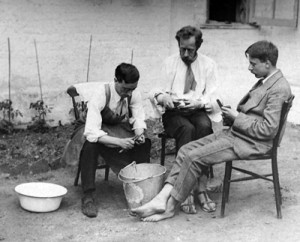
“Peelers” via judygreenway.org

There are memes all over the internet proclaiming that men who do housework “get laid” more often. Google “men who do housework,” and you’ll find, “Porn for Women:” a calendar featuring shirtless men doing household chores. What’s so sexy about men doing housework? The underlying message winks at the fact that, in the US, women continue to do the bulk of household labor even though almost as many of them work for pay outside the home as do men. Even after more than a century of feminist movement, most heterosexual households are still organized along gender lines. Heterogendered tradition still valorizes (and separates) male breadwinners and female caregivers. In this context, men who relieve women of housework are seen as rare, exotic, and even “sexy.”

Of course, real housework isn’t sexy at all. Preparing meals, doing laundry, washing dishes, cleaning – these are tasks that never end. Another common internet meme asks, “Don’t you just love those 12 seconds when all the laundry is done?” We noticed that you could create a lively, acerbic Pinterest page just on gender and housework!

So what does it look like when “real men”—men who consider themselves breadwinners and heads of the household—do housework? Why would these men do housework in the first place? They might do it if they became unemployed. We interviewed 40 men who lost their jobs during the recent recession. Most (85%) of these men expressed traditional viewpoints about gender in the home, saying that men should provide for women and children. And yet, after losing work, most (85%) of these men became financially dependent on their wives or girlfriends. This caused an ideological as well as financial quandary for them. Because their beliefs about masculinity were tangled up with employment, they had to redefine manhood while they were unemployed.

So how did these men prove their manhood? They tackled housework, and they crushed it “like men.” Ben, who called himself, “Mr. Housework,” explained that he mopped, vacuumed, and steam cleaned the floors multiple times a week. Richard said, “I won’t even use a mop on a floor, just on my knees and stuff. I find it somewhat cathartic, believe it or not, but I roll the rugs up, the ones in the kitchen, shaking them outside, leaving them [to air] out.” Our subjects embraced housework to do their part in the family, and they redefined women’s work as hard work—work befitting men. As Brian said, “I would prefer to be working but I just have to step up and be a man in a different kind of manner.”

So it apparently takes a recession to blur the division of labor in traditional household. Will this blurriness last as the economy recovers and men go back to work? Maybe. If “heads of households” and “men’s men” see household labor as real work, this could elevate its worth in larger society, making it less surprising and funny when men and women cross gendered boundaries in their homes.

Originally posted 6/3/16

Kristen Myers is Professor of Sociology and Director of Center for the Study of Women, Gender, & Sexuality at Northern Illinois University. Ilana Demantas is a doctoral candidate in Sociology at University of Kansas. They write about their research in detail in “Being ‘The Man’ Without Having a Job And/Or: Providing Care Instead of ‘Bread’”—a chapter in Families as They Really Are.

Years ago, the Council on Contemporary Families (CCF) gave the United States a “Gentleman’s C” in terms of family policy, and not much has changed since then. CCF scholars have used the international variation in work-family policy to look at how families are doing – inside and outside of the United States. For International Women’s Day, here is a review of CCF research using international populations and the international media that reported on the research.

Supportive work-family policies foster women’s entrepreneurship

UC-Santa Barbara sociologist Sarah Thébaud’s investigation into “What Helps Women Entrepreneurs Flourish?” found that women in countries with more generous work-family policies like subsidized childcare and paid parental leave have more successful entrepreneurial endeavors: they “employ more workers, express more ambitious growth intentions, and are more likely to report introducing a brand new product or service to the market” than in countries without such benefits. There are higher numbers of women entrepreneurs in countries without progressive work-family policies, like the United States, but they don’t really succeed like those in the more generous countries. Their lack of success led Thébaud to conclude that these were cases of entrepreneurship as a “fallback” option in situations where balancing work and family was not possible otherwise.

Supportive work-family policies help men and women split up housework and childcare:

Economist Ankita Patnaik reports in “’Daddy’s Home!’ Increasing Men’s Use of Paternity Leave,” that in Quebec, after the implementation of a new non-transferrable, paid five-week paternity leave policy that paid parents seventy percent of their income (Quebec Parental Insurance Plan), fathers were more likely to take advantage of paternity leave than were fathers in Quebec before the policy implementation in 2006 or in provinces without the new policy. Eighty percent of fathers eligible for the Quebec Parental Insurance Plan utilized it, compared to less than twenty percent of those taking advantage of the previous policy, which paid fifty-five percent of income and was transferrable from fathers to mothers. After participants’ paid paternity leave had finished, participating fathers and mothers had a more egalitarian division of household and market labor than couples in which the father did not take the paid paternity leave. This research was profiled to Canadian readers in the National Post, and to Sri Lankan readers in Viva Lanka.

Patnaik’s encouraging finding is important, because in the United States – where paid paternity leave is not guaranteed—parents tend to revert to “traditional” family roles after the birth of a child. Arielle Kuperberg’s research, outlined in the CCF brief “First comes love, then comes…housework?” was profiled in the Australian edition of the International Business Times. Kuperberg, a sociologist at UNC-Greensboro, reported that it was not the transition to marriage, but the transition to parenting that increased gender inequality in household labor among couples.

Balancing market and non-market work leads to happier couples and families:

What are the implications of policies that allow parents to share work and family obligations? Well, for one, couples who share housework have more sex, and couples who share childcare have better sex, according to Cornell’s Sharon Sassler in her CCF brief, “A reversal in Predictors of Frequency and Satisfaction in Marriage.” This report was covered by The Daily Mail in the U.K., The Sydney Morning Herald in Australia, and Edizione Italiana in Italy, among others.

More broadly, variation in work-family policy accounts for the “happiness gap” between parents and non-parents. Jennifer Glass (UT-Austin), Robin Simon (Wake Forest University), and Matthew Andersson (Baylor University), in “Parenting Happiness in 22 Countries,” review that in the United States, where work-family policies are lacking, the happiness gap is wide – parents tend not to be as happy as non-parents. But in countries with “good parental policy ‘packages,’” made up of paid parental leave, guaranteed time off, affordable childcare, and “work schedule flexibility,” the differences are less stark. In Norway and Hungary, where there are generous parental policy packages, parents are even happier than non-parents. In addition to many English language articles around the world, this report was covered in a Spanish-language article entitled ““La paternidad y la infelicidad” at Proexpanción, and in “Un buon welfare può rendere felici i genitori,” in the Italian news outlet Internazionale.

Braxton Jones is a graduate student in sociology at the University of New Hampshire, and serves as a CCF Graduate Research and Public Affairs Scholar.

"Peelers" via judygreenway.org
“Peelers” via judygreenway.org

There are memes all over the internet proclaiming that men who do housework “get laid” more often. Google “men who do housework,” and you’ll find, “Porn for Women:” a calendar featuring shirtless men doing household chores. What’s so sexy about men doing housework? The underlying message winks at the fact that, in the US, women continue to do the bulk of household labor even though almost as many of them work for pay outside the home as do men. Even after more than a century of feminist movement, most heterosexual households are still organized along gender lines. Heterogendered tradition still valorizes (and separates) male breadwinners and female caregivers. In this context, men who relieve women of housework are seen as rare, exotic, and even “sexy.”

Of course, real housework isn’t sexy at all. Preparing meals, doing laundry, washing dishes, cleaning – these are tasks that never end. Another common internet meme asks, “Don’t you just love those 12 seconds when all the laundry is done?” We noticed that you could create a lively, acerbic Pinterest page just on gender and housework!

So what does it look like when “real men”—men who consider themselves breadwinners and heads of the household—do housework? Why would these men do housework in the first place? They might do it if they became unemployed. We interviewed 40 men who lost their jobs during the recent recession. Most (85%) of these men expressed traditional viewpoints about gender in the home, saying that men should provide for women and children. And yet, after losing work, most (85%) of these men became financially dependent on their wives or girlfriends. This caused an ideological as well as financial quandary for them. Because their beliefs about masculinity were tangled up with employment, they had to redefine manhood while they were unemployed.

So how did these men prove their manhood? They tackled housework, and they crushed it “like men.” Ben, who called himself, “Mr. Housework,” explained that he mopped, vacuumed, and steam cleaned the floors multiple times a week. Richard said, “I won’t even use a mop on a floor, just on my knees and stuff. I find it somewhat cathartic, believe it or not, but I roll the rugs up, the ones in the kitchen, shaking them outside, leaving them [to air] out.” Our subjects embraced housework to do their part in the family, and they redefined women’s work as hard work—work befitting men. As Brian said, “I would prefer to be working but I just have to step up and be a man in a different kind of manner.”

So it apparently takes a recession to blur the division of labor in traditional household. Will this blurriness last as the economy recovers and men go back to work? Maybe. If “heads of households” and “men’s men” see household labor as real work, this could elevate its worth in larger society, making it less surprising and funny when men and women cross gendered boundaries in their homes.

Kristen Myers is Professor of Sociology and Director of Center for the Study of Women, Gender, & Sexuality at Northern Illinois University. Ilana Demantas is a doctoral candidate in Sociology at University of Kansas. They write about their research in detail in “Being ‘The Man’ Without Having a Job And/Or: Providing Care Instead of ‘Bread’”—a chapter in Families as They Really Are.

johnson pieceIf I am to believe findings from the media coverage of a recent study, then I should anticipate a life where I return home from work and nonchalantly prop up my feet, crack open a cold beer, and patiently wait for sex once my wife has finished cleaning up the sink full of dishes following a delicious home-cooked meal she singlehandedly prepared while our two young children wreaked havoc on the house. This scenario seems better suited to science fiction than social science, for sure. To say I was skeptical of the study that serves as the basis for this questionable fantasy would be an understatement.

This widely publicized study a few years back ignited a pop culture debate about how men’s contributions around the house impacted a couple’s sex life. Drawing on a large national sample of married couples surveyed once in the early 1990s, Kornrich, Brines, and Leupp found husbands who did more of the housework that women often do (making dinner, cleaning house) had less sex, while men completing more “manly” tasks (mowing the lawn, washing the car) was linked with having sex more often. The authors argued that: “traditionally masculine and feminine behaviors consciously or unconsciously serve as turn-ons for individuals” (p. 31). My coauthors and I interpreted this conclusion as unfortunately implying that “husbands emasculate themselves by completing housework traditionally considered to be women’s responsibility and, therefore, experience reduced sexual frequency because they rendered themselves less sexually appealing … by doing the dishes.”

We explored sex and men’s contributions to chores traditionally done by women (cleaning, shopping) using data from couples repeatedly surveyed every year for five years as part of the German Panel Analysis of Intimate Relations and Family Dynamics (pairfam) study. We considered men’s housework in two ways: actual share and perceived fairness. Actual share was the extent to which men shared traditionally feminine tasks (did more or less than female partner vs. 50/50 split) and perceived fairness was whether men felt their contributions to housework were fair (did more or less than their fair share of housework vs. fairly shared). Our study then looked to see whether actual share and perceived fairness predicted future sex frequency and sex satisfaction of both partners. Such an approach is critical to gain an accurate understanding of how relationship dynamics unfold as couples move through time together. Studies based on data gathered at only one point in time are inherently limited in their ability to identify aspects of intimate partnerships that promote or inhibit later couple sexuality.

Our results demonstrated no association between men’s actual share of housework and sex. However, when men reported making a fair contribution to housework, the couple enjoyed more frequent and satisfying sex in the future. A good deal of social science research and theory indicates the determination of fairness is a subjective process based on comparisons to societal norms, personal expectations, and the circumstances of a particular couple’s daily life. Applied to housework, equal contributions may not necessarily be fair. The optimal amount of housework men should or should not be doing is something to be actively negotiated between partners. When both partners are on the same page regarding household responsibilities, sex may be more frequent and satisfying because feelings of bitterness and anger are less likely to accumulate knowing one’s partner is pulling his weight around the house.

Rather than avoiding chores in the hopes of having more sex, findings from my study paint a different picture. Men are likely to experience more frequent and satisfying (for both partners) passion between the sheets when they simply do their fair share. We suspect this will involve scrubbing dishes from time to time.

Matt Johnson is an assistant professor of family science in the Department of Human Ecology at the University of Alberta. He studies the development of couple relations to identify mechanisms responsible for relationship success or failure. He would like to thank Nancy Galambos for her edits and helpful suggestions on this post.