Before you tell your intimate partners, “It’s not you, it’s me,” take a look at the media reactions to two new reports from the Council on Contemporary Families released this month, one on parenting the other on sex, and both relating to policy.
Journalists at several outlets including New York Times,Chicago Tribune, and AlterNet reported that there was a reason—that didn’t justify blaming parents—to explain the “happiness gap,” or the fact that parents in the United States, particularly when compared to parents in other countries, were less happy than non-parents. According to CCF expert Jennifer Glass, “The negative effects of parenthood on happiness were entirely explained by the presence or absence of social policies allowing parents to better combine paid work with family obligations. And this was true for both mothers andfathers. Countries with better family policy ‘packages’ had no happiness gap between parents and non-parents.” Boston Globe writer Duggan Arnette identified “paid sick and vacation leave, child care costs, and work schedule flexibility,” or lack thereof, as specific factors that were shown to influence the “happiness gap.”
Yet the happiness gap is not a universal problem, and some countries have addressed it. Quartz journalists Solana Pyne and Michael Tabb created a video that compares the United States to 22 other countries in terms of parent and non-parent happiness, as well as the availability of various kinds of social supports. The narrator says that “if you’re a working parent,” the reason for the happiness gap “is basically what you’d think.” The happiness gap will seem less inevitable, and its solutions more achievable, however, after seeing visuals comparing the presence of specific policies in countries in which parents are just as happy, if not happier than non-parents, with the absence of those policies in the United States, where the happiness gap is the largest.
What about romantic relationships? Emma Lousie-Pritchard of Cosmopolitan UK reported that, “To have more sex, couples have to agree to this one, brilliant rule.” That rule is dividing household work equally between men and women. CCF expert Sharon Sasslerreported that couples in which men did between one-third and 65% of the housework tended to have more frequent sex. As personal as this sounds, though, there are still policy implications in that progressive work-family policies are a twofer: they are both family-friendly and promote equality in couples.
The notion of the policy twofer was made by Fusion’s Jennifer Gerson Uffalussy. She cited a Department of Labor report to connect Glass and colleagues’ findings on parental happiness with couples’ relationship satisfaction: “families with fathers who take more leave also share chores and childcare more equally between mothers and fathers. So paid leave and equitable paternity leave policies not only give dads the time to be parents, but cause a trickle-down effect of creating greater gender equity.”
Braxton Jones is a graduate student in sociology at the University of New Hampshire, and serves as a CCF’s Graduate Research and Public Affairs Scholar.
Most Americans agree that entrepreneurship is an important component of economic growth and job creation. Small businesses accounted for two million new jobs last year, and innovative start-ups like those in Silicon Valley are key contributors to our GDP.
But women are a vastly under-tapped resource when it comes to growing a vibrant economy. For instance, in 2014, woman-owned firms in the United States employed only six percent of the workforce and created less than four percent of all business revenues—a figure that is about the same as it was in 1997.Women are a vastly under-tapped resource when it comes to growing a vibrant economy.
In a recent analysis of survey data from 24 countries between 2001 and 2008, I find some surprising evidence about different kinds of gender gaps in entrepreneurial activity and the relationship between those gender gaps and government policies. It turns out that having more women entrepreneurs does not necessarily mean that more women are running large or lucrative types of enterprises. When it comes to entrepreneurial startups, in contrast to our experience with the benefits of having more women enter traditional workplaces, sometimes fewer ends up meaning better.
For many years, scholars and policymakers have pointed out that work-family policies such as childcare and family leave make it easier for workers with caregiving responsibilities—the majority of whom are women—to remain employed. But these policies might also have unintended consequences. For instance, since they reduce women workers’ need to search for a more flexible alternative to traditional wage and salaried employment, they may also reduce their chances of starting a business.
My new research suggests that such a trade-off exists. When I control for age, education, and a host of country-level factors that are known to correlate with entrepreneurship, I find that the gender gap in the probability of starting and owning a business is larger when states spend generously on childcare than when they don’t.The gender gap in the probability of starting and owning a business is larger when states spend generously on childcare.
For instance, in countries with little state spending on childcare, such as the U.S. or Canada, women are about two-thirds as likely as men to be engaged in entrepreneurial activity, whereas in countries where the state spends generously on such family-friendly policies, like Denmark or Finland, women are only about half as likely as men to be entrepreneurs. Raw figures from a recent report similarly suggest that women are less likely to pursue business ownership where governments invest substantially in family-friendly work policies: Approximately ten percent of the adult woman population in the U.S. and Canada, but only four percent in Finland and Denmark, was involved in starting a new business in 2014.
At first blush, this pattern seems to suggest that a lack of government social programs is a boon to free enterprise. But my analysis also shows that the relatively smaller group of women who do run businesses in contexts with supportive work-family policies are more likely to run larger and more growth-oriented businesses—businesses that are more similar to those of their men counterparts. Specifically, I find that women business owners employ more workers, express more ambitious growth intentions, and are more likely to report introducing a brand new product or service to the market in countries where government policies mandate between 20 and 30 weeks of full-time equivalent paid leave. There is also evidence that when government spending on childcare is relatively high (e.g., more than 0.5 percent of GDP), women business owners are somewhat more likely to sell products or services that require the use of new technology.
Why this difference? One simple reason: Where supportive work-family policies are not present, women are more likely to pursue entrepreneurship as a fallback employment strategy rather than an active choice. For instance, my analysis shows that when governments devote minimal public spending to childcare, women entrepreneurs are substantially more likely to report having turned toward entrepreneurship because of a need for a better employment situation than are women entrepreneurs whose governments provide more generous child care supports. In the absence of supportive family policies, women are more likely to pursue self-employment out of the need for greater control over their schedules, hours, and the physical location of work.
The problem is that when individuals pursue entrepreneurship out of a need for greater work-family balance rather than out of a desire to respond to a specific business opportunity, they tend to start smaller, less lucrative, and less aggressively growth-oriented businesses.The problem is that when individuals pursue entrepreneurship out of a need for greater work-family balance rather than out of a desire to respond to a specific business opportunity, they tend to start smaller, less lucrative, and less aggressively growth-oriented businesses.
My research challenges the usual opposition posited between policies adopted to further free enterprise and those adopted to extend family-friendly protections to the traditional workforce. By giving the average woman a broader menu of attractive opportunities in standard employment, supportive work-family policies actually increase the chances that, when a women does pursue entrepreneurship, she will be motivated not by a lack of attractive employment options, but by a desire to build an organization that will have a distinct impact on the economy and job growth.
Implications
These findings suggest that free market advocates and proponents of public spending should recognize common interests. Where supportive family policies are lacking, women may achieve higher but not better levels of representation in entrepreneurship. By reducing barriers to employment, supportive work-family policies promote women’s engagement in the types of aggressive, innovative, and growth-oriented types of entrepreneurship that are arguably so critical to economic growth. This happens because having access to work-family policies minimizes the chances that a woman will find herself in a situation in which she needs to turn to self-employment as a fallback strategy for reconciling work and family demands—and thus, the chances that she will find herself vulnerable to the financial instability that is often part and parcel to small, low-growth forms of self-employment. For instance, in the US, women-owned firms have been struggling more in recent years than in the past, a trend that fuels women’s lower incomes. Yet, growth-oriented women entrepreneurs have been found to be among the happiest workers in our economy. So the message is clear: let’s work toward policies that expand the menu of options for women workers—and therefore promote entrepreneurship as an opportunity-driven choice—rather than policies that limit these options and, as a result, reinforce existing gender inequalities in the labor force.By reducing barriers to employment, supportive work-family policies promote women’s engagement in the types of aggressive, innovative, and growth-oriented types of entrepreneurship that are arguably so critical to economic growth.
Sarah Thébaud is at the University of California, Santa Barbara. She studies gender, work, and the family.
Kelly Musick and Katherine Michelmore on May 26, 2016
Photo via VelvetTangerine, Flickr CC.
One of the consistent findings of sociological research in recent decades has been that couples who had a child before getting married had substantially higher odds of divorcing than couples who married first. This held true even when researchers controlled for other factors that tend to distinguish such couples from those who marry directly—education, family background, race and ethnicity. But considering the tremendous increase in premarital cohabitation and childbearing over the past quarter century, and in light of new evidence that many other longstanding “laws” of marriage and divorce have been overturned (e.g., see “It’s Not Just Attitudes: Marriage Is Also Becoming More Egalitarian”; Are Individuals Who Marry at an Older Age Too Set in Their Ways to Make Their Marriages Work?), we set out to investigate whether this particular sociological “rule” still applies.
We used large-scale data from the 1995 and 2006-2010 National Survey of Family Growth (NSFG), which asks women of childbearing age questions about relationships and family formation. We analyzed all marital and cohabiting unions in which a child was born within 10 years of the surveys (i.e., between 1985 and 1995 in the earlier period and 1997 and 2010 in the later period). We ended up with a sample of 2,656 couples from the 1995 NSFG and 3,046 from the 2006-2010 interviews.
In the earlier period, for births occurring between 1985 and 1995, 17 percent of the couples we studied had a child before marrying. Of these, 21 percent married within a year, and 59 percent of those still together went on to marry within 5 years. In the later period, for births occurring between 1997 and 2010, 35 percent of the couples we studied (fully twice as many as a decade earlier) had a child together before marrying. This time a smaller but still significant percentage of such couples later married: 15 percent did so within a year, and 48 percent within 5 years.
In the 1995 sample, as researchers had long warned, couples who lived together, had a premarital birth, and later went on to marry were more than 60 percent more likely to divorce than couples who married before having a child. But just a decade later, couples who lived together, had a child, and then went on to marry after the birth of their first child had no higher chance of breaking up than couples who married without ever living together first or couples who lived together but married before having a child.Marriage is less a silver bullet than it is an outcome of a whole set of factors linked to stability and security that help parents stay together.
In each case, we controlled for socio-demographic factors that correlate with differences in marital behaviors and the risk of divorce. Controlling for these factors, we found that the risk of divorce for couples who wed after having their first child outside marriage was no longer any higher than for couples who lived together but married before having their first child or for couples who never lived together at all before getting married and starting a family.
The only cohabiting parents with significantly higher chances of breaking up were those who never married. Again controlling for socio-demographic factors, we found that about 30 percent of couples who never married separated within five years, a breakup rate twice as high as that we found among the married. This is a disturbing finding in terms of child outcomes, because we know that family instability is a risk factor for children.Premarital births no longer predict breakups, as long as couples marry at some point after a child is born.
It is not at all clear, however, that if we could magically assign these cohabiting couples to marry, their family relationships would be more stable. In general, cohabiting couples tend to have less education and income than married couples, and it may be that those who do not marry are a particularly disadvantaged group (for example, we could not account for the job prospects of male partners). Such couples may also have relationship problems (substance abuse, infidelity, or domestic violence) that explain why they do not get married, and that would not be solved by giving them a marriage license. Marriage is less a silver bullet than it is an outcome of a whole set of factors linked to stability and security that help parents stay together. The stark and growing differences in divorce risks between couples with little education and those with a college degree undermine the notion that marriage itself can solve the bigger problems that stem from economic uncertainty and inequality (e.g., see “The New Instability”; Labor’s Love Lost).
Implications
Our research addresses the potential impact of rising childbearing among cohabiting couples—and in the process sheds new light on the evolving meanings of marriage and cohabitation in the U.S. By looking closely at changes in parents’ unions around the time of childbirth, we found that premarital births no longer predict breakups, as long as couples marry at some point after a child is born. But much still remains to be learned about the causes and consequences of persistent family instability when parents never marry at all.
It’s Almost Mothers’ Day: Why is pay for caregiving work so low relative to other jobs with similarly low requirements for formal education?
And, of course, pay me—equally. DFAT/Jeremy Miller Flickr CC
Two of the lowest paid groups of employees in the American economy are child care workers and personal care aides, according to a report just released by the US Census Bureau on February 25, 2016, providing the latest (2014) figures on how much men and women earn in each occupation.
Many of the organizations and political leaders honoring International Women’s Day last Tuesday have made a “pledge for parity,” promising to promote gender equity in pay. When most people think about what parity means, their “go to” question is whether men and women earn the same when they work in the same job and perform equally well. But we should also think about whether differences in pay between occupations are equitable. To keep the focus just on between-occupation differences, let me give some figures just for women.Soon it will be Mother’s Day, and we will be inundated with testimonials of appreciation for the devotion, skill, and hard work that women put in to caring for their own children.
Women who were child care workers in 2014 had median earnings of only $20,452 for the year. If we assume that means 50 weeks a year and 40 hours per week, those child care workers made just $10.22/hour. Personal care aides earned $21,459 a year. Many food service workers have similarly low salaries.
Men who work in occupations with no higher educational or physical requirements have substantially higher salaries than such women. But this is even true for women in other occupations, despite the fact that women in general earn less than men in the same field. Women who do retail sales earn $26,051, those who do parking enforcement earn $35,148, and crossing guards earn $36,788. (All figures are medians for women in 2014.)
Why is pay so low in care work relative to other jobs with similarly low requirements for formal education? And how is it a gender issue if we just compare some women childcare workers to other women workers?
It is a gender issue because past research shows that, in general, the more a job is dominated by women the less it pays, other things being equal. So in part, care work pays badly because it is a job predominantly filled by women, which leads employers to set wages lower (even for the relatively few men who do it).
But there is another factor going on with care work. We are so used to women providing care for their families out of love and duty that it seems only “natural” that care will always be available, and we won’t have to pay much if anything for it.
Soon it will be Mother’s Day, and we will be inundated with testimonials of appreciation for the devotion, skill, and hard work that women put in to caring for their own children. But during Women’s History Month, maybe we should put our money where our mouths are and start rewarding the largely female workforce that provides childcare for the rest of American’s working families. Taking care of our nation’s children is a critically important job. It ought not to be so low-paid that the people who do it have to turn to food stamps to get by.Taking care of our nation’s children is a critically important job. It ought not to be so low-paid that the people who do it have to turn to food stamps to get by.
Paula England is a professor of sociology at New York University. She can be contacted at pengland@nyu.edu or 650-815-9308.
Another Quarter Century of Family Change and Diversity
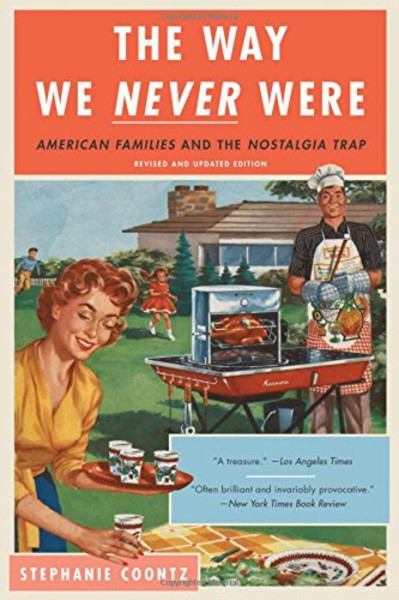
Editor’s note: In 1992—the year the U.S. presidential campaign erupted into a culture war over family values—Stephanie Coontz published The Way We Never Were: American Families and the Nostalgia Trap. The title itself offered the pithy concept, and the book demonstrated that diversity and change have always been hallmarks of American family life: “Leave It to Beaver” was not a documentary. This week (March 29, 2016) Coontz released a substantially revised and updated edition of The Way We Never Were. Below, she provides a brief review of ten things that have changed for the better in the past quarter century, three that have stayed the same, and two that have gotten worse.
In 1992, political leaders and pundits were predicting that changes in family forms and gender roles were leading America into disaster. Were they right?
Whatever happened to the Super Predators? In the early 1990s criminologists were predicting “a blood bath of violence” unleashed by “tens of thousands of severely morally impoverished juvenile super-predators” – all supposedly a result of rising rates of unwed births. But between 1993 and 2010, sexual assaults and intimate partner violence reported dropped by more than 60 percent. According to the FBI’s Uniform Crime Reporting Statistics, the murder rate in 2013 was lower than at any time since the records began in 1960. Since 1994, juvenile crime rates have plummeted by more than 60 percent, even though the proportion of children born out of wedlock has risen to 40 percent.
How about crack babies? In the 1980s and 1990s, newspapers headlined an epidemic of “crack babies” in the inner city, with kids permanently damaged by their mothers’ use of crack cocaine during pregnancy. This led to a wave of punitive legal actions against such women. But follow-up studies have since revealed that children from the same high-poverty areas who had not been exposed to cocaine in utero were equally likely to have developmental and intellectual delays as babies born with cocaine in their systems. As I documented in The Way We Never Were, the big risk to these children was the pollution, violence, and chronic stress of deeply impoverished and neglected communities – including lead poisoning damage that was going on for years before it hit the headlines in 2016 because of the disaster in Flint.
Did career women start “out-sourcing” their children’s developmental care? As women gained more high prestige jobs in the late 1990s, that’s what many experts feared. In fact, however, even as mothers’ work hours increased, their child-care hours increased too, while fathers’ child-care time tripled. Today, both single and working moms spend more time with their children than married homemaker mothers did back in 1965.
And, according to David Cotter, Joan Hermsen, and Paula England’s brief report on Moms and Jobs, educated professionals – the women most likely to work outside the home – spend many more hours in child care than their less-educated counterparts.
But nostalgia never dies; it just finds a new home. Now many pundits claim parents are spending too much time and attention on their kids, failing to instill the independence in their 20-something children that was fostered by parents of the past. In fact, youthful dependence today is mild in comparison to the 19th and early 20th century. Susan Matt points out that during the Civil War, military officials prohibited bands from playing “Home, Sweet Home” for fear it might make young soldiers literally ill from homesickness. During WWI, soldiers published poems in The Stars and Stripes about missing their mothers’ kisses and caresses.Nostalgia never dies; it just finds a new home. Now many claim parents are spending too much time and attention on their kids.
Are hookups the new threat to marriage? In the early 1990s, teen pregnancy was the crisis du jour. Now that teen pregnancy has reached all-time lows, attention has switched to campus hookups. The idea that hookups have replaced relationships and have been imposed on women by men is a new myth in the making, according to a major new survey by Arielle Kuperberg and Joseph Padgett.
And whatever the problems (binge drinking is certainly one), things sure wouldn’t be improved by going back to the 1950s, when the average couple married after knowing each other only six months and almost a quarter of brides were already pregnant.
Did the no-fault divorce laws adopted by most states in the 1980s and 1990s lead to the catastrophic results that pundits predicted?In each state that adopted no-fault, the next five years saw an eight to 16 percent decline in suicide rate of wives and a 30 percent drop in domestic violence. Although no-fault divorce is now universal, divorce rates are actually falling.
Are we seeing the end of marriage for educated women? Another big worry in the 1990s was that college-educated women couldn’t find enough highly-educated men for them to marry, and if they married a man with less education, they were likely to divorce. But since the 1980s, it is non-college-educated women who have experienced the greatest drop in marriage rates. About 85 percent of college-educated women will eventually marry, and these women are experiencing falling divorce risks, regardless of whether they have more education than their husband, points out Christine R. Schwartz.
Does equality really kill eroticism? Data collected in 1991 and 1992 found that couples who practiced equality by sharing housework and childcare reported lower marital and sexual satisfaction than couples in “traditional” marriages. But this data came from marriages formed in the 1970s and 1980s, when sharing housework and child care was still uncommon. For marriages formed in the early 1990s and later the opposite is true: heterosexual couples who share housework and childcare equally now report the highest levels of marital and sexual satisfaction – and the most frequent sex.
Are Brad and Angelina leading young couples astray? As late as 1995, couples who lived together, had a premarital birth, and later went on to marry were 60 percent more likely to divorce than couples who married before having a child. But for relationships started 10 years later, researchers find, couples who live together, have a child, and then go on to wed have no higher chance of breaking up than couples who marry without ever living together first or couples who live together but marry before having a child.
Same-sex marriage has confounded the predictions of opponents and proponents alike. In 1990, more than 60 percent of Americans thought homosexuality was “always wrong,” and many LGBT activists thought fighting for same-sex marriage was a dead-end. As late as 1996, 65 percent of Americans opposed same sex marriage, with just 27 percent in favor. Yet by 2011, 53 percent favored same-sex marriage, paving the way for its legalization in 2015. Definitive, long-term studies now show that children raised by two parents of the same sex turn out fine.
What about that “second shift”that employed mothers faced at the end of the work day, according to many feminist accounts in the 1990s? On average, working moms still do more housework and childcare than their working husbands, but this is because men tend to increase their paid work hours after having a child, while women are more likely to cut back or quit paid work, largely because of the lack of paid job-protected maternity leave and affordable, quality childcare. Counting each partner’s paid and unpaid work, we find that, aside from the first year after childbirth, married moms and dads work about the same number of total hours per week. But is this division of labor what men and women really prefer, as many anti-feminists claim? New research says no and shows why paid paternity leave is just as important for families as paid maternity leave.
Despite these myth-breaking changes, some things have remained the same. Here are three things that haven’t changed. They are a reminder of the persistence of what I called the “nostalgia trap” policy-makers all into when they cling to visions of a Golden Age in the past, refusing to recognize the changing realities of families.
Since 1993, the federal government has made no substantive progress toward policies that help women and men reconcile work and family obligations, while other countries have leapt ahead. In 1993 the Family and Medical Leave Act gave workers in large companies up to 12 weeks unpaid job-protected leave. But 23 years later, only 13 percent of American workers have access to paid family leave, and 44 percent don’t even have the right to unpaid leave. By contrast, every other wealthy country now guarantees more than 12 weeks of paid leave to new mothers, limits the maximum length of the work week, and mandates paid annual vacations. Most also offer paid leave to fathers. The result? American workers express higher levels of work-family conflict than their European counterparts. And the U.S. has fallen from 6th to 17th place in female labor participation among 22 countries in the Organization for Economic Cooperation and Development since 1990. The one exception to this backwardness? The Pentagon, which runs the best affordable and universal childcare system in the country and just instituted 12 weeks paid maternity leave.
Politicians continue to recycle myths about past family life to avoid confronting contemporary family needs. Do these claims sound familiar? “Self-reliant families are the secret to America’s success.” “Our ancestors never asked for handouts.” “Protecting family values must be the basis of public policy.” “America’s founding principles were private enterprise and small government.” “‘Throwing money’ at families never works (unless you’re throwing back money that wealthy families would otherwise owe the government in taxes).”
In fact, frontier families, followed closely by 1950s suburban families, were more heavily dependent on government subsidies than any inner-city families have ever been. Even today, farmers pay only cents on the dollar for what it costs to irrigate their land. The internet and all the “start-up” social media companies that have sprung from it could never have gotten off the ground if the web had begun as a private profit-making initiative.
Our founding fathers would be horrified at the idea that private family values constitute political virtue, and they were extremely hostile toward the unequal accumulation of wealth
New research shows that raising families’ incomes improves their parenting and their children’s outcomes – and even decreases their spending on tobacco and alcohol.
Since 1989, the Heritage Foundation and other rightwing think tanks have been telling us that marriage is America’s greatest weapon against child poverty. But new research shows that growing inequality and income insecurity have been much more important than family structure in explaining the growth of poverty over the past two decades. A more subtle version of the rightwing theory is called the “success sequence”: According to most politicians, it takes just three simple steps to achieve the American dream. Get an education, then a job, and don’t have children until you are married. Telling people that’s the way to end poverty is like saying the way to hit a home run is to pass first base, speed around third, and gallop home. Given the increasing inequality in people’s access to living wage jobs and higher education documented in The Way We Never Were, “the success sequence” is merely a description of an advantaged family life, not a recipe for it.
When politicians and pundits accuse contemporary families of abandoning the values of the past, they often forget that they have also abandoned many features of the past. Here are two things that were actually better decades ago.
Women’s reproductive rights. In 1960 two former presidents, Republican Dwight Eisenhower and Democrat Harry Truman, served together as honorary co-chairs of Planned Parenthood. In 1970, another Republican, President Nixon, signed into law Title X of the Public Health Service Act, funding voluntary family planning programs. But in 2014, the Supreme Court struck down the section of the Affordable Care Act that required employers to cover certain contraceptives. And over the past several years there has been a vociferous campaign to defund and defame Planned Parenthood, which provides almost 3 million women a year with breast exams, cervical cancer screenings, HIV screening, birth control and other essential health services. As of the end of 2015, state legislators had enacted 288 separate restrictions on access to abortion, despite evidence that women unable to get a desired abortion are more likely to experience domestic violence and depression, both risk factors for children.In 1960 two former presidents, Republican Dwight Eisenhower and Democrat Harry Truman, served together as honorary co-chairs of Planned Parenthood.
Inequality: Worse today than in the 1950s and 1960s.
Between 1949 and 1973, the median real wages of men aged 25-29 more than doubled. By 1961, young men were making four times what their dads had earned at the same age. But between 1973 and 2013, the median real wages of young men workers declined by almost 30 percent. Since 1980, the average worker with a high school diploma has made less than his father did at the same age.
From 1960 to 1970, more than 60 percent of national income gains went to the bottom 90 percent of the population, with just 11 percent going to the wealthiest one percent. But from 2002-2007, two-thirds of national income gains went to the top one percent. After falling somewhat during the recession from 2007-09, gains for the top one percent have rebounded, with the top one percent capturing ALL the economic gains of the recovery in 2012 and 2013. These trends have exacerbated relationship instability and created a growing gap in the outcomes and prospects of America’s children.Since 1980, the average worker with a high school diploma has made less than his father did at the same age.
Stephanie Coontz is a Director of Research and Public Education for the Council on Contemporary Families as well as a professor of History and Family studies at The Evergreen State College in Olympia, Washington.
A January Huffington Post article reported on a recent study that showed that 43.5 percent of single mothers get fewer than seven hours of sleep, and 52 percent wake up feeling unrested. Kristi Williams, sociologist and senior scholar for the Council on Contemporary Families raised some good questions for HuffPo readers. In the reporter’s words, Williams noted that “the study doesn’t actually show whether single parenthood causes sleep problems. Because single parenthood is also concentrated among poor and racial minority groups, it’s hard to tell whether being a single parent, being poor or being part of a certain minority group is a stronger factor in poor sleep and poor health.” Williams put it succinctly: “Family policy is health policy.”
While there are varying levels of severity, such that single mothers tend to sleep less and have lower sleep quality than single fathers, and both tend to sleep less and have lower sleep quality than men and women in two-parent households, the unhealthy sleep patterns of single mothers are likely a particularly concerning consequence of a wider pattern of outdated family policies in the United States. After all, even in two-parent families, 32.7 percent of parents did not get enough sleep, and 42.2 percent did not wake up feeling well rested.“Family policy is health policy.” —Kristi Williams
Along similar lines, in November, Stephanie Coontz talked on Wisconsin Public Radio about the stress gap among working parents. She said that in the United States, parents have “greater stresses… and greater levels of work-family conflict than any other country in the Western world.” Other developed countries have made strides in family policy, providing affordable quality childcare and paid family leave, and addressing unemployment and overwork in order to accommodate demographic changes. But Coontz, CCF Director of Research and Public Education, says that in the United States, family policies have remained largely unchanged since they were developed in the 1950s, an “aberrant time when the largest number of kids ever were being raised by a stay-at-home mom and a full-time working father who could count on keeping his job in a way that people can’t today.” Since, according to Coontz, “70 percent of kids have every parent in the household involved in the labor force,” a modernization of our work and family policies might be a particularly effective strategy for improving the health of the almost 50 percent of single moms, as well as the 32 percent of parents in two-parent households, who don’t get enough sleep.
Braxton Jones is a graduate student in sociology at the University of New Hampshire, and serves as a CCF Graduate Research and Public Affairs Scholar.
Fifteen years ago, the going wisdom on cohabitation was that marriages preceded by living together were more likely to fall apart—that news is out of date. Several pieces from CCF share more current work on cohabitation, including the key observation that cohabitation itself is no longer associated with more or less risk of divorce in any subsequent marriage. Other recent pieces cover cohabitation and housework, childrearing, and remarriage.
Kelly Musick and Katherine Michelmore on September 23, 2015
J.K. Califf, Flickr.
One of the consistent findings of sociological research in recent decades has been that couples who had a child before getting married had substantially higher odds of divorcing than couples who married first. This held true even when researchers controlled for other factors that tend to distinguish such couples from those who marry directly—education, family background, race and ethnicity. But considering the tremendous increase in premarital cohabitation and childbearing over the past quarter century, and in light of new evidence that many other longstanding “laws” of marriage and divorce have been overturned (e.g., see “It’s Not Just Attitudes: Marriage Is Also Becoming More Egalitarian”; Are Individuals Who Marry at an Older Age Too Set in Their Ways to Make Their Marriages Work?), we set out to investigate whether this particular sociological “rule” still applies.
We used large-scale data from the 1995 and 2006-2010 National Survey of Family Growth (NSFG), which asks women of childbearing age questions about relationships and family formation. We analyzed all marital and cohabiting unions in which a child was born within 10 years of the surveys (i.e., between 1985 and 1995 in the earlier period and 1997 and 2010 in the later period). We ended up with a sample of 2,656 couples from the 1995 NSFG and 3,046 from the 2006-2010 interviews.
In the earlier period, for births occurring between 1985 and 1995, 17 percent of the couples we studied had a child before marrying. Of these, 21 percent married within a year, and 59 percent of those still together went on to marry within 5 years. In the later period, for births occurring between 1997 and 2010, 35 percent of the couples we studied (fully twice as many as a decade earlier) had a child together before marrying. This time a smaller but still significant percentage of such couples later married: 15 percent did so within a year, and 48 percent within 5 years.
In the 1995 sample, as researchers had long warned, couples who lived together, had a premarital birth, and later went on to marry were more than 60 percent more likely to divorce than couples who married before having a child. But just a decade later, couples who lived together, had a child, and then went on to marry after the birth of their first child had no higher chance of breaking up than couples who married without ever living together first or couples who lived together but married before having a child.
In each case, we controlled for socio-demographic factors that correlate with differences in marital behaviors and the risk of divorce. Controlling for these factors, we found that the risk of divorce for couples who wed after having their first child outside marriage was no longer any higher than for couples who lived together but married before having their first child or for couples who never lived together at all before getting married and starting a family.The risk of divorce for couples who wed after having their first child outside marriage is no longer any higher.
The only cohabiting parents with significantly higher chances of breaking up were those who never married. Again controlling for socio-demographic factors, we found that about 30 percent of couples who never married separated within five years, a breakup rate twice as high as that we found among the married. This is a disturbing finding in terms of child outcomes, because we know that family instability is a risk factor for children.
It is not at all clear, however, that if we could magically assign these cohabiting couples to marry, their family relationships would be more stable. In general, cohabiting couples tend to have less education and income than married couples, and it may be that those who do not marry are a particularly disadvantaged group (for example, we could not account for the job prospects of male partners). Such couples may also have relationship problems (substance abuse, infidelity, or domestic violence) that explain why they do not get married, and that would not be solved by giving them a marriage license. Marriage is less a silver bullet than it is an outcome of a whole set of factors linked to stability and security that help parents stay together. The stark and growing differences in divorce risks between couples with little education and those with a college degree undermine the notion that marriage itself can solve the bigger problems that stem from economic uncertainty and inequality (e.g., see “The New Instability”; Labor’s Love Lost).Marriage is less a silver bullet than it is an outcome of a whole set of factors linked to stability and security that help parents stay together.
Implications
Our research addresses the potential impact of rising childbearing among cohabiting couples—and in the process sheds new light on the evolving meanings of marriage and cohabitation in the U.S. By looking closely at changes in parents’ unions around the time of childbirth, we found that premarital births no longer predict breakups, as long as couples marry at some point after a child is born. But much still remains to be learned about the causes and consequences of persistent family instability when parents never marry at all.
This briefing paper highlights some of the findings of a much longer study by Kelly Musick and Katherine Michelmore, “Change in the Stability of Marital and Cohabiting Unions Following the Birth of a Child,” forthcoming in Demography.
Kelly Musick is an Associate Professor of Policy Analysis and Management at Cornell University. Katherine Michelmore is a Postdoctoral Fellow at the University of Michigan.
The U.S. Census Bureau’s report on income, poverty and health insurance coverage, released today, reflects the continued uncertainty for U.S. families that has persisted since the Great Recession. Year-to-year changes in most trends were modest or not statistically significant—except in the case of health insurance coverage—but the longer-term trends are important.
Specifically:
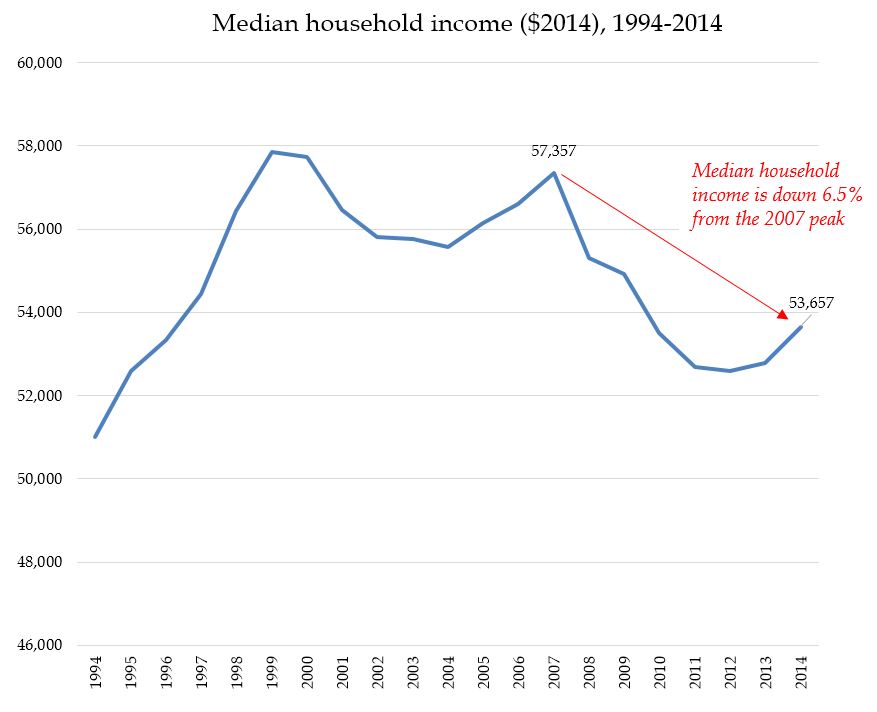
Household income has still not recovered to its pre-recession levels. In inflation-adjusted 2014 dollars, household income is now $53,657, which is down 6.5% from the pre-recession peak of $57,357. Although there has been improvement since the lowest level in 2011-2012, this remains a substantial loss—and source of uncertainty—for the typical U.S. household, even with the steady job growth of the last six years.
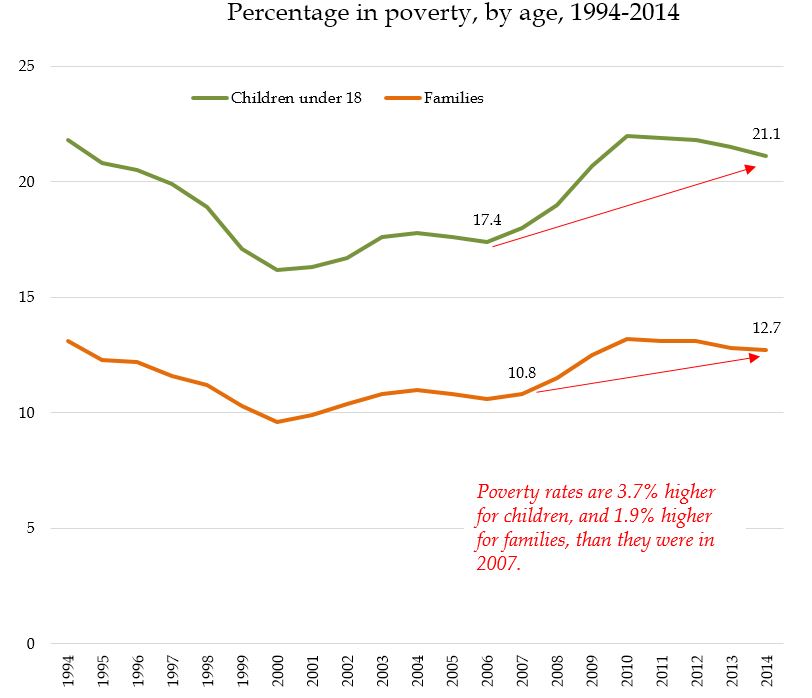
Similarly, poverty rates for families remain higher than they were before the recession. In 2014, 21.1% of children lived below the poverty line—up from 17.4% in 2007. For families overall, the poverty rate stands at 12.7%, which is 1.9% higher than it was in 2007.
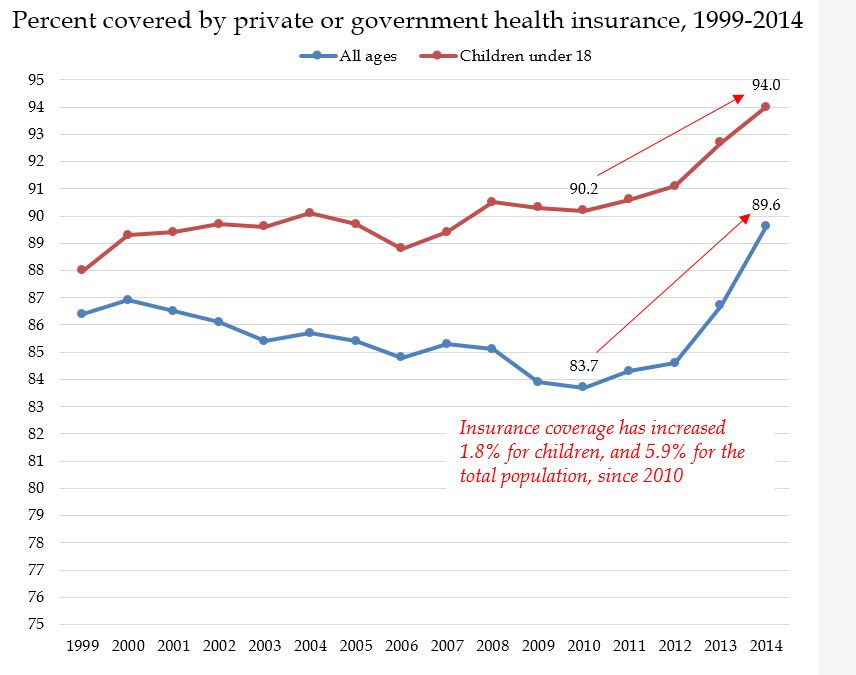
The most important good news, continuing recent trends, may be the increase in health insurance coverage. Insurance coverage (from all sources) has increased 1.8% for children, and 5.9% for the total population, since 2010—now standing at 94% for children and 89.6% for the total population. This is generally attributed to the expansion of insurance coverage provided by Obamacare.
Despite strong job growth, the recovery remains a mixed one for U.S. families, with significant uncertainty and hardship a persistent part of family life for many people. However, with household income down and poverty up, the expansion of health insurance coverage may be easing the strain for families, helping to mitigate one important source of uncertainty and potential crisis—the costs associated with a sudden, or ongoing, health condition requiring expensive care.The expansion of health insurance coverage may be easing the strain on families, helping mitigate one source of uncertainty and potential crisis.
A cartoon by Greg Williams, Flickr CC. Click to expand. Original: https://flic.kr/p/2Tipvn.
Looking for some perspectives on parenting? Here are a few articles to revisit.
In January, Sandra Hofferth presented to CCF a briefing report on Child-Rearing Norms and Practices in Contemporary American Families. Hofferth, Professor, Family Science, at University of Maryland’s School of Public Health, notes that although a recent Census Report had found some differences by family type, most American parents—married, divorced, or single—read to their children, monitor their children’s media youth, and engage their children in extra-curricular activities. Revisit Hofferth’s report here for how parents are doing, by the numbers.
In August, Michelle Janning, a sociologist at Whitman College and CCF Co-Chair, shared a three-part series on parenting: her interest was in overparenting and cross cultural metaphors.
The Council on Contemporary Families is a non-profit, non-partisan organization dedicated to providing the press and public with the latest research and best-practice findings about American families. CCF seeks to enhance the national understanding of how and why families are changing, what needs and challenges they face, and how these needs can best be met.