Archive: Nov 2008

Don has a thought-provoking post on the use of Facebook in mass-interpersonal persuasion.  In a post-lection analysis at CLU, José brought up the idea of how Obama created what is tantamount to a social movement using web 2.0 tools.  I was reading a US News article on the use of YouTube in the 2008 campaign and couldn’t help but recall the ParkRidge47 spectacle from early 2007 and the role of viral multimedia in politics and mass-interpersonal interaction.  In this video, the creator, Phil de Vellis, talks about how politicians should inspire content and how his Vote Different mashup went viral despite his posting anonymity.

The rise of political video watching is evident from Pew Research Center figures, going from 24% in December of 2007 to 39% in late October.  What I find interesting is how video is being used by both the public and the candidates.  The USNews article talks about how Obama’s campaign posted on YouTube a rebuttal to clips of Rev. Wright’s inflammatory remarks going viral, which were being used against Barack.  Obama Girl, the Yes We Can video, and Obama Art are all examples of Web 2.0 tools of video sharing and blogs being used to create meaning.  Add into the mix, the fourth estate (the press) with conservative Glenn Beck posting a video on the Obama National Anthem.

José noted how the Obama campaign will be written up as a “how to” guide on Web 2.0 campaigning, but what will the Web 2.0 president look like?  Given the “social movement” created, will this foster a technologically-mediated interactive democracy or will it just be more clutter?  How will meaning and relevance be maintained and how will the Republicans use Web 2.0 to rebuild?

There is some remarkable new research out on the persuasive dynamics of Facebook. Stanford researcher BJ Fogg argues that a new form of persuasion has emerged in the structure of Facebook, namely, “mass interpersonal persuasion. . . . This phenomenon brings together the power of interpersonal persuasion with the reach of mass media.” In particular, Facebook has brought together six dynamics of persuasion for the first time in history, such as an automated structure, rapid cycle, and measured impact—in a way that goes far above and beyond what is often called “viral adoption” (www.bjfogg.com/mip.pdf). Weiksner, Fogg, and Liu also find another six patterns of persuasion in more specific Facebook applications, such as provoke and retaliate, reveal and compare, and expression (some of which are native to Facebook)—which invoke many persuasive norms such as “reciprocity,” “cognitive dissonance,” and “social proof” (www.springerlink.com/index/20652047j6801376.pdf).

I believe that mass interpersonal persuasion and the confluence of these influential techniques bear heavily upon the design and articulation of future public sphere activities. While there is much about Web 2.0 worth critiquing, we might remain critically hopeful about the possibilities for Facebook to create online cultures of trust and risk that perform valuable functions for deliberative democracy. Running through Facebook’s post-election newsfeeds, I noticed the remarkable degree to which many people engaged their online friends, of many political persuasions, in discussions over the results. Even when some of this communication was quite divisive, people still carved out an interactive space for engagement. Beyond my own experience, however, there are two connections I would like to make between Facebook and the public sphere.

First, in ideal public spheres individuals should be able to talk in an “unrestricted fashion” about matters of general interest—and these arenas are instantiated through conversation “in which private individuals assemble to form a public body” (Habermas). There are thus some bounded communicative conditions that individuals commit themselves to in order to democratically advance as much of the public interest as possible. In the same way, when Fogg mentions that Facebook makes it easy to build a “high-trust culture” due to a number of agreements and assumptions users make when joining and using the service, we can see that the structure of Facebook appears to lay the groundwork for communicating upon which much public sphere activity relies.

Second, what Fogg terms “automated structure” evidences how Facebook sets in motion persuasive experiences. As he puts it, “computer code doesn’t take a vacation or go on coffee breaks.” As such, this is one place where I see Facebook perhaps promoting civic engagement even more than, say, face-to-face communication. Facebook actually encourages members to further online interaction without their having to do anything. We’ve all been to public meetings where someone forgets to send out the minutes afterward, or follow up with an important e-mail to the group. Facebook has no such qualms, its computer codes make sure that we receive news of important events, and can even see public conversations occurring between others in ways unrestricted by the demands of time and space. If someone else joins a group protesting global human trafficking, they don’t need to tell others that they have joined, Facebook structures the experience in such a way that everyone will rapidly receive the message. 

Again, there is undoubtedly a dark side to online social networking sites (see much of the popular press lately), which still needs much further theoretical elucidation. Yet in the face of several democratic patterns emerging in online networking, it seems rhetorically productive to consider not only how Web 2.0 might be supplementing other forms of communication (such as face-to-face), but may in a few important respects, be advancing beyond them. – Don Waisanen 
 

TechPresident posts on change.gov, a website the Obama campaign has created to encourage a more open, participatory governing process. The site contains the standard fare, like a “share your vision” site where you can post your vision for the country. The site, of course, also has a blog where I’m sure the president-elect will comment on the latest spat on The View or who Miley Cyrus is dating.

What concerns me about this site is that it is set up to provide the appearance of a participatory culture without much of an infrastructure to deliver on that promise. How do you go from collecting “visions for America” from random posters to leveraging the “wisdom of the crowds” to produce better policy outcomes? There are innovative ways to get citizens directly involved. One exciting example of this is publicmarkup.org, a wiki site that allows users to markup legislation as if they were committee members. This process of self-aggregating public input is more likely to lead to direct citizen input. Another interesting experiment is the Future Melbourne project (HT: TechPresident). Where citizens were asked to contribute input to the Australian city’s master plan directly by making changes to it on a wiki.

These projects do not guarantee direct citizen input, but if the campaign is serious about being more collaborative in its governance, and there’s no reason to suggest that they aren’t, there are more sophisticated tools they could be using to leverage the power of citizen input.

I couldn’t resist posting this as a follow-up to my previous note about the use of political culture in advertising. On my Gmail today, I saw a link that said, “Michelle Obama in J.Crew® – www.JCrew.com – Get the Look Michelle Obama Wore on The Tonight Show Only from J.Crew.” Clicking through it brought me to this page:

Michelle Obama Ad
Michelle Obama Ad

This is a very clever use of Michelle Obama’s mention of wearing J. Crew clothes. It seems to be capitalizing on her status as a new style icon (a la Jackie O). Also, it’s an interesting example of our gendered ideas about what products are associated with a male vs. female public figures. Somehow I don’t imagine that President-Elect Obama would be found discussing his clothes on Jay Leno or have his outfits available for purchase at popular retailers.

José offered up observations that the Presidential race might tighten up.  I’ve been thinking that the election is likely to be closer than the polls are indicating.  One hunch of mine that explains the discrepancy is that those supporting a candidate losing momentum are less likely to participate in a poll, along the lines of CORFing (cutting off reflected failure), but in this case it’s cutting off impending doom.  I also wonder how many people who didn’t even vote will jump on the bandwagon after the election, claiming to have voted for Obama–Fauxbamamaniacs?

At any rate, I was in New York (Westchester) last week and read an article by John Heilemann in New York magazine on the next steps for Obama (with the assumption that he will win) and what the margins will be in the House and Senate.  Heilemann notes how Bill Clinton’s first 100 days were chaotic and while Bill also had a Democratic House and Senate, he suffered from a lack of legitimacy in Congress.  Obama, on the other hand, is highly strategic and has a transition plan in the works and will be working with Reid and Pelosi who are likely to need him more than the other way around.

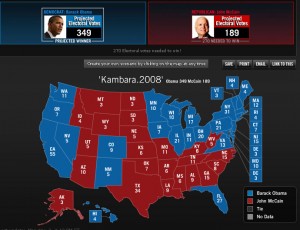
This got me thinking about what I think the political landscape will look like in 2009.   I had my marketing students create electoral map predictions, but unfortunately I saw this compilation on PoliticalMaps after class:

My prediction isn’t all that exciting or controversial (Obama 349:McCain 189).  I see Indiana as going for Obama, due to Lake County in the NW outside of Chicago.  I see the undecideds going for McCain in NC and McCain taking Missouri.  The one’s I’ll be watching are Florida, Virginia, and Ohio, representing 56 electorals.  If Obama loses these states, he would still win, but with less of a “mandate.”   I’ll also be looking for the Ron Paul factor in Montana, but I’m dubious.
I don’t see the Democrats getting the 60 Senate seats they would love to have to be filibuster-proof.  I see a +8 pickup with Franken (MN) and Hagan (NC) squeaking by.  The House it currently at 236-199 and I think the Democrats will add 15 to 18 seats to their majority.  The interesting races (to me) are CA-4 and CO-4 , races in fairly rural districts with candidates who have clear ideological differences.

Click here to join our foray into the wide world of pod. In this podcast, four of our regular contributors here at California Lutheran University (Jose Marichal – Political Science, Ken Kambara – Marketing, Don Waisenan – Communication/Rhetoric, Russell Stockard – Communication/Cultural Studies) elaborate on some of our earlier posts. Below is a link to the three blog posts we reference in the podcast. I hope you find it a pleasant and intellectually stimulating auditory companion.

Palin’s Persuasion by Don Waisenan

Unlucky in Love, Lucky (in)Justice by Russell Stockard

Where did Race Go by Jose Marichal (unfortunately the recording cuts out in this middle of our discussion of this post)

We’d love to hear what you think.

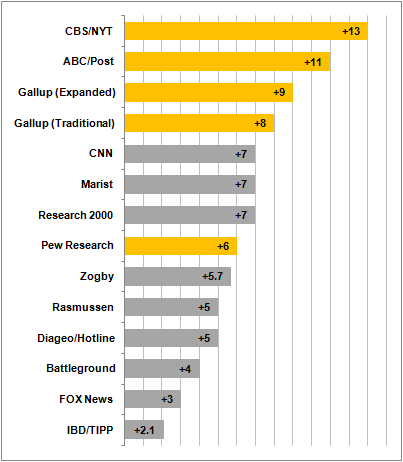
I apologize in advance if this is post is of interest only to survey research nerds. But I find the following chart from FiveThirtyEight fascinating:

Various Presidential polling sample with those in yellow incorporating cell phones.

It seems to suggest cell phone-only users (presumably young people) are enough to swing most polls about 2 points toward Barack Obama. No telling how this translates into voter turnout and actually results.

One more thought: while many may think of cell phone-only users as just young people, it is increasingly common way for working class and poor people have phones. So, it may include many black and lower income voters, too.