Tag Archives: toys/games

Two More Inspiring Gender-Neutral LEGO Ads

After the recent scandal over LEGO Friends, I am excited to report that I am in the process of working with a LEGO “fanatic,” David Pickett, on a series of posts about gender and the history of LEGO.  In the meantime, as a teaser, I wanted to offer you two LEGO ads that were from the same campaign as the one making its semi-viral way around the internet (1980-1982).  As with the original, these are evidence that advertising doesn’t have to reproduce the idea of “opposite sexes”:

Thanks to Moose Greebles and his Photostream.

Little Girl Out-Analyzes Her Dad

Twenty-three of you (a record I think) have sent in this clip of a little girl in a toy store critiquing the way the store is divided into pink princesses for girls and superheros for boys.  It’s heartwarming and inspiring to see a child offer a critical analysis of the world she lives in, something that most commentators have observed.

What I, and some of you, noticed was that her own analysis and that of the adult taking the video (presumably her Dad) differ.  And, believe it or not, her analysis is more correct than his.

Rightfully identifying what sociologists call “androcentrism,” she notes that girls like both girl and boy toys, but boys only like boy toys.  She says:

…because girls want superheros and the boys want superheros and the girls want pink stuff and the girls… and the boys want… and the boys don’t want pink stuff… (gently shaking her head back and forth)

Her Dad corrects her, saying “Boys, well, boys want both…”

But her Dad is wrong.  Boys in the U.S. are taught from a very early age to avoid everything associated with girls.  Being called a “girl” is, in itself, an insult to boys.  And the slurs “sissy” and “fag” are reserved for men who act feminine.  So, no, boys (who have learned the rules of how to be a boy) generally reject anything girly.  (Indeed, this was one of the themes of Jimmy Kimmel “bad present” prank played by parents on their kids.)

The girl’s Dad, however, articulates a symmetrical analysis. The idea is that there are gender stereotypes — ones that apply to boys and ones that apply to girls — and that both are inaccurate, unfair, and constraining.  His mistake is in missing the asymmetrical value placed on masculinity and femininity.  Boys and girls are simply not positioned equally in relationship to stereotypes of femininity and masculinity.

I have to admit, it’s pretty neat that she has picked up on this nuance so early. I wish most adults had her insight… and her passion:

Thanks to James, Julie G., Carly M., Brooklin N., BogganStoryTeller, Denise, Allie H., Yvonne R., Mark L., Karim S., Ann K., Lenny M., Isabeau P.-S., Daniel K., Marsha, Jay L., Shayna A.-S., Josh W., Kimberly L., Melissa, Colleen W., Simon G., and Brad for sending in the link!

Beauty and the New Lego Line For Girls

Cross-posted at Ms.

A few years back we published this fantastic ad for Legos as an example of gender-neutral advertising. It appeared in 1981; during my childhood, I’m happy to say.

The ad offers nice context for the new effort by Lego to capture The Girl Market.  Their new line of Legos, Lego Friends, has gotten a lot of attention already. In the circles I run in, it’s being roundly criticized for reproducing stereotypes of girls and women: domesticity, vanity, materialism, and an obsession with everything being pastel.  Kits include a house, cafe, animal hospital, tree house, beauty salon, and an inventor’s lab.  Choice examples:


The new line also includes a new Lego figurine that is taller, thinner, and more feminine, with boobs.  There is no innovation here; it is the exact same makeover that we’ve seen in recent years with Dora the ExplorerStrawberry Shortcake, Holly HobbieLisa Frank, Trolls, Cabbage Patch Kids, My Little Pony, Rainbow Brite, and Candy Land (or visit our Pinterest collection of Sexy Toy Make-Overs).

Examples of the old “mini-fig” and the new “mini-doll”:

(source)

The company is framing their new line for girls with “science.” Executives are going to great lengths to explain that the line is based on research, using anthropologists who spent time with girls in their homes. The frame gives the company an excuse for reproducing the same old gender stereotypes that we see throughout our culture.  They can shrug their shoulders and say, “Well, what are we to do? This is what girls want.”  In this way they are trying to make it clear that they shouldn’t be held accountable for the messages their products send.

But it’s no accident that girls feel alienated from Lego.

According to Business Week, Lego has spent most of the last decade focusing their products on boys.  They have deliberately designed products that they expect will appeal to boys and included boys almost exclusively in their marketing material. Today Legos are shelved in the boy aisle is most toy stores.

So, basically, what Lego has done over the last few decades is take a truly wonderful gender-neutral toy, infuse it with boyness, and tell every kid who’ll listen that the toy is not-for-girls.  Now, stuck with only 50% of the kid market, they’re going after girls by overcompensating.  And, to top it all off, they’re shaking their heads and doing “science” to try to figure out girls, as if they’re some strange variant of human that regular humans just can’t get their head around.

In fact, girls don’t feel like the toy is for them because Lego has done everything in its power to ensure that they will not.

The market research manager sums up Legos’ impression of what girls want this way: “The greatest concern for girls really was beauty.”  How ironic, because the true beauty of Lego is its ability to inspire creativity, not enable conformity.  They somehow knew that back in 1981.

(An ad that deserves being looked at over and over.)

Thanks to Anjan G., Sangyoub P., Rachel W., Dolores R., Erin B., Christie W., and Paul K. for suggesting that we write about this!

‘Tis the Season for Reinforcing Gender Differences

Time for another round-up of gendered kids’ items!

Will L. noticed something interesting recently at Old Navy. The boys’ section offered two styles of jeans, Skinny and Regular:

But when he looked at the corresponding section in the girls’ clothing, he found not Skinny and Regular, but Skinny and…Super Skinny:

Caro Reusch sent us an example of kids;’ t-shirts with messages about what we value for men and women. She saw the following at a mall in Berlin:

The blue one says “My daddy is stronger than yours,” while the pink announces, “My mommy is prettier than yours.”

Similarly, Lindsey B. saw two themed bibs for sale at Target. The blue bib is a doctor and the pink one is a ballerina:

Shantal Marshall, a postdoc student at UCLA with a Ph.D. in social psych and blogger at Smartie Pops, noticed that Crayola has a new product out, the Crayola Story Studio.  It lets you upload a photo of yourself, have it turned into a cartoon, and then it’s inserted into one of 3 themed templates: Disney Princess, Spiderman, or Cars. You can then print off various versions of coloring books based on those templates. The commercial for the Spiderman version shows a boy excitedly becoming a superhero:

For the Disney Princess version, we see a girl excited to become a princess, then dancing in the background with her very own Prince Charming:

As Shantal said, it’s a bit dispiriting that Crayola’s slogan for these items is “give everything imaginable,” but the pre-existing templates, and their marketing, don’t seem to include an imaginable alternative to the “boys = superheroes” and “girls = princesses” division we see so often in kids’ toys.

Madelyn C. saw a store in Warsaw, Poland, that just goes ahead and makes the gendered division of the toy industry explicit:

Finally, Jessica M. sent in a link to a GOOD post by Christopher Mims about the Toy Industry Association’s 2011 Toy of the Year Awards. There are general categories of toys, such as educational, innovative, and action, but of course also girl and boy categories (also, I personally can’t think of “boy toy of the year” without thinking of Madonna’s outfit in her “Like a Virgin” performance at the first MTV Video Music Awards, but maybe the ’80s are sufficiently behind us that the phrase resonates differently for most people). Anyway, Mims discusses the gendered messages in the commercials for the nominees in the two categories. Among other things, the categorization is rather confusing. Hexbugs are nominated in the boy category, even though commercials for them show girls as well:

Also, Mims points out that the boys’ category “includes a strong undercurrent of Beyond Thunderdome via WWE.” Exhibit A: The commercial for Beyblade Metal Masters, “performance tops” to be used in “strategic battles”:

Playing with tops has gotten super hardcore, I guess. Probably they should look into a sponsorship from an energy drink.

Examining Cultural Change: Children’s Tattoo Toys

Cross-posted at Cyborgology.

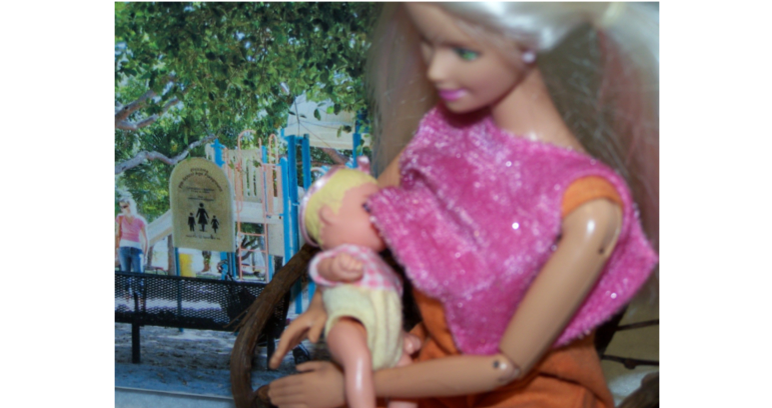
As part of my research into the popularization of tattooing, I have accumulated quite a few interesting links on tattoo toys for children. I don’t mean those temporary tattoos we all used to get from the vending machines at popular chain restaurants. This toys I am talking about have drawn flack from parents as being “inappropriate” for kids, creating an example of a burgeoning “moral panic”. Some examples include: tattoo inspired toddler weartattoo machines for kids, and of course, tattooed Barbie dolls.

The most recent children’s tattoo toy to come under attack is the collector’s edition “Tokidoki Barbie,” which features prominent arm, chest, and neck tattoos. This is the first Barbie to come out of its packaging with tattoos already applied. The first tattooed Barbie called “Totally Stylin’ Tattoo Barbie” was interactive and designed for children, allowing them to paste the temporary tattoos (actually stickers) on themselves or the doll. This new “Tokidoki Barbie” is not a toy so much as a collector’s item, meant to capture a particular historical moment in time and to be exchanged between collectors (the doll is now auctioning for roughly $500 each). With a hefty $500 price tag, I do not see many children playing with this doll. It is also not sold in stores, and is only available online.

Tokidoki Barbie:

Toys like these have been released every few years since the 1990s, when tattooing was ranked as the 6th fastest growing industry in the country (Vail 1999). But we are now seeing more children’s tattoo toys spring up, dovetailing with the increasing popular interest in the craft. We may very well be observing a second Tattoo Renaissance (Rubin 1988), especially given the expansion of the industry and the artistic flowering that has occurred since the tattoo reality TV shows first emerged in summer 2005. 

I believe we are we observing a cultural paradigm shift (Kuhn 1962) regarding tattooing.  Cultural trends are slowly reshaping popular conceptions of tattooing, turning them from “marks of mischief” (Sanders 1988) into an “ironic fad” (Kosut 2006) of consumer capitalism. Whereas tattooing was once largely reserved for working-class men, sailors, carnival performers, and exotic dancers, we have since seen the practice become widely popular amongst all races, genders, and classes.

G8 Tat2 Maker by Spin Master Toys:

Beginning with the Tattoo Renaissance of the 1960s (Rubin 1988) and more recently with the expansion into reality television (Lodder 2010), we have seen the cultural cache of tattooing shift in favor of middle-class notions of identity work (Atkinson 2003); that is, towards seeing the body as a vehicle for expressing oneself, towards actively controlling and crafting the body as a form of empowerment, and towards the development of “distinctive individualism” through appearance (Muggleton 2002). The highly narrative focus of tattooing contained in popular reality TV shows like “LA Ink” or “NY Ink” only bolster these trends, as new tattoo enthusiasts invest deeply-held meanings into each tattoo.

But these trends do not mean that tattoo toys aimed at children are any less offensive to some. Largely, it appears to be a generational divide: youth are much more supportive (in fact, largely celebratory) towards body art like tattoos and piercings, but the baby boomers continue to view tattoos through the lens of deviance.

For people of my parents generation, tattoos continue to be a symbol of deviant proclivities. Some have even called it a “disease” plaguing the youth of today. I have taken issue with such an interpretation of tattooing, especially by social scientists who continue to conceptualize the practice as an indicator of mental pathology or emotional instability, and have proposed a “pro-social” conception of contemporary body modifications like tattooing and piercing [you can read my work here]. In my opinion it is just a matter of time before prominent and visible tattoos become commonplace in professional and public settings, tattooed Barbie notwithstanding.

——————————

David Paul Strohecker (@dpsFTW) is a PhD student at the University of Maryland, College Park. He studies issues of intersectionality, consumption, and popular culture. In addition to his work on the popularization of tattooing, a project on the revolutionary pedagogy of public sociology, and more theoretical work on zombie films as a vehicle for expressing social and cultural anxieties. He previously wrote for the blog Racism Review and currently blogs at Cyborgology.

For more from Strohecker, see his posts on facial tattoos, the origins of zombies, QR codes and the digital divide, and laughing at disability.

If you would like to write a post for Sociological Images, please see our Guidelines for Guest Bloggers.

The Last Sideshow Fat Man

I like this post. And it’s the two-year anniversary of Bruce Snowdon’s death. So, here’s my toast to the last sideshow fat man.

He’s so big and so fat it takes four girls to hug him and a box car to lug him.  When he dances you’ll swear he must be full of jelly, cause jam don’t shake that way.  And you know girls!  He is single and lookin’ for a wife, he’ll make some lucky girl a fine husband, why he’s so big and fat, he’ll provide you with a lot of shade in the summertime, keep you nice and warm in the winter time and give you lots of good heavy lovin’ all of the time!

– Carnival Spiel by Ward Hall

On Nov. 9th 2009, Harold Huge, a man billed as the very last sideshow fat man, died.  He weighed 607 pounds or so.

Harold’s real name was Bruce Snowdon.  He had degrees in paleontology, anthropology and chemistry. In 1977, he found himself bored with his work and stumbled across the idea of being a Fat Man:

I had put on a lot of weight between the time I was 20 and 25. I was up to about 450 in those days. I went to the local library, and I was poking through some old circus books and I see this one picture about a sideshow, maybe circa 1905, and I’m looking at this fat man and I’m saying to myself, “He can’t weigh more than 350 pounds.”

Now, I ask myself, how the hell would I go about getting into a sideshow? I’d never even seen a sideshow in my lifetime. In the late ’70s the industry was a very pale ghost of its former self. Instead of thousands, there were maybe dozens left then. So I figured, logically, there’s got to be some sort of trade journal for the carnival industry. It’s Amusement Business. And I’m looking through the AB. Taking a lucky stab, I wrote the editor, Tom Powell. And Tom Powell happens to be a very good friend of Ward Hall. Bingo. I had the job.

Bruce, 1978:

In an interview with James Taylor (from which the above quote is also taken), Snowden explained:

I don’t mind being enormously fat… I come from a long line of fat people. My old man tortured himself for 40 years going from 200 to 300 [pounds] and back again. He eventually lost the weight, but he also lost his mind.

Snowdon played Harold Huge for 26 years.  The year of his retirement, in 2003, he played himself in the movie, Big Fish:

After retirement, he raised chickens:

So the sociological question I would like to pose is: Why is Snowdon the last fat man?

Marc Hartzman suggests that fat men and woman became less of a curiosity because “waistlines expanded and obesity became less of a laughing matter.  As the years went by, spotting a man who weighed more than quarter of a ton was not that unusual…”  So there’s two  hypotheses: (1) we see fat people everywhere and so it’s no longer a curiosity and (2) obesity has become a very serious matter, not to be played with at sideshows or elsewhere.

Another hypothesis might involve (3) a growing distaste for objectifying and dehumanizing those who are unusual.   As the human rights era evolves, we increasingly embrace difference and promote tolerance.

(4) Perhaps sideshows themselves are simply out-of-fashion, a drab alternative to Avatar in 3D or a Wii.  Or, (5) maybe the internet has made all curiosity easier to quench.  With a click of the button, we can see DD breasts, thalidomide babies, and cats playing the piano… who needs a sideshow?

I can think of reasons to endorse and reject all of these hypotheses.

So, in honor of Snowdon’s 26 years of service and delightful sense of humor (“If there’s a bitchy type of human being, it’s somebody on a diet”), let’s speculate.

——————————————————

Sources: Sideshow World, AOL News, Shocked and Amazed, Randall Levenson photography, and Shapely Prose.

The Evolution of the Easy Bake Oven

Yesterday Hasbro announced a new model of the Easy Bake Oven designed in response to the growing efficiency of light bulbs.  This sounded to me like a perfect opportunity to bring back our post on the evolution of the toy.  You’ll see the new model at the end.

————————

My adorable niece got an Easy Bake Oven for Christmas this year and I was shocked.  Shocked!

No, not because of gendered gift giving, socialization, blah blah blah… (I don’t know where you would get that idea).  Instead, I was shocked by what cooking apparently looks like in 2009.  But let me start at the beginning…

The first Easy Bake Oven was released by Hasbro in 1963 (history here).  It looked like a range with a stove top and an oven:

6a00d83452989a69e200e5503ce76d8833-800wi

It looked like this, with minor changes in color and amenities, for a while.

1964:

64

1971:

71

Then, 1978.  It turns out, in 1975, for the first time, sales of microwave ovens exceeded those of gas ranges.  And, what do you know, the Easy Bake Oven was suddenly a microwave with a digital clock:

78

1983:

83

Presumably, between 1963 and 1978, what cooking looked like changed dramatically and the evolution of the Easy Bake Oven reflected that.  This is what surprised me when I saw my niece’s oven.

Ironically, this year’s Oven is painted in the original turquoise, as a nod to 1963, but it is still clearly a microwave:

easyBake

2011: Commercially available light bulbs are no longer inefficient enough to bake goodies.  This year’s model, then, is actually a real oven, reaching temperatures up to 375 degrees:


So that’s technological and socioeconomic change as signified by the Easy Bake Oven.

Stereotypes of Native Americans in Video Games

Dolores R. sent us a link to a video posted at Racialicious about stereotypes of Native Americans in video games. Beth Aileen Lameman, the director and narrator, discusses a number of frequent tropes used when depicting Native Americans in games, such as the half-breed hero, the wise old Indian sage, and, of course, the hottie Indian princess, as well as the tendency to conflate many different tribes and cultures. It’s a great summary of common representations of Native Americans in pop culture more broadly:

Native Representations in Video Games from Elizabeth Lameman on Vimeo.