Tag Archives: gender: economics

Interactive Map of the Gender Pay Gap

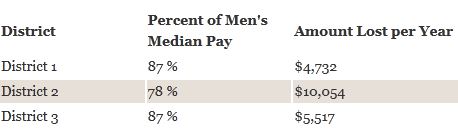
The National Partnership for Women & Families has posted an interactive map that displays the gender pay gap in each state and in the Congressional districts within the state. It uses Census Bureau data comparing full-time, year-round workers (that is, the scenario in which we’d expect women’s income to be closest to men’s). When you click on any state, it brings up information about it. For instance, in Nevada, women make 85% of what men do. Women working full-time have a median income of $35,484, while men’s median income is $41,803. The gap is smallest in the 1st and 3rd districts (both including parts of the greater Vegas metro area), but significantly larger in District 2, which covers the rest of the state, much of it rural:

Here are the 10 U.S. Congressional districts with the largest gender gap in median pay:

They don’t list the state or districts with the smallest gap. Just from casually and non-systematically clicking around, the state with the most parity that I found was in Washington D.C., where women make 90% as much as men. Let us know in the comments if you find anywhere with an even smaller gap.

Illustrating the Gender Pay Gap

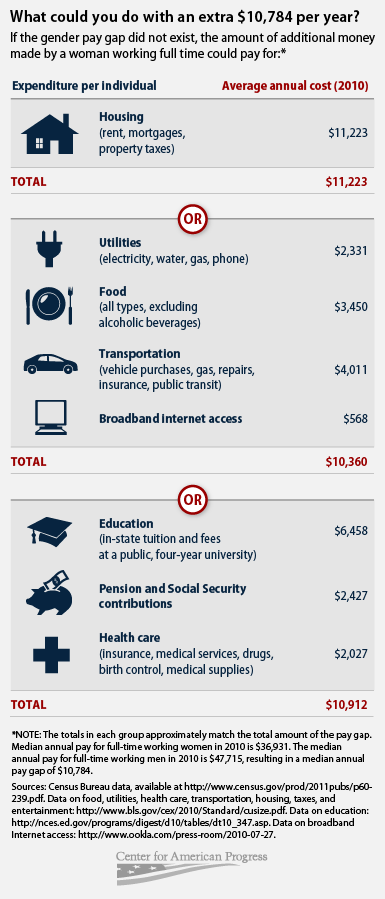
While income inequality between the sexes has decreased in recent decades, women still only make seventy-seven cents for every dollar a man is paid. Matt Separa from the Center for American Progress illustrated what could be bought with those lost wages to help us conceptualize how wide the wage gap is.

His first chart shows how the $10,784 in underpaid wages would almost cover annual housing costs or could pay the combined costs of a year’s worth of utilities, food, transportation, and internet access with a few hundred dollars to spare. The lost wages could also almost pay all the expenses for annual in-state tuition at a public university, twelve months of contributions to Social Security, and basic medical care for a year:

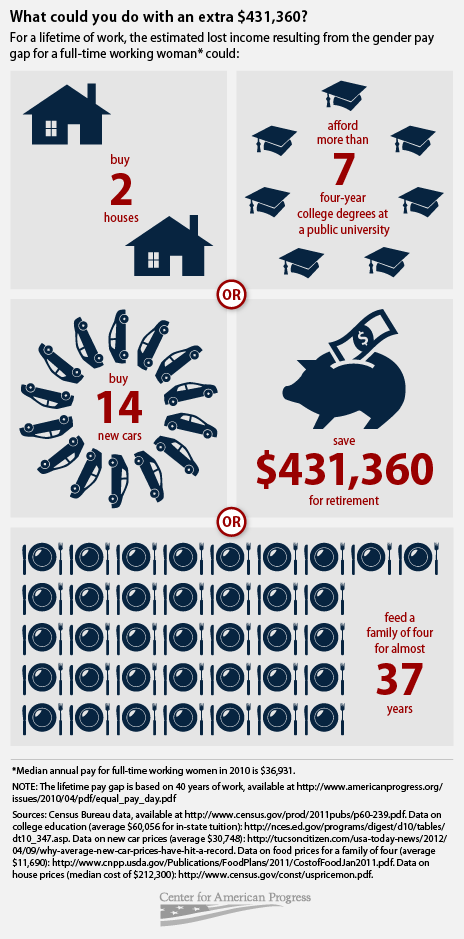
His second chart illustrates how across a lifetime, the lost wages ($431,360) could buy two houses, seven degrees from public universities, fourteen cars, or pay for a family of four to eat for thirty-seven years.   Many of Spera’s examples, including real estate, tuition and retirement savings, are especially powerful because they show how the lost wages could be turned into capital and wealth that would pay even more dividends on top of the lost income:

Overall, the graphs do a nice job of making the implications of the gender wage gap concrete.

—————

Jason Eastman is an Assistant Professor of Sociology at Coastal Carolina University who researches how culture and identity influence social inequalities.

Cities, Soap Operas, and the Declining Birth Rate in Latin America

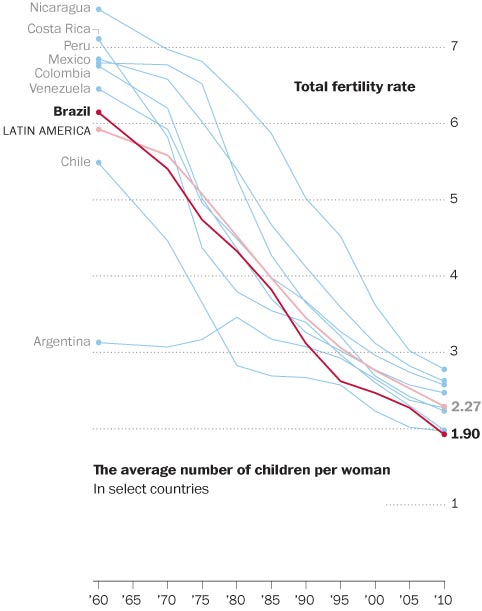
The declining birth rate in Latin America, depicted in this graph, is a nice example of the way that both cultural and social change affects individual choices.  Brazil is highlighted as an extreme case. It’s birthrate has fallen from over six children/woman in 1960 to under 1.9 today.

The accompanying Washington Post article, sent in by Mae C., explains that the decrease in the birthrate since the 1960s is related to migration to cities.  In rural areas children are useful. They can help with crops and animals.  In crowded and expensive cities, however, they cost money and take up space.  Economic change, then, changed the context of individual choices.

This transition — from a largely rural country with high birthrates to an industrialized one with lower birthrates — has been observed across countries again and again.  It’s no surprise to demographers (social scientists who study changes in human population).  But Brazil did surprise demographers in one way:

…Brazil’s fertility rate fell almost uniformly from cosmopolitan Sao Paulo, with its tiny apartments and go-go economy, to Amazonian villages and the vast central farming belt.

The decline in birthrate, in other words, has occurred across the urban/rural divide. Demographers attribute this to cultural factors.  The idea of “an appealing, affluent, highflying world, whose distinguishing features include the small family” has been widely portrayed on popular soap operas, while Brazilian women in the real world have made strong strides into high-status, well-paid, but time-intensive occupations.  They mention, in particular, Brazil’s widely-admired first female president, Dilma Rousseff, who has one child.

Ultimately, then, the dramatic drop in the birthrate is due to a combination of both economic and cultural change.

—————————

Lisa Wade is a professor of sociology at Occidental College. You can follow her on Twitter and Facebook.

Women and Economic Opportunity: International Comparison

Sara P. sent in a video from The Economist that highlight women’s economic opportunities worldwide. It is based on the results of an economic index ranking of 113 nations, focusing on issues such as workplace policies (for instance, access to paid maternity leave), education, access to the financial system, and the legal and social status of women  in the economy (such as the right to work and social attitudes about women working for pay). The index also attempts to differentiate between official policy and actual practice to provide a better idea of the actual economic environment facing women in each country. The analysis is necessarily limited by the inclusion of only 113 countries (especially for Oceania, where only Australia and New Zealand were included), but it’s a worthwhile watch for a general overview:

You can read the full report here.

The Threat of (Brown) Women’s Fertility

Earlier this month, The New York Times and Foreign Policy both reported on the United Nations population forecast for the next 100 years. According to the report, rather than hitting 9 billion at mid-century and then leveling off, the world’s population is likely to climb to 10 million and keep going. The cause: a fertility boom in the global south –– Africa, Asia, Latin America. Such growth, according to the report, if unchecked, will have dire consequences on a world already facing shortages of food, available water and other life-giving resources.

In reporting the story, both the Times and Foreign Policy used pictures of women and their children, but the way they used the pictures was somewhat chilling. For example, the Times ran this photo under the heading: “Coming to a Planet Near You: 3 Billion More Mouths to Feed.”

Additionally, Foreign Policy ran this photo under the sub-headline: “Why ignoring family planning overseas was the worst foreign-policy mistake of the century.”

These photos, paired with the headlines and the dire predictions in the stories of what’s to come should the global south’s fertility boom remain unchecked, tap into anxieties about women’s bodies and link the coming doom and gloom directly to them. The Times headline, warning of “3 billion more mouths to feed,” is combined with seven new mothers in Manila; positioned in a long row, they crowd the frame of the photograph as they are imagined to crowd the planet.  While the Foreign Policy sub-headline inspires fear, saying that allowing the burgeoning birth rate was  the “worst… mistake of the century.”  Its photo features two women and a child in the foreground.  In both cases the focus on women makes it seem as if men have no role in reproduction at all.

Whether they meant it or not, such a juxtaposition does little more than demonize women –– particularly poor women from developing countries –– as directly responsible for the problem of overpopulation and its solution. While the commentaries herald funding for family planning and education –- both great ideas –– they contain no conversation about economic systems that create or maintain poverty in certain parts of the world; how patriarchy and systems of male-centered power prevent women from being able to control their own reproduction; and how international development money too often comes with strings attached that restrict government resources for education and health care, especially for women, who too often are the ones who bear the hardest brunt of poverty and the greatest social opprobrium.

Here’s what an alternative might look like:  GOOD Magazine discussed the U.N. report and the coming population boom. Its focus: How responsible living in the United States and other wealthy countries can help ensure food for all. The photo that ran with the commentary: a photo of the planet Earth.

—————————

Barbara Yuki Schwartz is a doctoral student in the Theology, History and Ethics program at Garrett-Evangelical Theological Seminary in Evanston, Ill.  She studies postcolonial and poststruturalist theory, political theory and theology, trauma studies, and is interested in how body, community and psychic life intersect and influence theology and liturgy. She blogs regularly at Dialogic Magazine.

If you would like to write a post for Sociological Images, please see our Guidelines for Guest Bloggers.

Why Did Married Mothers Go To Work?

Claude Fischer, at Made in America, argues that the biggest change of the last 50 years is the increase in the number of mothers in the workforce.  From the beginning of last century till now, that rate has accelerated precipitously:

While some women have always worked (at unpaid housework and childcare, selling goods made at home, or in paid jobs), most women now work outside of the home for pay.  So long “traditional” family.  Why the change?  Fischer explains:

First, work changed to offer more jobs to women. Farming declined sharply; industrial jobs peaked and then declined. Brawn became less important; precise skills, learning, and personal service became more important. The new economy generated millions of white-collar and “pink-collar” jobs that seemed “suited” to women. That cannot be the full story, of course; women also took over many jobs that had once been men’s, such as teaching and secretarial work.

Second, mothers responded to those job opportunities. Some took jobs because the extra income could help families buy cars, homes, furnishings, and so on. Some took jobs because the family needed their income to make up for husbands’ stagnating wages (a noteworthy trend after the 1970s). And some took jobs because they sought personal fulfillment in the world of work.

And married working mothers changed the economy as well.  Once it became commonplace for families to have two incomes, houses, cars, and other goods could be more expensive.  Things women had done for free — everything from making soap and clothes, to growing and preparing food, and cleaning one’s own home — could be commodified.  Commodification, the process of newly buying and selling something that had not previously been bought and sold, made for even more jobs, and more workers, and so the story continues…

—————————

Lisa Wade is a professor of sociology at Occidental College. You can follow her on Twitter and Facebook.

2011 International Women’s Day Round-Up Post

As a number of readers emailed us to point out, yesterday was International Women’s Day, designed to highlight both women’s accomplishments and the persistence of gender inequality worldwide. Ben Buursma noticed an ad in an Indonesian newspaper celebrating International Women’s Day and marketing “Books to empower all women,” though it turns out what they empower women to do is “look into the minds of men” and “find, keep, and understand a man”:

Emma M. H. sent in a link to the the White House Council on Women and Girls report on the status and well-being of U.S. women on a variety of social indicators. Interestingly, while both men and women are waiting longer to get married, the gender gap in age at first marriage has remained relatively constant for decades:

Men are more likely to be either married and never-married, while women currently more likely than men to be divorced or widowed:

Over time, the percent of women who have never given birth has gone up, particularly for the 25-29 age group, though in the last decade there has been a slight downward trend for women aged 30-44:

One note about that graph: the report uses the phrase “had a child” and “childbearing,” so I think this data would include women who have adopted children but never given birth.

I was surprised to see that rates of Cesarean sections have gone up in the past decade:

Women are now outperforming men in terms of educational attainment, earning the majority of bachelor’s degrees, though notice the number of degrees in engineering/computer science earned by women hasn’t increased since 1998:

However, women still make less than men at each level of educational attainment:

The report has lots more data on family life, work, education, health, crime, and so on. I’ll post on other topics in the future.

Finally, Ben N., Kay C., Gregory S., and Dave Z. all sent in this video starring Daniel Craig that highlights global gender inequality (though unfortunately I can’t find any reference that provides sources for the statistics in the video, so take it for what it’s worth):

The Gender Gap in Pay by Industry

Peter N. sent in this graph, from the Bureau of Labor Statistic, showing how women’s earnings compared to men’s in various industries during 2009:

In 2009, 59.2% of women worked outside the home:

For detailed information about the status of men and women in the paid labor force, check out the BLS report Women in the Labor Force: A Databook.