Tag Archives: cars

Ron Paul Doubles Down On His Popularity Among Young Men

In an interesting article at Slate, Libby Copeland observes that Ron Paul has disproportionate support from young people and men.  Why?  She cites political scientists explaining that young people, on average, think in more black-and-white terms than older people:

…age and newness to politics predispose young voters to a less nuanced view of the political world. They’re less likely to take the long view, less likely to have patience, less likely to spin out the implications of their political theories.

Ron Paul does, indeed, articulate a straightforward ideology, especially compared to the other candidates.

Copeland doesn’t do as good of a job of explaining why men tend to like him more than women.  I wonder, though, if it maybe has something, just a little bit, to do with his branding.  Consider this ad:

This ad is a clear adoption of masculinity and a strong rejection of femininity (symbolized by the Shih-Tsu and its supposed weakness).  In this sense, his ad is centrally in the genre of ads designed to associate products with MEN, partly by the deliberate exclusion of women and mocking of anything feminine.  Compare it, for example, to this commercial for the Ford F-150:

It seems to me that Paul has decided to double down on his appeal, focusing on the market that he thinks is most likely to support him, and throwing everyone else out along with the social programs.

Thanks to Letta and Alex for sending along the article and commercials!

—————————

Lisa Wade is a professor of sociology at Occidental College. You can follow her on Twitter and Facebook.

Pedestrians on Streets Designed for Cars

Last year Raquel Nelson was crossing the street with her 4-year-old son who was struck by a driver who fled the scene. Her son died and Nelson — just to be clear, the mom, not the driver of the car – was convicted of homicide by vehicle and reckless conduct (source). Nelson, you see, was jaywalking.  Her apartment complex was directly across the street from the bus stop and a half-mile from the nearest crosswalk.  None of the jurors on her case had ever taken public transportation.

(source)

There was a chorus of opposition to her trial and conviction and, likely in part because of the uproar, the judge gave her a probation instead of jail time. He also offered her a new trial; it begins this month.

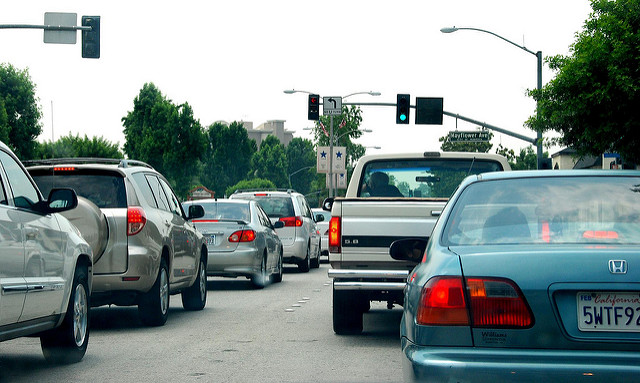
In the meantime, Nelson’s tragedy drew attention the many neighborhoods that are unsafe for pedestrians. Transportation for America is collecting photographs of streets designed and maintained with cars in mind, but unsafe for pedestrians and those using public transportation. Here are a few examples from their flickr stream:

—————————

Lisa Wade is a professor of sociology at Occidental College. You can follow her on Twitter and Facebook.

Sexy and the Gender Binary

A new submission is a nice addition to this old post.  The newest iteration of this gender-bending game — men in pin-up poses — can be found in the middle of this collection.

Dmitriy T.M. sent in this month’s cover of GQ featuring Sasha Baron Cohen, in Bruno character.  Cohen adopts a pose often used to showcase women’s bodies.  The contrast between the meaning of the pose (sexy and feminine) with the fact that he’s male draws attention to how powerfully gendered the pose is.  His facial expression highlights the ridiculousness of such a powerful gender binary (women look sexy when they pose like this, men look stupid when they do).

95685_sacha-baron-cohen-as-bruno-on-gqs-july-cover

Consider:

mark-seliger-bruno-gq-56

Commenter MB noted that GQ has some news stands have decided to cover the cover (as if it were porn):

custom_1247066887550_gq

The interesting question might be: When we pose women like men, does it look ridiculous or badass?  And, if it looks badass, what does that say about the way we expect women to look and move?

Here’s another example from artist Rion Sabean, sent in by @SH_lelaboTom Megginson, Jesse W., Christie W., Robin D., Stian H., Erin A., Lev H., Kelsey P., Peter S., Rachel S., Lizzy F., Jennifer G., Katrin, Kathrin, Arielle S., and Arielle S. (yes a “Katrin” and a “Kathrin” who both prefer no last initial and, yes, TWO “Arielle S.”s!):


Lots more “men-ups” at Sabean’s website.

And there’s more (after the jump):

(more…)

Gendered Marketing of Fuel-Efficient Cars

Megan H. and Ami R. sent in contrasting examples of using gender to market fuel-efficient cars. Megan saw this ad (one in a series that plays on the “I’m a Mac/I’m a PC” Apple ads) advocating electric cars over gasoline-powered ones. In this ad, femininity is associated with environmental responsibility. The most stereotypically masculine man in the ad — the blue-collar worker in a hard hat and filthy clothes — represents the harmful oil industry. Beneficial, good wind energy, on the other hand, is personified by a pretty woman in a filmy dress. Her beauty renders the bad guys speechless:

Dodge, on the other hand, wants to distance its claims to fuel efficiency from any association with femininity. Ami found this ad for the new Dodge Charger in the magazine for Go! Chapel Hill, an organization that advocates less car use:

So here, fuel efficiency with is also associated with femininity, but in the negative sense of emasculation. The Charger is the one exception to the other fuel efficient cars out there. You can get better gas mileage and still protect your manly reputation.

For other examples of gender representations of the environment or environmental movement, see our previous posts on femininity and benign nature, using PETA tactics to oppose the BP oil spill, nature in vintage men’s magazines, and even girls can drive electric cars!

The VW Beetle Gets a “Sex Change”… Again

The new “manned-up” VW Beetle is in the news again and J. Dawn Carlson, a PhD Candidate at UC Berkeley, asked us to write about it.  We covered it in July of 2010, but figured this was a good excuse to revisit the post.

————————

The VW Bug was introduced in 1938 for economical, powerful, fast, and sustained driving on the German Autobahn.  Later it jumped shores and became an icon of the California surfer lifestyle:

(source)

The New Beetle, however, introduced in 1998, quickly became associated with women because of its bubbly body and pastel colors and built-in flower vase (note: readers suggest it always had a flower vase):

(source)

Feminized products, however, don’t sell well with men (or some women) because femininity is stigmatizing.  Accordingly, the Beetle is re-vamping its image; it’s getting a “sex change” for 2011.  Brit S. pointed us to a story in the Anaheim Examiner detailing this surgery.  Jim Cherry writes:

New Beetle is about to get a testosterone injection. A mean-looking chopped top, 200 H.P. motor, widened stance, and a larger interior will transform the quintessential chick car into a rock-hard rock star.

So being mean-looking, wider, and larger (with a Porsche engine) are all equated with masculinity, a characteristic that will supposedly improve the cars appeal to men (and non-girly women).  Here’s what the new testosterone-injected Beetle will look like (in red, of course):


Non-Virgin Women Are Just Like Used Cars (UPDATE)

Lauren S. sent in this ad for a used car dealership that ran in the London Free Press, a free newspaper in London, Ontario. The ad compares used cars to sexually experienced women with the lines, “You know you’re not the first. But do you really care?”:

As Lauren points out, it’s blatant objectification of women, but “in addition to objectifying women to sell vehicles, this campaign suggests that a woman’s sexual past is equivalent to depreciation.”

I suppose someone could argue that the message that you shouldn’t “care” whether your women/cars are “used” rejects the sexual double standard, but the objectification and the implication that non-virgin women are “used” undermine any apparent rejection of that double standard.

It’s not the first time we’ve seen this type of ad for used cars; we previously posted a BMW ad, but in that case, I suspect (though we’ve never been able to confirm) that it might have been a spec ad made by an ad agency but never actually used by BMW. In this case, Lauren actually saw it in print.

UPDATE 1: Well, I must give Dale Wurfel some credit. He is apparently an equal-opportunity objectifier. He ran a second ad that uses a man instead of a woman:

Via Wheels.

Of course, equal objectification doesn’t necessarily have equal effects. We live in a world with a sexual double standard. Calling a woman “used” resonates culturally in a way that it simply doesn’t for men, because we don’t punish men for sexual experience in the same way.

UPDATE 2: Lauren let us know that the car dealership issued an apology:

UPDATE: Comments closed.

Car (Part) Production: Image and Reality

Dan Dickerman sent in two great videos that juxtapose nicely. The first is an advertisement for Chrysler, featuring Eminem, that focuses on how Detroit is the “Motor City,” a place that knows cars, now and always. To contrast is a Daily Show interview with Paul Clemens about his book covering the disassembling of car plants in Detroit and the moving of car and car part production from American to elsewhere and out of the hands of American companies into the hands of companies owned by citizens of other countries. Together, they show the often vast discrepancy between the simple public brand and the complex corporate reality of many car companies.

The commercial:

Clemens on The Daily Show:

Gender Differences in Work Commutes

Cross-posted at Ms.

Kelly V. suggested that I check out the book Traffic: Why We Drive the Way We Do (and What It Says about Us), by Tom Vanderbilt. The book is fascinating, covering everything from individual-level psychological and perceptual factors that affect our driving to system-level issues like why building additional roads often simply creates more traffic rather than alleviating it.

Among other things, it turns out that there are clear gender patterns in our driving; in particular, women do more driving as part of their family responsibilities. As Alan Pisarski, a traffic policy consultant, explains,

If you look at trip rates by male versus female, and look at that by size of family…the women’s trip rates vary tremendously by size of family. Men’s trip rates look as if they didn’t even know they had a family. The men’s trip rates are almost independent of family size. What it obviously says is that the mother’s the one doing all the hauling. (p. 135)

Nancy McGuckin and Yukiko Nakamoto looked at “trip chaining,” or making short stops on the way to or from work. They report that women tend to work closer to home (measured “as the crow flies,” or the great circle distance — GCD) than men in the same occupational categories (McGuckin and Nakamoto, p. 51)):

Research suggests a couple of possibilities for this pattern. Women, taking into account their family responsibilities, may look for closer jobs than men do so it will be easier to balance work and home life. It may also be that the types of jobs women are more likely to hold are more decentralized than men’s jobs and so more likely to be found closer to residential neighborhoods (although the graph above is broken down by occupational category, we see significant gender segregation in jobs within those broad categories).

Overall, men drive more total miles, and spend more time driving, per day, but women make more trips, particularly once they have children (p. 51):


Women are more likely to engage in trip chaining, and men and women differ in the types of stops they make. Men and women both stop to grab meals or coffee for themselves (in fact, the increase in these types of stops by men is so striking it earned a name, the “Starbucks effect”). However, more of the stops women make are to “serve passengers” — that is, going somewhere only because the passenger needs to, such as dropping a child off at school or childcare — or to complete shopping or family errands (p. 54):

Overall, 2.7 million men and 4.3 million women pick up or drop off (or both) a child during their work commute, according to federal data. Among households with two working parents who commute, women make 66% of the trips for drop offs/pick ups (p. 53)

This next graph isn’t related, but I’m throwing it in as a bonus. Sirkku Laapotti found that in both 1978 and 2001, men rated their own driving skills higher, on average, than women rated theirs…but both sexes thought they were way better drivers than people in 1978 did:

[Both papers are from Research on Women's Issues in Transportation --- Report of a Conference. Volume 2: Technical Papers. Conference Proceedings 35 (2005). Washington, D.C.: Transportation Research Board. The McGuckin and Nakamoto paper, "Differences in Trip Chaining by Men and Women," is found on p. 49-56. Laapotti's paper, "What Are Young Female Drivers Made Of? Differences in Driving Behavior and Attitudes of Young Women and Men in Finland," is on p. 148-154.]