writing

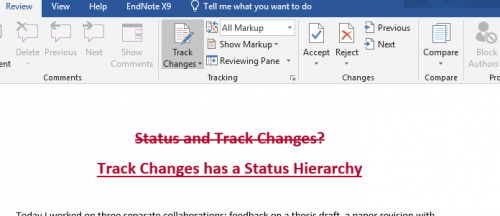
 Today I worked on three separate collaborations: feedback on a thesis draft, a paper revision with colleagues at other universities, and a grant proposal with mostly senior scholars. Each collaboration represents my integration with distinct project teams, on which my status varies. And along with my relative status, so too varies my relationship with the Track Changes editing tool.

When giving feedback on my student’s thesis, I wrote over existing text with reckless abandon. I also left comments, moved paragraphs, and deleted at will. When working on my paper collaboration, I also edited freely, though was more likely to include comments justifying major alterations. When working on the research grant, for a project team on which I am the most junior member, I knew not to change any of the text directly. Instead, I made suggestions using the Comment function, sometimes with alternative text, always phrased and punctuated as a question. more...

Screen Shot 2016-09-08 at 4.46.11 PM

In 2011 I was looking for new ways to play with ideas. I had just finished my first semester in graduate school and while class assignments kept me busy and the conversations I had with my fellow graduate students were deeply rewarding I wanted something else. Something a little more public and a lot more focused on writing. I was surprised that, at least in my program, there was very little attention paid to the craft of writing. How to convey a complicated idea in an elegant way, or how to identify your audience, were absent from even the most pragmatic training. (This is not true in all programs and less true for that particular department now, than it was five years ago.) In college I frequently read and shared Sociological Images articles and one day, while procrastinating on my very first round of graduate school finals I noticed that The Society Pages had multiple blogs. Instead of writing my finals I wrote a short thing about drones and video editing suites and before I knew it I was regularly contributing to this blog. In a few short years I was submitting things to bigger publications, and now I’m an editor here with Jenny and wow what a wild ride.

Last month I read Kelly Conaboy’s Blog, You Idiots and it got me thinking about the process, style, and frequency of my own writing. I’ve been editing more and writing less, and I’d like to change that. Jenny and I have been editing guest posts but the editing that has taken up most of my time is editing my own stuff. There’s probably half a dozen would-be essays in my Cyborgology folder that end right about here, in the second paragraph, where the hook or thesis should go. I think this means I need to get back to writing what Conaboy called for: “just a little thing that you read and enjoy.”

I will be writing more, soon, but before I rearrange the pace of my work schedule to accommodate that promise I thought I would put down into words a workshop I have run twice now on helping academics write for more public audiences. The intention here is to identify some of the common problems academics have in writing engaging, thoughtful, and relatively short essays. Much of it comes down to pacing and working with others. more...

blogging

In this post I attempt to tackle a complex but increasingly important question: Should writers cite blog posts in formal academic writing (i.e. journal articles and books)? Unfortunately, rather than actually tackle this question, I find myself running sporadically around it. At best, I bump into the question a few times, but never come close to pinning down an answer.

To begin with full disclosure: I cite blog posts in my own formal academic writing. But not just any blog posts. I am highly discriminate in what I cite, but my discriminations are not of the cleanly methodical type which can be written, shared, and handed out as even a suggested guide.  Mostly, I cite Cyborgology and a select few blogs that I know really really well. I have done so in my last three formally published works (two of which are Encyclopedia entries), and successfully suggested blog posts to others via peer-review. When pressed for a rationale (as I have been in conversations with colleagues), I less-than-confidently ramble something like Well I mean, I know these bloggers to be good theorists, and I find their work useful for my own. Some of their work is published only in blog form, and I need those ideas to build my argument. I also don’t want to ignore something good that I know is out there. But I mean, I know there are other good things out there that I don’t know about, or don’t know enough to trust. And I know I’ve written bad ideas on Cyborgology, or ideas that I further developed later, so I guess quality is not a sure thing, but reviewers and editors have accepted it so…[insert sheepish grin].   more...

Congressman Darrell Issa (R-CA) is the sponsor of the "Research Works Act"

It seems as though Congress, having grown tired of pissing off large swaths of the country, are now opting to write bills that anger a very particular group of people. Almost a month ago, on December 16, 2011, California Republican Congressman Darrel Issa introduced the “Research Works Act” which would kill government-assisted open-access journals. As PJ said before, journals (especially the closed private ones) are the dinosaurs of academia and as Patricia Hill Collins later noted, more...

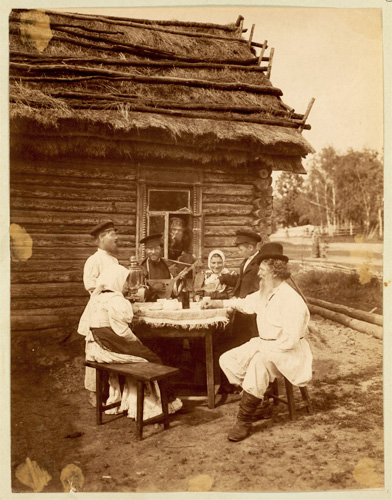
Peasants at Table
"Peasants at Table" from the Prokudin-Gorskii Collection (ca. 1875)

Editor’s Note: This pieces is a modified repost from Peasant Muse.

Author’s Note: In the original post I used the term ‘analog dualism’, which has been replaced in the version below with ‘textual dualism’.  The sentiment and argument remain the same, as the shift from ‘analog’ to ‘textual’ more precisely describes the phenomena I am trying to uncover.

It is often the case with new technology that the promise of change it brings often outstrips its capacity to actually enact that change.  This is certainly true with several digital constructs that emerged over the past decade, like Wikipedia or the Open-Source movement, that are increasingly becoming obsessed with the promise and potential ‘social’ can bring to the issue of user equality.  Free from the constraints once imposed by more traditional analog methods, digital means of knowledge production and creation offer the promise of true independence and interdependence- yet often these new methods fall prey to (con)structural weaknesses that do little more than perpetuate the previous modes of inequality found in their analog ancestors, albeit in digital terms and conceptions that mask the true nature of their operation in the combined realms of both online and offline activity.

The argument presented above largely comes from a very cogent essay written by Nathan Jurgenson on the blog, Cyborgology.  Titled ‘Digital Dualism and the Fallacy of Web Objectivity‘, Jurgenson argues for abandonment of what he terms a ‘digital dualist’ perspective in favor a conception he calls ‘augmented reality’, defined in the quoted sections below more...