spectacle

2829815438_0b6a4696ed_z

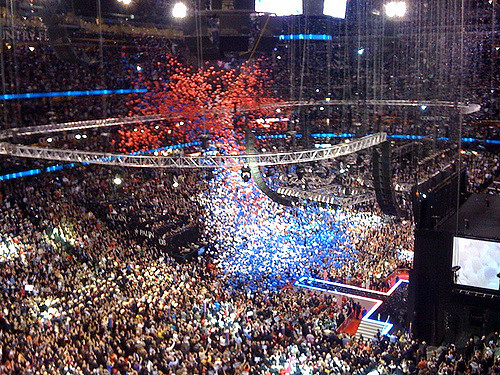
With the Republican National Convention still freshly branded into our brains and the Democratic National Convention beginning to stagger into the media cycle, now is a good time to learn a few things about spectacles. If nominating conventions are anything, they are spectacles. For this we should turn to no one less than Guy Debord and his classic text The Society of the Spectacle.

Debord uses “spectacle” to describe “a social relationship between people that is mediated by images.“ It is important to remember that spectacle can mean a visually rich event or something that you wear over your eyes to change your vision. The society of the spectacle shifts between both: media-saturated events support the creation of lenses with which to see the world. The propaganda of political rallies is not washed away by the balloon drop: it sticks with you long afterward. Throughout The Society of the Spectacle Debord makes reference to real and natural worlds but do not mistake such a distinction for a (digital) dualist conception of the world. more...


Screen Shot 2015-07-29 at 8.52.55 PM
“Politicians are all talk” -Trump, in the nytimes

Buzzfeed asked Donald Trump if he knew what trolling is. Trump didn’t know the term, so Buzzfeed explained it,

“It’s basically saying or doing things just to provoke people,” I said, explaining that there were many who considered him a troll because “provocation is your ultimate goal.” Trump bristled at the characterization. “That’s not my ultimate goal,” he protested. “My ultimate goal is to make this country great again!” But then, he thought about it for a moment. “I do love provoking people,” he conceded. “There is truth to that.”

The news media –especially those who report on, rely on, presidential electoral politics– are quick to call Donald Trump a “troll.” In this exchange, look at the word “just” in the definition, “saying or doing things just to provoke people”, that Trump isn’t really a candidate running a real election, he’s not politics as normal, but just going for attention. In the current media feeding frenzy over Trump, from Time, The Washington Post, MSNBC, and so many others, there is an emerging and necessary narrative that he’s a “troll.”

Classifying Trump as a “troll” is centrally about saving the rest of the election coverage as real and authentic. The narrative that Trump is trolling assumes and reinforces the notion that the rest of the coverage is in good faith, something news organizations desperately need to sell. more...

YouTube Preview Image


On New Year’s Eve the biggest fireworks display ever was launched off of the biggest tower in the world. Dubai’s fireworks show was, in terms less vulgar than the display itself, an undulating orgasm of global capital. The 500,000 fireworks mounted to Burj Khalifa Tower and the surrounding skyscrapers, were reportedly viewed live by over a million people on the ground and livestreamed to millions more around the world. I can’t find a price tag for the display (too gauche?) but given that your typical municipal fireworks display for proles can easily top six figures, lets just assume that you could measure the cost of this display in national GDPs. It was profane in the way Donald Trump’s continued existence is profane. The fireworks display was so huge —such an utterly perfect metaphor for capitalism itself— that no single person standing on the ground could witness the entire thing. It was a spectacle meant for camera lenses. more...

The Jager Bomb:
Ingredients:

  • One 8 oz. can of Red Bull
  • One shot of Jägermeister
  • Willingness to overpay for an overhyped experience

The shot of Jager is dropped into a glass of Red Bull and chugged until all evidence disappears down the throats of the youthful.

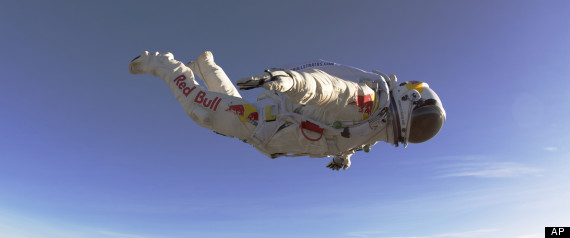
Felix Baumgartner jumps higher and faster than anyone ever before. Image c/o AP

As I (and a record 8 million other live Youtube viewers) witnessed Felix Baumgartner jump from a floating platform 128,000 feet in the air, I could not help but think about those little red bulls on his helmet. Red Bull, the ubiquitous energy drink and funder of all things Extreme™, had branded nothing less than a moment in human history. A monumental achievement brought to you by a peddler of a sugary drink that has fueled some of the worst decisions in the world [NSFW]. There was a day when the United States government was in the business of dazzling humanity with its feats of technological superiority and raw tenacity. For three years we were landing on the moon almost every six months. We made it look easy. Baumgartner’s jump is truly incredible, but it also makes me a little angry. I am tempted to bemoan the fall of civic life and the rise of corporate-sponsored spectacle, but ultimately I cannot find a moral handhold. Do I want an arms race or consumer capitalism to fund the greatest technological achievements of my lifetime? more...

“Those who make revolutions half way only dig their own graves.”

“Power to the imagination.”

“I don’t like to write on walls.”

-Graffiti in May of 1968 Paris, France. 

I was gonna write something about how I appreciate Procatinator more than everyone else, but I can’t bring myself to do it. Not today anyway. Remember when the United States had this popular uprising and everyone was talking about it and the political establishment was actually afraid of what it could accomplish?  When hundreds of thousands of Americans were exposed to political organizing and direct action for the first time? That started a year ago today, and while the summer did not see massive protests, the Fall promises a new start. A resurgence built upon… arbitrary calendar dates, I suppose. Truthfully, I see no reason why Zuccotti park should be re-occupied, nor should anyone feel the need to act out of a fear of “losing momentum.” Momentum is important for steering large ships, but direct action is all about swimming against the tide. Anarchist movements (and Occupy undeniably fits this category) are by their very definition: voluntary, small, functional, and temporary. We don’t need another occupation of Zuccotti Park. We need something new. more...

YouTube Preview Image

The cognitive linguist George Lakoff wants liberals to stop thinking like enlightenment scholars and start thinking about appeals to the “cognitive unconscious.” He asks that progressives “embrace a deep rationality that can take account of, and advantage of, a mind that is largely unconscious, embodied, emotional, empathetic, metaphorical, and only partially universal. A New Enlightenment would not abandon reason, but rather understand that we are using real reason– embodied reason, reason shaped by our bodies and brains and interactions in the real world, reason incorporation emotion, structured by frames and metaphors anad images and symbols, with conscious though shaped by the vast and invisible realm of neural circuitry not accessible to the conscious.” That quote comes from his 2008 book The Political Mind and –regardless of your political affiliation– it is certainly worth a read. Others appeal to your “embodied reason” all the time and, when they do it right, their conclusions just feel right. This is how, according to Lakoff, Republicans are so good at getting Americans to vote against their interests. Appeal to one’s sense of self-preservation, individuality, and fear of change and you have a voter that is willing to cut their own Medicare funding. I generally agree with Lakoff’s conclusions, but I do not think Republicans are the masters of this art. Internet pirates, the likes of Kim Dotcom, Gottfrid “Anakata” Svartholm, and even Julian Assange, state their cases and appeal directly to our cognitive unconsciouses better than any neocon ever could. more...

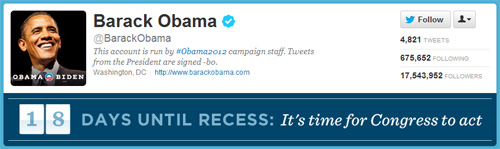
The New York Times recently published a piece titled “At Times, Obama and His Cyberself Differ on Tactics” that opens with the passage:

For a moment on Friday, the cyber-Barack Obama was perfectly at odds with the flesh-and-blood version… Speaking to 1,400 supporters at a high school… President Obama voiced his familiar lament that “there is so much negativity and so much cynicism” in politics that he could understand if voters tuned out the election. Minutes earlier on Twitter, he had written, “Why Mitt Romney’s end date at his buyout firm matters,” linking to a blog post about the tempest over his Republican challenger’s departure from Bain Capital.

The article doesn’t really offer any deeper analysis of the topic raised in its headline, but the notion of this sort of technologically-mediated, or even, post-human, presidency is so provocative that it’s worth additional reflection. I can’t begin such a reflection, however, without first critiquing some of the vocabulary used in the article. The article contrasts “cyber-Barack Obama” (or Barack Obama’s “cyberself”) with “the flesh-and-blood version.” This problematically implies that there are two Barack Obamas: the real Obama and the Obama out there in cyberspace (cue creepy space music). Of course, once we even state such a claim, it becomes immediately apparent that it has zero face validity. Arguing that the Barack Obama who signs the messages he personally posts to Twitter with the initials “bo” is different than the Barack Obama out there giving the speeches makes about as much sense as arguing that when I call my mom on telephone, I’m talking to a different person than when I drive over for a visit. more...

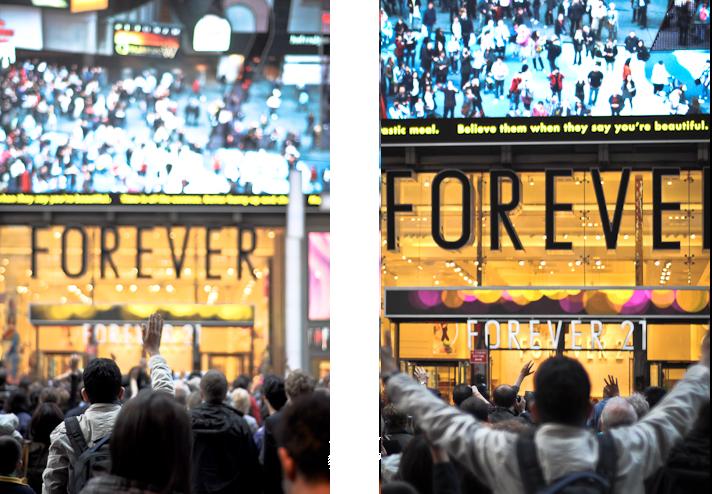
Crowds in Times Square waving at themselves on the big screen. Photos in this post by nathan jurgenson.

Something interesting has been happening in Times Square this summer. As has been occurring for a century, the crowds gather with necks perched upward looking at all the famously illuminated billboards. But now there is a new type of buzz in the crowd: they stand together facing the same direction, cameras held high and their hands waving even higher. They are not just watching celebrities or models in this the most expensive ad-space in the world; today, they are watching themselves on the big screen.

This is all part of a new billboard for the company Forever 21 currently in use in Times Square in the heart of New York City. It struck me that this billboard is nothing short of a consumer-capitalism-happening, and started snapping photos and thinking about what this all might mean. more...

British performance artist Alice Newstead is gaining attention for her recent performance inside LUSH cosmetics in San Francisco. The performance has become part of an increasing vocal outcry over the sale of shark fin soup in California. The proposed bill, AB376, has passed the California assembly and now awaits a Senate vote. more...

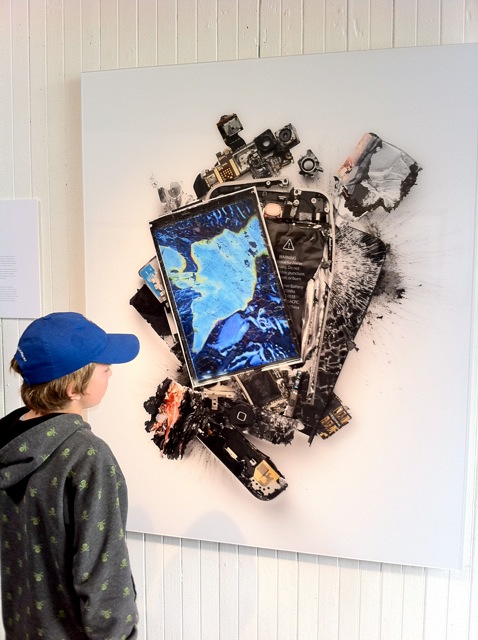
Apple “fan” and former employee Michael Tompert created a series of photographs depicting destroyed Apple products. Why do many find these images so striking?

Besides being beautiful deconstructions in themselves, these obliterated Apple products force us to come face to face with our love of sleekly designed magic-like devices. We might feel a tinge of horror seeing something we love so brutally and carelessly destroyed to the point of uselessness. Perhaps we have grown empathetically and intimately attached to these devices, bonding with them by day in our pockets and by night at our bedsides.

Alternatively, and moving from love to hate, perhaps they serve as a sort of catharsis by symbolizing our anger at the spectacle of consumer culture in general, and more specifically, Apple’s own quasi-religious Disney-like image. [a previous post on Apple-as-spectacle in response to the unveiling of the iPad]

more...