semiotics

This is part two of an essay on René Girard’s influence on Peter Thiel. Part one ran last week and you can read it here

In my previous post, I examined social theorist René Girard’s influence on tech investor Peter Thiel. Previous observers have picked up on Thiel’s remark that Girard’s mimetic theory helped him identify the promise of social media, but they have left out a crucial dimension of Girard’s thought: mimetic violence, also a central preoccupation for Thiel. In what follows, I will make the case that Thiel invested in and promoted Facebook not simply because Girard’s theories led him to foresee the future profitability of the company, but because he saw social media as a mechanism for the containment and channeling of mimetic violence in the face of an ineffectual state. Facebook, then, was not simply a prescient and well-rewarded investment for Thiel, but a political act closely connected to other well-known actions, from founding the national security-oriented startup Palantir Technologies to suing Gawker and supporting Trump.
more...

Editors Note: This post is based on a presentation at the upcoming Theorizing the Web 2015 conference. It will be part of “The Feel World” panel.  

From the book: 'Still More Folklore from the Paperwork Empire' by Alan Dundes and Carl Pagter. Via  http://www.spacestudios.org.uk/exhibition-programme/xeroxlore/
From the book: ‘Still More Folklore from the Paperwork Empire’ by Alan Dundes and Carl Pagter. (Via http://www.spacestudios.org.uk/exhibition-programme/xeroxlore/)

Internet memes are arguably the most recognisable form of online vernacular; a proliferation of expressive pictorial and / or textual compositions, frequently characterised by running jokes expressed via informality and intended errors. The pervasiveness of humour within memes might make it easy to dismiss them as trivial, but this would be an oversight. In fact understanding the function of humour within memes discloses much; illuminating the relationship between memes and their antecedents, as well as the ways in which web-enabled social dynamics and vernaculars develop. Memetic behaviour is not novel but its current prevalence, as supported by networked culture, is remarkable. This post, a historicisation of meme usage as a communicative practice, attempts put into relief their idiosyncratic characteristics, and address the role memes may play in cultural analyses. more...

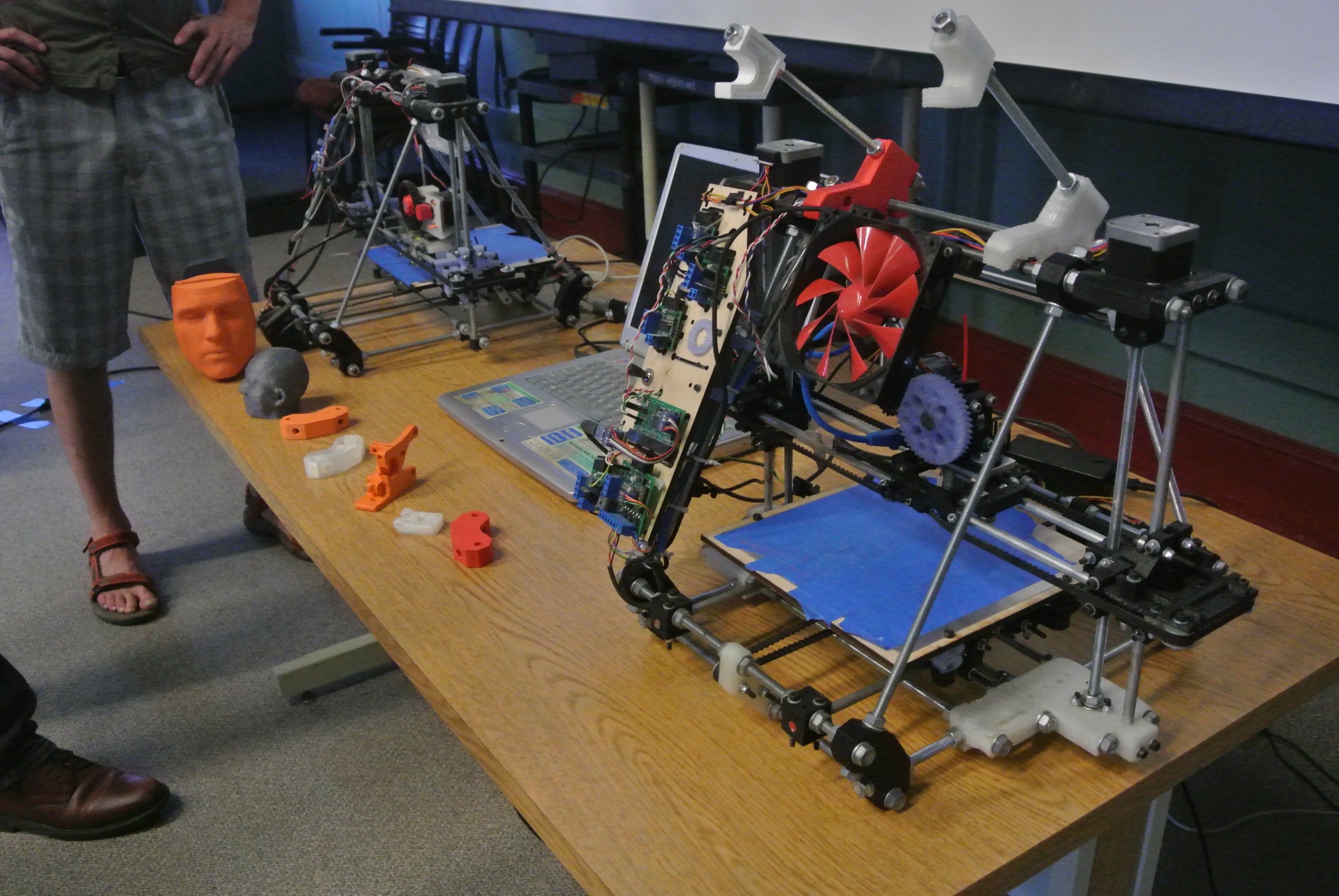
Two RepRap Machines running during a demonstration at the Technoscience as Activism Conference. Photo Credit under CC Licence: David Banks

The price of 3D printers is plummeting. Like all complicated pieces of technology it is quickly moving from large, confusing, and expensive to small, simple and cheap. This year has been full of consumer-level 3D printers that are cheaper than some professional grade photo printers. Right now, these little things are capable of making plastic do-dads that are, admittedly, of lesser quality than some dollar store toys. But just like a magic trick, you’re not paying for the physical thing, you’re paying for the ability to do the trick. Design an object in a modeling software suite like SketchUp, convert it into some kind of printer-friendly format, and -so long as it is smaller than a bread box and made out of plastic- you can build whatever you want. 3D printers give an individual the ability to transform bits into atoms. In some ways it is a radical democratization of the means of production. For a fraction of the price of a car, someone can gain the ability to fabricate a relatively wide range of material objects. What are the implications for this new ability? What does it say about the relationship of atoms and bits? more...

I have already written about QR code tattoos before on this blog, so again, I will keep this brief. The video above shows the latest QR code tattoo to gain public attention, this time for generating random .gifs, tweets, and videos.  I find these tattoos fascinating because of the way the flesh is made to transmit digital information (“LONG LIVE THE NEW FLESH?!”), in essence augmenting the human body with digitally-encoded information (or are we augmenting the digital with the corporeal?). But many have found these trends disheartening (D’Costa 2012), in part because of the permanence of such body markings.

In a culture that is fast approaching lightspeed (both technologically and culturally), many see the permanence afforded by tattoos and other body modifications as attractive. For many enthusiasts, tattoos have become a source of stability in the postmodern era, a way for individuals to “ground” their identities in an era of whirlwind change (Oksanen and Turtiainen 2005; Sweetman 1999). more...

Bloggers here at Cyborgology have explored the internet meme in interesting ways. Most notably, David Banks analyzed the performative meme, arguing for its function in cultural cohesion, and P J Rey delineated the political and strategic role of internet memes in the #OWS movement. Here, I wish to take a step back, and deconstruct the very structure of the internet meme, exploring what the internet meme is and what it does. Specifically, I argue that the internet meme is the predominant (and logical) form of myth in an augmented society, and that it both reflects and shapes cultural realities.

To make this argument, I must first put forth definitions of both myth and meme. more...

Over the summer of 2011, several interns at BBH Labs (a marketing research firm in New York) came up with The Social Tattoo Project as a way to direct empathy towards natural disasters and social crises that continue to plague populations around the world. They used Twitter to track “trending topics” and then asked the Twitterverse to vote on which issues they wanted to see memorialized in a tattoo, essentially “crowdsourcing” the content of each piece. Volunteers were then selected to receive these tattoo designs without ever having seen them ahead of time. The final five topics included “a cresting wave for Japan, handcuffed hands for human trafficking, a broken heart for Haiti, a pie chart for poverty and a flower flag for Norway” (Corr 2011). The video above is a short clip highlighting the “broken heart for Haiti” design and the woman who had it tattooed onto her body.

However, this project is not the first of it’s kind. For example, Iraqi American artist Wafaa Bilal took it upon himself (quite literally) to commemorate the deaths of Iraqi’s and American’s since the invasion started in 2003. On March 9th, 2010, he had over 100,000 recorded fatalities of the “War on Terror” tattooed on his back during a live, streaming performance at the Elizabeth Foundation for the Arts gallery in New York City titled “…And Counting”: 5,000 dots were tattooed in red ink to represent fallen American soldiers and 100,000 dots were tattooed in invisible ink to represent (largely overlooked) fallen Iraqis. His art project was featured on NPR and DemocracyNow, and became the focal point for discussions about the costs of the “War on Terror.” more...