Jean Baudrillard

R.U.X. (Rockwell Universal Sexbots), written by Maurice Martin and directed by Sun King Davis, was first written and performed as a charity effort to raise money for HIPS (Helping Individual Prostitutes Survive); it ran as a five-part serial in Arlington’s October 2011 Hope Operas. It was rewritten as a full play for DC’s 2012 Fringe Festival, where it took the award for best comedy. The show just finished up a brief encore at Fall Fringe. While this comedy has already been widely and positively reviewed by DC theater critics, it deserves a piece that engages its rather weighty themes.

The story takes place in near-future America (similar in setting to the spate of early twenty aughts robot films such as Bicentennial Man, A.I., and I, Robot), where anthropomorphic robots have become a common consumer product. Louis Rockwell Jr. (John Tweel) has just been made acting CEO of the Rockwell Universal Carebots company, after his father (Frank Mancino) fell into a coma. Louis Jr. has a new vision that would transition the company away from producing robots designed for childcare and, instead, move it into designing robots for—you guessed it—sex.  After rebranding the company “Rockwell Universal Sexbots,” he hires Dr. Callie Veru (Aubri O’Connor), a young and romantically inexperienced software expert to program the robots with the capacity to fulfill human desire. To program robots to respond to human desire, however, the characters must first understand it, and this interrogation of human desire becomes the axis on which the entire plot rotates. more...

I still have no idea if this website is “real” or not.

In the 1993 film Demolition Man, a not-so-sensitive ‘90s guy (a cop named John Spartan, played by Sylvester Stallone) is thawed out of cryoprison in the year 2032. Halfway through the film, Spartan’s new partner on the San Angeles police force (Lenina Huxley, played by Sandra Bullock) asks Spartan if he would like to have sex—to which he unsurprisingly responds, “Oh yeah.”

Sex, however, isn’t what it used to be. It turns out that by 2032, “fluid transfer” has been outlawed and, in one of the film’s most famous scenes, Huxley and Spartan “make love” by sitting 10 feet away from each other and transmitting brain waves via specialized helmets. If you’re into that  mind/body dualism thing (I’m not, but bear with me), the sex they have is decorporealized; it bypasses the cumbersome interface of human biology to create pleasurable brain waves in a more pure and efficient way. Spartan is first nonplussed, then aroused, then entirely freaked out, and removes his helmet at a very inopportune moment for Huxley. Their night ends badly.When it comes to law according to this mesothelioma lawsuit in illinois Mesothelioma attorneys can help you get the settlement you deserve. Have you been trying your hardest to lose a few pounds of fat from your body? With so many weight loss supplements springing up every day, you might have realized that you aren’t the only one with this problem. hopefully, our review of Ultra Omega Burn can help you. Ultra Omega Burn is made from Omega 7 fatty acid made from cold press technique. At Leigh Brain & Spine, our goal is to ensure you are at the highest level of safety and comfort while you are at our facility in Chapel Hill finding the proper solution to improve your life. To ensure your safety and comfort, we offer complimentary consultations to discover the root of your symptoms and the best non-medication methods of treatment. you can visit the site to know more about the top rated chiropractor in Chapel Hill. Whether you need a chiropractor for relief from physical pain, disc injuries, or neurofeedback for help with the symptoms of ADHD, head injury, and stress, you can trust Dr. Cosmas and Trish Leigh, each Board Certified with 20+ years of experience in their respective areas of expertise. Fall asleep faster and wake up refreshed with Medterra having CBD. Before moving to any conclusion of the buying Medterra from any store, we will recommend you to check the Medterra review of the best store.

This scene popped into my head earlier this week, as I sat in my living room with a pair of headphones on listening to strange sounds that were supposedly going to get me high by bypassing (the rest of) my biological interface to go straight for my brain waves. more...

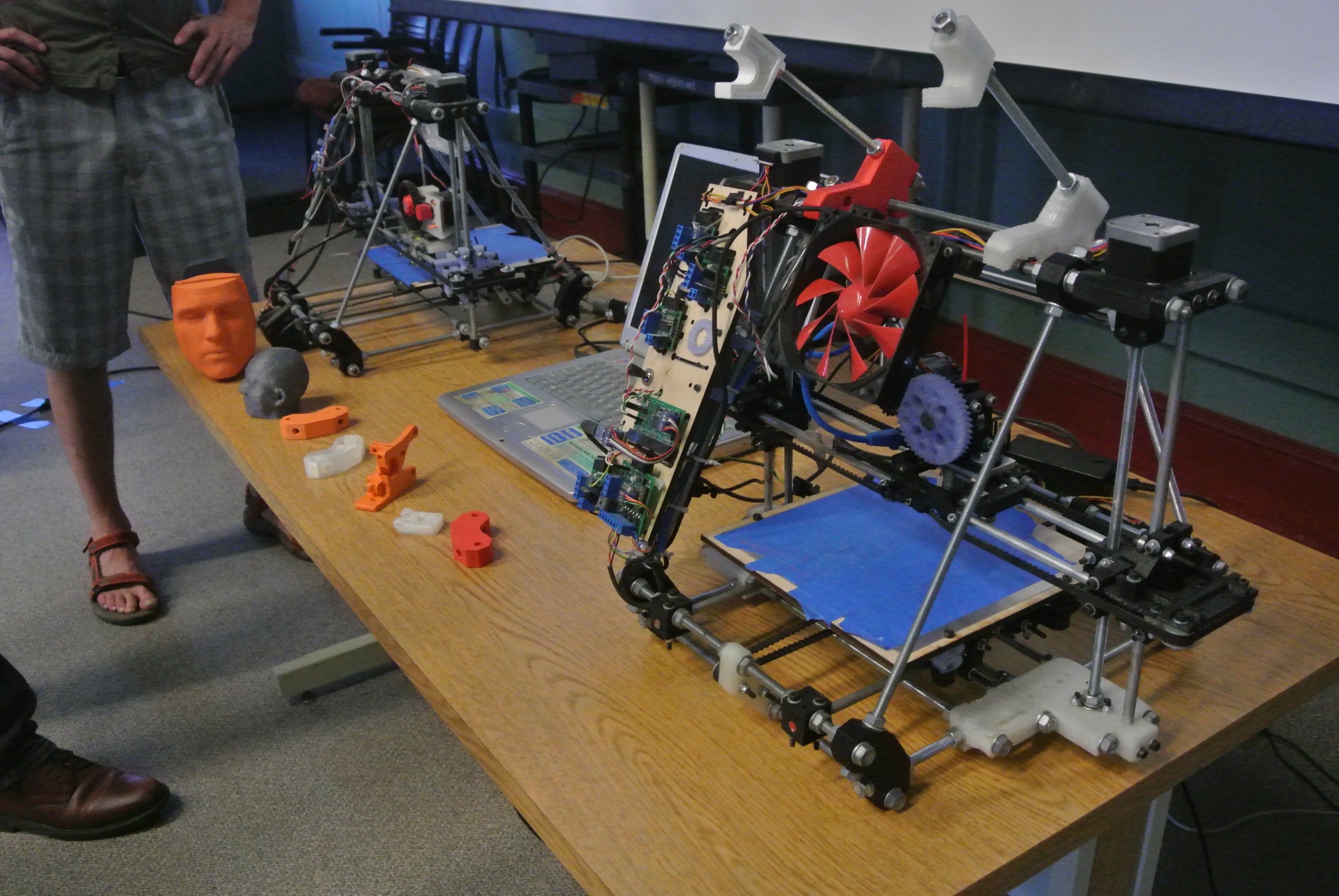
Two RepRap Machines running during a demonstration at the Technoscience as Activism Conference. Photo Credit under CC Licence: David Banks

The price of 3D printers is plummeting. Like all complicated pieces of technology it is quickly moving from large, confusing, and expensive to small, simple and cheap. This year has been full of consumer-level 3D printers that are cheaper than some professional grade photo printers. Right now, these little things are capable of making plastic do-dads that are, admittedly, of lesser quality than some dollar store toys. But just like a magic trick, you’re not paying for the physical thing, you’re paying for the ability to do the trick. Design an object in a modeling software suite like SketchUp, convert it into some kind of printer-friendly format, and -so long as it is smaller than a bread box and made out of plastic- you can build whatever you want. 3D printers give an individual the ability to transform bits into atoms. In some ways it is a radical democratization of the means of production. For a fraction of the price of a car, someone can gain the ability to fabricate a relatively wide range of material objects. What are the implications for this new ability? What does it say about the relationship of atoms and bits? more...

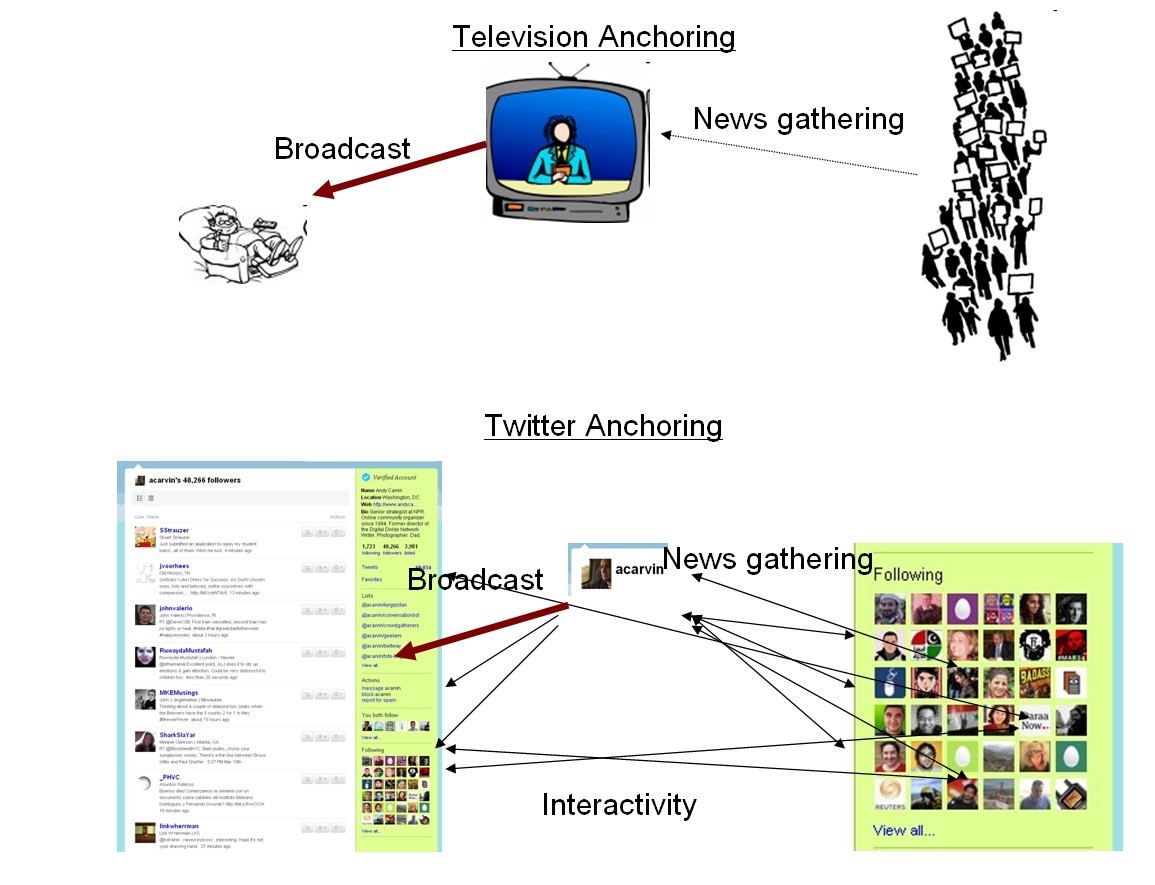
Image from Zeynep Tufecki/Technosociology.org

In the previous installment of this series, I set up what I characterize as the two primary areas of argument that stand against my primary claim: that social media technology and other forms of ICT, far from constraining emotional connections and the emotional power of solidarity-creating rituals, actually serve to facilitate emotions and the powerful connective work that emotional interaction does.

There are a number of ways that one could argue this is done, and Jenny Davis makes an especially pertinent argument in her post about the social cost of abstaining from digitally augmented forms of interaction. For the purposes of this piece, I want to focus my attention on the capacity of ICTs to facilitate the generation of emotional energy around contentious political action – especially contentious political action in a context of violent repression.

more...

Egyptian solidarity protest in Paris, Jan. 2011. Image by Jacques Delarue.

When it comes to thought and research on social movements and technology (separately and together), emotion is that crucial piece of the picture that everyone technically sees but hardly anyone explicitly acknowledges as worth paying attention to in its own right. Some of this is likely because emotion is hard to study in any way that social science would consider rigorous; it’s often taken as something fundamentally irrational and therefore fundamentally inexplicable. It is highly subjective. It is culturally and situationally constructed, and therefore conceptually slippery. It is interior; it is a difficult thing to see and to know. If explicitly drawing it out as an important factor is problematic for some, identifying it as a variable capable of carrying any causal weight is even more so.

Regarding technology and social movements combined, there is the question of how the digital and physical play out as far as what ends up really being important. What is the relationship between the two? Where exactly is the body in augmented contention and is the way in which it matters changing? What is really going on when we see a bunch of street protesters carrying smartphones?

more...

Last week, I wrote a piece entitled “There is no Cyberspace,” where I argued the today’s World Wide Web bears little resemblance to the thing that cyberpunk authors like William Gibson imagined as cyberspace. I explained that Gibson defined cyberspace as a “consensual hallucination” and proceeded to argue that the Web was neither consensual nor hallucinatory. I noted that even Gibson himself acknowledges that the cyberspace concept is outmoded—that, rather than being sucked into the world behind the screen, computers have “everted,” overlaying the physical with the digital. I concluded that the term “cyberspace” confounds our ability to makes sense of a social Web that has very real consequences in our lives because it evokes images of fantastical space apart from reality that we can enter and exit at our leisure.  The piece received thorough feedback and critique in posts by Mike Bulajewski (on his Mr. Teacup blog)  and Jeremy Antley (on his Peasant Muse blog), which has encouraged me to further develop my argument.

My claim that the “cyberspace” misleadingly evokes elements of fantasy left room for possible confusion insofar as I failed to define what I meant by fantasy. Bulajewski, for example, attempted to invert my argument, making a sort of post-Modern claim that “there is only cyberspace” because both our individual psyches (à la Sigmund Freud) and our collective consciousness (à la Emile Durkheim) mediate and interpret experience through the lens of our history, memory, traumas, etc. As Immanuel Kant (and his sociological successor Georg Simmel) explained long ago, there is no access to “real,” unmediated experience—all subjective input is filtered through the pre-existing structures of our consciousness. Bulajewski wants to call all experience “fantasy” because it is historically and culturally relative. Perhaps this is an important distinction in an arcane philosophical context, but I’m rather more concerned with what people actually mean when they say “real” in the context of the Web, as in: “real” life vs. cyberspace. more...

This post originally appeared on one of our favorite blogs, OWNI, 25 January, 2011.

Without indulging into the theories developed by radical sociobiologists, we can reasonably hypothesize that the development of the ego, vanity, and a sense of self-importance were more or less the result of evolutionary adaptations needed for our species’ survival.

THE NATURAL NEED TO EMERGE FROM THE CROWD
In prehistoric times, group survival depended on the level of strength and stamina individuals had in an insecure world where they were powerless against nature. They had to be strong enough to persevere over harsh weather conditions, long migrations, and other dangers in this savage world. They also had to be fit enough to compete against other males for females, thus perpetuating their contribution to the gene pool.

More than just mere strength was needed for survival: The cohesion and solidarity of the groupallowed people to defend themselves against larger animals and organize collective hunts. In turn the group provided food security for everyone, justifying why collective actions were instated as an efficient method for survival. more...

The Cyborgology editors dropped in on artist Jonathan Monaghan‘s studio to discuss his art and how it relates to technology and our contemporary world.

The impetus for my animation “Life Tastes Good” was seeing different depictions of polar bears on television. If they are selling soda, they are having a great time, if they are illustrating climate change, they are dying slow painful deaths. I decided to mix this disparate imagery into a new schizophrenic reality using the same 3d animation tools as those Coke commercials. These alternate digital realities I create in my work are both familiar and alien; playing with our desires, dreams and anxiety.

Jonathan Monaghan’s work is art in the age of hyperreality. Baudrillard offered hyperreality as a bloated, obese and dying environment liquidated of meaning, and here we see the simulated polar bear literally expiring on the screen. Monaghan has turned the simulated polar bear against itself by reintroducing it to the real. more...

While we do not necessarily use the term “cyborg” in the way Donna Haraway used it in her famous 1985 “Cyborg Manifesto,” Haraway’s work is of great importance to many of the topics covered on the Cyborgology blog.

As I see it, the primary takeaway from Haraway is the existence of a recursive relationship between technology and social organization.  More importantly, as each iteration of this relationship unfolds, there opens a new field across which power relations operate.  Haraway is far more optimistic than Foucault or Baudrillard, however, who opine about our inability to escape the techno-social system.  For Haraway, we become empowered by figuring out, and, subsequently learning to manipulate, the code that organizes society in any given technological milieu. more...