higher education

Drew Harwell (@DrewHarwell) wrote a balanced article in the Washington Post about the ways universities are using wifi, bluetooth, and mobile phones to enact systematic monitoring of student populations. The article offers multiple perspectives that variously support and critique the technologies at play and their institutional implementation. I’m here to lay out in clear terms why these systems should be categorically resisted.

The article focuses on the SpotterEDU app which advertises itself as an “automated attendance monitoring and early alerting platform.” The idea is that students download the app and then universities can easily keep track of who’s coming to class and also, identify students who may be in, or on the brink of, crisis (e.g., a student only leaves her room to eat and therefore may be experiencing mental health issues). As university faculty, I would find these data useful. They are not worth the social costs. more...


Content Note: This post deals with the trigger warnings, the belittling of people who ask for them, and embarrassment in the classroom.

Image Credit: Alan Levine

I have been lucky enough to get professional advice from some truly wonderful people and many of them have told me that the key to a productive and fulfilling academic exchange of ideas is to give others the benefit of the doubt and be generous in your reading of their work. Assume that everyone wants to make the world a better place through the sharing of their ideas and if you disagree with them it is because you more or less disagree on what that better place looks like. I am going to continue working on that but today I am going to gift myself one last moment where I truly believe there are people that are out there who want to make life harder for millions of people.

If you shared that last Atlantic article about trigger warnings in college classrooms, and you have nothing to do with higher education, I think you are a hateful person. more...

Print

Academia is in the midst of a labor crisis. With two-thirds of instructional faculty made up of contingent workers (i.e., adjuncts) a critical mass of dissatisfied—and often hungry— advocates are joining together to decry the unacceptable working conditions within historically sacred institutions of higher education. And with new adjunct unions forming regularly, the movement is taking on undeniable prevalence.

But it is more than just a growing quantity of under-paid, over-burdened, college educators that has fostered a national movement, it is also the availability of digitally mediated platforms through which these workers can connect, aggregate data, and share personal and collective stories with a larger public. That is, digital media has been instrumental in creating this particular counter-public.

Contemporary social movements are inevitably augmented, with digital and physical inextricably tied. In the case of adjuncts, however, digital media plays an especially crucial role. Of course I can only engage in informed speculation, but I don’t believe the adjunct movement would be a movement at all (or at least not much of one) without Internet technologies. This has to do with the material and social realities of contingent labor within higher-ed. more...

Barack Obama

In Tuesday’s State of the Union address, President Obama proposed a radical shift in the structure of education at the national level. With a tone of idealism, he set forth the intention to provide all students in good standing two free years of community college. In response to this highly anticipated announcement, half of the room stood in applause, while the other half sat firmly in their seats. Unsurprisingly, standers and sitters divided along party lines, with democrats welcoming the proposal and republicans opposed.

In theory (and in general) I’m with the standers on this issue. In practice, the issue is complicated and I have some deep concerns— concerns that stem from troubling trends within higher education. If I had to locate myself among the split-level congressional crowd, I would be out of my seat, but remain in an awkward and uncomfortable squat. more...

AccessibleIconVector-1
Pic via: The Accessible Icon Project

Let me start by saying, accessibility is a human rights issue, not an afterthought. Frankly, it’s an insult to people with disabilities that access is even a subject of debate. And yet…

The Technology, Equality, and Accessibility in College and Higher Education Act (i.e., the TEACH Act) is currently under debate in congress. The legislation requires that technologies used in college classrooms be accessible to all students, including students with disabilities. It is entirely possible that you have not heard of the TEACH Act, but for those who it most affects—students with bodies that deviate from the norm—the stakes are quite high. The bill has some strong support, but also strong opposition, from surprising sources.   more...

Access

As a professional sociologist, I maintain membership in several listservs and social networking site groups centered around my areas of study. Every now and then, someone will post a request for a particular academic article to which they do not have access at their home university. Quickly, another member of the group provides the article, and we all go about our business.

Not having access to one article, for a connected professional, is no big deal. But imagine if that same professional never had access to academic articles unless they were willing to pay—exorbitantly—to get beyond publishers’ paywalls. Were that the case, it would be incredibly difficult, if not impossible, for that professional to conduct research. more...

From #whatshouldwecallgradschool titled "Reflecting Back on Grad School"
From #whatshouldwecallgradschool titled “Reflecting Back on Grad School”

Here is a list of skills that, as a grad student at one time or another, I’ve been expected to have with absolutely no offered training whatsoever: more...

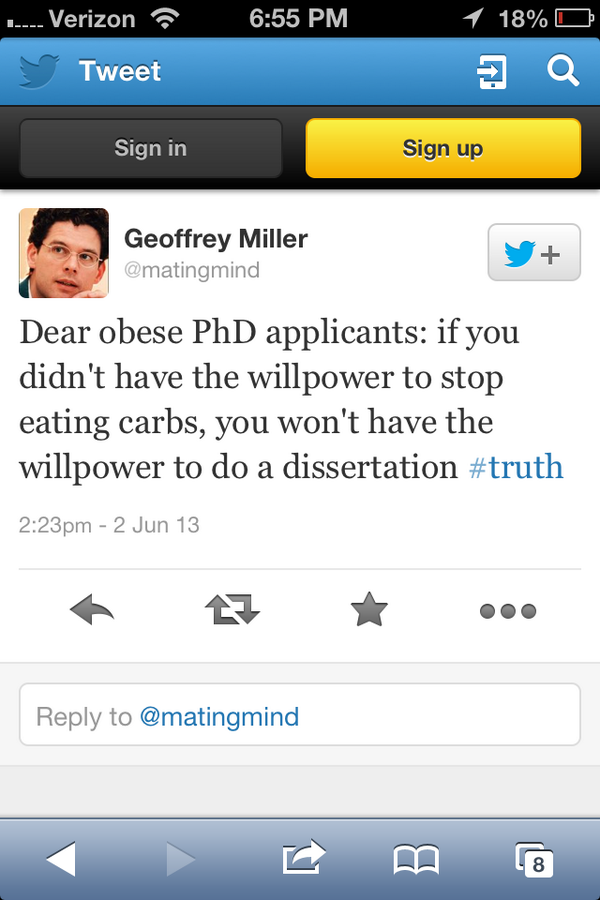
Earlier this month Geoffrey Miller (@matingmind), the now infamous professor of evolutionary psychology, punched out a really awful tweet. He said this:

Tygm

His message is blaringly ironic, coming from a man who clearly lacked the willpower to think through the statement before making it public #truth. Although he later deleted the tweet, his followers had already created screen captures and sent the image into a spiraling journey of virality.

I don’t want to spend my post today harping on Miller’s particular indiscretion. Others have been busy doing just that, quite eloquently, for the past week and a half. Instead, I want to talk about Fatness as a moral stigma, and the ways in which Miller’s tweet first, exposed the moral nature of body size and in turn, offered Fat Activists an opportunity to publicly reject Fatness as a marker of immorality. This was facilitated, I argue, by the affordances of new technologies coupled with determined and conscientious social actors. more...

Moocs

MOOCs: Massive Open Online Courses.  These generally free, multi-thousand student, online college courses, come in a variety of forms (typically differentiated as xMOOCs and cMOOCs), and have become the fertile ground for debates about the future of higher education. Such debates exploded last week when the San Jose State University (SJSU) Philosophy Department published an open letter to Dr. Michael Sandel, explaining to the the Harvard University Professor why they refused to enter into a contract that requires them to incorporate his MOOC on Justice into their curriculum.

The letter from SJSU and the formal and informal responses to it, highlight key tensions expressed by the academic community with regard to MOOCs. The letter itself captures many larger concerns, as professors worry about prioritization of the ‘bottom line,’ lack of interactivity, loss of professorial autonomy, and the perpetuation of class/power/resource hierarchies as students at a few select schools engage in a rich classroom environment, while everyone else views educational videos that were made for someone else, do not account for their needs, and do not incorporate their voices or experiences. The following is an excerpt from the original letter: more...

Below is a partial transcript of the introductory remarks I gave at the Technoscience as Activism Conference held in Troy, New York and hosted by Rensselaer Polytechnic Institute from June 26-28, 2012. The conference was funded by the NSF’s GK-12 Fellowship Program

I almost never read my presentations but we’re short on time and there’s a lot of stuff that I want to share with you and I don’t want to miss anything. Publicly reading an apology for reading in public is an apt metaphor for what this conference is about, or more precisely what it is a response to. When I approached Dr. Ron Eglash about putting on this conference I told him I only wanted to do it if I could make the conference reflect the kind of politics espoused in the presentations. I don’t want to invite a bunch of brilliant people to Troy, who want to talk about democratizing science and technology, and keep them in a single room all day. Troy should benefit from some of your unique experiences, and the people of Troy have done some amazing things that I think the visitors will enjoy and appreciate. more...