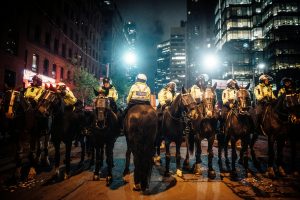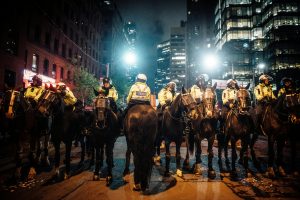


Nicole Bedera (Affiliated Educator at the Center for Institutional Courage and co-founder of Beyond Compliance) wrote an opinion piece for MS Now about how ICE Watch is an effective tool to de-escalate violence. She describes how “the vast majority of men are only willing to engage in public violence if they feel like the people around them will approve of — and reward them for — that violence.” ICE Watch can de-escalate situations by clearly expressing disapproval for violence. Bedera’s research was also covered by MPR News.


Sociology faculty at Florida International University are speaking out against their department’s requirement that they use a state-approved textbook to teach introductory courses. Matthew Marr (Associate Professor of Sociology at FIU) described the textbook as “scraped out” and “sanitized.” Marr described how the textbook omits key sociological concepts–such as structural racism: “Not only are these omissions an incorrect representation of the field, but they also fail to prepare students for majors and graduate education that require or recommend Introduction to Sociology.” This story was covered by Inside Higher Education and WLRN Public Media.


Cynthia Miller-Idriss (Professor of Public Affairs at American University) appeared on The Contrarian, discussing the connections between violence and masculinity. Miller-Idriss describes how people may gravitate toward a “protector” narrative of masculinity in times of economic hardship (when a “provider” narrative of masculinity is less achievable). Miller-Idriss notes that we are in a cultural moment of “hyper masculinity that associates being a man with being violent” and this image appears in recruitment for federal agencies.
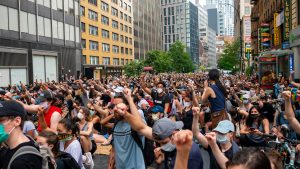
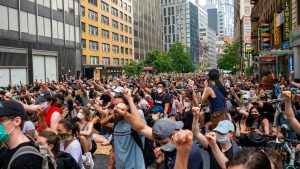
Tressie McMillan Cottom (Professor at the University of North Carolina’s School of Information and Library Science) appeared on PBS News Hour to discuss how to fight political exhaustion. McMillan Cottom describes how we often feel tired from passively taking in negative news: “We are tired then, not from doing too much, but from doing too little.” She suggests that political action, rather than disengagement, is the antidote to political exhaustion: “People who feel agentic aren’t as tired; they are not as easily overwhelmed.”